Recognition: no theorem link
Photoproduction of J/Psi in peripheral Oxygen-Oxygen collisions
Pith reviewed 2026-05-13 04:57 UTC · model grok-4.3
The pith
Predictions show J/Ψ photoproduction is experimentally feasible in peripheral oxygen-oxygen collisions at the LHC.
A machine-rendered reading of the paper's core claim, the machinery that carries it, and where it could break.
Core claim
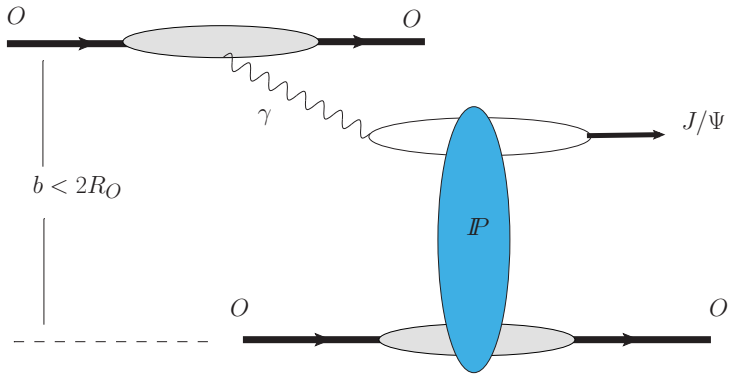
We investigate the photoproduction of J/Ψ in peripheral Oxygen-Oxygen collisions at the LHC considering distinct assumptions for the nuclear photon flux, overlap function and dipole-proton scattering amplitude. Predictions for the associated rapidity distributions and total cross-sections are presented. Our results indicate that the experimental study of the photoproduction of J/Ψ in peripheral OO collisions is, in principle, feasible. In addition, they point out that the combination of the results for this final state in OO collisions with those obtained for PbPb collisions will allow us to derive important constraints on the description of photon-induced process at peripheral collisions.
What carries the argument
The modeling framework that combines nuclear photon flux, overlap function, and dipole-proton scattering amplitude to compute rapidity distributions and cross sections for J/Ψ photoproduction.
If this is right
- The predicted cross sections are large enough that experimental observation of J/Ψ in peripheral OO collisions is possible.
- Data from OO collisions can be combined with PbPb results to derive constraints on photon-induced processes.
- Variations in modeling assumptions produce distinguishable differences in rapidity distributions that can be tested.
- Peripheral collisions of lighter nuclei provide an independent handle on the same photon flux and scattering mechanisms studied in heavier systems.
Where Pith is reading between the lines
- The same framework could be applied to other light-ion systems to map how photon flux scales with nuclear size.
- Future LHC runs dedicated to OO collisions would directly test whether the feasibility claim holds under real detector conditions.
- Discrepancies between OO and PbPb data could point to nuclear-structure effects that current overlap-function models miss.
Load-bearing premise
The modeling assumptions for the nuclear photon flux, overlap function, and dipole-proton scattering amplitude are accurate enough to produce reliable predictions for rapidity distributions and total cross sections in peripheral OO collisions.
What would settle it
A precision measurement of the J/Ψ rapidity distribution or total cross section in peripheral OO collisions at the LHC that lies well outside the range spanned by the model variants would falsify the claim that current modeling assumptions are reliable.
Figures


read the original abstract
The photoproduction of $J/\Psi$ in peripheral Oxygen - Oxygen ($OO$) collisions at the Large Hadron Collider (LHC) is investigated considering distinct assumptions for the modeling of the nuclear photon flux, overlap function and dipole - proton scattering amplitude. Predictions for the associated rapidity distributions and total cross - sections are presented. Our results indicate that the experimental study of the photoproduction of $J/\Psi$ in peripheral $OO$ collisions is, in principle, feasible. In addition, they point out that the combination of the results for this final state in $OO$ collisions with those obtained for $PbPb$ collisions will allow us to derive important constraints on the description of photon - induced process at peripheral collisions.
Editorial analysis
A structured set of objections, weighed in public.
Referee Report
Summary. The manuscript investigates the photoproduction of J/Ψ in peripheral oxygen-oxygen collisions at the LHC. It considers distinct modeling assumptions for the nuclear photon flux, overlap function, and dipole-proton scattering amplitude, and presents predictions for the associated rapidity distributions and total cross sections. The authors conclude that experimental studies of this process are feasible in principle and that combining OO results with those from PbPb collisions can provide important constraints on photon-induced processes in peripheral collisions.
Significance. If the central predictions hold under realistic conditions, the work would demonstrate a viable channel for studying photon-nucleus interactions in lighter nuclear systems, offering complementary constraints to heavy-ion data. The explicit variation over multiple modeling choices for flux, overlap, and dipole amplitude is a positive feature that allows readers to assess theoretical spread. However, the overall significance is tempered because the feasibility and constraint claims rest on unanchored model outputs without demonstrated connection to observable LHC rates or existing data.
major comments (2)
- [Results section (rapidity distributions and total cross sections)] Results section (rapidity distributions and total cross sections): The statement that the process 'is, in principle, feasible' is not supported by any quantitative comparison of the predicted rates to LHC luminosities, detector acceptances, or estimated backgrounds. Without such anchoring, it remains unclear whether the computed cross sections would yield observable signals.
- [Modeling section (nuclear photon flux, overlap function, dipole-proton amplitude)] Modeling section (nuclear photon flux, overlap function, dipole-proton amplitude): Although several distinct assumptions are explored, the paper provides no external validation or comparison against measured photon fluxes or J/Ψ photoproduction data from other systems (e.g., pPb UPC or lighter-ion collisions). This leaves open the possibility that the true values lie outside the sampled range, potentially rendering the predicted rates unobservable and undermining both the feasibility and constraint claims.
minor comments (2)
- [Abstract] The abstract would benefit from specifying the LHC center-of-mass energy per nucleon pair and the rapidity range considered.
- [Figures and text] Notation for the overlap function and photon flux could be made more uniform across figures and text to improve readability.
Simulated Author's Rebuttal
We thank the referee for the careful reading and constructive comments, which help clarify the presentation of our results. We address each major comment below and indicate the corresponding revisions.
read point-by-point responses
-
Referee: Results section (rapidity distributions and total cross sections): The statement that the process 'is, in principle, feasible' is not supported by any quantitative comparison of the predicted rates to LHC luminosities, detector acceptances, or estimated backgrounds. Without such anchoring, it remains unclear whether the computed cross sections would yield observable signals.
Authors: We agree that the current manuscript lacks explicit numerical anchoring to luminosities and backgrounds, which weakens the feasibility statement. The original emphasis was on the theoretical predictions under varied modeling assumptions. In the revised version we will add a short subsection with order-of-magnitude event-rate estimates that employ the published LHC luminosities for peripheral OO running together with typical J/Ψ reconstruction efficiencies drawn from existing PbPb analyses. This addition will make the feasibility claim quantitative while remaining within the scope of the paper. revision: yes
-
Referee: Modeling section (nuclear photon flux, overlap function, dipole-proton amplitude): Although several distinct assumptions are explored, the paper provides no external validation or comparison against measured photon fluxes or J/Ψ photoproduction data from other systems (e.g., pPb UPC or lighter-ion collisions). This leaves open the possibility that the true values lie outside the sampled range, potentially rendering the predicted rates unobservable and undermining both the feasibility and constraint claims.
Authors: The photon-flux and dipole-amplitude parametrizations we employ are taken from frameworks that have already been confronted with data in pPb ultraperipheral collisions and PbPb photoproduction. We will revise the modeling section to include explicit references to those prior validations and to state the range of parameters that reproduce existing measurements. Because no OO data yet exist, the paper remains predictive; the added discussion will nevertheless demonstrate that the explored model space is anchored to available experimental constraints rather than chosen arbitrarily. revision: partial
Circularity Check
No circularity: predictions generated from external phenomenological models
full rationale
The paper computes rapidity distributions and total cross sections for J/Ψ photoproduction in peripheral OO collisions by varying standard inputs: nuclear photon flux, overlap function, and dipole-proton scattering amplitude. These are treated as independent modeling choices drawn from the literature rather than fitted to the OO observables or redefined in terms of the target predictions. The feasibility statement follows directly from the numerical outputs exceeding plausible detection thresholds under those assumptions; no equation reduces the output to the input by construction, no self-citation chain is load-bearing for the central result, and no ansatz is smuggled via prior author work. The derivation chain is therefore self-contained against external benchmarks.
Axiom & Free-Parameter Ledger
Reference graph
Works this paper leans on
-
[1]
36 TeV) for the rapidity ranges covered by a central ( − 2 ≤ yΨ ≤ 2) and a forward (2 ≤ yΨ ≤ 4
02 TeV)/σ J/ψ OO (√ sNN = 5. 36 TeV) for the rapidity ranges covered by a central ( − 2 ≤ yΨ ≤ 2) and a forward (2 ≤ yΨ ≤ 4. 5) detector, respectively. Our results indicate that the ra tio is sensitive to the description of the effective nuclear photon flux, dipole - proton scattering amplitude and overlap functions. Therefore, a future experimental analy s...
work page 2024
-
[2]
K. Yagi, T. Hatsuda and Y. Miake, Camb. Monogr. Part. Phys. Nu cl. Phys. Cosmol. 23, 1-446 (2005)
work page 2005
- [3]
-
[4]
C. A. Bertulani and G. Baur, Phys. Rep. 163, 299 (1988); F. Krauss, M. Greiner and G. Soff, Prog. Part. Nucl. Phys. 39, 503 (1997); C. A. Bertulani, S. R. Klein and J. Nystrand, Ann. Rev . Nucl. Part. Sci. 55, 271 (2005); V. P. Goncalves and M. V. T. Machado, J. Phys. G 32, 295 (2006); A. J. Baltz et al. , Phys. Rept. 458, 1 (2008); J. G. Contreras and J. ...
work page 1988
-
[5]
S. R. Klein, J. Nystrand, Phys. Rev. C 60, 014903 (1999)
work page 1999
-
[6]
V. P. Goncalves and C. A. Bertulani, Phys. Rev. C 65, 054905 (2002)
work page 2002
-
[7]
L. Frankfurt, M. Strikman and M. Zhalov, Phys. Lett. B 540, 220-226 (2002)
work page 2002
-
[8]
S. R. Klein and H. Mantysaari, Nature Rev. Phys. 1, no.11, 662-674 (2019)
work page 2019
-
[9]
J. L. Nagle and W. A. Zajc, Ann. Rev. Nucl. Part. Sci. 68, 211-235 (2018)
work page 2018
- [10]
- [11]
-
[12]
V. P. Goncalves, B. D. Moreira and L. Santana, Phys. Rev. C 107, no.5, 055205 (2023)
work page 2023
-
[13]
K. J. Eskola, C. A. Flett, V. Guzey, T. L¨ oyt¨ ainen and H. Pauk kunen, Phys. Rev. C 107, no.4, 044912 (2023) [erratum: Phys. Rev. C 108, no.6, 069901 (2023)]
work page 2023
- [14]
-
[15]
A. Hayrapetyan et al. [CMS], Phys. Rev. Lett. 136, no.16, 162301 (2026)
work page 2026
- [16]
- [17]
- [18]
- [19]
- [20]
-
[21]
Massacrier [ALICE], [arXiv:2407.09707 [nucl-ex]]
L. Massacrier [ALICE], [arXiv:2407.09707 [nucl-ex]]
- [22]
-
[23]
K/suppress lusek-Gawenda and A
M. K/suppress lusek-Gawenda and A. Szczurek, Phys. Rev. C93, no.4, 044912 (2016)
work page 2016
-
[24]
W. Zha, S. R. Klein, R. Ma, L. Ruan, T. Todoroki, Z. Tang, Z. Xu, C. Yang, Q. Yang and S. Yang, Phys. Rev. C 97, no.4, 044910 (2018)
work page 2018
-
[25]
M. B. Gay Ducati and S. Martins, Phys. Rev. D 96, no.5, 056014 (2017)
work page 2017
-
[26]
M. B. Gay Ducati and S. Martins, Phys. Rev. D 97, no.11, 116013 (2018)
work page 2018
-
[27]
W. Shi, W. Zha and B. Chen, Phys. Lett. B 777, 399-405 (2018)
work page 2018
-
[28]
W. Zha, L. Ruan, Z. Tang, Z. Xu and S. Yang, Phys. Lett. B 789, 238-242 (2019)
work page 2019
-
[29]
P. E. A. da Costa, A. V. Giannini, V. P. Goncalves and B. D. Moreir a, Phys. Rev. D 112, no.3, 034012 (2025)
work page 2025
-
[30]
V. M. Budnev, I. F. Ginzburg, G. V. Meledin and V. G. Serbo, Phy s. Rept. 15, 181 (1975)
work page 1975
-
[31]
C. W. De Jager, H. De Vries and C. De Vries, Atom. Data Nucl. Dat a Tabl. 14, 479 (1974) Erratum: [Atom. Data Nucl. Data Tabl. 16, 580 (1975)]. 10
work page 1974
-
[32]
F. Gelis, E. Iancu, J. Jalilian-Marian and R. Venugopalan, Ann. Re v. Nucl. Part. Sci. 60, 463 (2010); H. Weigert, Prog. Part. Nucl. Phys. 55, 461 (2005); J. Jalilian-Marian and Y. V. Kovchegov, Prog. Part. Nucl. Phys. 56, 104 (2006); A. Morreale and F. Salazar, Universe 7, no.8, 312 (2021)
work page 2010
-
[33]
R. J. Glauber, in Lecture in Theoretical Physics, Vol. 1, edited b y W. E. Brittin, L. G. Duham (Interscience, New York, 1959)
work page 1959
-
[34]
V. N. Gribov, Sov. Phys. JETP 29, 483 (1969); Sov. Phys. JETP 30, 709 (1970)
work page 1969
-
[35]
A. H. Mueller, Nucl. Phys. B 335, 115 (1990)
work page 1990
- [36]
- [37]
- [38]
- [39]
-
[40]
H. Kowalski, T. Lappi and R. Venugopalan, Phys. Rev. Lett. 100, 022303 (2008)
work page 2008
-
[41]
A. H. Rezaeian, M. Siddikov, M. Van de Klundert and R. Venugopa lan, Phys. Rev. D 87, 034002 (2013)
work page 2013
-
[42]
H. Mantysaari and P. Zurita, Phys. Rev. D 98, 036002 (2018) 11 σJ/ψ tot (µb ) ( − 2 ≤ yΨ ≤ 2) 5.36 T eV Dipole - proton model 10%–30% 30%–50% 50%–70% 70%–90% Effective nuclear photon flux: N (0)(ω,b ) bCGC 0.297 (0.291) 0.435 (0.425) 0.400 (0.391) 0.340 (0.333) IP-SAT 0.264 (0.239) 0.387 (0.350) 0.355 (0.321) 0.303 (0.274) IPnon-SAT 0.290 (0.266) 0.425 (0.3...
work page 2018
discussion (0)
Sign in with ORCID, Apple, or X to comment. Anyone can read and Pith papers without signing in.