Recognition: no theorem link
Following the thread: surface and bulk solvent migration in silicone elastomers from local volumetric swelling
Pith reviewed 2026-05-13 04:35 UTC · model grok-4.3
The pith
In situ 3D swelling measurements show solvent entry into silicone elastomers is limited by surface flux rather than full drainage.
A machine-rendered reading of the paper's core claim, the machinery that carries it, and where it could break.
Core claim
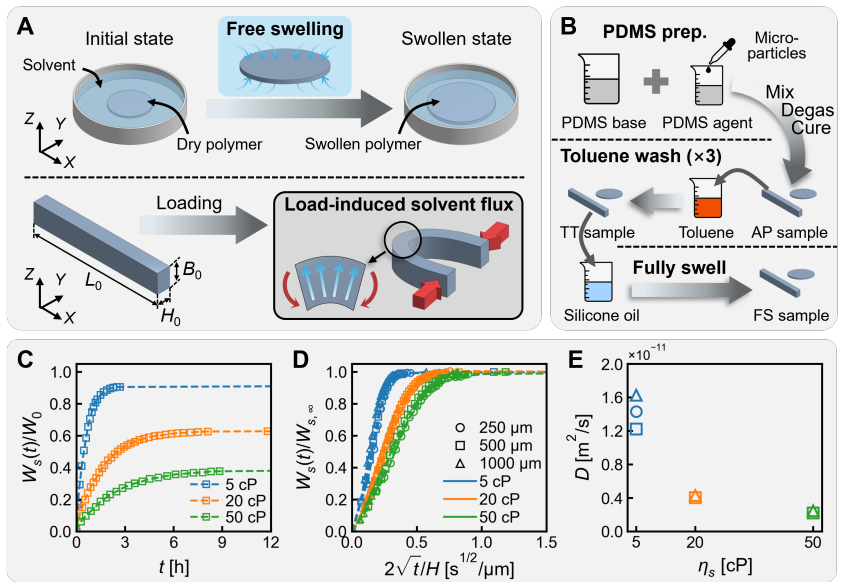
In situ 3D spatiotemporal measurements of local volumetric swelling during free swelling of PDMS networks identify a flux-limited interfacial boundary condition, contradicting the canonical fully drained assumption. This correction removes an order-of-magnitude underestimation of diffusivity obtained from standard bulk analysis. Swelling equilibrium is described by a Flory-Rehner theory modified to include effective finite extensibility of the filled network. In a bending configuration, as-prepared and mobile-phase-free beams exhibit no net volumetric change or force relaxation, yet local measurements resolve tensile-side dilation and compressive-side contraction that yield effective diffusv
What carries the argument
The flux-limited interfacial boundary condition identified through local volumetric swelling measurements, which sets the solvent entry rate at the elastomer surface.
If this is right
- Diffusivity extracted from bulk swelling data increases by an order of magnitude once the surface flux limit is included.
- Swelling equilibrium requires a Flory-Rehner relation adjusted for finite extensibility of the crosslinked network.
- Local volumetric dilation on the tensile side and contraction on the compressive side directly resolve solvent diffusivity in bent beams.
- Effective diffusivities from local measurements agree with independent force-relaxation results across the tested preparations.
- Solvent migration shows no discernible net volume change or force relaxation in as-prepared and mobile-phase-free beams.
Where Pith is reading between the lines
- The same local volumetric approach could be used to extract transport parameters in other poroelastic solids such as hydrogels or geomaterials.
- Revised interfacial conditions may improve time-dependent models for poroelastic effects in biological tissues or seismic contexts.
- Controlled variation of surface chemistry or solvent viscosity could test whether the flux limit is a general feature or specific to silicone-oil pairs.
Load-bearing premise
The three material preparations produce comparable solvent migration behavior without preparation-induced changes in network structure or mobile-phase content that would confound the local strain measurements.
What would settle it
Direct measurement of solvent concentration profiles immediately inside the interface showing unlimited influx matching the fully drained rate, or bulk analysis with the corrected boundary still underestimating diffusivity relative to local data, would falsify the flux-limited claim.
Figures


read the original abstract
Poroelastic materials, consisting of a permeable solid matrix infiltrated with fluid, are ubiquitous in natural and engineering contexts. In poroelastic polymer solids, the elastic matrix swells to equilibrium when immersed in a solvent bath; thus, the network elasticity couples to the solvent transport. Despite the ubiquity and importance of poroelastic theory in describing phenomena as diverse as earthquakes and biological tissues, there is a paucity of experimental data that probe the local network response to controlled stress and solvent boundary conditions. Here, we first probe the baseline diffusion kinetics of a polymeric solvent during free swelling of a polydimethylsiloxane (PDMS) network with well-characterized silicone oils. In situ 3D spatiotemporal measurements identify a flux-limited interfacial boundary condition, contradicting the canonical fully drained assumption. This correction eliminates an order-of-magnitude underestimation of diffusivity in standard bulk analysis. The swelling equilibrium is accurately captured by a Flory-Rehner theory that requires modification to include the effective finite extensibility of the filled network. Solvent migration is then studied using a bending configuration for three material preparations: as-prepared, mobile-phase-free, and fully swollen in silicone oils. The as-prepared and mobile-phase-free beams show no discernible volumetric change or force relaxation, whereas local in situ measurements directly resolve tensile-side dilation and compressive-side contraction, yielding the effective diffusivities in agreement with the force-relaxation data. These measurements rigorously benchmark solvent diffusivity in polymer networks, underscoring the importance of unambiguous interfacial boundary conditions and shedding light on mechanics and engineering across poroelastic polymers and geomaterials.
Editorial analysis
A structured set of objections, weighed in public.
Referee Report
Summary. The manuscript reports in situ 3D spatiotemporal measurements of solvent migration in PDMS elastomers during free swelling and bending. It identifies a flux-limited interfacial boundary condition (contradicting the canonical fully drained assumption) that corrects an order-of-magnitude underestimation of diffusivity from standard bulk analysis. Swelling equilibrium is captured by a modified Flory-Rehner theory that incorporates effective finite extensibility of the filled network. Bending tests on as-prepared, mobile-phase-free, and fully swollen samples resolve local tensile dilation and compressive contraction, yielding effective diffusivities that agree with force-relaxation data.
Significance. If the central claims hold, the work is significant for poroelastic modeling of polymer networks because it supplies direct local volumetric data that challenge standard boundary-condition assumptions and provides a cross-validated benchmark for solvent diffusivity. The multi-configuration experimental design (free swelling plus bending) and the use of in situ 3D imaging are clear strengths that could improve predictions in applications ranging from soft robotics to geomaterials.
major comments (2)
- [Bending configuration experiments] Bending configuration experiments: the validation that local tensile dilation/compressive contraction yields diffusivities agreeing with force-relaxation data (and thereby confirms the flux-limited boundary condition extracted from free-swelling data) rests on the claim that the three material preparations produce comparable solvent-migration behavior without preparation-induced changes in network structure or mobile-phase content. No explicit characterization (e.g., crosslink density via swelling ratio, residual solvent via spectroscopy, or chain mobility) is provided to rule out mechanical artifacts in the local strain measurements; this is load-bearing for the benchmarking claim.
- [Free-swelling and diffusivity analysis] Free-swelling and diffusivity analysis: the order-of-magnitude diffusivity correction is asserted to follow from the flux-limited interfacial boundary condition identified in the 3D spatiotemporal data. The manuscript does not detail the quantitative extraction procedure, fitting protocol, or error analysis that converts the observed concentration profiles into the corrected diffusivity value, making independent verification of the magnitude of the correction impossible from the presented information.
minor comments (2)
- [Abstract] The abstract states that the PDMS network is 'well-characterized' but supplies no numerical values for crosslink density, oil molecular weight, or viscosity; adding these parameters would improve immediate reproducibility.
- Notation for the effective finite extensibility parameter in the modified Flory-Rehner theory is introduced without an explicit equation reference in the main text; a numbered equation would clarify its definition and use.
Simulated Author's Rebuttal
We thank the referee for their positive evaluation of the work's significance and for the detailed, constructive comments. We address each major point below with clarifications and commitments to revision.
read point-by-point responses
-
Referee: [Bending configuration experiments] Bending configuration experiments: the validation that local tensile dilation/compressive contraction yields diffusivities agreeing with force-relaxation data (and thereby confirms the flux-limited boundary condition extracted from free-swelling data) rests on the claim that the three material preparations produce comparable solvent-migration behavior without preparation-induced changes in network structure or mobile-phase content. No explicit characterization (e.g., crosslink density via swelling ratio, residual solvent via spectroscopy, or chain mobility) is provided to rule out mechanical artifacts in the local strain measurements; this is load-bearing for the benchmarking claim.
Authors: We appreciate the referee's emphasis on this critical validation step. The three preparations are standard protocols in the silicone elastomer literature, and the complete absence of detectable volumetric change or force relaxation in the as-prepared and mobile-phase-free beams already provides indirect evidence that network structure and mobile-phase content are not altered in a way that would produce artifacts. Nevertheless, to make this explicit and rule out mechanical artifacts, the revised manuscript will include additional characterization: equilibrium swelling ratios (to confirm crosslink density equivalence), FTIR spectroscopy (to quantify any residual solvent in the mobile-phase-free samples), and a brief discussion of chain mobility inferred from the lack of relaxation. These data will be added to the methods and results sections. revision: yes
-
Referee: [Free-swelling and diffusivity analysis] Free-swelling and diffusivity analysis: the order-of-magnitude diffusivity correction is asserted to follow from the flux-limited interfacial boundary condition identified in the 3D spatiotemporal data. The manuscript does not detail the quantitative extraction procedure, fitting protocol, or error analysis that converts the observed concentration profiles into the corrected diffusivity value, making independent verification of the magnitude of the correction impossible from the presented information.
Authors: We agree that the quantitative procedure for extracting the corrected diffusivity was not described in sufficient detail. The order-of-magnitude correction originates from replacing the canonical Dirichlet (fully drained) boundary condition with a flux-limited Robin condition whose coefficient is determined directly from the 3D concentration profiles. In the revision we will add a dedicated subsection in the Methods and a supplementary note that fully specifies the extraction: (i) the 3D spatiotemporal solvent volume-fraction fields are obtained from the imaging data, (ii) these fields are fitted to the numerical solution of the diffusion equation subject to the flux-limited boundary condition via nonlinear least-squares minimization, (iii) the resulting diffusivity is compared against the value obtained under the standard bulk (Dirichlet) assumption, and (iv) error bars are computed from the covariance matrix of the fit together with propagation of imaging noise. This will allow independent verification of the correction factor. revision: yes
Circularity Check
No circularity: experimental identification of boundary condition and diffusivity from direct measurements, independent of self-referential definitions or fitted inputs.
full rationale
The derivation chain rests on in situ 3D volumetric strain measurements during free swelling and bending of PDMS samples. The flux-limited interfacial boundary condition is extracted from observed spatiotemporal solvent migration kinetics, directly contradicting the fully drained assumption and correcting bulk diffusivity estimates. Effective diffusivities from local tensile/compressive strains in as-prepared, mobile-phase-free, and fully swollen beams are benchmarked against independent force-relaxation data. Swelling equilibrium is compared to a modified Flory-Rehner model incorporating finite extensibility, but the modification is presented as required by the data rather than presupposed. No step reduces a claimed prediction to a fitted parameter by construction, no self-citation chain bears the central claim, and the three preparations serve as consistency checks without definitional loops. The analysis is self-contained against external experimental benchmarks.
Axiom & Free-Parameter Ledger
free parameters (1)
- effective finite extensibility parameter
axioms (1)
- domain assumption Network elasticity couples to solvent transport in poroelastic solids, with swelling reaching equilibrium when immersed in solvent.
Reference graph
Works this paper leans on
-
[1]
Wang,Theory of linear poroelasticity with applications to geomechanics and hydrogeology, vol
H. Wang,Theory of linear poroelasticity with applications to geomechanics and hydrogeology, vol. 2 (Princeton university press) (2000)
work page 2000
-
[2]
V. C. Mow, S. Kuei, W. M. Lai, C. G. Armstrong, Biphasic creep and stress relaxation of articular cartilage in compression: theory and experiments.Journal of biomechanical engineering102(1), 73–84 (1980)
work page 1980
-
[3]
S. C. Cowin, Bone poroelasticity.Journal of biomechanics32(3), 217–238 (1999)
work page 1999
-
[4]
F. Liu,et al., Intercellular flow dominates the poroelasticity of multicellular tissues.Nature Physicspp. 1–8 (2025)
work page 2025
-
[5]
R. Foudazi, R. Zowada, I. Manas-Zloczower, D. L. Feke, Porous hydrogels: present challenges and future opportunities.Langmuir39(6), 2092–2111 (2023)
work page 2092
-
[6]
Y. Hu, X. Chen, G. M. Whitesides, J. J. Vlassak, Z. Suo, Indentation of polydimethylsiloxane submerged in organic solvents.Journal of Materials Research26(6), 785–795 (2011)
work page 2011
-
[7]
M. A. Biot, General theory of three-dimensional consolidation.Journal of applied physics12(2), 155–164 (1941)
work page 1941
-
[8]
A. H.-D. Cheng,Poroelasticity, vol. 27 (Springer) (2016)
work page 2016
-
[9]
Doi, Gel dynamics.Journal of the Physical Society of Japan78(5), 052001 (2009)
M. Doi, Gel dynamics.Journal of the Physical Society of Japan78(5), 052001 (2009)
work page 2009
-
[10]
M. Rubinstein, R. H. Colby,Polymer physics(Oxford university press) (2003)
work page 2003
-
[11]
D. J. Beebe,et al., Functional hydrogel structures for autonomous flow control inside microfluidic channels. nature404(6778), 588–590 (2000)
work page 2000
-
[12]
D. T. Eddington, D. J. Beebe, Flow control with hydrogels.Advanced drug delivery reviews56(2), 199–210 (2004)
work page 2004
-
[13]
A. Beck,et al., Fundamentals of hydrogel-based valves and chemofluidic transistors for lab-on-a-chip technology: a tutorial review.Advanced Materials Technologies8(3), 2200417 (2023)
work page 2023
-
[14]
L. Chen,et al., PDMS-Swelling Induced Microchannel Reshaping and Its Applications in Droplet Microfluidics. ACS Materials Letters7(6), 2172–2180 (2025)
work page 2025
-
[15]
S. W. Kim, Y. H. Bae, T. Okano, Hydrogels: swelling, drug loading, and release.Pharmaceutical research9(3), 283–290 (1992)
work page 1992
-
[16]
W. B. Liechty, D. R. Kryscio, B. V. Slaughter, N. A. Peppas, Polymers for drug delivery systems.Annual review of chemical and biomolecular engineering1(1), 149–173 (2010)
work page 2010
-
[17]
J. G. Turner, L. R. White, P. Estrela, H. S. Leese, Hydrogel-forming microneedles: current advancements and future trends.Macromolecular bioscience21(2), 2000307 (2021)
work page 2021
-
[18]
B. Kim,et al., Rapid custom prototyping of soft poroelastic biosensor for simultaneous epicardial recording and imaging.Nature Communications12(1), 3710 (2021)
work page 2021
-
[19]
W. Feng, Z. Wang, Tailoring the swelling-shrinkable behavior of hydrogels for biomedical applications.Advanced Science10(28), 2303326 (2023). 13
work page 2023
-
[20]
V. Selvaprithiviraj, C. Vaquette, S. Ivanovski, Hydrogel based soft tissue expanders for orodental reconstruction. Acta Biomaterialia172, 53–66 (2023)
work page 2023
-
[21]
P. J. Flory, J. Rehner Jr, Statistical mechanics of cross-linked polymer networks II. Swelling.The journal of chemical physics11(11), 521–526 (1943)
work page 1943
-
[22]
P. J. Flory,Principles of polymer chemistry(Cornell university press) (1953)
work page 1953
-
[23]
S. P. Obukhov, M. Rubinstein, R. H. Colby, Network modulus and superelasticity.Macromolecules27(12), 3191–3198 (1994)
work page 1994
-
[24]
L. G. Treloar,The physics of rubber elasticity(OUP Oxford) (1975)
work page 1975
-
[25]
J. Tang, J. Li, J. J. Vlassak, Z. Suo, Fatigue fracture of hydrogels.Extreme Mechanics Letters10, 24–31 (2017)
work page 2017
-
[26]
T. Yamamoto, J. A. Campbell, S. Panyukov, M. Rubinstein, Scaling theory of swelling and deswelling of polymer networks.Macromolecules55(9), 3588–3601 (2022)
work page 2022
-
[27]
R. Subramani,et al., The influence of swelling on elastic properties of polyacrylamide hydrogels.Frontiers in Materials7, 212 (2020)
work page 2020
-
[28]
G. W. Scherer, Bending of gel beams: method for characterizing elastic properties and permeability.Journal of non-crystalline solids142, 18–35 (1992)
work page 1992
-
[29]
Y. Hu, X. Zhao, J. J. Vlassak, Z. Suo, Using indentation to characterize the poroelasticity of gels.Applied Physics Letters96(12) (2010)
work page 2010
-
[30]
J. Yoon, S. Cai, Z. Suo, R. C. Hayward, Poroelastic swelling kinetics of thin hydrogel layers: comparison of theory and experiment.Soft Matter6(23), 6004–6012 (2010)
work page 2010
-
[31]
N. Bouklas, R. Huang, Swelling kinetics of polymer gels: comparison of linear and nonlinear theories.Soft Matter 8(31), 8194–8203 (2012)
work page 2012
-
[32]
X.-F. Wei, E. Linde, M. S. Hedenqvist, Plasticiser loss from plastic or rubber products through diffusion and evaporation.npj Materials Degradation3(1), 18 (2019)
work page 2019
- [33]
-
[34]
N. Joshi,et al., A mechanically resilient soft hydrogel improves drug delivery for treating post-traumatic os- teoarthritis in physically active joints.Proceedings of the National Academy of Sciences122(14), e2409729122 (2025)
work page 2025
- [35]
-
[36]
S. G. Harrellson,et al., Hydration solids.Nature619(7970), 500–505 (2023)
work page 2023
-
[37]
G. Y. Gor, G. W. Scherer, H. A. Stone, Bacterial spores respond to humidity similarly to hydrogels.Proceedings of the National Academy of Sciences121(10), e2320763121 (2024)
work page 2024
-
[38]
S. Li, D. A. Matoz-Fernandez, A. Aggarwal, M. Olvera de la Cruz, Chemically controlled pattern formation in self-oscillating elastic shells.Proceedings of the National Academy of Sciences118(10), e2025717118 (2021). 14
work page 2021
-
[39]
A. A. Polotsky, F. A. Plamper, O. V. Borisov, Collapse-to-swelling transitions in pH-and thermoresponsive microgels in aqueous dispersions: The thermodynamic theory.Macromolecules46(21), 8702–8709 (2013)
work page 2013
-
[40]
Z. Wang, S. Das, A. Joshi, A. J. Shaikeea, V. S. Deshpande, 3D observations provide striking findings in rubber elasticity.Proceedings of the National Academy of Sciences121(24), e2404205121 (2024)
work page 2024
-
[41]
M. Pezzulla, S. A. Shillig, P. Nardinocchi, D. P. Holmes, Morphing of geometric composites via residual swelling. Soft Matter11(29), 5812–5820 (2015)
work page 2015
-
[42]
J. Wang,et al., Programmable shape-shifting 3D structures via frontal photopolymerization.Materials & Design 198, 109381 (2021)
work page 2021
-
[43]
A. Marcilla, S. Garcıa, J. Garcıa-Quesada, Study of the migration of PVC plasticizers.Journal of Analytical and Applied Pyrolysis71(2), 457–463 (2004)
work page 2004
- [44]
-
[45]
C. Durning, K. Morman Jr, Nonlinear swelling of polymer gels.The Journal of chemical physics98(5), 4275–4293 (1993)
work page 1993
-
[46]
G. W. Scherer, Measurement of permeability I. Theory.Journal of non-crystalline solids113(2-3), 107–118 (1989)
work page 1989
-
[47]
W. Hong, X. Zhao, J. Zhou, Z. Suo, A theory of coupled diffusion and large deformation in polymeric gels. Journal of the Mechanics and Physics of Solids56(5), 1779–1793 (2008)
work page 2008
- [48]
-
[49]
N. Bouklas, C. M. Landis, R. Huang, Effect of solvent diffusion on crack-tip fields and driving force for fracture of hydrogels.Journal of Applied Mechanics82(8), 081007 (2015)
work page 2015
-
[50]
Y. Yu, C. M. Landis, R. Huang, Steady-state crack growth in polymer gels: a linear poroelastic analysis.Journal of the Mechanics and Physics of Solids118, 15–39 (2018)
work page 2018
-
[51]
Y. Yu, C. M. Landis, R. Huang, Poroelastic effects on steady state crack growth in polymer gels under plane stress.Mechanics of Materials143, 103320 (2020)
work page 2020
-
[52]
Y. Yang,et al., Rate-dependent fracture of hydrogels due to water migration.Journal of the Mechanics and Physics of Solids167, 105007 (2022)
work page 2022
-
[53]
A. Plummer, C. Adkins, J.-F. Louf, A. Ko ˇsmrlj, S. S. Datta, Obstructed swelling and fracture of hydrogels.Soft matter20(7), 1425–1437 (2024)
work page 2024
-
[54]
Vesely, Diffusion of liquids in polymers.International Materials Reviews53(5), 299–315 (2008)
D. Vesely, Diffusion of liquids in polymers.International Materials Reviews53(5), 299–315 (2008)
work page 2008
- [55]
-
[56]
I. Sotiri,et al., Tunability of liquid-infused silicone materials for biointerfaces.Biointerphases13(6) (2018). 15
work page 2018
-
[57]
C. J. Wolf, K. L. Jerina, H. J. Brandon, V. Young, The transport of octamethylcyclotetrasiloxane (D4) and polydimethylsiloxane (PDMS) in lightly cross-linked silicone rubber.Journal of Biomaterials Science, Polymer Edition12(7), 801–815 (2001)
work page 2001
-
[58]
G. Cocchi, M. G. De Angelis, F. Doghieri, Solubility and diffusivity of liquids for food and pharmaceutical applications in crosslinked polydimethylsiloxane (PDMS) films: I. Experimental data on pure organic components and vegetable oil.Journal of Membrane Science492, 600–611 (2015)
work page 2015
-
[59]
S. Wagner,et al., Solvent Diffusion Modeling in Silicone.Journal of Chemical & Engineering Data69(2), 472–481 (2023)
work page 2023
-
[60]
C.-Y. Hui, Y. Y. Lin, F.-C. Chuang, K. R. Shull, W.-C. Lin, A contact mechanics method for characterizing the elastic properties and permeability of gels.Journal of Polymer Science Part B: Polymer Physics44(2), 359–370 (2006)
work page 2006
-
[61]
Z. I. Kalcioglu, R. Mahmoodian, Y. Hu, Z. Suo, K. J. Van Vliet, From macro-to microscale poroelastic charac- terization of polymeric hydrogels via indentation.Soft Matter8(12), 3393–3398 (2012)
work page 2012
-
[62]
Y. Hu, E. P. Chan, J. J. Vlassak, Z. Suo, Poroelastic relaxation indentation of thin layers of gels.Journal of Applied Physics110(8) (2011)
work page 2011
-
[63]
J.-F. Louf, S. S. Datta, Poroelastic shape relaxation of hydrogel particles.Soft matter17(14), 3840–3847 (2021)
work page 2021
-
[64]
C. Li, D. Zubko, D. Delespaul, J. M. Kolinski, 3D characterization of kinematic fields and poroelastic swelling near the tip of a propagating crack in a hydrogel.International Journal of Fracture248(1), 221–235 (2024)
work page 2024
-
[65]
C. Hartquist, S. Wang, X. Zhao, Local volume changes in deformed elastomers with mobile chains.Proceedings of the National Academy of Sciences121(30), e2410811121 (2024)
work page 2024
-
[66]
Vergne, Super low traction under EHD & mixed lubrication regimes, inSuperlubricity(Elsevier), pp
P. Vergne, Super low traction under EHD & mixed lubrication regimes, inSuperlubricity(Elsevier), pp. 427–443 (2007)
work page 2007
-
[67]
J.-L. Viovy, Electrophoresis of DNA and other polyelectrolytes: Physical mechanisms.Reviews of Modern Physics 72(3), 813 (2000)
work page 2000
-
[68]
M. O. de la Cruz, D. Gersappe, E. O. Shaffer, Dynamics of DNA during pulsed-field gel electrophoresis.Physical review letters64(19), 2324 (1990)
work page 1990
-
[69]
J. M. Clough, C. Creton, S. L. Craig, R. P. Sijbesma, Covalent bond scission in the Mullins effect of a filled elastomer: real-time visualization with mechanoluminescence.Advanced Functional Materials26(48), 9063– 9074 (2016)
work page 2016
-
[70]
J. Suriboot,et al., Amphiphilic, thixotropic additives for extrusion-based 3D printing of silica-reinforced silicone. Soft Matter17(15), 4133–4142 (2021)
work page 2021
-
[71]
B. Deng, S. Wang, C. Hartquist, X. Zhao, Nonlocal intrinsic fracture energy of polymerlike networks.Physical Review Letters131(22), 228102 (2023)
work page 2023
-
[72]
J. Li, Z. Suo, J. J. Vlassak, A model of ideal elastomeric gels for polyelectrolyte gels.Soft matter10(15), 2582–2590 (2014)
work page 2014
-
[73]
D. Okumura, S. A. Chester, Ultimate swelling described by limiting chain extensibility of swollen elastomers. International Journal of Mechanical Sciences144, 531–539 (2018). 16
work page 2018
-
[74]
Y. Zhou, L. Jin, Hydrolysis-induced large swelling of polyacrylamide hydrogels.Soft Matter16(24), 5740–5749 (2020)
work page 2020
-
[75]
A. N. Gent, A new constitutive relation for rubber.Rubber chemistry and technology69(1), 59–61 (1996)
work page 1996
-
[76]
Mullins, Softening of rubber by deformation.Rubber chemistry and technology42(1), 339–362 (1969)
L. Mullins, Softening of rubber by deformation.Rubber chemistry and technology42(1), 339–362 (1969)
work page 1969
-
[77]
J. Kim, T. Yin, Z. Suo, Polyacrylamide hydrogels. V. Some strands in a polymer network bear loads, but all strands contribute to swelling.Journal of the Mechanics and Physics of Solids168, 105017 (2022)
work page 2022
-
[78]
T. Benkley, C. Li, J. Kolinski, Estimation of the deformation gradient tensor by particle tracking near a free boundary with quantified error.Experimental Mechanics63(7), 1255–1270 (2023)
work page 2023
-
[79]
J. Wang, J. C. Burton, Hyperelastic swelling of stiff hydrogels.Physical Review Letters134(14), 148203 (2025)
work page 2025
- [80]
discussion (0)
Sign in with ORCID, Apple, or X to comment. Anyone can read and Pith papers without signing in.