Recognition: 2 theorem links
· Lean TheoremSlow Movable Antenna System Design Based on Cell-Specific Long-Term Angular Power Spectrum
Pith reviewed 2026-05-13 04:11 UTC · model grok-4.3
The pith
Movable antenna positions can be optimized over long timescales using only the base station's cell-specific angular power spectrum to improve ergodic system utilities without short-term user CSI.
A machine-rendered reading of the paper's core claim, the machinery that carries it, and where it could break.
Core claim
The paper establishes that the CEBAP design, obtained by balancing the eigenvalues of the users' channel covariance matrices derived from the BS-side angular power spectrum, asymptotically approximates the antenna positions that maximize the ergodic system utility; this solution requires no short-term user-specific CSI and only infrequent antenna adjustments yet still improves long-term performance metrics including weighted sum rate and minimum SINR.
What carries the argument
The covariance-eigenvalues-balancing antenna positions (CEBAP) design, which uses the cell-specific long-term APS to statistically decorrelate user channels and thereby approximate optimal ergodic-utility positions.
Load-bearing premise
That a cell-wide long-term angular power spectrum alone is sufficient to choose near-optimal antenna positions without any short-term user-specific channel information.
What would settle it
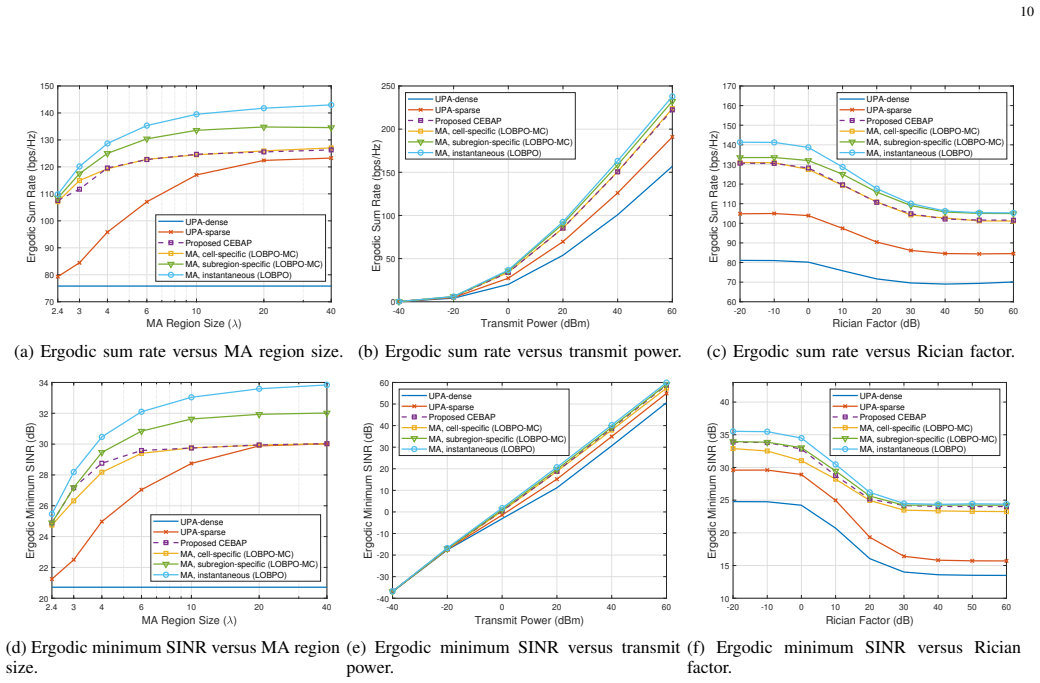
A measurement showing that, in realistic urban ray-tracing channels, the ergodic weighted sum rate achieved by CEBAP positions fails to exceed that of fixed antennas or to approach the instantaneous-CSI upper bound for moderately large antenna regions.
Figures

read the original abstract
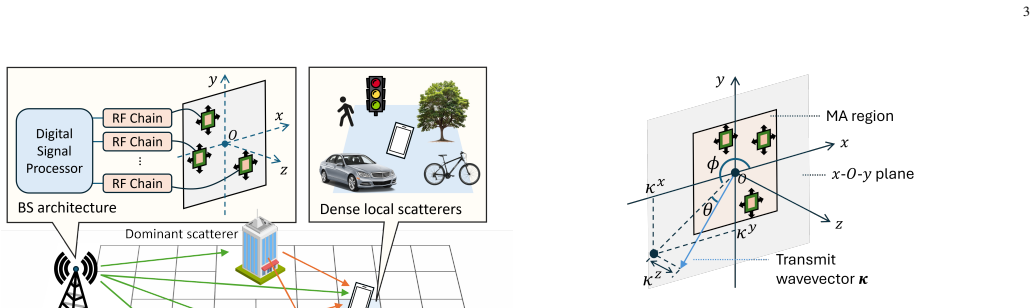
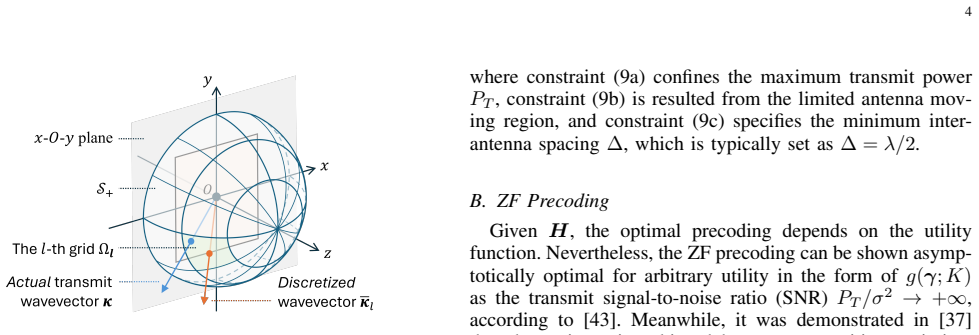
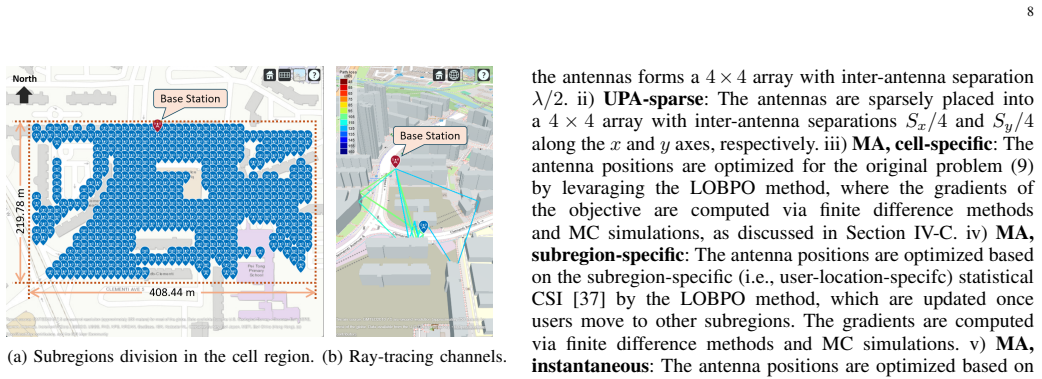
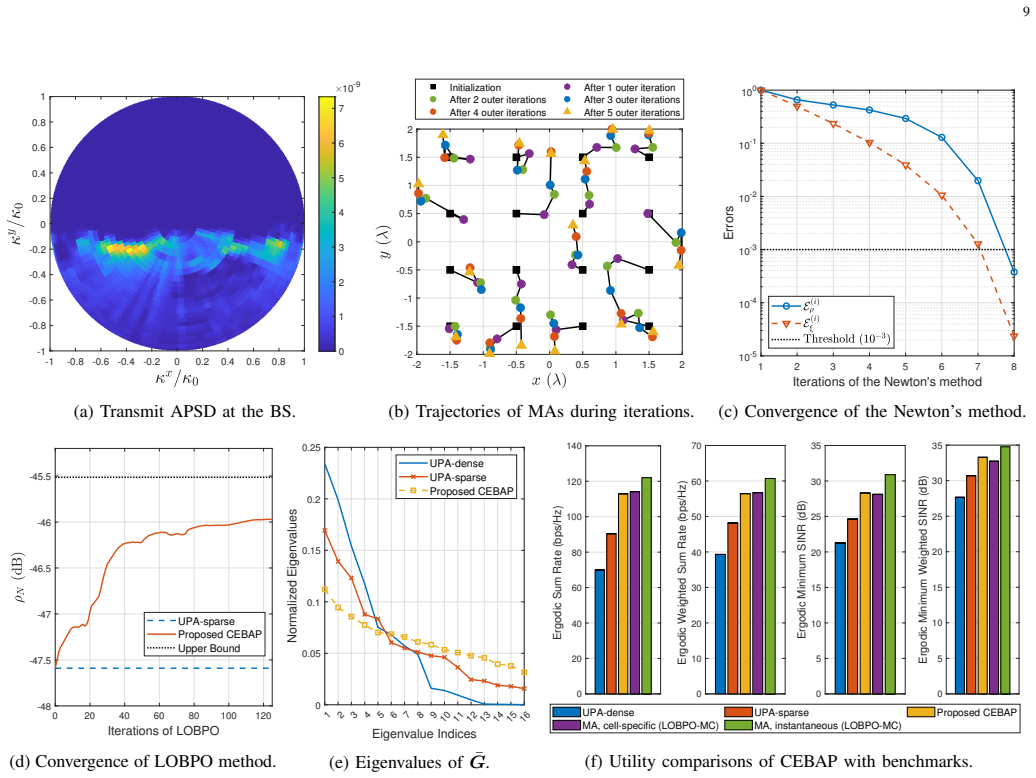
Movable antenna (MA) has recently emerged as a promising paradigm for enhancing wireless communication performance by exploiting spatial degrees of freedom through flexible antenna repositioning. However, most existing designs rely on short-term user-specific instantaneous/statistical channel state information (CSI), which incurs excessive channel estimation overhead and complexity due to frequent antenna movement. To address this issue, this paper proposes a new design framework for antenna position optimization over a much longer timescale based on the cell-level statistical channel information acquired at the base station (BS). To this end, a cell-specific statistical channel model is developed for MA-aided multiuser communication systems, based on which the antenna position optimization framework for maximizing the ergodic system utility is formulated. Then, the covariance-eigenvalues-balancing antenna positions (CEBAP) design is derived to asymptotically approximate optimal solutions by statistically reducing users' channel correlation. Notably, the CEBAP solution solely depends on the BS-side angular power spectrum (APS) of wireless channels for mobile users across the cell, which significantly alleviates the overhead of channel acquisition and antenna movement, and yet remains effective for improving various system utilities over long timescales, such as weighted sum rate and minimum signal-to-interference-plus-noise ratio. Moreover, a low-complexity log-barrier penalized optimization (LOBPO) method is proposed to numerically solve the CEBAP. Simulation results based on realistic urban layouts and ray-tracing channels demonstrate consistent performance gains of the proposed CEBAP over fixed-position antenna systems across different utility functions, which closely approaches the upper bound achieved by instantaneous CSI-based MA optimization for moderately large antenna regions.
Editorial analysis
A structured set of objections, weighed in public.
Referee Report
Summary. The paper claims to develop a cell-specific statistical channel model for movable antenna (MA) systems and proposes the covariance-eigenvalues-balancing antenna positions (CEBAP) design, which uses only the long-term BS-side angular power spectrum (APS) to asymptotically optimize antenna positions for maximizing ergodic system utilities like weighted sum rate and minimum SINR. It introduces a low-complexity LOBPO method to solve it and demonstrates via ray-tracing simulations in urban settings that it achieves gains over fixed antennas and approaches instantaneous CSI performance for moderately large regions.
Significance. If the CEBAP approximation holds with acceptable error, this framework could meaningfully reduce channel estimation and repositioning overhead in MA systems by depending solely on long-term cell-level APS rather than short-term user CSI. The ray-tracing validation in realistic urban layouts provides empirical grounding for the long-timescale utility improvements, representing a practical step beyond instantaneous-CSI designs.
major comments (2)
- [§IV (CEBAP Design)] §IV (CEBAP Design): The asymptotic approximation that balances covariance eigenvalues to approximate ergodic utility maximization is presented without error bounds, convergence rates, or analysis of deviation from the true optimum for finite antenna regions. This is load-bearing for the central claim that long-term BS-side APS alone suffices for effective optimization without short-term CSI, as the paper asserts the design approaches instantaneous-CSI performance for moderately large regions.
- [§V (Numerical Results)] §V (Numerical Results): The ray-tracing simulations report consistent gains and close approach to the instantaneous-CSI upper bound, but provide no quantification of how the unanalyzed approximation error in CEBAP propagates to the observed utilities or sensitivity to the cell-specific APS model assumptions.
minor comments (2)
- The term 'moderately large antenna regions' is used repeatedly without a precise definition in terms of wavelength-normalized size or number of candidate positions, which would aid reproducibility.
- [§II] Notation for the angular power spectrum (APS) and its cell-specific estimation procedure could be clarified with an explicit equation or diagram early in the model section.
Simulated Author's Rebuttal
We sincerely thank the referee for the constructive and detailed feedback on our manuscript. The comments on the theoretical foundations of the CEBAP approximation and the need for better quantification in the simulations are well-taken. We address each major comment below and outline the revisions we will make to improve the rigor of the presentation.
read point-by-point responses
-
Referee: [§IV (CEBAP Design)] §IV (CEBAP Design): The asymptotic approximation that balances covariance eigenvalues to approximate ergodic utility maximization is presented without error bounds, convergence rates, or analysis of deviation from the true optimum for finite antenna regions. This is load-bearing for the central claim that long-term BS-side APS alone suffices for effective optimization without short-term CSI, as the paper asserts the design approaches instantaneous-CSI performance for moderately large regions.
Authors: We agree that explicit error bounds and convergence analysis would provide stronger theoretical support. The CEBAP design relies on an asymptotic argument that eigenvalue balancing of the long-term covariance matrices reduces user channel correlation as the movable region grows, which is justified via properties of the angular power spectrum and random matrix theory. In the revised manuscript, we have expanded Section IV with a new discussion subsection that clarifies the conditions for the approximation (e.g., sufficiently large regions relative to wavelength) and cites relevant concentration results. We have also added numerical curves showing the utility gap versus region size to illustrate convergence behavior. Deriving tight, closed-form finite-region error bounds is challenging due to the non-convex ergodic utility and remains an open issue; we have explicitly noted this limitation and flagged it for future work. revision: partial
-
Referee: [§V (Numerical Results)] §V (Numerical Results): The ray-tracing simulations report consistent gains and close approach to the instantaneous-CSI upper bound, but provide no quantification of how the unanalyzed approximation error in CEBAP propagates to the observed utilities or sensitivity to the cell-specific APS model assumptions.
Authors: We acknowledge that additional quantification would better substantiate the practical value of the long-term APS-based design. In the revised Section V, we have incorporated a sensitivity study that perturbs the estimated cell-specific APS (modeling estimation inaccuracies) and reports the resulting utility degradation for both weighted sum-rate and min-SINR objectives. For smaller regions where the asymptotic approximation is less accurate, we have added comparisons against a brute-force benchmark (computed for low-dimensional cases) to directly measure the utility gap attributable to the CEBAP approximation. These results help quantify error propagation and demonstrate robustness under realistic APS variations. revision: yes
Circularity Check
No circularity: derivation uses APS as independent input for asymptotic approximation
full rationale
The paper develops a cell-specific statistical channel model from long-term BS-side APS, formulates ergodic utility maximization over antenna positions, and derives CEBAP as an eigenvalue-balancing approximation to reduce multiuser correlation. This chain treats APS as external statistical input acquired at the BS and produces positions as output without reducing the result back to a fitted parameter, self-cited uniqueness theorem, or input by construction. The claim that CEBAP depends solely on cell-level APS is consistent with the stated framework and does not exhibit any of the enumerated circular patterns.
Axiom & Free-Parameter Ledger
Reference graph
Works this paper leans on
-
[1]
Movable antennas for wireless commu- nication: Opportunities and challenges,
L. Zhu, W. Ma, and R. Zhang, “Movable antennas for wireless commu- nication: Opportunities and challenges,”IEEE Commun. Mag., vol. 62, no. 6, pp. 114–120, Jun. 2024
work page 2024
-
[2]
A tutorial on movable antennas for wireless networks,
L. Zhu, W. Ma, W. Mei, Y . Zeng, Q. Wu, B. Ning, Z. Xiao, X. Shao, J. Zhang, and R. Zhang, “A tutorial on movable antennas for wireless networks,”IEEE Commun. Surv. Tutor., vol. 28, pp. 3002–3054, Feb. 2026
work page 2026
-
[3]
Movable-antenna array enhanced beam- forming: Achieving full array gain with null steering,
L. Zhu, W. Ma, and R. Zhang, “Movable-antenna array enhanced beam- forming: Achieving full array gain with null steering,”IEEE Commun. Lett., vol. 27, no. 12, pp. 3340–3344, Dec. 2023
work page 2023
-
[4]
Multi-beam forming with movable- antenna array,
W. Ma, L. Zhu, and R. Zhang, “Multi-beam forming with movable- antenna array,”IEEE Commun. Lett., vol. 28, no. 3, pp. 697–701, Mar. 2024
work page 2024
-
[5]
Modeling and performance analysis for movable antenna enabled wireless communications,
L. Zhu, W. Ma, and R. Zhang, “Modeling and performance analysis for movable antenna enabled wireless communications,”IEEE Trans. Wireless Commun., vol. 23, no. 6, pp. 6234–6250, Jun. 2024
work page 2024
-
[6]
MIMO capacity characterization for movable antenna systems,
W. Ma, L. Zhu, and R. Zhang, “MIMO capacity characterization for movable antenna systems,”IEEE Trans. Wireless Commun., vol. 23, no. 4, pp. 3392–3407, Apr. 2024
work page 2024
-
[7]
On performance of fluid antenna system using maximum ratio combining,
X. Lai, T. Wu, J. Yao, C. Pan, M. Elkashlan, and K.-K. Wong, “On performance of fluid antenna system using maximum ratio combining,” IEEE Commun. Lett., vol. 28, no. 2, pp. 402–406, Feb. 2024
work page 2024
-
[8]
Flexible-position MIMO for wireless communications: Fundamentals, challenges, and future directions,
J. Zheng, J. Zhang, H. Du, D. Niyato, S. Sun, B. Ai, and K. B. Letaief, “Flexible-position MIMO for wireless communications: Fundamentals, challenges, and future directions,”IEEE Wirel. Commun., vol. 31, no. 5, pp. 18–26, Oct. 2024
work page 2024
-
[9]
Rotatable antenna enabled wireless communication and sensing: Opportunities and challenges,
B. Zheng, T. Ma, C. You, J. Tang, R. Schober, and R. Zhang, “Rotatable antenna enabled wireless communication and sensing: Opportunities and challenges,”IEEE Wirel. Commun., Oct. 2025, early access, DOI: 10.1109/MWC.2025.3611919
-
[10]
Rotatable an- tenna enabled wireless communication: Modeling and optimiza- tion,
B. Zheng, Q. Wu, T. Ma, and R. Zhang, “Rotatable an- tenna enabled wireless communication: Modeling and optimiza- tion,”IEEE Trans. Commun., Mar. 2026, early access, DOI: 10.1109/TCOMM.2026.3672230
-
[11]
Flexible-antenna systems: A pinching-antenna perspective,
Z. Ding, R. Schober, and H. Vincent Poor, “Flexible-antenna systems: A pinching-antenna perspective,”IEEE Trans. Commun., vol. 73, no. 10, pp. 9236–9253, Oct. 2025
work page 2025
-
[12]
Modeling and beamforming optimization for pinching-antenna systems,
Z. Wang, C. Ouyang, X. Mu, Y . Liu, and Z. Ding, “Modeling and beamforming optimization for pinching-antenna systems,”IEEE Trans. Commun., vol. 73, no. 12, pp. 13 904–13 919, Dec. 2025
work page 2025
-
[13]
Performance analysis and optimization for movable antenna aided wideband communications,
L. Zhu, W. Ma, Z. Xiao, and R. Zhang, “Performance analysis and optimization for movable antenna aided wideband communications,” IEEE Trans. Wireless Commun., vol. 23, no. 12, pp. 18 653–18 668, Dec. 2024
work page 2024
-
[14]
Movable-antenna enhanced multiuser communication via antenna position optimization,
L. Zhu, W. Ma, B. Ning, and R. Zhang, “Movable-antenna enhanced multiuser communication via antenna position optimization,”IEEE Trans. Wireless Commun., vol. 23, no. 7, pp. 7214–7229, Jul. 2024
work page 2024
-
[15]
Z. Xiao, X. Pi, L. Zhu, X.-G. Xia, and R. Zhang, “Multiuser commu- nications with movable-antenna base station: Joint antenna positioning, receive combining, and power control,”IEEE Trans. Wireless Commun., vol. 23, no. 12, pp. 19 744–19 759, Dec. 2024
work page 2024
-
[16]
Y . Wu, D. Xu, D. Wing Kwan Ng, W. Gerstacker, and R. Schober, “Globally optimal movable antenna-enabled multiuser communication: Discrete antenna positioning, power consumption, and imperfect CSI,” IEEE Trans. Commun., vol. 73, no. 10, pp. 9903–9923, Oct. 2025
work page 2025
-
[17]
Weighted sum-rate maximiza- tion for movable antenna-enhanced wireless networks,
B. Feng, Y . Wu, X.-G. Xia, and C. Xiao, “Weighted sum-rate maximiza- tion for movable antenna-enhanced wireless networks,”IEEE Wireless Commun. Lett., vol. 13, no. 6, pp. 1770–1774, Jun. 2024
work page 2024
-
[18]
Movable antenna enabled near-field communications: Channel modeling and performance opti- mization,
L. Zhu, W. Ma, Z. Xiao, and R. Zhang, “Movable antenna enabled near-field communications: Channel modeling and performance opti- mization,”IEEE Trans. Commun., vol. 73, no. 9, pp. 7240–7256, Sep. 2025
work page 2025
-
[19]
Near-field multiuser communications aided by movable antennas,
J. Ding, L. Zhu, Z. Zhou, B. Jiao, and R. Zhang, “Near-field multiuser communications aided by movable antennas,”IEEE Wireless Commun. Lett., vol. 14, no. 1, pp. 138–142, Jan. 2025
work page 2025
-
[20]
Deep learning enabled multicast beamforming with mov- able antenna array,
J.-M. Kang, “Deep learning enabled multicast beamforming with mov- able antenna array,”IEEE Wireless Commun. Lett., vol. 13, no. 7, pp. 1848–1852, Jul. 2024
work page 2024
-
[21]
6D movable antenna based on user distribution: Modeling and optimization,
X. Shao, Q. Jiang, and R. Zhang, “6D movable antenna based on user distribution: Modeling and optimization,”IEEE Trans. Wireless Commun., vol. 24, no. 1, pp. 355–370, Jan. 2025
work page 2025
-
[22]
6D movable antenna enhanced wireless network via discrete position and rotation optimiza- tion,
X. Shao, R. Zhang, Q. Jiang, and R. Schober, “6D movable antenna enhanced wireless network via discrete position and rotation optimiza- tion,”IEEE J. Sel. Areas Commun., vol. 43, no. 3, pp. 674–687, Mar. 2025
work page 2025
-
[23]
X. Shao and R. Zhang, “6DMA enhanced wireless network with flexible antenna position and rotation: Opportunities and challenges,”IEEE Commun. Mag., vol. 63, no. 4, pp. 121–128, Apr. 2025
work page 2025
-
[24]
Joint beamforming and antenna position design for IRS-aided multi-user movable antenna systems,
Y . Geng, T. H. Cheng, K. Zhong, K. C. Teh, and Q. Wu, “Joint beamforming and antenna position design for IRS-aided multi-user movable antenna systems,” 2024. [Online]. Available: https://arxiv.org/abs/2410.00634
-
[25]
Movable-antenna aided secure transmission for RIS-ISAC systems,
Y . Ma, K. Liu, Y . Liu, L. Zhu, and Z. Xiao, “Movable-antenna aided secure transmission for RIS-ISAC systems,”IEEE Trans. Wireless Commun., vol. 24, no. 12, pp. 10 019–10 035, Dec. 2025
work page 2025
-
[26]
Movable-antenna enabled cell-free networks,
H. Wei, W. Wang, W. Ni, C. Zhang, and Y . Huang, “Movable-antenna enabled cell-free networks,”IEEE Trans. Veh. Technol., vol. 74, no. 10, pp. 16 533–16 537, Oct. 2025
work page 2025
-
[27]
Y . Zhang, Y . Zhang, W. Ma, L. Zhu, J. Wang, W. Tang, and R. Zhang, “6D movable antenna enhanced cell-free MIMO: Two-timescale decentralized beamforming and antenna movement optimization,” 2026. [Online]. Available: https://arxiv.org/abs/2601.04969
-
[28]
Movable antenna-enhanced secure communication: Opportunities, challenges, and solutions,
Y . Ma, K. Liu, L. Zhu, Y . Liu, Y . Zhu, and D. B. d. Costa, “Movable antenna-enhanced secure communication: Opportunities, challenges, and solutions,”IEEE Wirel. Commun., Jan. 2026, early access, DOI: 10.1109/MWC.2025.3644320
-
[29]
Movable antenna enhanced wireless sensing via antenna position optimization,
W. Ma, L. Zhu, and R. Zhang, “Movable antenna enhanced wireless sensing via antenna position optimization,”IEEE Trans. Wireless Com- mun., vol. 23, no. 11, pp. 16 575–16 589, Nov. 2024
work page 2024
-
[30]
Movable antennas enabled ISAC systems: Fundamentals, opportunities, and future directions,
Z. Li, J. Ba, Z. Su, J. Huang, H. Peng, W. Chen, L. Du, and T. H. Luan, “Movable antennas enabled ISAC systems: Fundamentals, opportunities, and future directions,”IEEE Wirel. Commun., vol. 32, no. 6, pp. 110– 117, Dec. 2025
work page 2025
-
[31]
A survey on reconfigurable and movable antennas for wireless communications and sensing,
W. Maet al., “A survey on reconfigurable and movable antennas for wireless communications and sensing,”IEEE Commun. Surv. Tutor., vol. 28, pp. 4842–4882, Feb. 2026
work page 2026
-
[32]
Compressed sensing based channel estimation for movable antenna communications,
W. Ma, L. Zhu, and R. Zhang, “Compressed sensing based channel estimation for movable antenna communications,”IEEE Commun. Lett., vol. 27, no. 10, pp. 2747–2751, Oct. 2023
work page 2023
-
[33]
Z. Xiao, S. Cao, L. Zhu, Y . Liu, B. Ning, X.-G. Xia, and R. Zhang, “Channel estimation for movable antenna communication systems: A framework based on compressed sensing,”IEEE Trans. Wireless Com- mun., vol. 23, no. 9, pp. 11 814–11 830, Sep. 2024
work page 2024
-
[34]
Joint beamforming and antenna movement design for moveable antenna systems based on statistical CSI,
X. Chen, B. Feng, Y . Wu, D. W. Kwan Ng, and R. Schober, “Joint beamforming and antenna movement design for moveable antenna systems based on statistical CSI,” inProc. IEEE Global Commun. Conf., Kuala Lumpur, Malaysia, Dec. 2023, pp. 4387–4392
work page 2023
-
[35]
Two-timescale design for movable antenna array-enabled multiuser uplink communications,
G. Hu, Q. Wu, G. Li, D. Xu, K. Xu, J. Si, Y . Cai, and N. Al-Dhahir, “Two-timescale design for movable antenna array-enabled multiuser uplink communications,”IEEE Trans. Veh. Technol., vol. 74, no. 3, pp. 5152–5157, Mar. 2025
work page 2025
-
[36]
Two-timescale design for mov- able antenna-enabled multiuser MIMO systems,
Z. Zheng, Q. Wu, W. Chen, and G. Hu, “Two-timescale design for mov- able antenna-enabled multiuser MIMO systems,”IEEE Trans. Commun., vol. 73, no. 11, pp. 10 554–10 571, Nov. 2025
work page 2025
-
[37]
G. Yan, L. Zhu, and R. Zhang, “Movable antenna aided multiuser communications: Antenna position optimization based on statistical channel information,”IEEE Trans. Commun., vol. 74, pp. 1793–1810, Jan. 2026
work page 2026
-
[38]
Q. Jiang, X. Shao, and R. Zhang, “Statistical channel-based low- complexity rotation and position optimization for 6D movable antennas enabled wireless communication,”IEEE Trans. Wireless Commun., vol. 25, pp. 8874–8889, Jan. 2026
work page 2026
-
[39]
Channel covariance conversion and modelling using infinite dimensional hilbert spaces,
L. Miretti, R. L. G. Cavalcante, and S. Sta ´nczak, “Channel covariance conversion and modelling using infinite dimensional hilbert spaces,” IEEE Trans. Signal Process., vol. 69, pp. 3145–3159, May 2021
work page 2021
-
[40]
FDD massive MIMO channel spatial covariance conversion using projection methods,
L. Miretti, R. L. Cavalcante, and S. Stanczak, “FDD massive MIMO channel spatial covariance conversion using projection methods,” in Proc. IEEE Int. Conf. Acoust., Speech and Signal Process. (ICASSP), Calgary, AB, Canada, Apr. 2018, pp. 3609–3613
work page 2018
-
[41]
Adaptive estimation of angular power spectra for time-varying MIMO channels,
N. Agrawal, R. L. G. Cavalcante, and S. Sta ´nczak, “Adaptive estimation of angular power spectra for time-varying MIMO channels,” inProc. IEEE 22nd Int. Workshop Signal Process. Adv. Wireless Commun. (SPAWC), Lucca, Italy, Sep. 2021, pp. 96–100
work page 2021
-
[42]
Planet dump retrieved from https://planet.osm.org ,
OpenStreetMap contributors, “Planet dump retrieved from https://planet.osm.org ,” https://www.openstreetmap.org, 2017
work page 2017
-
[43]
E. Bjornson, M. Bengtsson, and B. Ottersten, “Optimal multiuser trans- mit beamforming: A difficult problem with a simple solution structure [lecture notes],”IEEE Signal Process. Mag., vol. 31, no. 4, pp. 142–148, Jul. 2014
work page 2014
-
[44]
M. A. Woodbury,Inverting modified matrices. Princeton University, Princeton, NJ, 1950, statistical Research Group, Memo. Rep. no. 42,
work page 1950
- [45]
-
[46]
Bayesian inference for the von mises-fisher distribution,
K. V . MARDIA and S. A. M. EL-ATOUM, “Bayesian inference for the von mises-fisher distribution,”Biometrika, vol. 63, no. 1, pp. 203–206, 1976
work page 1976
-
[47]
Spatial fading correlation model using mixtures of von mises fisher distributions,
K. Mammasis, R. W. Stewart, and J. S. Thompson, “Spatial fading correlation model using mixtures of von mises fisher distributions,”IEEE Trans. Wireless Commun., vol. 8, no. 4, pp. 2046–2055, Apr. 2009. 16
work page 2046
-
[48]
Q.-U.-A. Nadeem, A. Kammoun, M. Debbah, and M.-S. Alouini, “A generalized spatial correlation model for 3d mimo channels based on the fourier coefficients of power spectrums,”IEEE Trans. Signal Process., vol. 63, no. 14, pp. 3671–3686, Jul. 2015
work page 2015
-
[49]
Clustering on the unit hypersphere using von mises-fisher distributions,
A. Banerjee, I. S. Dhillon, J. Ghosh, and S. Sra, “Clustering on the unit hypersphere using von mises-fisher distributions,”Journal of Machine Learning Research, vol. 6, no. 46, pp. 1345–1382, 2005. [Online]. Available: http://jmlr.org/papers/v6/banerjee05a.html
work page 2005
-
[50]
Minimization of functions having Lipschitz continuous first partial derivatives,
L. Armijo, “Minimization of functions having Lipschitz continuous first partial derivatives,”Pacific Journal of Mathematics, vol. 16, no. 1, pp. 1–3, 1966
work page 1966
-
[51]
C. Grossmann, H. Roos, and M. Stynes,Numerical Treatment of Partial Differential Equations, ser. Universitext. Springer Berlin Heidelberg,
-
[52]
Available: https://books.google.com/books?id=Nu7- ZZAyPZYC
[Online]. Available: https://books.google.com/books?id=Nu7- ZZAyPZYC
-
[53]
Rethinking WMMSE: Can its complexity scale linearly with the number of BS antennas?
X. Zhao, S. Lu, Q. Shi, and Z.-Q. Luo, “Rethinking WMMSE: Can its complexity scale linearly with the number of BS antennas?”IEEE Trans. Signal Process., vol. 71, pp. 433–446, Feb. 2023
work page 2023
-
[54]
A unified analysis of max- min weighted SINR for MIMO downlink system,
D. W. H. Cai, T. Q. S. Quek, and C. W. Tan, “A unified analysis of max- min weighted SINR for MIMO downlink system,”IEEE Trans. Signal Process., vol. 59, no. 8, pp. 3850–3862, Aug. 2011
work page 2011
-
[55]
Spatially-stationary model for holographic MIMO small-scale fading,
A. Pizzo, T. L. Marzetta, and L. Sanguinetti, “Spatially-stationary model for holographic MIMO small-scale fading,”IEEE J. Sel. Areas Commun., vol. 38, no. 9, pp. 1964–1979, Sep. 2020
work page 1964
-
[56]
L. V . Ahlfors,Complex Analysis: An Introduction to the Theory of Analytic Functions of One Complex Variable, 3rd ed. New York, NY: McGraw-Hill, 1979
work page 1979
-
[57]
Electromagnetic information theory-based statistical channel model for improved channel estimation,
J. Zhu, Z. Wan, L. Dai, and T. Jun Cui, “Electromagnetic information theory-based statistical channel model for improved channel estimation,” IEEE Trans. Inf. Theory, vol. 71, no. 3, pp. 1777–1793, Mar. 2025
work page 2025
discussion (0)
Sign in with ORCID, Apple, or X to comment. Anyone can read and Pith papers without signing in.