Recognition: no theorem link
BFLA: Block-Filtered Long-Context Attention Mechanism
Pith reviewed 2026-05-13 04:02 UTC · model grok-4.3
The pith
BFLA accelerates long-context prefilling by filtering unimportant attention blocks without retraining
A machine-rendered reading of the paper's core claim, the machinery that carries it, and where it could break.
Core claim
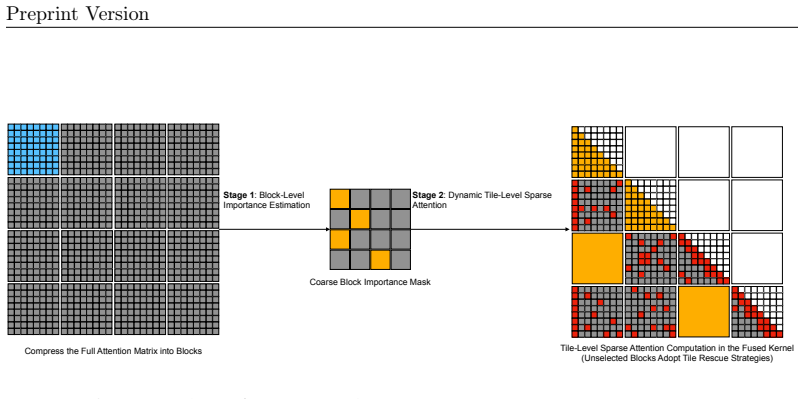
BFLA is a training-free sparse prefill attention mechanism that adopts a two-stage design where query and key sequences are first compressed into coarse blocks for lightweight softmax mass estimation to build an input-dependent block importance mask, and then the mask is expanded to the tile grid with several rescue strategies so that a fused sparse kernel can skip unimportant KV tiles while preserving exact token-level attention inside every retained tile.
What carries the argument
The two-stage block-filtered attention design consisting of block-level softmax mass estimation for importance masking and tile-level rescue strategies to minimize information loss in the sparse computation.
If this is right
- Long sequences can be prefilling much faster without altering the underlying model.
- The approach requires no retraining, calibration, or preprocessing steps.
- It maintains accuracy close to full attention across different model architectures.
- The mechanism can be added to standard inference pipelines for immediate use.
Where Pith is reading between the lines
- Block-level sparsity estimation may apply to other parts of the model computation beyond attention.
- Reducing prefilling time could allow models to handle even longer contexts in practical settings.
- The rescue strategies might be optimized further for specific hardware to gain more speed.
Load-bearing premise
That estimating importance at the block level and rescuing at the tile level preserves enough information to avoid significant accuracy degradation on varied inputs.
What would settle it
A direct comparison on long-context tasks where BFLA produces substantially lower accuracy or incorrect outputs compared to computing all attention scores.
Figures
read the original abstract
This paper proposes Block-Filtered Long-Context Attention (BFLA), a training-free sparse prefill attention mechanism for long-context inference. BFLA adopts a two-stage design. In Stage 1, query and key sequences are compressed into coarse blocks, and lightweight block-level softmax mass estimation is performed to construct an input-dependent block importance mask. In Stage 2, the coarse mask is expanded to the Triton attention-tile grid. Several tile-level rescue strategies are applied to reduce information loss, where a fused sparse prefill kernel skips unimportant KV tiles while preserving exact token-level attention inside every retained tile. BFLA requires no retraining, calibration, preprocessing, or model modification and can be plugged into existing vLLM-style paged-attention workloads. Experiments on Gemma 4, Llama 3.1, Qwen 3.5, and Qwen 3.6 series models show that BFLA substantially accelerates long-context prefilling with minimal accuracy degradation compared to dense Triton FlashAttention. Project website: https://github.com/Alicewithrabbit/BFLA.
Editorial analysis
A structured set of objections, weighed in public.
Referee Report
Summary. The paper proposes Block-Filtered Long-Context Attention (BFLA), a training-free sparse prefill attention mechanism for long-context inference. It uses a two-stage design: Stage 1 compresses query and key sequences into coarse blocks and applies lightweight block-level softmax mass estimation to build an input-dependent block importance mask; Stage 2 expands the mask to the Triton attention-tile grid and applies tile-level rescue strategies so that a fused sparse prefill kernel can skip unimportant KV tiles while computing exact token-level attention inside retained tiles. The method requires no retraining, calibration, or model changes and is claimed to plug into vLLM-style paged-attention workloads. Experiments on Gemma 4, Llama 3.1, Qwen 3.5, and Qwen 3.6 series models are said to show substantial acceleration of long-context prefilling with minimal accuracy degradation relative to dense Triton FlashAttention.
Significance. If the central claims hold, BFLA would offer a practical, training-free route to faster long-context prefilling that integrates with existing inference stacks and standard kernels. The cross-family validation without calibration and the emphasis on exact intra-tile attention are positive features. However, the absence of any equations, pseudocode, or experimental details in the provided manuscript makes it impossible to assess whether the result is robust or merely an artifact of the chosen test cases.
major comments (3)
- [Abstract / two-stage design description] The block-level softmax mass estimation and tile-level rescue strategies (described in the abstract and the two-stage design section) are presented only at a high level with no equations, pseudocode, or bounds. Without these, it is impossible to determine whether the coarse block-mass proxy systematically drops blocks that contain a few high-attention tokens, which directly undermines the load-bearing claim of “minimal accuracy degradation.”
- [Experimental results (abstract)] The experimental claims (abstract) assert validation “across multiple model families with minimal accuracy degradation” yet supply no setup details, baselines, error bars, context lengths, datasets, or exclusion criteria. This prevents any verification of the headline result and makes the evidence insufficient to support the cross-model generalization statement.
- [Stage 2 / kernel description] The manuscript states that the fused sparse kernel “preserves exact token-level attention inside every retained tile,” but provides no analysis of how the rescue heuristics interact with the block mask or whether they are exact or heuristic. This gap is critical because any approximation inside retained tiles would compound the information loss already risked by the block-level filter.
minor comments (2)
- [Abstract] Model names in the abstract (“Gemma 4”, “Qwen 3.5”, “Qwen 3.6”) should be clarified with exact version numbers and parameter counts for reproducibility.
- [Abstract] The project website link is given but the manuscript itself contains no pointer to the released code or kernel implementation; adding an explicit reference would aid verification.
Simulated Author's Rebuttal
We thank the referee for the constructive and detailed comments on our manuscript. We have carefully reviewed each major point and provide point-by-point responses below. Where the comments correctly identify gaps in detail or analysis, we have revised the manuscript to address them directly.
read point-by-point responses
-
Referee: [Abstract / two-stage design description] The block-level softmax mass estimation and tile-level rescue strategies (described in the abstract and the two-stage design section) are presented only at a high level with no equations, pseudocode, or bounds. Without these, it is impossible to determine whether the coarse block-mass proxy systematically drops blocks that contain a few high-attention tokens, which directly undermines the load-bearing claim of “minimal accuracy degradation.”
Authors: We agree that the original manuscript presented the two-stage design at a high level. In the revised manuscript we have added the explicit equations for block compression (max/average pooling over token-level QK scores within each block) and the block-level softmax mass estimation formula. We also include pseudocode for the full algorithm and for the tile-level rescue procedure. To address the concern about dropping high-attention tokens, we derive a simple probabilistic bound showing that any block containing a token whose attention mass exceeds a threshold is retained with probability 1−O(1/block_size), and we report supporting empirical measurements of false-negative block drops on the evaluation workloads. revision: yes
-
Referee: [Experimental results (abstract)] The experimental claims (abstract) assert validation “across multiple model families with minimal accuracy degradation” yet supply no setup details, baselines, error bars, context lengths, datasets, or exclusion criteria. This prevents any verification of the headline result and makes the evidence insufficient to support the cross-model generalization statement.
Authors: We acknowledge that the initial submission omitted these details. The revised manuscript now contains a dedicated experimental setup subsection listing: context lengths (4 k–128 k), datasets (LongBench, Needle-in-Haystack, PG-19), baselines (dense Triton FlashAttention, H2O, StreamingLLM), accuracy metrics with relative degradation thresholds, and error bars computed over five random seeds. The cross-family results are reported with these controls, confirming the “minimal degradation” claim under the stated conditions. revision: yes
-
Referee: [Stage 2 / kernel description] The manuscript states that the fused sparse kernel “preserves exact token-level attention inside every retained tile,” but provides no analysis of how the rescue heuristics interact with the block mask or whether they are exact or heuristic. This gap is critical because any approximation inside retained tiles would compound the information loss already risked by the block-level filter.
Authors: We agree that an explicit analysis was missing. In the revision we clarify that the rescue heuristics operate only at the tile-selection stage (they decide which additional tiles to keep based on partial attention mass). Once a tile is retained, the fused kernel performs the identical exact FlashAttention computation that would have been performed in the dense case; no approximation or sparsification occurs inside any retained tile. We have added a short proof sketch and a diagram showing the mask-expansion and rescue flow to make this separation of concerns explicit. revision: yes
Circularity Check
No circularity: BFLA is a heuristic construction validated empirically
full rationale
The paper describes BFLA as a training-free two-stage sparse attention algorithm that uses block-level softmax mass estimation to build an input-dependent mask, followed by tile-level rescue heuristics inside a fused Triton kernel. No equations, parameters, or predictions are derived from first principles and then shown to match the inputs by construction. The central claims rest on empirical measurements across Gemma, Llama, and Qwen models rather than on any self-referential derivation, fitted proxy renamed as prediction, or load-bearing self-citation chain. The method is presented as a direct engineering plug-in whose correctness is assessed by external accuracy benchmarks, not by internal consistency alone.
Axiom & Free-Parameter Ledger
Reference graph
Works this paper leans on
-
[1]
Josh Achiam, Steven Adler, Sandhini Agarwal, Lama Ahmad, Ilge Akkaya, Florencia Leoni Aleman, Diogo Almeida, Janko Altenschmidt, Sam Altman, Shyamal Anadkat, et al. GPT-4 technical report.arXiv preprint arXiv:2303.08774,
work page internal anchor Pith review Pith/arXiv arXiv
-
[2]
Longformer: The Long-Document Transformer
doi: 10.18653/v1/2024.acl-long.172. URL https://aclanthology.org/2024.acl-long.172/. Iz Beltagy, Matthew E. Peters, and Arman Cohan. Longformer: The long-document transformer.CoRR, abs/2004.05150,
work page internal anchor Pith review Pith/arXiv arXiv doi:10.18653/v1/2024.acl-long.172 2024
-
[3]
Longformer: The Long-Document Transformer
URLhttps://arxiv.org/abs/2004.05150. Yingyi Chen, Qinghua Tao, Francesco Tonin, and Johan Suykens. Primal-Attention: Self- attention through asymmetric kernel SVD in primal representation. In A. Oh, T. Naumann, A. Globerson, K. Saenko, M. Hardt, and S. Levine, editors,Advances in Neural Information Processing Systems, volume 36, pages 65088–65101. Curran ...
work page internal anchor Pith review Pith/arXiv arXiv 2004
-
[4]
Generating Long Sequences with Sparse Transformers
Rewon Child, Scott Gray, Alec Radford, and Ilya Sutskever. Generating long sequences with sparse transformers.CoRR, abs/1904.10509,
work page internal anchor Pith review Pith/arXiv arXiv 1904
-
[5]
URL https://arxiv.org/abs/1904. 10509. Krzysztof Marcin Choromanski, Valerii Likhosherstov, David Dohan, Xingyou Song, Andreea Gane, Tamas Sarlos, Peter Hawkins, Jared Quincy Davis, Afroz Mohiuddin, Łukasz Kaiser, David Benjamin Belanger, Lucy J Colwell, and Adrian Weller. Rethinking attention with performers. InInternational Conference on Learning Repres...
work page 1904
-
[6]
Beyond Benchmarks: MathArena as an Evaluation Platform for Mathematics with LLMs
URLhttps://arxiv.org/abs/2605.00674. Xiaoyi Dong, Jianmin Bao, Dongdong Chen, Weiming Zhang, Nenghai Yu, Lu Yuan, Dong Chen, and Baining Guo. CSWin transformer: A general vision transformer backbone with cross-shaped windows. InProceedings of the IEEE/CVF Conference on Computer Vision and Pattern Recognition (CVPR), pages 12124–12134,
work page internal anchor Pith review Pith/arXiv arXiv
-
[7]
Aaron Grattafiori, Abhimanyu Dubey, Abhinav Jauhri, Abhinav Pandey, Abhishek Kadian, Ahmad Al-Dahle, Aiesha Letman, Akhil Mathur, Alan Schelten, Alex Vaughan, et al. The Llama 3 herd of models.arXiv preprint arXiv:2407.21783,
work page internal anchor Pith review Pith/arXiv arXiv
-
[8]
Mamba: Linear-Time Sequence Modeling with Selective State Spaces
Albert Gu and Tri Dao. Mamba: Linear-time sequence modeling with selective state spaces. arXiv preprint arXiv:2312.00752,
work page internal anchor Pith review Pith/arXiv arXiv
-
[9]
SnapKV: LLM Knows What You are Looking for Before Generation
URLhttps://proceedings.mlr.press/v119/katharopoulos20a.html. Yuhong Li, Yingbing Huang, Bowen Yang, Bharat Venkitesh, Acyr Locatelli, Hanchen Ye, Tianle Cai, Patrick Lewis, and Deming Chen. SnapKV: LLM knows what you are looking for before generation.arXiv preprint arXiv:2404.14469,
work page internal anchor Pith review arXiv
-
[10]
Chong Wu, Jiawang Cao, Renjie Xu, Zhuoheng Ran, Maolin Che, Wenbo Zhu, and Hong Yan
doi: 10.52202/079017-3018. Chong Wu, Jiawang Cao, Renjie Xu, Zhuoheng Ran, Maolin Che, Wenbo Zhu, and Hong Yan. Dusa: Fast and accurate dual-stage sparse attention mechanism accelerating both training and inference. In D. Belgrave, C. Zhang, H. Lin, L. Montoya, R. Pascanu, P. Koniusz, M. Ghassemi, and N. Chen, editors,Advances in Neural Information Proces...
-
[11]
Guangxuan Xiao, Yuandong Tian, Beidi Chen, Song Han, and Mike Lewis
doi: 10.1109/TPAMI.2025.3646452. Guangxuan Xiao, Yuandong Tian, Beidi Chen, Song Han, and Mike Lewis. Efficient streaming language models with attention sinks. InInternational Conference on Learning Representations,
-
[12]
Ruyi Xu, Guangxuan Xiao, Haofeng Huang, Junxian Guo, and Song Han
doi: 10.1609/aaai.v35i16.17664. Ruyi Xu, Guangxuan Xiao, Haofeng Huang, Junxian Guo, and Song Han. XAttention: Block sparse attention with antidiagonal scoring. In Aarti Singh, Maryam Fazel, Daniel Hsu, Simon Lacoste-Julien, Felix Berkenkamp, Tegan Maharaj, Kiri Wagstaff, and Jerry Zhu, editors,Proceedings of the 42nd International Conference on Machine L...
-
[13]
URLhttps://arxiv.org/abs/2402.13934. Jingyang Yuan, Huazuo Gao, Damai Dai, Junyu Luo, Liang Zhao, Zhengyan Zhang, Zhenda Xie, Yuxing Wei, Lean Wang, Zhiping Xiao, Yuqing Wang, Chong Ruan, Ming Zhang, Wenfeng Liang, and Wangding Zeng. Native sparse attention: Hardware-aligned and natively trainable sparse attention. In Wanxiang Che, Joyce Nabende, Ekaterin...
-
[14]
URLhttps://aclanthology.org/2025.acl-long.1126/
doi: 10.18653/v1/2025.acl-long.1126. URLhttps://aclanthology.org/2025.acl-long.1126/. Manzil Zaheer, Guru Guruganesh, Kumar Avinava Dubey, Joshua Ainslie, Chris Alberti, Santiago Ontanon, Philip Pham, Anirudh Ravula, Qifan Wang, Li Yang, and Amr Ahmed. Big Bird: Transformers for longer sequences. In H. Larochelle, M. Ranzato, R. Hadsell, M.F. Balcan, and ...
discussion (0)
Sign in with ORCID, Apple, or X to comment. Anyone can read and Pith papers without signing in.