Recognition: 1 theorem link
· Lean TheoremProbing Non-Equilibrium Grain Boundary Dynamics with XPCS and Domain-Adaptive Machine Learning
Pith reviewed 2026-05-13 04:51 UTC · model grok-4.3
The pith
A combination of X-ray photon correlation spectroscopy and domain-adaptive machine learning extracts kinetic parameters of grain boundary motion from experimental data.
A machine-rendered reading of the paper's core claim, the machinery that carries it, and where it could break.
Core claim
The central claim is that XPCS measurements combined with domain-adaptive ML enable extraction of bulk diffusivity, GB stiffness, and effective GB concentration from experimental two-time correlation maps, which show pronounced departures from time-translation invariance indicating far-from-equilibrium dynamics.
What carries the argument
Domain-adaptive representation alignment in a semi-supervised learning framework that maps simulation-derived physical parameters onto unlabeled experimental XPCS maps.
If this is right
- Quantitative parameters of grain boundary dynamics become accessible from standard XPCS experiments.
- Non-equilibrium relaxation in nanocrystalline materials can be characterized over lab timescales.
- The method provides a route to study defect motion in solids using fluctuation data and machine learning.
- Key material properties like stiffness and concentration of grain boundaries can be measured directly.
Where Pith is reading between the lines
- This technique could be applied to monitor grain boundary evolution in real time during material processing.
- Similar domain adaptation might help other experimental techniques where simulations can label data.
- Improved understanding of non-equilibrium states may help design more stable nanocrystalline materials.
Load-bearing premise
The domain-adaptive representation alignment transfers physical parameter labels from continuum simulations to experimental XPCS maps without introducing significant bias or artifacts.
What would settle it
Comparing the extracted parameters to values obtained from independent experiments like atomic-scale imaging or separate diffusion studies on the same samples, and finding systematic disagreements.
Figures


read the original abstract
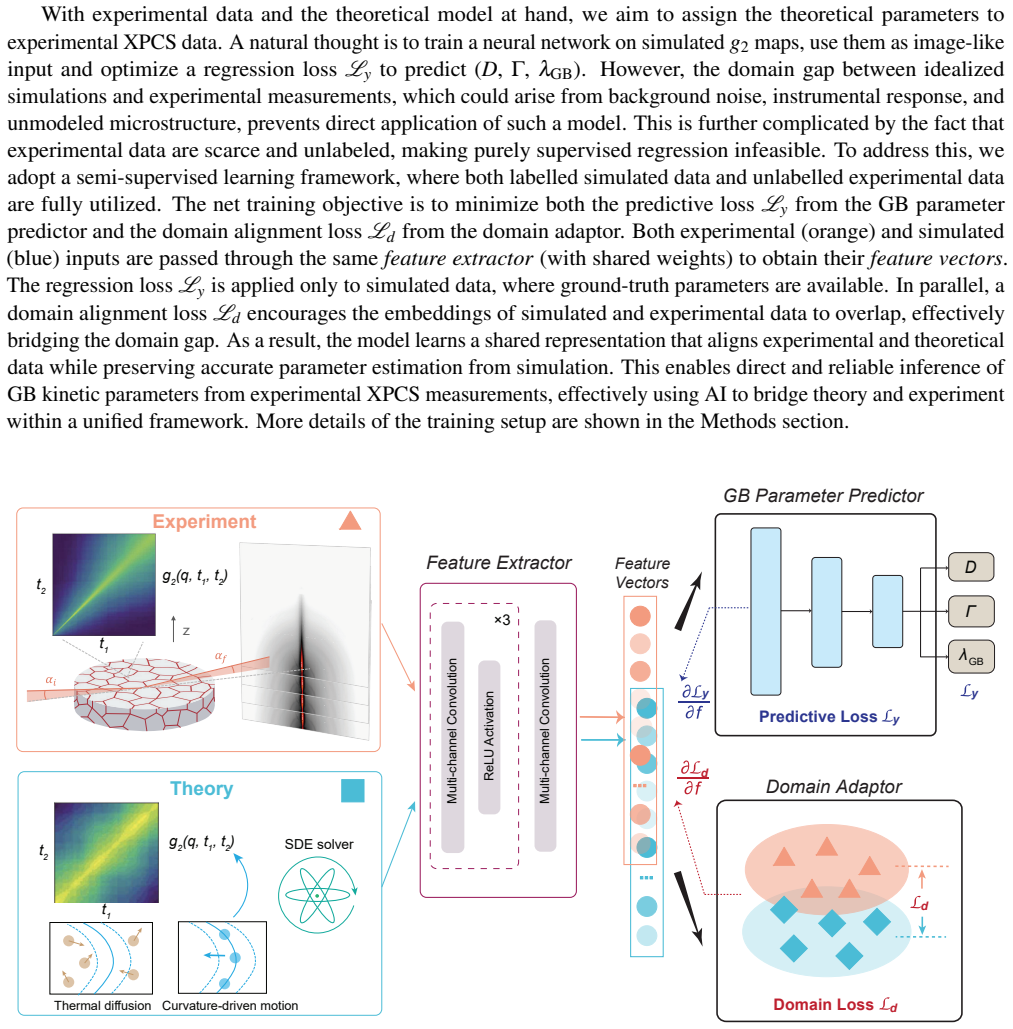
Grain-boundary (GB) dynamics control the stability, mechanical, and functional response of nanocrystalline materials, but direct experimental access to their slow non-equilibrium motion has been limited. Here we establish X-ray photon correlation spectroscopy (XPCS), combined with domain-adaptive machine learning, as a quantitative probe of GB dynamics. Temperature- and grain-size-dependent two-time XPCS measurements in nanocrystalline silicon reveal pronounced departures from time-translation invariance, showing that GB relaxation can remain far from equilibrium over experimental timescales. However, direct extraction of quantitative physical information from these high-dimensional, noisy fluctuation maps faces a significant challenge. To overcome this barrier, we develop a semi-supervised learning framework that transfers physical parameter labels from continuum simulations to unlabeled experimental XPCS maps through domain-adaptive representation alignment. This AI-augmented approach enables the extraction of key kinetic parameters, including bulk diffusivity, GB stiffness, and effective GB concentration, directly from experimental XPCS measurements. Our results show how machine learning can transform indirect fluctuation signals into quantitative materials dynamics, providing a general route to study non-equilibrium defect motion in solids.
Editorial analysis
A structured set of objections, weighed in public.
Referee Report
Summary. The manuscript claims that XPCS two-time correlation measurements on nanocrystalline silicon, combined with a semi-supervised domain-adaptive machine learning framework, can extract quantitative kinetic parameters (bulk diffusivity, GB stiffness, and effective GB concentration) from experimental fluctuation maps by transferring labels from continuum simulations. It reports pronounced departures from time-translation invariance, indicating persistent non-equilibrium GB relaxation, and positions the AI-augmented method as a general route to study slow defect dynamics.
Significance. If the domain-adaptive alignment proves robust, the work would provide a valuable new capability for quantifying non-equilibrium GB kinetics from indirect XPCS signals where conventional analysis is intractable. The integration of continuum modeling with representation alignment is a clear strength that could generalize to other fluctuation spectroscopies and materials systems lacking ground-truth labels.
major comments (2)
- [Abstract] Abstract: The central claim that the method 'enables the extraction of key kinetic parameters, including bulk diffusivity, GB stiffness, and effective GB concentration, directly from experimental XPCS measurements' is presented without any reported quantitative validation (recovered values with uncertainties, comparison to independent experiments such as tracer diffusion, or ablation studies on the alignment step). This is load-bearing because experimental maps carry no ground-truth labels, so correctness rests entirely on unshown fidelity of the transfer.
- [Methods / Results] Simulation-to-experiment transfer section: The workflow assumes continuum simulations generate XPCS signals faithful to experiment across the explored parameter ranges, yet no sensitivity analysis, mismatch quantification, or cross-validation against known GB migration rates is described. Any systematic discrepancy would propagate directly into the reported diffusivity, stiffness, and concentration values.
minor comments (1)
- [Abstract] Abstract: Adding one sentence specifying the neural-network architecture and loss function used for domain-adaptive alignment would improve immediate clarity and reproducibility.
Simulated Author's Rebuttal
We thank the referee for their positive evaluation of our work and for the constructive major comments. We address each point below and outline revisions that will strengthen the manuscript without altering its core claims.
read point-by-point responses
-
Referee: [Abstract] Abstract: The central claim that the method 'enables the extraction of key kinetic parameters, including bulk diffusivity, GB stiffness, and effective GB concentration, directly from experimental XPCS measurements' is presented without any reported quantitative validation (recovered values with uncertainties, comparison to independent experiments such as tracer diffusion, or ablation studies on the alignment step). This is load-bearing because experimental maps carry no ground-truth labels, so correctness rests entirely on unshown fidelity of the transfer.
Authors: We acknowledge that the abstract states the central claim without accompanying quantitative metrics. The main text reports domain-adaptation performance via held-out simulation accuracy and qualitative consistency with experimental trends, but does not include explicit recovered parameter values with uncertainties from the experimental maps, ablation studies, or direct comparisons to independent measurements. In the revised version we will add a validation subsection that reports the extracted bulk diffusivity, GB stiffness, and effective concentration values together with their uncertainties, includes an ablation study on the domain-alignment component, and discusses consistency with literature values for silicon self-diffusion. Direct tracer-diffusion data on the identical nanocrystalline samples are unavailable, which we will note explicitly. revision: yes
-
Referee: [Methods / Results] Simulation-to-experiment transfer section: The workflow assumes continuum simulations generate XPCS signals faithful to experiment across the explored parameter ranges, yet no sensitivity analysis, mismatch quantification, or cross-validation against known GB migration rates is described. Any systematic discrepancy would propagate directly into the reported diffusivity, stiffness, and concentration values.
Authors: The referee is correct that the current manuscript does not present a dedicated sensitivity analysis or quantitative mismatch metrics between simulated and experimental fluctuation maps. The continuum model follows established GB evolution equations, and parameter ranges were chosen to bracket experimental conditions, but explicit propagation of simulation-experiment discrepancies was not quantified. We will revise the Methods and Results sections to add: (i) a sensitivity study showing how variations in simulation inputs (mobility, stiffness, concentration) affect the downstream experimental parameter estimates; (ii) latent-space distribution distances as a mismatch measure; and (iii) cross-validation against published GB migration rates for silicon where comparable data exist. These additions will make the robustness of the label transfer explicit. revision: yes
Circularity Check
No significant circularity; transfer-learning pipeline is externally grounded
full rationale
The paper's core workflow generates labeled XPCS maps from independent continuum simulations of GB dynamics, then applies domain-adaptive representation alignment to map those labels onto unlabeled experimental two-time correlation maps. This is a standard semi-supervised transfer procedure whose inputs (simulation physics and real experimental data) are not defined in terms of the extracted outputs (bulk diffusivity, GB stiffness, effective GB concentration). No equation or method step reduces a prediction to a fitted parameter by construction, no self-citation chain is load-bearing for the central claim, and the derivation remains self-contained against external simulation benchmarks and experimental measurements.
Axiom & Free-Parameter Ledger
axioms (2)
- domain assumption Grain-boundary relaxation in nanocrystalline silicon remains far from equilibrium on experimental timescales, as evidenced by departures from time-translation invariance in two-time XPCS data.
- domain assumption Continuum simulations generate physically accurate labels for bulk diffusivity, GB stiffness, and GB concentration that can be aligned with experimental fluctuation maps.
Lean theorems connected to this paper
-
IndisputableMonolith/Cost/FunctionalEquation.leanwashburn_uniqueness_aczel unclear?
unclearRelation between the paper passage and the cited Recognition theorem.
semi-supervised learning framework that transfers physical parameter labels from continuum simulations to unlabeled experimental XPCS maps through domain-adaptive representation alignment... extraction of key kinetic parameters, including bulk diffusivity D, GB stiffness Γ, and effective GB concentration λGB
What do these tags mean?
- matches
- The paper's claim is directly supported by a theorem in the formal canon.
- supports
- The theorem supports part of the paper's argument, but the paper may add assumptions or extra steps.
- extends
- The paper goes beyond the formal theorem; the theorem is a base layer rather than the whole result.
- uses
- The paper appears to rely on the theorem as machinery.
- contradicts
- The paper's claim conflicts with a theorem or certificate in the canon.
- unclear
- Pith found a possible connection, but the passage is too broad, indirect, or ambiguous to say the theorem truly supports the claim.
Reference graph
Works this paper leans on
-
[1]
Rupert, T., Gianola, D., Gan, Y . & Hemker, K. Experimental observations of stress-driven grain boundary migration.Science326, 1686–1690 (2009). 2.Wang, L.et al.Tracking the sliding of grain boundaries at the atomic scale.Science375, 1261–1265 (2022)
work page 2009
-
[2]
Fang, Z.et al.Atomic-scale observation of dynamic grain boundary structural transformation during shear- mediated migration.Sci. Adv.8, eabn3785 (2022)
work page 2022
-
[3]
Zhang, B., Tang, Y ., Mei, Q., Li, X. & Lu, K. Inhibiting creep in nanograined alloys with stable grain boundary networks.Science378, 659–663 (2022)
work page 2022
-
[4]
Barr, C. M.et al.Irradiation-induced grain boundary facet motion: In situ observations and atomic-scale mechanisms.Sci. Adv.8, eabn0900 (2022)
work page 2022
-
[5]
Bernier, J. V ., Suter, R. M., Rollett, A. D. & Almer, J. D. High-energy x-ray diffraction microscopy in materials science.Annu. Rev. Mater. Res.50, 395–436 (2020). 7.Zewail, A. H. Four-dimensional electron microscopy.science328, 187–193 (2010)
work page 2020
-
[6]
Tian, Y .et al.Grain rotation mechanisms in nanocrystalline materials: Multiscale observations in pt thin films. Science386, 49–54 (2024)
work page 2024
-
[7]
Robinson, I., Clark, J. & Harder, R. Materials science in the time domain using bragg coherent diffraction imaging.J. Opt.18, 054007 (2016)
work page 2016
-
[8]
Yau, A., Cha, W., Kanan, M. W., Stephenson, G. B. & Ulvestad, A. Bragg coherent diffractive imaging of single-grain defect dynamics in polycrystalline films.Science356, 739–742 (2017)
work page 2017
-
[9]
García-Moreno, F.et al.Tomoscopy: Time-resolved tomography for dynamic processes in materials.Adv. Mater.33, 2104659 (2021)
work page 2021
-
[10]
McKenna, I., Poulsen, S., Lauridsen, E. M., Ludwig, W. & V oorhees, P. W. Grain growth in four dimensions: A comparison between simulation and experiment.Acta materialia78, 125–134 (2014). 13.Zhang, J.et al.Grain boundary mobilities in polycrystals.Acta Materialia191, 211–220 (2020)
work page 2014
-
[11]
Gottstein, G., Ma, Y . & Shvindlerman, L. Triple junction motion and grain microstructure evolution.Acta Materialia53, 1535–1544 (2005). 12/14
work page 2005
-
[12]
Upmanyu, M., Srolovitz, D., Shvindlerman, L. & Gottstein, G. Misorientation dependence of intrinsic grain boundary mobility: simulation and experiment.Acta materialia47, 3901–3914 (1999)
work page 1999
-
[13]
Taylor, J. E., Cahn, J. W. & Handwerker, C. A. Overview no. 98 i—geometric models of crystal growth.Acta Metall. et Materialia40, 1443–1474 (1992)
work page 1992
-
[14]
Mishin, Y . M. Atomistic theory and computer simulation of grain boundary diffusion. InDefect and Diffusion Forum, vol. 143, 1357–1372 (Trans Tech Publ, 1997)
work page 1997
-
[15]
Kobayashi, R., Warren, J. A. & Carter, W. C. A continuum model of grain boundaries.Phys. D: Nonlinear Phenom.140, 141–150 (2000)
work page 2000
-
[16]
Trautt, Z. & Mishin, Y . Grain boundary migration and grain rotation studied by molecular dynamics.Acta Materialia60, 2407–2424 (2012)
work page 2012
-
[17]
Leheny, R. L. Xpcs: Nanoscale motion and rheology.Curr. opinion colloid & interface science17, 3–12 (2012)
work page 2012
-
[18]
X-ray photon correlation spectroscopy for the characterization of soft and hard condensed matter
Bikondoa, O. X-ray photon correlation spectroscopy for the characterization of soft and hard condensed matter. X-ray Neutron Tech. for Nanomater. Charact.95–156 (2016)
work page 2016
-
[19]
Lu, X., Mochrie, S., Narayanan, S., Sandy, A. & Sprung, M. Temperature-dependent structural arrest of silica colloids in a water–lutidine binary mixture.Soft Matter6, 6160–6177 (2010)
work page 2010
-
[20]
Zinn, T., Sharpnack, L. & Narayanan, T. Phoretic dynamics of colloids in a phase separating critical liquid mixture.Phys. Rev. Res.2, 033177 (2020)
work page 2020
-
[21]
Porter, Z.et al.Understanding the superconductivity and charge density wave interaction through quasi-static lattice fluctuations.Proc. Natl. Acad. Sci.121, e2412182121 (2024)
work page 2024
-
[22]
Shen, L.et al.Interplay between relaxational atomic fluctuations and charge density waves in la 2- x sr x cuo 4. Phys. Rev. B108, L201111 (2023)
work page 2023
-
[23]
Tumbleson, Z.et al.Thermodynamic phase transitions of nematic order in magnetic helices.Sci. Adv.11, eadt5680 (2025)
work page 2025
-
[24]
Horwath, J. P.et al.Ai-nerd: Elucidation of relaxation dynamics beyond equilibrium through ai-informed x-ray photon correlation spectroscopy.Nat. Commun.15, 5945 (2024)
work page 2024
-
[25]
K.et al.Nanostructured bulk silicon as an effective thermoelectric material.Adv
Bux, S. K.et al.Nanostructured bulk silicon as an effective thermoelectric material.Adv. Funct. Mater.19, 2445–2452 (2009)
work page 2009
-
[26]
Siegert, A.On the fluctuations in signals returned by many independently moving scatterers(Radiation Laboratory, Massachusetts Institute of Technology, 1943)
work page 1943
-
[27]
Berne, B. J. & Pecora, R.Dynamic light scattering: with applications to chemistry, biology, and physics (Courier Corporation, 2000). 31.Allen, M. P. & Tildesley, D. J.Computer simulation of liquids(Oxford university press, 2017)
work page 2000
-
[28]
Chen, D. & Kulkarni, Y . Atomistic modeling of grain boundary motion as a random walk.Phys. Rev. Mater.2, 093605 (2018)
work page 2018
-
[29]
Sun, B. & Saenko, K. Deep coral: Correlation alignment for deep domain adaptation. InEuropean conference on computer vision, 443–450 (Springer, 2016)
work page 2016
-
[30]
UMAP: Uniform Manifold Approximation and Projection for Dimension Reduction
McInnes, L., Healy, J. & Melville, J. Umap: Uniform manifold approximation and projection for dimension reduction.arXiv preprint arXiv:1802.03426(2018). 35.Qiu, C.et al.Grain boundaries are brownian ratchets.Science385, 980–985 (2024). 36.Carrasquilla, J. Machine learning for quantum matter.Adv. Physics: X5, 1797528 (2020)
work page internal anchor Pith review Pith/arXiv arXiv 2018
-
[31]
Chen, Z.et al.Machine learning on neutron and x-ray scattering and spectroscopies.Chem. Phys. Rev.2(2021). 13/14
work page 2021
-
[32]
Cheng, M., Okabe, R., Chotrattanapituk, A. & Li, M. Machine learning detection of majorana zero modes from zero-bias peak measurements.Matter7, 2507–2520 (2024)
work page 2024
-
[33]
Han, X.-Q.et al.Ai-driven inverse design of materials: Past, present, and future.Chin. Phys. Lett.42, 027403 (2025)
work page 2025
-
[34]
Fu, C.-L.et al.Ai-driven defect engineering for advanced thermoelectric materials.Adv. Mater.37, 2505642 (2025)
work page 2025
-
[35]
Cheng, M.et al.Artificial intelligence-driven approaches for materials design and discovery.Nat. Mater.1–17 (2026)
work page 2026
-
[36]
Cheng, M.et al.A foundation model for non-destructive defect identification from vibrational spectra.Matter 102728 (2026)
work page 2026
-
[37]
Chen, X.et al.Detecting thermodynamic phase transition via explainable machine learning of photoemission spectroscopy.Newton1(2025)
work page 2025
-
[38]
Nelson, K., Kreiman, T., Levine, S. & Krishnapriyan, A. S. Bridging the simulation-to-experiment gap with generative models using adversarial distribution alignment.arXiv preprint arXiv:2604.01169(2026)
-
[39]
Nye, A., Leff, A., Barr, C. M. & Taheri, M. Direct observation of recrystallization mechanisms during annealing of cu in low and high strain conditions.Scripta Materialia146, 308–311 (2018)
work page 2018
-
[40]
Zhang, L., Han, J., Srolovitz, D. J. & Xiang, Y . Equation of motion for grain boundaries in polycrystals.npj Comput. Mater.7, 64 (2021). 47.Rohrer, G. S.et al.Grain boundary migration in polycrystals.Annu. Rev. Mater. Res.53, 347–369 (2023). 14/14
work page 2021
discussion (0)
Sign in with ORCID, Apple, or X to comment. Anyone can read and Pith papers without signing in.