Recognition: no theorem link
ECTO: Exogenous-Conditioned Temporal Operator for Ultra-Short-Term Wind Power Forecasting
Pith reviewed 2026-05-13 06:43 UTC · model grok-4.3
The pith
ECTO improves wind power forecasts by adaptively selecting key meteorological variables with physical priors and refining outputs through regime-specific experts.
A machine-rendered reading of the paper's core claim, the machinery that carries it, and where it could break.
Core claim
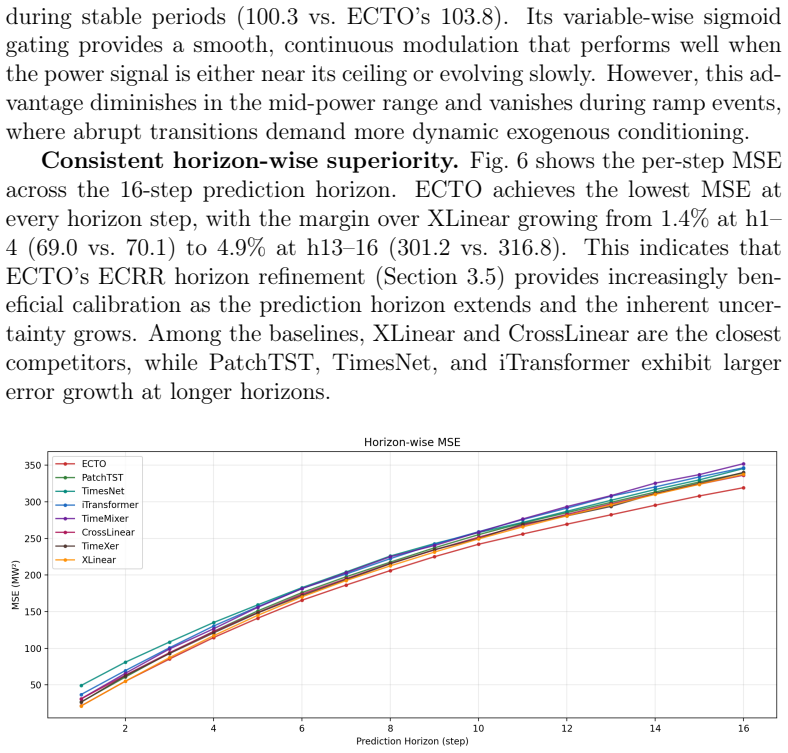
The central claim is that decomposing exogenous variable modeling into Physically-Grounded Variable Selection, which performs hierarchical group-aware sparse selection via domain-informed physical priors and sparsemax, plus Exogenous-Conditioned Regime Refinement, which applies mixture-of-experts gain-bias calibration and horizon-specific corrections, produces the lowest MSE on ultra-short-term wind power tasks. On three wind farms the method outperforms the strongest baseline by 2.2 to 5.2 percent relative improvement, widening to 8.6 percent at the 32-step horizon, with each exogenous module contributing positively in isolation and the learned selections proving physically interpretable.
What carries the argument
The ECTO framework, which decomposes exogenous handling into Physically-Grounded Variable Selection (PGVS) for sparse, group-aware selection using physical priors and sparsemax, and Exogenous-Conditioned Regime Refinement (ECRR) for mixture-of-experts regime calibration with gain-bias adjustments.
If this is right
- Forecast error decreases relative to uniform mixing or PCA-based baselines for exogenous inputs.
- Relative accuracy gains widen as the prediction horizon lengthens from short to 32 steps.
- Both the variable selection module and the regime refinement module independently reduce error when added to a base temporal model.
- The learned variable importance patterns align with physical expectations and differ by site in interpretable ways.
- The regime experts converge to distinct, repeatable calibration strategies that transfer across the tested climates.
Where Pith is reading between the lines
- The same two-module split could be tested on solar power or load forecasting where exogenous drivers also shift by condition.
- Operational systems might reduce manual feature engineering by letting the physical prior guide selection instead of exhaustive search.
- Extending the physical prior to be partially learned from data could improve performance in data-rich but poorly documented sites.
Load-bearing premise
The physical grouping and selection priors in PGVS remain effective across new sites and changing conditions without needing frequent redefinition or causing the mixture-of-experts to overfit regimes.
What would settle it
Retraining ECTO on data from two of the wind farms and evaluating on the third unseen farm; if the MSE advantage over a simple concatenation baseline vanishes or reverses, the claim that the exogenous decomposition generalizes would be falsified.
Figures




read the original abstract
Accurate ultra-short-term wind power forecasting is critical for grid dispatch and reserve management, yet remains challenging due to the non-stationary, condition-dependent nature of wind generation. Meteorological exogenous variables carry substantial predictive information, but the most informative variable combination varies across sites, operating conditions, and prediction horizons. Existing deep learning approaches either treat exogenous inputs as generic auxiliary channels through uniform mixing or soft gating, or rely on fixed preprocessing steps such as PCA, without exploiting the physical structure of meteorological variables. We propose ECTO (Exogenous-Conditioned Temporal Operator), a unified framework that decomposes exogenous variable modeling into two complementary modules. Physically-Grounded Variable Selection (PGVS) performs hierarchical, group-aware sparse selection over exogenous variables using a domain-informed physical prior and sparsemax activations, producing a compact, condition-adaptive exogenous context. Exogenous-Conditioned Regime Refinement (ECRR) routes the forecast through learned regime experts that apply gain--bias calibration and horizon-specific corrections via a mixture-of-experts paradigm. Experiments on three wind farms spanning different climates, capacities (66--200 MW), and exogenous dimensions (11--13 variables) demonstrate that ECTO achieves the lowest MSE across all sites, with relative improvements over the strongest baseline ranging from 2.2% to 5.2%, widening to 8.6% at the longer prediction horizon ($H=32$). Ablation analysis confirms that each exogenous-related component contributes positively (PGVS +1.84%, ECRR +2.86%), and interpretability analysis reveals that PGVS learns physically meaningful, site-specific variable selection patterns, while ECRR converges to well-separated calibration strategies consistent across sites.
Editorial analysis
A structured set of objections, weighed in public.
Referee Report
Summary. The paper proposes ECTO, a framework for ultra-short-term wind power forecasting that decomposes exogenous modeling into Physically-Grounded Variable Selection (PGVS) for hierarchical group-aware sparse selection via domain-informed priors and sparsemax, and Exogenous-Conditioned Regime Refinement (ECRR) as a mixture-of-experts applying gain-bias and horizon-specific corrections. On three wind farms (66-200 MW, 11-13 exogenous variables), ECTO reports the lowest MSE with relative gains of 2.2-5.2% over the strongest baseline (widening to 8.6% at H=32), positive ablations (+1.84% PGVS, +2.86% ECRR), and interpretable site-specific patterns.
Significance. If the empirical gains hold under rigorous verification, the work provides a concrete method to embed physical structure and regime adaptation into temporal models for non-stationary exogenous inputs, which is directly relevant to grid operations. The consistent cross-site results and interpretability analysis add practical value beyond generic DL baselines.
major comments (1)
- [Experiments] Experiments section: The reported MSE improvements and ablation deltas (+1.84%, +2.86%) are presented without standard deviations across runs, number of random seeds, or statistical significance tests (e.g., Diebold-Mariano). This is load-bearing for the central claim of consistent superiority, as small relative gains (2.2-5.2%) could be sensitive to initialization or data splits.
minor comments (2)
- [Abstract and §3] Abstract and §3: The description of PGVS as 'hierarchical, group-aware' would benefit from an explicit equation or pseudocode showing how the physical prior is encoded into the sparsemax selection at each level.
- [Results tables] Table 1 or results tables: Clarify the exact set of baselines (e.g., which Transformer or LSTM variants) and whether they also receive the same exogenous inputs.
Simulated Author's Rebuttal
We thank the referee for the constructive feedback and the recommendation of minor revision. The concern regarding statistical robustness of the reported gains is well-taken, and we address it directly below.
read point-by-point responses
-
Referee: Experiments section: The reported MSE improvements and ablation deltas (+1.84%, +2.86%) are presented without standard deviations across runs, number of random seeds, or statistical significance tests (e.g., Diebold-Mariano). This is load-bearing for the central claim of consistent superiority, as small relative gains (2.2-5.2%) could be sensitive to initialization or data splits.
Authors: We agree that the absence of standard deviations, seed counts, and formal significance tests leaves the small relative gains vulnerable to questions of robustness. In the revised manuscript we will rerun all experiments (including baselines and ablations) over five independent random seeds, reporting mean MSE ± one standard deviation for every site, horizon, and method. We will also add pairwise Diebold-Mariano tests comparing ECTO against the strongest baseline at each horizon, with p-values reported in a new table. These additions will be placed in the Experiments section and will not alter the central claims, which remain supported by the consistent ordering across three geographically and climatically distinct wind farms. revision: yes
Circularity Check
No significant circularity detected in derivation or claims
full rationale
The paper presents an empirical ML architecture (ECTO) with two new modules (PGVS for sparse variable selection and ECRR for regime refinement) whose definitions are architectural and trained end-to-end on data. All central claims consist of reported MSE reductions, ablation deltas (+1.84% PGVS, +2.86% ECRR), and site-specific interpretability on three external wind-farm datasets. No equations, first-principles derivations, or predictions are shown that reduce by construction to fitted parameters or self-citations; performance numbers are presented as experimental outcomes on held-out test sets rather than tautologies. Self-citations, if present, are not load-bearing for the performance claims.
Axiom & Free-Parameter Ledger
free parameters (1)
- hyperparameters for PGVS and ECRR
axioms (1)
- domain assumption Exogenous meteorological variables have a physical structure that allows for hierarchical group-aware sparse selection.
Reference graph
Works this paper leans on
-
[1]
R. Tawn, J. Browell, A review of very short-term wind and solar power forecasting, Renewable and Sustainable Energy Reviews 153 (2022) 111758
work page 2022
-
[2]
R. A. Jacobs, M. I. Jordan, S. J. Nowlan, G. E. Hinton, Adaptive mix- tures of local experts, Neural Computation 3 (1) (1991) 79–87
work page 1991
-
[3]
Y. Wang, R. Zou, F. Liu, L. Zhang, Q. Liu, A review of wind speed and wind power forecasting with deep neural networks, Applied Energy 304 (2021) 117766
work page 2021
-
[4]
H. Liu, C. Chen, Data processing strategies in wind energy forecasting models and applications: A comprehensive review, Applied Energy 249 (2019) 392–408
work page 2019
-
[5]
C. Gallego-Castillo, A. Cuerva-Tejero, O. Lopez-Garcia, A review on the recent history of wind power ramp forecasting, Renewable and Sus- tainable Energy Reviews 52 (2015) 1148–1157
work page 2015
- [6]
-
[7]
N. Kirchner-Bossi, G. Kathari, F. Porté-Agel, A hybrid physics-based and data-driven model for intra-day and day-ahead wind power forecast- ing considering a drastically expanded predictor search space, Applied Energy 367 (2024) 123375
work page 2024
-
[8]
C. Gallego-Castillo, E. García-Bustamante, A. Cuerva, J. Navarro, Iden- tifying wind power ramp causes from multivariate datasets: a method- ological proposal and its application to reanalysis data, IET Renewable Power Generation 9 (3) (2015) 254–263. 38
work page 2015
-
[9]
M.Wanek, VariablerenewableenergyforecastinginGermany: Reassess- ing simplicity with Bayesian-optimised multilayer perceptrons, Renew- able Energy 262 (2026) 125409
work page 2026
-
[10]
H. Wang, D. Guo, L. Wang, T. Zhou, C. Jia, Y. Liu, A novel frequency sparsedownsamplinginteractiontransformerforwindpowerforecasting, Energy 326 (2025) 136199
work page 2025
-
[12]
Y. Nie, N. H. Nguyen, P. Sinha, A. Ravichander, K. Gao, A time se- ries is worth 64 words: Long-term forecasting with transformers, in: International Conference on Learning Representations, ICLR, 2023
work page 2023
-
[13]
Y. Liu, T. Hu, H. Zhang, H. Wu, S. Wang, L. Ma, M. Long, iTrans- former: Inverted transformers are effective for time series forecasting, in: International Conference on Learning Representations, ICLR, 2024
work page 2024
-
[14]
Y. Wang, H. Wu, J. Dong, et al., TimeXer: Empowering transformers for time series forecasting with exogenous variables, in: Advances in Neural Information Processing Systems, NeurIPS, 2024
work page 2024
-
[15]
X. Chen, H. Jin, Y. Huang, Z. Feng, XLinear: A lightweight and ac- curate MLP-based model for long-term time series forecasting with ex- ogenous inputs, in: Proceedings of the AAAI Conference on Artificial Intelligence, AAAI, 2026
work page 2026
-
[16]
P. Zhou, Y. Liu, J. Liang, Q. Song, X. Li, CrossLinear: Plug-and-play cross-correlation embedding for time series forecasting with exogenous variables, in: Proceedings of the ACM SIGKDD Conference on Knowl- edge Discovery and Data Mining, KDD, 2025
work page 2025
-
[17]
B. Lim, S. O. Arik, N. Loeff, T. Pfister, Temporal fusion transformers for interpretable multi-horizon time series forecasting, International Journal of Forecasting 37 (4) (2021) 1748–1764
work page 2021
- [18]
-
[19]
Z. Li, X. Qiu, Y. Zhu, X. Wu, J. Hu, C. Guo, B. Yang, GCGNet: Graph-consistent generative network for time series forecasting with ex- ogenous variables, in: International Conference on Learning Represen- tations, ICLR, 2026
work page 2026
-
[20]
A. F. T. Martins, R. F. Astudillo, From softmax to sparsemax: A sparse model of attention and multi-label classification, in: International Con- ference on Machine Learning, ICML, 2016, pp. 1614–1623
work page 2016
-
[21]
J. B. Olson, J. S. Kenyon, I. Djalalova, et al., Improving wind energy forecasting through numerical weather prediction model development, Bulletin of the American Meteorological Society 100 (11) (2019) 2201– 2220
work page 2019
-
[22]
S. Al-Yahyai, Y. Charabi, A. Gastli, Review of the use of numerical weather prediction (NWP) models for wind energy assessment, Renew- able and Sustainable Energy Reviews 14 (9) (2010) 3192–3198
work page 2010
-
[23]
J. Jung, R. P. Broadwater, Current status and future advances for wind speed and power forecasting, Renewable and Sustainable Energy Re- views 31 (2014) 762–777
work page 2014
-
[24]
T. Gneiting, K. Larson, K. Westrick, M. G. Genton, E. Aldrich, Cal- ibrated probabilistic forecasting at the Stateline Wind Energy Center: The regime-switching space-time method, Journal of the American Sta- tistical Association 101 (475) (2006) 968–979
work page 2006
-
[25]
J. Browell, D. R. Drew, K. Philippopoulos, Improved very short-term spatio-temporal wind forecasting using atmospheric regimes, Wind En- ergy 21 (11) (2018) 968–979
work page 2018
-
[26]
A. Aziz Ezzat, M. Jun, Y. Ding, Spatio-temporal short-term wind fore- cast: A calibrated regime-switching method, Annals of Applied Statis- tics 13 (3) (2019) 1484–1510
work page 2019
- [27]
-
[28]
K. Wang, X. Qi, H. Liu, J. Song, Deep belief network based k-means cluster approach for short-term wind power forecasting, Energy 165, Part A (2018) 840–852. 40
work page 2018
- [29]
-
[30]
T. Kim, J. Kim, Y. Tae, C. Park, J.-H. Choi, J. Choo, Reversible in- stance normalization for accurate time-series forecasting against distri- bution shift, in: International Conference on Learning Representations, ICLR, 2022
work page 2022
-
[31]
A. Vaswani, N. Shazeer, N. Parmar, et al., Attention is all you need, in: Advances in Neural Information Processing Systems, NeurIPS, 2017, pp. 5998–6008
work page 2017
- [32]
-
[33]
Z. Chen, J. Xu, State Grid wind and solar power generation dataset, Mendeley Data, V1 (2022). DOI: 10.17632/7my63z6b8x.1
-
[34]
H. Zhou, S. Zhang, J. Peng, S. Zhang, J. Li, H. Xiong, W. Zhang, In- former: Beyond efficient transformer for long sequence time-series fore- casting, in: Proceedings of the AAAI Conference on Artificial Intelli- gence, AAAI, 2021, pp. 11106–11115
work page 2021
-
[35]
A. Zeng, M. Chen, L. Zhang, Q. Xu, Are transformers effective for time series forecasting?, in: Proceedings of the AAAI Conference on Artificial Intelligence, AAAI, 2023, pp. 11109–11117
work page 2023
-
[36]
H. Wu, T. Hu, Y. Liu, H. Zhou, J. Wang, M. Long, TimesNet: Temporal 2D-variation modeling for general time series analysis, in: International Conference on Learning Representations, ICLR, 2023
work page 2023
-
[37]
S. Wang, H. Wu, J. Shi, T. Hu, H. Zhang, M. Long, TimeMixer: Decom- posable multiscale mixing for time series forecasting, in: International Conference on Learning Representations, ICLR, 2024
work page 2024
-
[38]
S. Hochreiter, J. Schmidhuber, Long short-term memory, Neural Com- putation 9 (8) (1997) 1735–1780. 41
work page 1997
-
[39]
K. Cho, B. van Merriënboer, C. Gulcehre, D. Bahdanau, F. Bougares, H. Schwenk, Y. Bengio, Learning phrase representations using RNN encoder–decoder for statistical machine translation, in: Proceedings of the 2014 Conference on Empirical Methods in Natural Language Pro- cessing (EMNLP), 2014, pp. 1724–1734. 42
work page 2014
discussion (0)
Sign in with ORCID, Apple, or X to comment. Anyone can read and Pith papers without signing in.