Recognition: no theorem link
Interfacial waves from pressure forcing: revisiting classical theories from an IVP perspective
Pith reviewed 2026-05-13 03:57 UTC · model grok-4.3
The pith
Formulating the problem as an initial-value problem reveals that algebraically decaying time-dependent solutions select unique wave patterns with short capillary waves ahead and long gravity waves behind a translating overpressure on a two-
A machine-rendered reading of the paper's core claim, the machinery that carries it, and where it could break.
Core claim
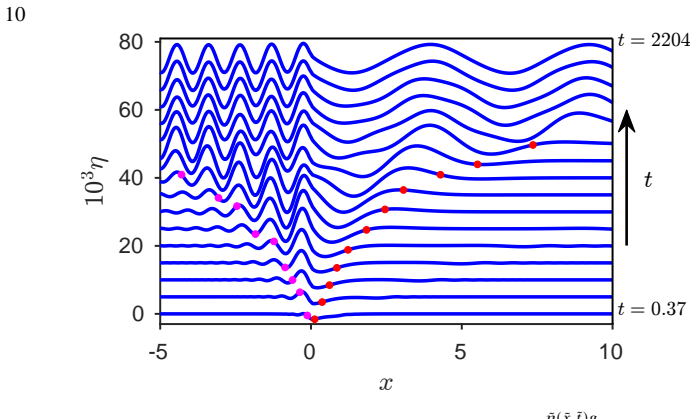
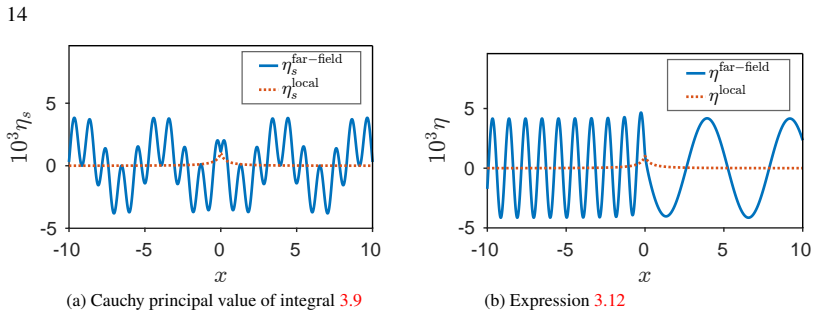
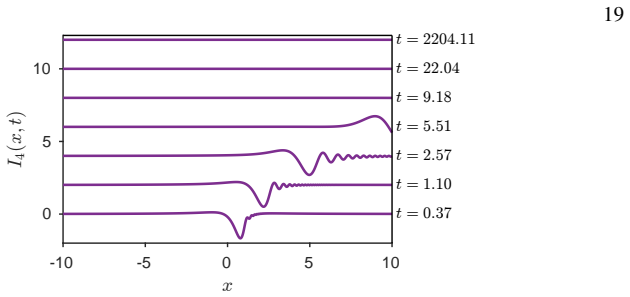
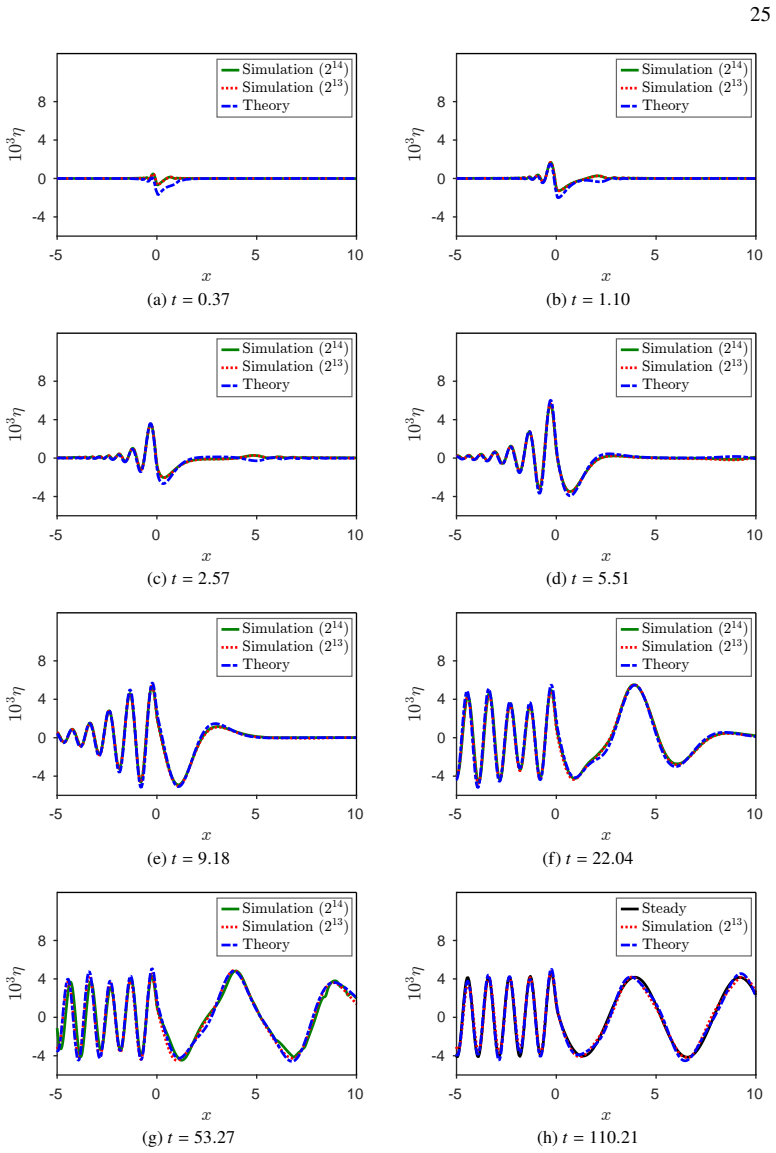
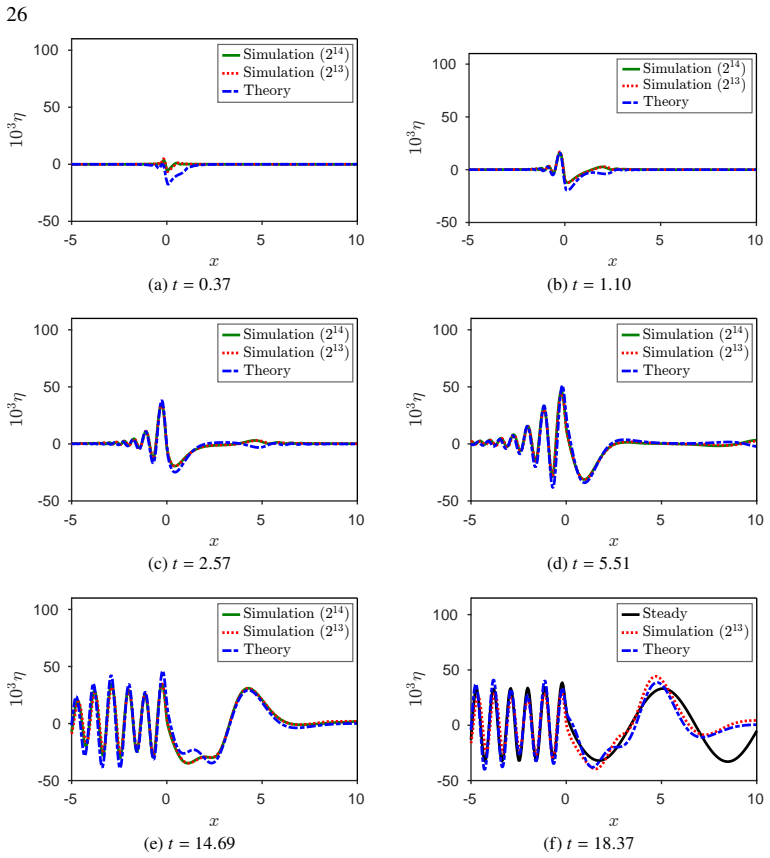
A localised overpressure translating uniformly above a critical speed across the interface between two deep fluid layers of different densities produces a steady-state interface containing short capillary waves ahead of the forcing and long gravity waves behind it. The pattern originates from asymmetric cancellation of Fourier components in the far field, with the algebraically decaying time-dependent part of the solution supplying the selection mechanism. This initial-value-problem treatment contrasts with classical steady formulations, which need extra conditions to pick a unique solution.
What carries the argument
The initial-value-problem formulation inside the linearised inviscid potential-flow framework, in which the algebraically decaying transient solution enforces asymmetric Fourier cancellation that fixes the far-field steady state.
Load-bearing premise
The linearised inviscid potential-flow model remains valid and the algebraically decaying time-dependent solution dominates the far-field cancellation.
What would settle it
If high-resolution simulations or laboratory experiments show either symmetric wave patterns on both sides of the forcing or no waves on one side despite supercritical translation speed, the claimed asymmetric cancellation would be falsified.
Figures





read the original abstract
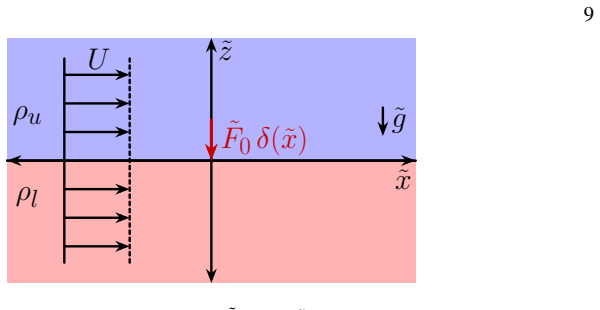
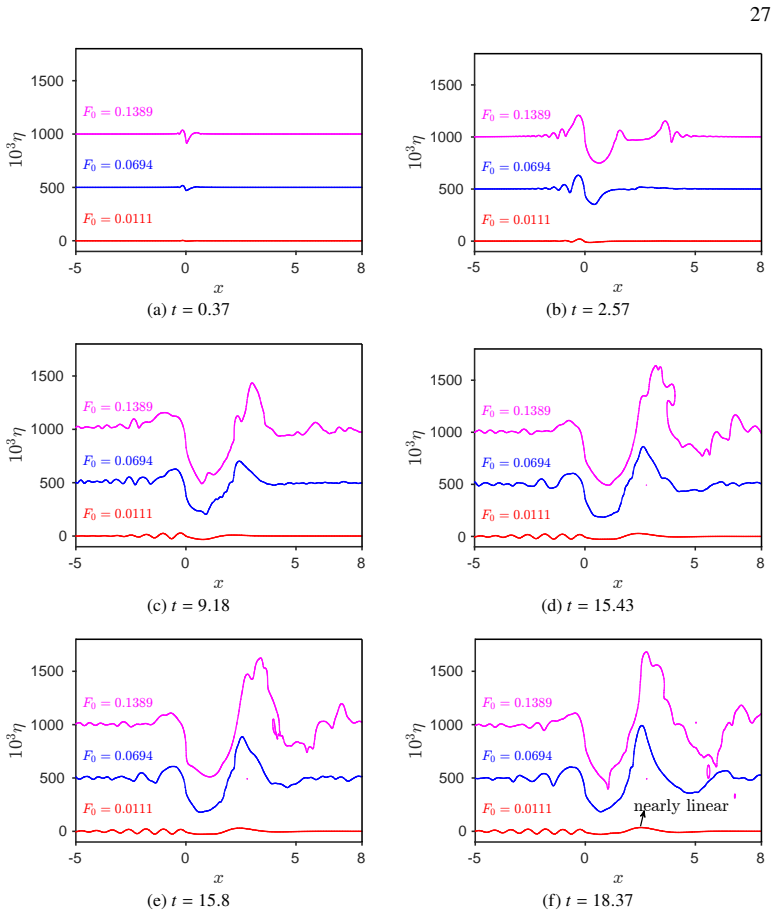
A localised overpressure translating at a uniform speed greater than a critical value acts at the interface between two deep fluid layers with different densities. We analyse the resulting wave patterns using an initial-value problem formulation within the linearised, inviscid, potential flow framework. The steady-state interface exhibits short capillary waves ahead of the forcing and long gravity waves behind it, arising from an asymmetric cancellation of Fourier components in the far field. The time-dependent part of the solution, decaying algebraically with time, plays a crucial role in this mechanism. This contrasts with classical steady approaches, which require additional conditions to select a unique solution. We extend this approach to a two-fluid interface and validate the predictions against nonlinear simulations.
Editorial analysis
A structured set of objections, weighed in public.
Referee Report
Summary. The paper formulates the problem of a localised overpressure translating at constant speed across the interface between two deep fluid layers of differing densities as an initial-value problem (IVP) within the linearised inviscid potential-flow framework. It claims that the resulting steady-state interface displacement exhibits short capillary waves ahead of the forcing and long gravity waves behind it, produced by an asymmetric cancellation of Fourier components in the far field; the algebraically decaying time-dependent solution is essential to this selection mechanism. The approach is contrasted with classical steady-state analyses that require auxiliary conditions, and the predictions are validated against nonlinear simulations for the two-fluid case.
Significance. If the central mechanism holds, the work supplies a natural, parameter-free explanation for far-field wave selection in forced interfacial problems without invoking radiation conditions or other ad-hoc constraints. The explicit role assigned to algebraically decaying transients and the direct comparison to nonlinear simulations constitute clear strengths. This perspective could clarify analogous selection issues in ship-wake and stratified-flow problems and may encourage wider use of IVP formulations for steady-state limits in potential-flow theory.
major comments (2)
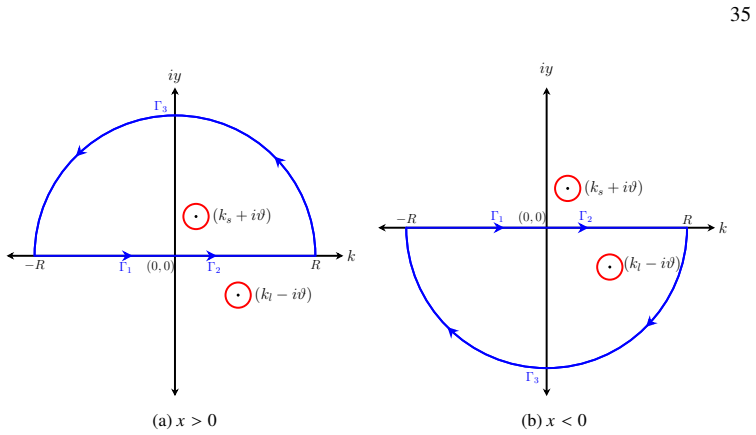
- [Fourier-analysis derivation (likely §3–4)] The asymmetric Fourier cancellation that selects capillary waves upstream and gravity waves downstream is the load-bearing step for the central claim. The manuscript should provide an explicit decomposition (e.g., contour integration or residue analysis) showing which poles or branches are retained or cancelled in each far-field region and how the algebraic time decay enforces the asymmetry; without this level of detail the mechanism remains plausible but not fully verified.
- [Two-fluid extension and numerical validation] The extension to the two-fluid interface and the comparison with nonlinear simulations are presented as validation, yet the linearised inviscid assumption is retained throughout. A quantitative assessment of the regime (e.g., Froude number, density ratio, and forcing amplitude) in which the algebraic transients dominate over viscous or nonlinear effects would strengthen the claim that the IVP mechanism survives in the nonlinear regime.
minor comments (2)
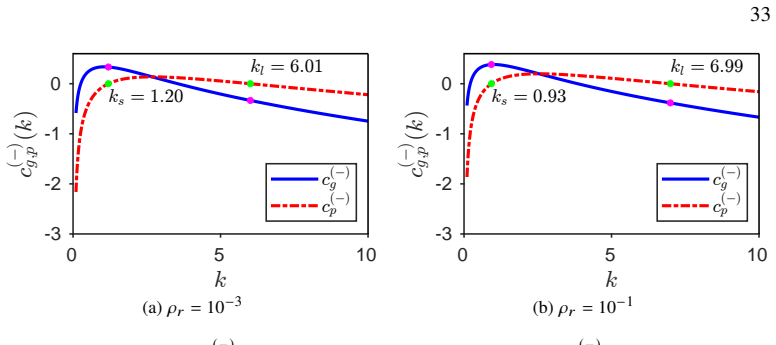
- [Introduction / setup] The critical speed separating sub- and super-critical regimes is invoked in the abstract but should be stated explicitly in terms of the dispersion relation and density ratio at the first appearance in the text.
- [Throughout] Notation for the interface displacement, pressure forcing, and Fourier transforms should be collected in a single table or consistently defined on first use to aid readability.
Simulated Author's Rebuttal
We thank the referee for the positive summary, the recommendation for minor revision, and the constructive comments that will improve the clarity and robustness of the manuscript. We address each major comment below.
read point-by-point responses
-
Referee: [Fourier-analysis derivation (likely §3–4)] The asymmetric Fourier cancellation that selects capillary waves upstream and gravity waves downstream is the load-bearing step for the central claim. The manuscript should provide an explicit decomposition (e.g., contour integration or residue analysis) showing which poles or branches are retained or cancelled in each far-field region and how the algebraic time decay enforces the asymmetry; without this level of detail the mechanism remains plausible but not fully verified.
Authors: We agree that an explicit contour-integration analysis would make the selection mechanism fully rigorous. In the revised manuscript we will add a dedicated subsection (in §3) that performs the far-field asymptotic analysis via contour integration in the complex wavenumber plane. This will identify the relevant poles for the capillary and gravity branches, show which residues are retained or cancelled in the upstream versus downstream regions, and demonstrate how the algebraically decaying time-dependent contribution enforces the asymmetry. revision: yes
-
Referee: [Two-fluid extension and numerical validation] The extension to the two-fluid interface and the comparison with nonlinear simulations are presented as validation, yet the linearised inviscid assumption is retained throughout. A quantitative assessment of the regime (e.g., Froude number, density ratio, and forcing amplitude) in which the algebraic transients dominate over viscous or nonlinear effects would strengthen the claim that the IVP mechanism survives in the nonlinear regime.
Authors: We appreciate this suggestion for strengthening the validation. In the revised version we will insert a quantitative discussion (in §5) that estimates the parameter regimes—expressed in terms of Froude number, density ratio, and forcing amplitude—where the linear IVP mechanism is expected to dominate before viscous or nonlinear effects become significant. The estimates will be supported by scaling arguments and direct reference to the existing nonlinear simulation results. revision: yes
Circularity Check
No significant circularity; derivation self-contained from standard IVP setup
full rationale
The paper sets up the problem directly from the linearised inviscid potential flow equations for two deep fluid layers as an initial-value problem (IVP). The steady-state far-field wave pattern (short capillary waves ahead, long gravity waves behind) is obtained via Fourier analysis of the governing equations, with the algebraically decaying time-dependent transients providing the asymmetric cancellation mechanism in the long-time limit. This is contrasted with classical steady-state approaches but does not rely on fitted parameters, self-definitional relations, or load-bearing self-citations for the core selection mechanism. Independent validation against nonlinear simulations further confirms the derivation remains non-circular and externally falsifiable.
Axiom & Free-Parameter Ledger
axioms (2)
- domain assumption Linearised, inviscid, potential flow for deep fluid layers with different densities
- domain assumption Pressure forcing translates at uniform speed greater than a critical value
Reference graph
Works this paper leans on
-
[1]
How does the wind generate waves? , author=. Physics Today , volume=. 2021 , publisher=
work page 2021
-
[2]
Generation of waves in the concurrent flow of air and a liquid , author=. AIChE Journal , volume=. 1965 , publisher=
work page 1965
-
[3]
International Journal of Multiphase Flow , volume=
Classification of instabilities in parallel two-phase flow , author=. International Journal of Multiphase Flow , volume=. 1996 , publisher=
work page 1996
-
[4]
Journal of fluid mechanics , volume=
Liquid jet eruption from hollow relaxation , author=. Journal of fluid mechanics , volume=. 2014 , publisher=
work page 2014
-
[5]
Resonantly forced gravity--capillary lumps on deep water. Part 1. Experiments , author=. Journal of fluid mechanics , volume=. 2011 , publisher=
work page 2011
-
[6]
Annual Review of Fluid Mechanics , volume=
Mass transfer at the ocean--atmosphere interface: the role of wave breaking, droplets, and bubbles , author=. Annual Review of Fluid Mechanics , volume=. 2022 , publisher=
work page 2022
-
[7]
Annual review of fluid mechanics , volume=
Mixing efficiency in stratified shear flows , author=. Annual review of fluid mechanics , volume=. 2003 , publisher=
work page 2003
-
[8]
Proceedings of the royal society of London
On the formation of water waves by wind , author=. Proceedings of the royal society of London. Series A, containing papers of a mathematical and physical character , volume=. 1925 , publisher=
work page 1925
-
[9]
Progress in oceanography , volume=
Wave modelling--the state of the art , author=. Progress in oceanography , volume=. 2007 , publisher=
work page 2007
-
[10]
Journal of Computational Physics , volume=
Progress in ocean wave forecasting , author=. Journal of Computational Physics , volume=. 2008 , publisher=
work page 2008
-
[11]
Annual Review of Fluid Mechanics , volume=
Internal gravity waves: from instabilities to turbulence , author=. Annual Review of Fluid Mechanics , volume=. 2002 , publisher=
work page 2002
-
[12]
Annual review of fluid mechanics , volume=
Breaking waves in deep and intermediate waters , author=. Annual review of fluid mechanics , volume=. 2013 , publisher=
work page 2013
-
[13]
Annual review of fluid mechanics , volume=
Internal waves in the ocean , author=. Annual review of fluid mechanics , volume=. 1979 , publisher=
work page 1979
-
[14]
Journal of Geophysical Research , volume=
The excitation, dissipation, and interaction of internal waves in the deep ocean , author=. Journal of Geophysical Research , volume=. 1975 , publisher=
work page 1975
-
[15]
Journal of Fluid Mechanics , volume=
On the stability of the asymptotic suction boundary-layer profile , author=. Journal of Fluid Mechanics , volume=. 1965 , publisher=
work page 1965
- [16]
-
[17]
Journal of Fluid Mechanics , volume=
Effect of wind profile on the instability of wind blowing over water , author=. Journal of Fluid Mechanics , volume=. 1993 , publisher=
work page 1993
- [18]
- [19]
-
[20]
John V. Wehausen and Edmund V. Laitone , title =. 1948 , howpublished =
work page 1948
- [21]
-
[22]
NIST handbook of mathematical functions cambridge university press , author=. New York , year=
-
[23]
Xliv. on waves due to a travelling disturbance, with an application to waves in superposed fluids , author=. The London, Edinburgh, and Dublin Philosophical Magazine and Journal of Science , volume=. 1916 , publisher=
work page 1916
-
[24]
Advanced mathematical methods for scientists and engineers , author=. 1978 , publisher=
work page 1978
- [25]
-
[26]
On the temporal linear stability of the asymptotic suction boundary layer , author=. Physics of Fluids , volume=. 2021 , publisher=
work page 2021
- [27]
-
[28]
Aerodynamic Theory: A General Review of Progress, Vol. 6 , author=. 1976 , publisher=
work page 1976
-
[29]
Oxford University Press, USA , pages=
Laminar boundary layers , author=. Oxford University Press, USA , pages=
- [30]
-
[31]
Journal of Fluid Mechanics , volume=
Surface waves in flowing water , author=. Journal of Fluid Mechanics , volume=. 1972 , publisher=
work page 1972
- [32]
-
[33]
Quarterly of Applied Mathematics , volume=
Some recent investigations in the theory of hydrodynamic stability , author=. Quarterly of Applied Mathematics , volume=
-
[34]
Journal of Fluid Mechanics , volume=
The barotropic stability of the mean winds in the atmosphere , author=. Journal of Fluid Mechanics , volume=. 1962 , publisher=
work page 1962
-
[35]
Journal of Mathematics and Physics , volume=
On instability of parallel flow of inviscid fluid in a rotating system with variable coriolis parameter journal of mathematics and physics , author=. Journal of Mathematics and Physics , volume=. 1964 , publisher=
work page 1964
-
[36]
Journal of Fluid Mechanics , volume=
Barotropic instability of the Bickley jet , author=. Journal of Fluid Mechanics , volume=. 1991 , publisher=
work page 1991
-
[37]
Journal of Fluid Mechanics , volume=
Surface waves on shear currents: solution of the boundary-value problem , author=. Journal of Fluid Mechanics , volume=. 1993 , publisher=
work page 1993
-
[38]
Journal of Fluid Mechanics , volume=
Weakly nonlinear analysis of wind-driven gravity waves , author=. Journal of Fluid Mechanics , volume=. 2004 , publisher=
work page 2004
-
[39]
Shear instability of fluid interfaces: Stability analysis , author=. Physical Review E , volume=. 2002 , publisher=
work page 2002
-
[40]
On the generation of surface waves by shear flows. Part 2 , author=. Journal of Fluid Mechanics , volume=. 1959 , publisher=
work page 1959
-
[41]
Journal of Fluid Mechanics , volume=
Parasitic capillary waves: a direct calculation , author=. Journal of Fluid Mechanics , volume=. 1995 , publisher=
work page 1995
-
[42]
Journal of Fluid Mechanics , volume=
The generation of capillary waves by steep gravity waves , author=. Journal of Fluid Mechanics , volume=. 1963 , publisher=
work page 1963
- [43]
-
[44]
Journal of Fluid Mechanics , volume=
On the generation of surface waves by shear flows , author=. Journal of Fluid Mechanics , volume=. 1957 , publisher=
work page 1957
-
[45]
Kelvin-Helmholtz instability , author=
On the generation of surface waves by shear flows Part 3. Kelvin-Helmholtz instability , author=. Journal of Fluid Mechanics , volume=. 1959 , publisher=
work page 1959
-
[46]
Journal of fluid mechanics , volume=
Generation of surface waves by shear-flow instability , author=. Journal of fluid mechanics , volume=. 2014 , publisher=
work page 2014
- [47]
-
[48]
David E. Müller , title =. Mathematical Tables and Other Aids to Computation , volume =
-
[49]
Journal of Atmospheric Sciences , volume=
The transition between Kelvin--Helmholtz and Holmboe instability: An investigation of the overreflection hypothesis , author=. Journal of Atmospheric Sciences , volume=
-
[50]
Physics of Fluids A: Fluid Dynamics , volume=
The stability of a sheared density interface , author=. Physics of Fluids A: Fluid Dynamics , volume=. 1991 , publisher=
work page 1991
-
[51]
Applied Mechanics Reviews , volume=
Instability in stratified shear flow: Review of a physical interpretation based on interacting waves , author=. Applied Mechanics Reviews , volume=. 2011 , publisher=
work page 2011
-
[52]
Identifying unstable modes in stratified shear layers , author=. Physics of Fluids , volume=. 2010 , publisher=
work page 2010
- [53]
-
[54]
Proceedings of the National Academy of Sciences , volume=
Some physical aspects of the stability of parallel flows , author=. Proceedings of the National Academy of Sciences , volume=
-
[55]
Ein allgemeines Kriterium der Instabilitat laminarer Gescgwindigkeits-verteilungen , author=. Nachr. Wiss Fachgruppe, G
-
[56]
Journal of Fluid Mechanics , volume=
Wind-generated waves on a water layer of finite depth , author=. Journal of Fluid Mechanics , volume=
-
[57]
Journal of Fluid Mechanics , volume=
Asymptotic interpretation of the Miles mechanism of wind-wave instability , author=. Journal of Fluid Mechanics , volume=. 2022 , publisher=
work page 2022
-
[58]
Journal of Physical Oceanography , volume=
A physical interpretation of the wind-wave instability as interacting waves , author=. Journal of Physical Oceanography , volume=
-
[59]
On the generation of surface waves by shear flows. Part 4 , author=. Journal of Fluid Mechanics , volume=. 1962 , publisher=
work page 1962
-
[60]
Proceedings of the Royal Society of London
Waves generated by shear layer instabilities , author=. Proceedings of the Royal Society of London. Series A: Mathematical and Physical Sciences , volume=. 1991 , publisher=
work page 1991
-
[61]
Capillary waves generated by a shear current in water , author=. Mem. Soc. R. Sci. Liege , volume=
-
[62]
Reviews of geophysics , volume=
Gravity wave dynamics and effects in the middle atmosphere , author=. Reviews of geophysics , volume=. 2003 , publisher=
work page 2003
-
[63]
Amplification of nonlinear surface waves by wind , author=. Physics of Fluids , volume=. 2007 , publisher=
work page 2007
-
[64]
Experimental and analytical study of the shear instability of a gas-liquid mixing layer , author=. Physics of fluids , volume=. 2011 , publisher=
work page 2011
-
[65]
Nonlinear Processes in Geophysics , volume=
Resurrecting dead-water phenomenon , author=. Nonlinear Processes in Geophysics , volume=. 2011 , publisher=
work page 2011
-
[66]
On the nonlinear evolution of wind-driven gravity waves , author=. Physics of Fluids , volume=. 2004 , publisher=
work page 2004
-
[67]
Journal of fluid mechanics , volume=
On the mechanism of shear flow instabilities , author=. Journal of fluid mechanics , volume=. 1994 , publisher=
work page 1994
-
[68]
Journal of Fluid Mechanics , volume=
The viscous Holmboe instability for smooth shear and density profiles , author=. Journal of Fluid Mechanics , volume=. 2020 , publisher=
work page 2020
-
[69]
Boundary-Layer Meteorology , volume=
Fine structure of laboratory wind-wave surfaces studied using an optical method , author=. Boundary-Layer Meteorology , volume=. 1987 , publisher=
work page 1987
-
[70]
Physical Processes in Lakes and Oceans , volume=
In search of Holmboe's instability , author=. Physical Processes in Lakes and Oceans , volume=. 1998 , publisher=
work page 1998
-
[71]
Journal of physical oceanography , volume=
Turbulence and mixing in Holmboe waves , author=. Journal of physical oceanography , volume=
-
[72]
Geofysiske Publikasjoner , volume=
On the behavior of symmetric waves in stratified shear layers , author=. Geofysiske Publikasjoner , volume=
-
[73]
Proceedings of the London Mathematical Society , volume=
On the stability or instability of certain fluid motions (iii.) , author=. Proceedings of the London Mathematical Society , volume=. 1895 , publisher=
-
[74]
Hydrokinetic solutions and observations , author=
XLVI. Hydrokinetic solutions and observations , author=. The London, Edinburgh, and Dublin Philosophical Magazine and Journal of Science , volume=. 1871 , publisher=
-
[75]
On discontinuous movements of fluids , author=
XLIII. On discontinuous movements of fluids , author=. The London, Edinburgh, and Dublin Philosophical Magazine and Journal of Science , volume=. 1868 , publisher=
-
[76]
Journal of Fluid Mechanics , volume=
Propagating Holmboe waves at the interface between two immiscible fluids , author=. Journal of Fluid Mechanics , volume=. 1994 , publisher=
work page 1994
-
[77]
Annual review of fluid mechanics , volume=
Critical layers in shear flows , author=. Annual review of fluid mechanics , volume=
-
[78]
Fluid Dynamics: Part 4: Hydrodynamic Stability Theory , author=. 2023 , publisher=
work page 2023
-
[79]
Proceedings of the Royal Society of London
On the stability of superposed streams of fluids of different densities , author=. Proceedings of the Royal Society of London. Series A, Containing Papers of a Mathematical and Physical Character , volume=. 1931 , publisher=
work page 1931
-
[80]
Proceedings of the Royal Society of London
Effect of variation in density on the stability of superposed streams of fluid , author=. Proceedings of the Royal Society of London. Series A, Containing Papers of a Mathematical and Physical Character , volume=. 1931 , publisher=
work page 1931
discussion (0)
Sign in with ORCID, Apple, or X to comment. Anyone can read and Pith papers without signing in.