Recognition: no theorem link
Probing charge noise in bilayer graphene quantum dots by Landau-Zener-St\"uckelberg-Majorana spectroscopy
Pith reviewed 2026-05-13 03:43 UTC · model grok-4.3
The pith
Bilayer graphene quantum dots exhibit charge noise of 0.5-0.9 neV/√Hz dominated by thermal or phonon sources rather than two-level fluctuators.
A machine-rendered reading of the paper's core claim, the machinery that carries it, and where it could break.
Core claim
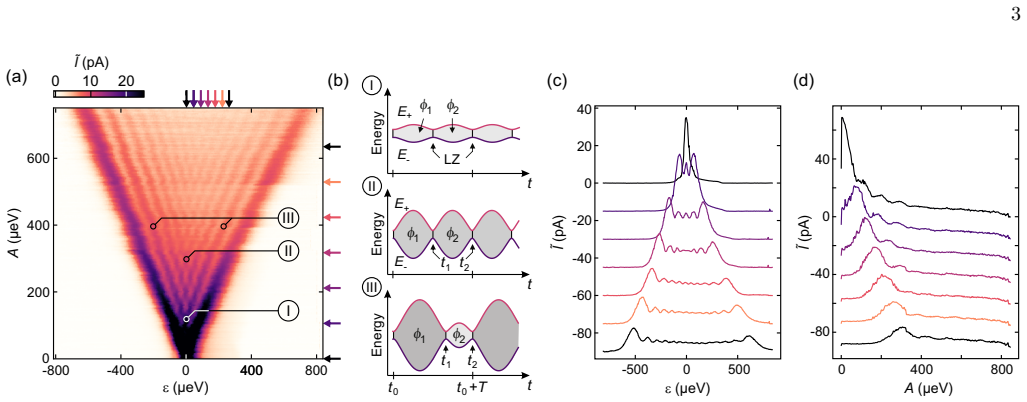
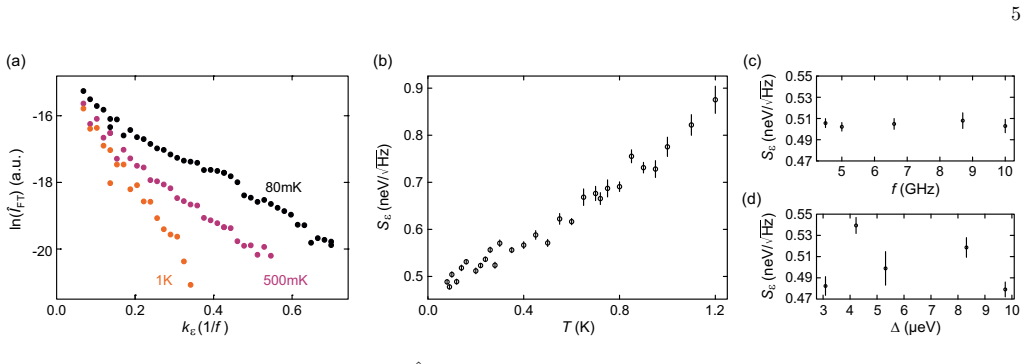
In a bilayer graphene double quantum dot, a single-particle charge qubit is formed and driven through avoided crossings at 5-10 GHz. Landau-Zener-Stückelberg-Majorana interference visibility is recorded and converted into a charge-noise spectral density S_ε of order 0.5-0.9 neV/√Hz. The dependence of decoherence on temperature and frequency shows that thermal (Johnson) noise or electron-phonon coupling dominates over two-level fluctuators.
What carries the argument
Landau-Zener-Stückelberg-Majorana interference spectroscopy on a charge qubit in a bilayer graphene double quantum dot, which converts measured visibility loss into a quantitative charge-noise spectral density S_ε.
If this is right
- The measured noise level is low enough to support coherent operation of spin- and valley-based qubits in bilayer graphene at levels already achieved in silicon and III-V platforms.
- Dominance of thermal or phonon contributions implies that further cooling or phonon engineering would directly improve qubit coherence times.
- Absence of dominant two-level fluctuators means charge noise in this system may be more predictable and tunable than in platforms where fluctuators set the floor.
- Frequency-dependent data provide a practical diagnostic for separating thermal, phonon, and fluctuator contributions in future quantum-dot devices.
Where Pith is reading between the lines
- Encapsulation or dielectric engineering that suppresses phonon coupling could lower the observed noise floor still further.
- The same LZSM protocol could be applied to other two-dimensional-material dots to generate a comparative map of high-frequency charge noise across van der Waals platforms.
- If thermal Johnson noise remains the leading term, improvements in cryogenics would produce larger coherence gains than attempts to eliminate fluctuators.
Load-bearing premise
The observed decoherence and interference visibility can be mapped directly to a single charge-noise spectral density using the standard LZSM model without significant contributions from other decoherence channels or experimental imperfections.
What would settle it
An independent measurement on the same device, such as Ramsey or echo spectroscopy at overlapping frequencies, that returns a noise density differing by more than a factor of two or that identifies two-level fluctuators as the dominant source.
Figures


read the original abstract
Charge noise is an important factor limiting qubit coherence and relaxation in solid-state devices. In bilayer graphene (BLG) quantum dots, recently established as a promising platform for spin- and valley-based qubits, both the origin and magnitude of charge noise remain largely unexplored. Here, we investigate high-frequency charge noise using Landau-Zener-St\"uckelberg-Majorana (LZSM) interference spectroscopy. We study a single-particle charge qubit formed in a BLG double quantum dot at frequencies between 5 and 10 GHz and extract a noise spectral density $S_\varepsilon$ on the order of 0.5-0.9 neV$/\sqrt{\mathrm{Hz}}$. This is comparable to values reported for III-V semiconductor platforms and silicon. From the temperature and frequency dependence of the charge qubit decoherence, we conclude that thermal (Johnson) noise or electron-phonon coupling dominates over two-level fluctuators.
Editorial analysis
A structured set of objections, weighed in public.
Referee Report
Summary. The paper claims to probe high-frequency charge noise in bilayer graphene double quantum dots via LZSM interference spectroscopy on a single-particle charge qubit. Measurements at 5-10 GHz yield an extracted noise spectral density S_ε of 0.5-0.9 neV/√Hz; temperature and frequency dependence of the decoherence then indicate dominance of thermal (Johnson) noise or electron-phonon coupling over two-level fluctuators.
Significance. If the quantitative mapping from LZSM visibility to S_ε holds, the work supplies the first reported high-frequency charge-noise benchmark for the BLG platform, with values comparable to III-V and Si systems. The explicit use of the standard LZSM phase-diffusion formula after subtracting measured relaxation times, together with temperature sweeps, strengthens the identification of the dominant noise mechanism and directly supports coherence-engineering efforts in graphene qubits.
minor comments (2)
- The methods section should include a brief explicit statement of how the relaxation times T1 are independently measured and subtracted before applying the phase-diffusion formula, to make the extraction of S_ε fully reproducible from the raw visibility data.
- Figure captions for the temperature- and frequency-dependent visibility plots would benefit from a short note on the fitting range and any constraints applied to the LZSM model parameters.
Simulated Author's Rebuttal
We thank the referee for the positive assessment of our manuscript and for recommending minor revision. The summary and significance statements accurately reflect the key results on high-frequency charge noise extraction in bilayer graphene quantum dots via LZSM spectroscopy, including the extracted S_ε values and the identification of dominant noise mechanisms.
Circularity Check
No significant circularity in the derivation chain
full rationale
The paper reports an experimental extraction of charge noise spectral density S_ε (0.5-0.9 neV/√Hz) from measured LZSM interference visibility in a bilayer graphene double quantum dot. The derivation applies the standard LZSM phase-diffusion model to raw visibility data across 5-10 GHz, with explicit temperature sweeps and frequency dependence used to distinguish thermal/Johnson or phonon noise from TLS. No equation reduces the reported S_ε value to a fitted input or prior result by construction, and no self-citation is invoked as a load-bearing uniqueness theorem or ansatz. The mapping from visibility to noise relies on independently measured relaxation times subtracted from the data, keeping the central claim self-contained against external benchmarks.
Axiom & Free-Parameter Ledger
axioms (2)
- domain assumption Standard LZSM theory accurately maps observed interference visibility to charge noise spectral density S_ε without significant corrections from other decoherence sources.
- domain assumption Temperature and frequency dependence of decoherence can be used to distinguish thermal/Johnson or electron-phonon noise from two-level fluctuator noise.
Reference graph
Works this paper leans on
-
[1]
L. D. Landau, On the theory of transfer of energy at collisions II, Physics of the Soviet Union2, 46 (1932)
work page 1932
-
[2]
Zener, Non-adiabatic crossing of energy levels, Proc
C. Zener, Non-adiabatic crossing of energy levels, Proc. R. Soc. London A137, 696 (1932)
work page 1932
-
[3]
E. C. G. St¨ uckelberg, Theorie der unelastischen st¨ oße zwischen atomen, Helvetica Physica Acta5, 369 (1932)
work page 1932
-
[4]
Majorana, Atomi orientati in campo magnetico vari- abile, Il Nuovo Cimento9, 43 (1932)
E. Majorana, Atomi orientati in campo magnetico vari- abile, Il Nuovo Cimento9, 43 (1932)
work page 1932
-
[5]
S. N. Shevchenko, S. Ashhab, and F. Nori, Lan- dau–Zener–St¨ uckelberg interferometry, Phys. Rep.492, 1 (2010)
work page 2010
-
[6]
W. D. Oliver, Y. Yu, J. C. Lee, K. K. Berggren, L. S. Levitov, and T. P. Orlando, Mach-Zehnder Interferome- try in a Strongly Driven Superconducting Qubit, Science 310, 1653 (2005)
work page 2005
-
[7]
M. Sillanp¨ a¨ a, T. Lehtinen, A. Paila, Y. Makhlin, and P. Hakonen, Continuous-Time Monitoring of Landau- Zener Interference in a Cooper-Pair Box, Phys. Rev. Lett. 96, 187002 (2006)
work page 2006
-
[8]
C. M. Wilson, G. Johansson, T. Duty, F. Persson, M. Sandberg, and P. Delsing, Dressed relaxation and de- phasing in a strongly driven two-level system, Phys. Rev. B81, 024520 (2010)
work page 2010
-
[9]
E. Dupont-Ferrier, B. Roche, B. Voisin, X. Jehl, R. Wac- quez, M. Vinet, M. Sanquer, and S. De Franceschi, Co- herent Coupling of Two Dopants in a Silicon Nanowire Probed by Landau-Zener-St¨ uckelberg Interferometry, Phys. Rev. Lett.110, 136802 (2013)
work page 2013
- [10]
-
[11]
J. R. Petta, H. Lu, and A. C. Gossard, A Coherent Beam Splitter for Electronic Spin States, Science327, 669 (2010)
work page 2010
-
[12]
J. Stehlik, Y. Dovzhenko, J. R. Petta, J. R. Johans- son, F. Nori, H. Lu, and A. C. Gossard, Landau-Zener- St¨ uckelberg interferometry of a single electron charge qubit, Phys. Rev. B86, 121303 (2012)
work page 2012
-
[13]
F. Forster, G. Petersen, S. Manus, P. H¨ anggi, D. Schuh, W. Wegscheider, S. Kohler, and S. Ludwig, Characteri- zation of Qubit Dephasing by Landau-Zener-St¨ uckelberg- Majorana Interferometry, Phys. Rev. Lett.112, 116803 (2014)
work page 2014
-
[14]
F. Forster, M. M¨ uhlbacher, R. Blattmann, D. Schuh, W. Wegscheider, S. Ludwig, and S. Kohler, Landau- Zener interference at bichromatic driving, Phys. Rev. B 92, 245422 (2015)
work page 2015
-
[15]
A. Chatterjee, S. N. Shevchenko, S. Barraud, R. M. Otxoa, F. Nori, J. J. L. Morton, and M. F. Gonzalez- Zalba, A silicon-based single-electron interferometer cou- pled to a fermionic sea, Phys. Rev. B97, 045405 (2018)
work page 2018
-
[16]
X. Mi, S. Kohler, and J. R. Petta, Landau-Zener interfer- ometry of valley-orbit states in Si/SiGe double quantum dots, Phys. Rev. B98, 161404 (2018)
work page 2018
-
[17]
D. Loss and D. P. DiVincenzo, Quantum computation with quantum dots, Phys. Rev. A57, 120 (1998)
work page 1998
-
[18]
J. R. Petta, A. C. Johnson, J. M. Taylor, E. A. Laird, A. Yacoby, M. D. Lukin, C. M. Marcus, M. P. Hanson, and A. C. Gossard, Coherent Manipulation of Coupled Electron Spins in Semiconductor Quantum Dots, Science 309, 2180 (2005)
work page 2005
-
[19]
O. E. Dial, M. D. Shulman, S. P. Harvey, H. Bluhm, V. Umansky, and A. Yacoby, Charge Noise Spectroscopy Using Coherent Exchange Oscillations in a Singlet- Triplet Qubit, Phys. Rev. Lett.110, 146804 (2013)
work page 2013
-
[20]
J. Yoneda, K. Takeda, T. Otsuka, T. Nakajima, M. R. Delbecq, G. Allison, T. Honda, T. Kodera, S. Oda, Y. Hoshi, N. Usami, K. M. Itoh, and S. Tarucha, A quantum-dot spin qubit with coherence limited by charge noise and fidelity higher than 99.9%, Nat. Nanotechnol. 13, 102 (2018)
work page 2018
-
[21]
B. Trauzettel, D. V. Bulaev, D. Loss, and G. Burkard, Spin qubits in graphene quantum dots, Nat. Phys.3, 192 (2007)
work page 2007
-
[22]
Y. Zhang, T.-T. Tang, C. Girit, Z. Hao, M. C. Martin, A. Zettl, M. F. Crommie, Y. R. Shen, and F. Wang, Direct observation of a widely tunable bandgap in bilayer graphene, Nature459, 820 (2009)
work page 2009
-
[23]
E. Icking, L. Banszerus, F. W¨ ortche, F. Volmer, P. Schmidt, C. Steiner, S. Engels, J. Hesselmann, M. Goldsche, K. Watanabe, T. Taniguchi, C. Volk, B. Beschoten, and C. Stampfer, Transport Spectroscopy of Ultraclean Tunable Band Gaps in Bilayer Graphene, Adv. Electron. Mater.8, 2200510 (2022)
work page 2022
-
[24]
L. Banszerus, B. Frohn, A. Epping, D. Neumaier, K. Watanabe, T. Taniguchi, and C. Stampfer, Gate- Defined Electron–Hole Double Dots in Bilayer Graphene, Nano Lett.18, 4785 (2018)
work page 2018
-
[25]
M. Eich, R. Pisoni, A. Pally, H. Overweg, A. Kurzmann, Y. Lee, P. Rickhaus, K. Watanabe, T. Taniguchi, K. En- sslin, and T. Ihn, Coupled Quantum Dots in Bilayer Graphene, Nano Lett.18, 5042 (2018)
work page 2018
-
[26]
M. Eich, F. Herman, R. Pisoni, H. Overweg, A. Kurz- mann, Y. Lee, P. Rickhaus, K. Watanabe, T. Taniguchi, M. Sigrist, T. Ihn, and K. Ensslin, Spin and Valley States in Gate-Defined Bilayer Graphene Quantum Dots, Phys. Rev. X8, 031023 (2018)
work page 2018
-
[27]
L. Banszerus, S. M¨ oller, C. Steiner, E. Icking, S. Trel- lenkamp, F. Lentz, K. Watanabe, T. Taniguchi, C. Volk, and C. Stampfer, Spin-valley coupling in single-electron bilayer graphene quantum dots, Nat. Commun.12, 5250 (2021)
work page 2021
-
[28]
A. Kurzmann, M. Eich, H. Overweg, M. Mangold, F. Her- man, P. Rickhaus, R. Pisoni, Y. Lee, R. Garreis, C. Tong, K. Watanabe, T. Taniguchi, K. Ensslin, and T. Ihn, Ex- cited States in Bilayer Graphene Quantum Dots, Phys. Rev. Lett.123, 026803 (2019)
work page 2019
-
[29]
S. M¨ oller, L. Banszerus, A. Knothe, C. Steiner, E. Icking, S. Trellenkamp, F. Lentz, K. Watanabe, T. Taniguchi, L. I. Glazman, V. I. Fal’ko, C. Volk, and C. Stampfer, Probing Two-Electron Multiplets in Bilayer Graphene Quantum Dots, Phys. Rev. Lett.127, 256802 (2021)
work page 2021
-
[30]
L. Banszerus, K. Hecker, S. M¨ oller, E. Icking, K. Watan- abe, T. Taniguchi, C. Volk, and C. Stampfer, Spin re- laxation in a single-electron graphene quantum dot, Nat. Commun.13, 3637 (2022)
work page 2022
-
[31]
L. M. G¨ achter, R. Garreis, J. D. Gerber, M. J. Ruckriegel, C. Tong, B. Kratochwil, F. K. de Vries, A. Kurzmann, K. Watanabe, T. Taniguchi, T. Ihn, K. Ensslin, and W. W. Huang, Single-Shot Spin Readout in Graphene Quantum Dots, PRX Quantum3, 020343 (2022)
work page 2022
-
[32]
L. Banszerus, K. Hecker, L. Wang, S. M¨ oller, K. Watan- abe, T. Taniguchi, G. Burkard, C. Volk, and C. Stampfer, Phonon-limited valley lifetimes in single-particle bilayer graphene quantum dots, Phys. Rev. B112, 035409 (2025)
work page 2025
-
[33]
A. O. Denisov, V. Reckova, S. Cances, M. J. Ruckriegel, M. Masseroni, C. Adam, C. Tong, J. D. Gerber, W. W. Huang, K. Watanabe, T. Taniguchi, T. Ihn, K. Ensslin, and H. Duprez, Spin–valley protected Kramers pair in bilayer graphene, Nat. Nanotechnol.20, 494 (2025)
work page 2025
-
[34]
L. Wang and G. Burkard, Valley relaxation in a single- electron bilayer graphene quantum dot, Phys. Rev. B 110, 035409 (2024)
work page 2024
-
[35]
L. Wang and G. Burkard, Spin relaxation in a single- electron bilayer graphene quantum dot, Phys. Rev. Res. 7, 043061 (2025)
work page 2025
- [36]
-
[37]
M. S. Rudner, A. V. Shytov, L. S. Levitov, D. M. Berns, W. D. Oliver, S. O. Valenzuela, and T. P. Orlando, Quantum Phase Tomography of a Strongly Driven Qubit, Phys. Rev. Lett.101, 190502 (2008)
work page 2008
-
[38]
O. V. Ivakhnenko, S. N. Shevchenko, and F. Nori, Nona- diabatic Landau–Zener–St¨ uckelberg–Majorana transi- tions, dynamics, and interference, Phys. Rep.995, 1 (2023)
work page 2023
-
[39]
E. J. Connors, J. Nelson, L. F. Edge, and J. M. Nichol, Charge-noise spectroscopy of Si/SiGe quantum dots via dynamically-decoupled exchange oscillations, Nat. Com- mun.13, 940 (2022)
work page 2022
-
[40]
K. D. Petersson, J. R. Petta, H. Lu, and A. C. Gossard, Quantum Coherence in a One-Electron Semiconductor 7 Charge Qubit, Phys. Rev. Lett.105, 246804 (2010)
work page 2010
-
[41]
L. Banszerus, A. Rothstein, T. Fabian, S. M¨ oller, E. Icking, S. Trellenkamp, F. Lentz, D. Neumaier, K. Watanabe, T. Taniguchi, F. Libisch, C. Volk, and C. Stampfer, Electron–Hole Crossover in Gate-Controlled Bilayer Graphene Quantum Dots, Nano Lett.20, 7709 (2020)
work page 2020
-
[42]
L. Banszerus, A. Rothstein, E. Icking, S. M¨ oller, K. Watanabe, T. Taniguchi, C. Stampfer, and C. Volk, Tunable interdot coupling in few-electron bilayer graphene double quantum dots, Appl. Phys. Lett.118, 103101 (2021)
work page 2021
-
[43]
L. Banszerus, S. M¨ oller, E. Icking, K. Watanabe, T. Taniguchi, C. Volk, and C. Stampfer, Single-Electron Double Quantum Dots in Bilayer Graphene, Nano Lett. 20, 2005 (2020)
work page 2005
-
[44]
T. Hayashi, T. Fujisawa, H. D. Cheong, Y. H. Jeong, and Y. Hirayama, Coherent Manipulation of Electronic States in a Double Quantum Dot, Phys. Rev. Lett.91, 226804 (2003)
work page 2003
- [45]
-
[46]
Y. Dovzhenko, J. Stehlik, K. D. Petersson, J. R. Petta, H. Lu, and A. C. Gossard, Nonadiabatic quantum control of a semiconductor charge qubit, Phys. Rev. B84, 161302 (2011)
work page 2011
-
[47]
T. H. Stoof and Yu. V. Nazarov, Time-dependent reso- nant tunneling via two discrete states, Phys. Rev. B53, 1050 (1996)
work page 1996
-
[48]
W. G. van der Wiel, S. De Franceschi, J. M. Elzerman, T. Fujisawa, S. Tarucha, and L. P. Kouwenhoven, Elec- tron transport through double quantum dots, Rev. Mod. Phys.75, 1 (2002)
work page 2002
-
[49]
Note, that in this reference, they refer toϕ 1 asζ 1 andϕ 2 asζ 2
-
[50]
M. F. Gonzalez-Zalba, S. N. Shevchenko, S. Barraud, J. R. Johansson, A. J. Ferguson, F. Nori, and A. C. Betz, Gate-Sensing Coherent Charge Oscillations in a Silicon Field-Effect Transistor, Nano Lett.16, 1614 (2016)
work page 2016
-
[51]
C. Buizert, F. H. L. Koppens, M. Pioro-Ladri` ere, H.- P. Tranitz, I. T. Vink, S. Tarucha, W. Wegscheider, and L. M. K. Vandersypen,InSituReduction of Charge Noise in GaAs/Al xGa1−xAs Schottky-Gated Devices, Phys. Rev. Lett.101, 226603 (2008)
work page 2008
-
[52]
E. J. Connors, J. J. Nelson, H. Qiao, L. F. Edge, and J. M. Nichol, Low-frequency charge noise in Si/SiGe quantum dots, Phys. Rev. B100, 165305 (2019)
work page 2019
-
[53]
U. G¨ ung¨ ord¨ u and J. P. Kestner, Indications of a soft cut- off frequency in the charge noise of a Si/SiGe quantum dot spin qubit, Phys. Rev. B99, 081301 (2019)
work page 2019
-
[54]
L. Petit, J. M. Boter, H. G. J. Eenink, G. Droulers, M. L. V. Tagliaferri, R. Li, D. P. Franke, K. J. Singh, J. S. Clarke, R. N. Schouten, V. V. Dobrovitski, L. M. K. Van- dersypen, and M. Veldhorst, Spin Lifetime and Charge Noise in Hot Silicon Quantum Dot Qubits, Phys. Rev. Lett.121, 076801 (2018)
work page 2018
- [55]
- [56]
-
[57]
T. Fujisawa and Y. Hirayama, Charge noise analysis of an AlGaAs/GaAs quantum dot using transmission- type radio-frequency single-electron transistor technique, Appl. Phys. Lett.77, 543 (2000)
work page 2000
-
[58]
O. Astafiev, Yu. A. Pashkin, Y. Nakamura, T. Ya- mamoto, and J. S. Tsai, Quantum Noise in the Josephson Charge Qubit, Phys. Rev. Lett.93, 267007 (2004)
work page 2004
-
[59]
W. Albrecht, J. Moers, and B. Hermanns, HNF - Helmholtz Nano Facility, Journal of Large-Scale Research Facilities3, 112 (2017)
work page 2017
discussion (0)
Sign in with ORCID, Apple, or X to comment. Anyone can read and Pith papers without signing in.