Recognition: 2 theorem links
· Lean TheoremA New Look at the X Compositeness from its Lineshape
Pith reviewed 2026-05-13 03:47 UTC · model grok-4.3
The pith
A lineshape parametrization with an auxiliary X field consistently describes molecular states, as shown by deuteron scattering data.
A machine-rendered reading of the paper's core claim, the machinery that carries it, and where it could break.
Core claim
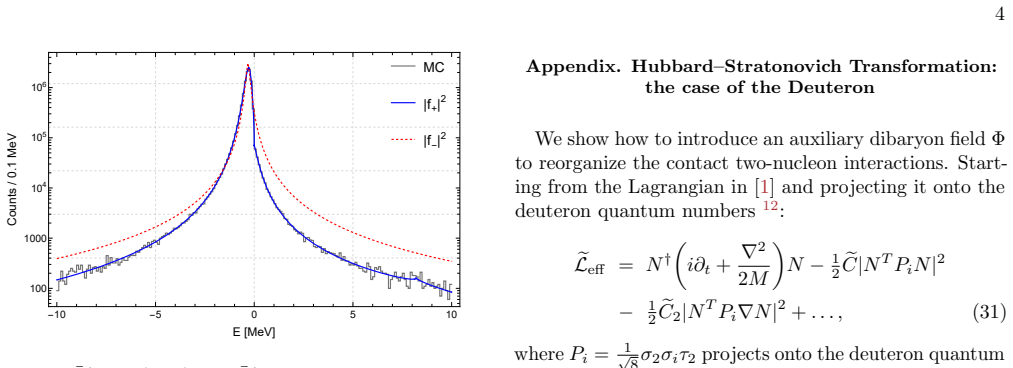
In an effective theory where the X(3872) is introduced only as an auxiliary field for a molecular bound state of D and Dbar*, the resulting lineshape parametrization differs from the Flatté form and provides a fully consistent description of scattering data when tested in the analogous nucleon-deuteron system with an auxiliary deuteron field.
What carries the argument
Effective Lagrangian with auxiliary, unphysical X field for the molecular bound state, which generates a lineshape parametrization distinct from the one obtained when X is treated as elementary.
If this is right
- The molecular hypothesis for X(3872) can be tested with a parametrization that does not presuppose an elementary X field.
- Re-analysis of current X(3872) data with the auxiliary-field form may alter conclusions about its compositeness.
- If the parametrization describes the X lineshape as well as it does the deuteron case, the molecular interpretation gains support from scattering consistency.
- The distinction between auxiliary and elementary treatments becomes the key observable discriminator between molecular and compact pictures.
Where Pith is reading between the lines
- Similar auxiliary-field methods could be applied to other near-threshold exotic candidates such as the Zc or Zb states to check for consistent molecular signatures.
- High-precision lineshape data from future experiments could distinguish the two parametrizations even if both can be tuned to low-statistics samples.
- The approach highlights that effective-theory consistency with scattering data, rather than lineshape shape alone, is the proper test of compositeness.
Load-bearing premise
The lineshape parametrization derived for the nucleon-deuteron system with auxiliary deuteron transfers directly to the D-D* system of the X(3872) without further adjustments for mass scales or interaction details.
What would settle it
A fit of the auxiliary-field parametrization to existing X(3872) lineshape data that fails to reproduce the observed distribution or yields parameters incompatible with the molecular binding picture.
Figures
read the original abstract
The existing analyses on the X(3872) lineshape are consistent with the hypothesis that it is a compact particle composed of four quarks. This conclusion follows from fitting available data with a Flatte' distribution derived from an effective Lagrangian in which X, D, and D* are all elementary fields. A molecular X, i.e., a deuteron-like bound state of D and Dbar*, must instead be described by an effective theory where the X field is initially absent or introduced as an auxiliary, unphysical, field, yielding a lineshape parametrization that differs significantly from the Flatte' one. We demonstrate, in the analogous theory of nucleons with an auxiliary deuteron field, that this parametrization gives a fully consistent description of np--> deuteron --> np scattering data, and motivate applying the same method to the X lineshape.
Editorial analysis
A structured set of objections, weighed in public.
Referee Report
Summary. The manuscript argues that existing X(3872) lineshape analyses using the Flatté distribution assume elementary fields for X, D and D*, consistent with a compact tetraquark interpretation. For a molecular (deuteron-like) state, an effective theory with an auxiliary unphysical X field instead yields a distinct lineshape parametrization. The authors validate this approach in the analogous nucleon-deuteron system by showing consistency with np → deuteron → np scattering data and motivate its direct application to X(3872) data.
Significance. If the parametrization is transferable and produces measurably different predictions, the work could enable a data-driven distinction between molecular and compact interpretations of X(3872) without relying solely on Flatté fits. The explicit validation against independent np scattering data is a clear strength, as it provides an external consistency check that avoids circularity with X(3872) observations.
major comments (1)
- [Abstract] Abstract and the motivation section: the central claim that the deuteron-derived parametrization applies without modification to the X(3872) DD* system is load-bearing for the paper's motivation, yet the manuscript provides no explicit re-derivation or power-counting analysis accounting for the orders-of-magnitude difference in binding energy (≪0.1 MeV vs. 2.2 MeV) and reduced mass (~940 MeV vs. ~470 MeV). This leaves open whether additional momentum-dependent operators or relativistic corrections, negligible for the deuteron, become O(1) near the DD* threshold and alter the functional form of the lineshape.
Simulated Author's Rebuttal
We thank the referee for the careful reading and constructive feedback on our manuscript. We address the major comment point by point below, providing a substantive response while agreeing to strengthen the discussion of applicability.
read point-by-point responses
-
Referee: [Abstract] Abstract and the motivation section: the central claim that the deuteron-derived parametrization applies without modification to the X(3872) DD* system is load-bearing for the paper's motivation, yet the manuscript provides no explicit re-derivation or power-counting analysis accounting for the orders-of-magnitude difference in binding energy (≪0.1 MeV vs. 2.2 MeV) and reduced mass (~940 MeV vs. ~470 MeV). This leaves open whether additional momentum-dependent operators or relativistic corrections, negligible for the deuteron, become O(1) near the DD* threshold and alter the functional form of the lineshape.
Authors: We thank the referee for highlighting this important point. The effective theory with an auxiliary composite field is constructed in the non-relativistic limit for both systems, and the leading-order lineshape follows from the same Lagrangian structure (contact interactions plus the auxiliary field propagator). The scale differences actually reinforce applicability to X(3872): the typical momentum is p_X ≈ √(2μB) ≲ 13 MeV (using B ≪ 0.1 MeV and μ ≈ 940 MeV), versus p_d ≈ 45 MeV for the deuteron. Consequently, relativistic corrections (∼ p²/m²) and higher-order momentum-dependent operators (∼ (p/Λ)², with Λ set by m_π or the inverse interaction range) are more strongly suppressed than in the deuteron case. We will add a concise power-counting paragraph to the motivation section that explicitly compares these scales, shows that the functional form of the lineshape is unchanged at leading order, and notes that any residual scale dependence is absorbed into the low-energy constants fitted to data. This revision directly addresses the concern while preserving the central claim. revision: yes
Circularity Check
No circularity: validation uses independent external data and the X application is an unforced analogy
full rationale
The paper's core chain is: (1) contrast the elementary-field Flatté Lagrangian with an auxiliary-field EFT for a molecular state, (2) validate the auxiliary parametrization on np→deuteron→np scattering using external nuclear data, (3) motivate the same functional form for the X lineshape. Step (2) is benchmarked against independent experimental input that does not involve X(3872) parameters or fits. No equation is shown to equal its own input by construction, no fitted X parameter is relabeled as a prediction, and no load-bearing uniqueness theorem or ansatz is imported via self-citation. The transfer assumption to the X system is an analogy whose validity can be tested externally; it does not reduce the claimed lineshape difference to a tautology. The derivation therefore remains self-contained against external benchmarks.
Axiom & Free-Parameter Ledger
axioms (2)
- domain assumption Effective field theories with auxiliary fields correctly describe molecular bound states when the physical field is omitted or introduced as unphysical
- ad hoc to paper The lineshape parametrization derived for the deuteron system applies without modification to the X(3872) D D* system
invented entities (1)
-
auxiliary unphysical X field
no independent evidence
Lean theorems connected to this paper
-
IndisputableMonolith/Cost/FunctionalEquation.leanwashburn_uniqueness_aczel unclear?
unclearRelation between the paper passage and the cited Recognition theorem.
Leff = N†(i∂t + ∇²/2M)N + σ Φ†(i∂t + ∇²/4M − Δ)Φ − (y Φ† N N + h.c.) − ½ C (N†N)² + … with σ = −1
-
IndisputableMonolith/Foundation/ArithmeticFromLogic.leanembed_injective unclear?
unclearRelation between the paper passage and the cited Recognition theorem.
f+ ≡ my²/2π / (E−Δ − i my²/2π [√(2mE) + i √(−2m(E−δ))] − i Γr/2)
What do these tags mean?
- matches
- The paper's claim is directly supported by a theorem in the formal canon.
- supports
- The theorem supports part of the paper's argument, but the paper may add assumptions or extra steps.
- extends
- The paper goes beyond the formal theorem; the theorem is a base layer rather than the whole result.
- uses
- The paper appears to rely on the theorem as machinery.
- contradicts
- The paper's claim conflicts with a theorem or certificate in the canon.
- unclear
- Pith found a possible connection, but the passage is too broad, indirect, or ambiguous to say the theorem truly supports the claim.
Reference graph
Works this paper leans on
-
[1]
More Effective Field Theory for Nonrelativistic Scattering
David B. Kaplan, “More effective field theory for nonrela- tivistic scattering,” Nucl. Phys. B494, 471–484 (1997), arXiv:nucl-th/9610052
work page Pith review arXiv 1997
-
[2]
Small Binding Energies in Quan- tum Field Theory,
Lev Davidovich Landau, “Small Binding Energies in Quan- tum Field Theory,” J. Exp. Theor. Phys.39(1960), 10.1016/b978-0-08-010586-4.50104-8
-
[3]
Evidence That the Deuteron Is Not an Elementary Particle,
Steven Weinberg, “Evidence That the Deuteron Is Not an Elementary Particle,” Phys. Rev.137, B672–B678 (1965)
work page 1965
-
[4]
Normalization of the deuteron wave function,
Ya. A. Smorodinsky, “Normalization of the deuteron wave function,” Dokl.Akad.Nauk SSSR.60, 217 (1948)
work page 1948
-
[5]
L. D. Landau and E. M. Lifshitz,Quantum Mechanichs, Vol. 3(Butterworth, 2003)
work page 2003
-
[6]
Theory of the Effective Range in Nuclear Scattering,
H. A. Bethe, “Theory of the Effective Range in Nuclear Scattering,” Phys.Rev.76, 38 (1949)
work page 1949
-
[7]
From the line shape of the X(3872) to its structure,
Angelo Esposito, Luciano Maiani, Alessandro Pilloni, An- tonio D. Polosa, and Veronica Riquer, “From the line shape of the X(3872) to its structure,” Phys. Rev. D105, L031503 (2022), arXiv:2108.11413 [hep-ph]
-
[8]
The role of the pion in the lineshape of the X(3872),
Angelo Esposito, Davide Germani, Alfredo Glioti, Anto- nio D. Polosa, Riccardo Rattazzi, and Michele Tarquini, “The role of the pion in the lineshape of the X(3872),” Phys. Lett. B847, 138285 (2023), arXiv:2307.11400 [hep- ph]
-
[9]
Study of the lineshape of the χc1(3872) state,
R. Aaijet al.(LHCb), “Study of the lineshape of the χc1(3872) state,” Phys. Rev. D102, 092005 (2020), arXiv:2005.13419 [hep-ex]
-
[10]
Effective range expansion for narrow near-threshold resonances,
Vadim Baru, Xiang-Kun Dong, Meng-Lin Du, Ar- seniy Filin, Feng-Kun Guo, Christoph Hanhart, Alexey Nefediev, Juan Nieves, and Qian Wang, “Effective range expansion for narrow near-threshold resonances,” Phys. Lett. B833, 137290 (2022), arXiv:2110.07484 [hep-ph]
-
[11]
A. D. Polosa, “Constraints from precision measure- ments on the hadron-molecule interpretation of X , Y , Z resonances,” Phys. Lett. B746, 248–250 (2015), arXiv:1505.03083 [hep-ph]
- [12]
-
[13]
Luciano Maiani, Antonio D. Polosa, and Veronica Riquer, “Hydrogen bond of QCD,” Phys. Rev. D100, 014002 (2019), arXiv:1903.10253 [hep-ph]
-
[14]
Hydrogen bond of QCD in doubly heavy baryons and tetraquarks,
Luciano Maiani, Antonio D. Polosa, and Veronica Ri- quer, “Hydrogen bond of QCD in doubly heavy baryons and tetraquarks,” Phys. Rev. D100, 074002 (2019), arXiv:1908.03244 [hep-ph]
-
[15]
Doubly heavy tetraquarks in the Born-Oppenheimer approximation,
Luciano Maiani, Alessandro Pilloni, Antonio D. Polosa, and Veronica Riquer, “Doubly heavy tetraquarks in the Born-Oppenheimer approximation,” Phys. Lett. B836, 137624 (2023), arXiv:2208.02730 [hep-ph]
-
[16]
Tetraquarks in the Born-Oppenheimer ap- proximation,
Davide Germani, Benjamin Grinstein, and Antonio Da- vide Polosa, “Tetraquarks in the Born-Oppenheimer ap- proximation,” JHEP04, 004 (2025), arXiv:2501.13249 [hep-ph]
-
[17]
Tetraquarks at large M and large N,
H´ elo¨ ıse Allaman, Majid Ekhterachian, Filippo Nardi, Ric- cardo Rattazzi, and Stefan Stelzl, “Tetraquarks at large M and large N,” JHEP11, 034 (2024), arXiv:2407.18298 [hep-ph]
-
[18]
Matthias Berwein, Nora Brambilla, Abhishek Mohap- atra, and Antonio Vairo, “Hybrids, tetraquarks, pen- taquarks, doubly heavy baryons, and quarkonia in Born- Oppenheimer effective theory,” Phys. Rev. D110, 094040 (2024), arXiv:2408.04719 [hep-ph]
-
[19]
Nature of χc1(3872) and T + cc(3875),
Nora Brambilla, Abhishek Mohapatra, Tommaso Scirpa, and Antonio Vairo, “Nature of χc1(3872) and T + cc(3875),” Phys. Rev. Lett.135, 131902 (2025), arXiv:2411.14306 [hep-ph]
-
[20]
Exotic Hidden- heavy Hadrons and Where to Find Them,
Eric Braaten and Roberto Bruschini, “Exotic Hidden- heavy Hadrons and Where to Find Them,” (2024), arXiv:2409.08002 [hep-ph]
discussion (0)
Sign in with ORCID, Apple, or X to comment. Anyone can read and Pith papers without signing in.