Recognition: 1 theorem link
· Lean TheoremMagnon polaritons in a van der Waals ferromagnet coupled to a superconducting resonator
Pith reviewed 2026-05-13 03:31 UTC · model grok-4.3
The pith
Magnon-photon hybridization is achieved in 30-nm-thick flakes of the van der Waals ferromagnet Cr₂Ge₂Te₆ by coupling to a superconducting resonator.
A machine-rendered reading of the paper's core claim, the machinery that carries it, and where it could break.
Core claim
Magnon polaritons are formed by strong coupling between magnons in exfoliated Cr₂Ge₂Te₆ flakes and photons confined in a low-impedance superconducting resonator, with the hybridization appearing as reproducible avoided crossings in the transmission spectra for thicknesses down to 30 nm. The extracted coupling rate scales as the square root of thickness, consistent with the reduced magnetic moment volume, and the linear extrapolation of this trend places the monolayer regime within experimental reach.
What carries the argument
Avoided crossings in the microwave resonator transmission spectrum that arise from coherent magnon-photon coupling, with the low-impedance resonator design providing the necessary field enhancement to overcome the small magnetic volume of the thin flakes.
If this is right
- Coupling strength can be tuned by changing flake thickness while preserving the hybrid character.
- The same resonator design can be used with other van der Waals magnets to test hybridization in different materials.
- Reaching the monolayer limit would allow magnon polaritons in truly two-dimensional magnetic systems.
- Integration with superconducting circuits becomes feasible for thin-flake magnetic devices.
Where Pith is reading between the lines
- Devices combining 2D magnets and superconducting resonators could enable coherent microwave control of spins at the atomic scale.
- The thickness scaling provides a direct experimental knob for testing models of magnon-photon coupling in the ultrathin limit.
- Similar avoided-crossing signatures might appear in heterostructures where the van der Waals magnet is stacked with other 2D materials.
Load-bearing premise
The observed avoided crossings result only from magnon-photon interaction and are not produced by other resonances, losses, or fabrication effects in the thin flakes.
What would settle it
Replacing the magnetic flake with a non-magnetic material of identical thickness and geometry while keeping the same resonator and measurement conditions, then checking whether the avoided crossing disappears.
Figures


read the original abstract
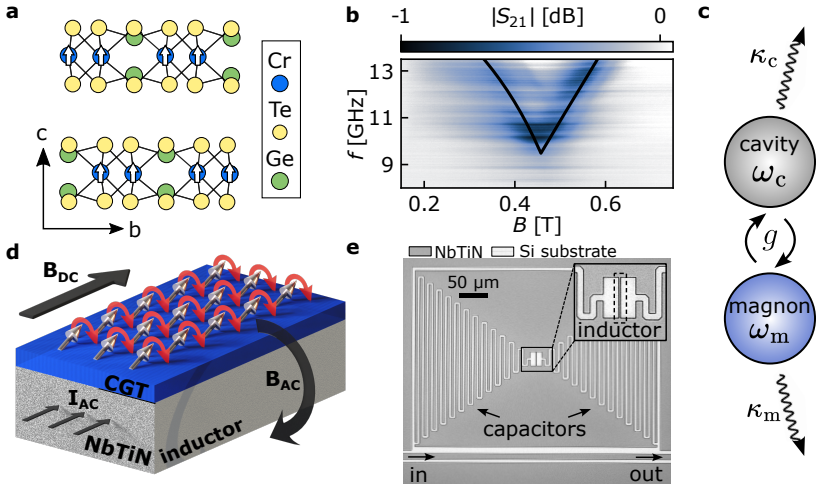
Achieving magnon-photon hybridization in the microwave regime is essential for integrating magnetic excitations with superconducting circuits. While this has been extensively demonstrated in bulk magnetic systems, realizing it in two-dimensional van der Waals materials remains challenging due to their reduced magnetic volume and increased dissipation. Here, magnon-photon hybridization is observed in exfoliated flakes of the van der Waals ferromagnet Cr$_2$Ge$_2$Te$_6$, with thicknesses down to 30 nm. The resulting magnon polaritons-hybrid excitations of cavity photons and magnons-are evidenced by reproducible avoided crossings across six devices, enabled by a low-impedance superconducting resonator design. The coupling strength follows the expected square-root dependence on thickness, and extrapolation of this scaling indicates that hybridization in the monolayer limit is within reach.
Editorial analysis
A structured set of objections, weighed in public.
Referee Report
Summary. The paper reports experimental observation of magnon-photon hybridization in exfoliated flakes of the van der Waals ferromagnet Cr₂Ge₂Te₆ down to 30 nm thickness. Hybridization is evidenced by reproducible avoided crossings in the microwave spectra of six devices fabricated with a low-impedance superconducting resonator; the extracted coupling strength scales as the square root of flake thickness, consistent with volume-dependent magnon-photon coupling, and extrapolation suggests monolayer hybridization may be feasible.
Significance. If the avoided crossings are confirmed to arise from coherent magnon-photon interaction, this constitutes a notable advance in hybrid quantum systems by demonstrating magnon polaritons in the 2D van der Waals limit, where magnetic volume is minimal. The low-impedance resonator approach is a practical technical contribution that enhances coupling efficiency, and the reproducibility across multiple devices plus the observed sqrt(thickness) scaling are positive indicators of robustness.
major comments (2)
- [Results (avoided crossings and thickness scaling)] Results section (avoided-crossing spectra and scaling analysis): the manuscript attributes the observed splittings to magnon polaritons on the basis of reproducibility and sqrt(thickness) dependence, but does not present data or controls that exclude alternative explanations such as dielectric resonances, strain-induced modes, or superconducting vortex features whose frequencies could also track the applied field. This is load-bearing for the central claim because the scaling alone is expected for any volume-proportional resonance and does not uniquely identify magnons.
- [Methods and supplementary information] Experimental methods and supplementary spectra: full raw transmission data, error bars on the extracted gap sizes, and quantitative fits to a coupled-oscillator model (including dissipation rates) are not provided for all six devices. Without these, it is difficult to assess whether the reported avoided crossings exceed the linewidths sufficiently to confirm strong coupling rather than weak or incoherent effects.
minor comments (2)
- [Abstract] The abstract and introduction would benefit from a brief statement of the resonator frequency and the magnetic-field range over which the crossings are observed, to allow immediate comparison with prior bulk magnon-polariton work.
- [Figure captions] Figure captions should explicitly note the number of devices and thicknesses shown in each panel to improve traceability of the reproducibility claim.
Simulated Author's Rebuttal
We thank the referee for their positive assessment of the significance of our results and for the constructive comments, which have helped us strengthen the manuscript. We address each major comment below and have revised the manuscript and supplementary information accordingly.
read point-by-point responses
-
Referee: [Results (avoided crossings and thickness scaling)] Results section (avoided-crossing spectra and scaling analysis): the manuscript attributes the observed splittings to magnon polaritons on the basis of reproducibility and sqrt(thickness) dependence, but does not present data or controls that exclude alternative explanations such as dielectric resonances, strain-induced modes, or superconducting vortex features whose frequencies could also track the applied field. This is load-bearing for the central claim because the scaling alone is expected for any volume-proportional resonance and does not uniquely identify magnons.
Authors: We agree that the sqrt(thickness) scaling by itself is not unique to magnons. However, the resonance frequencies display a magnetic-field dependence that quantitatively matches the Kittel formula for thin-film ferromagnets, f = (γ/2π)√[B(B + μ₀M_s)], with the known saturation magnetization of Cr₂Ge₂Te₆; this functional form is not expected for dielectric or strain-induced resonances. Superconducting vortex modes are further inconsistent with the observed temperature dependence and the absence of hysteresis in the spectra. We have added a dedicated paragraph in the revised Results section and a new Supplementary Note that explicitly discusses these alternatives and shows why they are ruled out by the field and temperature dependence. We have also included additional control spectra taken on bare resonators and on non-magnetic flakes. revision: partial
-
Referee: [Methods and supplementary information] Experimental methods and supplementary spectra: full raw transmission data, error bars on the extracted gap sizes, and quantitative fits to a coupled-oscillator model (including dissipation rates) are not provided for all six devices. Without these, it is difficult to assess whether the reported avoided crossings exceed the linewidths sufficiently to confirm strong coupling rather than weak or incoherent effects.
Authors: We acknowledge that the original submission did not include the complete raw data set or the full set of coupled-oscillator fits. In the revised supplementary information we now provide (i) the full raw transmission spectra for all six devices, (ii) the extracted avoided-crossing gaps with statistical error bars obtained from multiple field sweeps, and (iii) quantitative fits to the two-mode coupled-oscillator Hamiltonian that explicitly report both the coupling strength g and the photon and magnon dissipation rates κ_ph and κ_m. These fits confirm g > (κ_ph + κ_m)/2 for every device, placing the system in the strong-coupling regime. We have also added a brief description of the fitting procedure in the Methods section. revision: yes
Circularity Check
No significant circularity; experimental claims rest on direct spectral observations rather than self-referential derivations.
full rationale
The paper reports experimental observation of avoided crossings in six devices fabricated from Cr2Ge2Te6 flakes coupled to a superconducting resonator, with coupling strength scaling as the square root of thickness. This scaling is stated as 'expected' from prior theory and is not derived or fitted within the paper's own equations to force the result. No self-definitional loops, fitted inputs renamed as predictions, or load-bearing self-citations appear in the abstract or described claims. The central evidence is reproducibility of spectral features across devices, which is independent of any internal derivation chain. The interpretation of these features as magnon polaritons is subject to possible alternative explanations (as noted by the skeptic), but that is a question of experimental controls and not circularity in the derivation.
Axiom & Free-Parameter Ledger
axioms (1)
- standard math Standard electromagnetic coupling theory predicts square-root dependence of magnon-photon coupling on magnetic volume (thickness).
Lean theorems connected to this paper
-
IndisputableMonolith/Foundation/RealityFromDistinction.leanreality_from_one_distinction unclear?
unclearRelation between the paper passage and the cited Recognition theorem.
The coupling strength follows the expected square-root dependence on thickness... hybridization is observed... avoided crossings across six devices
What do these tags mean?
- matches
- The paper's claim is directly supported by a theorem in the formal canon.
- supports
- The theorem supports part of the paper's argument, but the paper may add assumptions or extra steps.
- extends
- The paper goes beyond the formal theorem; the theorem is a base layer rather than the whole result.
- uses
- The paper appears to rely on the theorem as machinery.
- contradicts
- The paper's claim conflicts with a theorem or certificate in the canon.
- unclear
- Pith found a possible connection, but the passage is too broad, indirect, or ambiguous to say the theorem truly supports the claim.
Reference graph
Works this paper leans on
-
[1]
L. McKenzie-Sell, J. Xie, C.-M. Lee, J. W. A. Robinson, C. Ciccarelli, J. A. Haigh,Phys. Rev. B 2019,99140414
work page 2019
-
[2]
C. Roy, S. Frasca, P. Scarlino,Phys. Rev. Appl.2026,25014069
work page 2026
-
[3]
C. W. Zollitsch, J. O’Sullivan, O. Kennedy, G. Dold, J. J. L. Morton,AIP Advances2019,9, 12 125225
-
[4]
A. Vervelaki, K. Bagani, D. Jetter, M.-H. Doan, T. K. Chau, B. Gross, D. V. Christensen, P. Bøggild, M. Poggio,Communications Materials2024,5, 1 40
-
[5]
X. Shen, H. Chen, Y. Li, H. Xia, F. Zeng, J. Xu, H. Y. Kwon, Y. Ji, C. Won, W. Zhang, Y. Wu, Journal of Magnetism and Magnetic Materials 528167772
-
[6]
M. Aspelmeyer, T. J. Kippenberg, F. Marquardt,Rev. Mod. Phys.2014,861391
work page 2014
-
[7]
S. R.-K. Rodriguez,European Journal of Physics2016,37, 2 025802
-
[8]
Data available at Zenodohttps://doi.org/10.5281/zenodo.16876694
- [9]
-
[10]
F. Zhu, L. Zhang, X. Wang, F. J. dos Santos, J. Song, T. Mueller, K. Schmalzl, W. F. Schmidt, A. Ivanov, J. T. Park, J. Xu, J. Ma, S. Lounis, S. Bl¨ ugel, Y. Mokrousov, Y. Su, T. Br¨ uckel,Science Advances2021,7, 37 eabi7532. 11
-
[11]
S. Klingler, A. V. Chumak, T. Mewes, B. Khodadadi, C. Mewes, C. Dubs, O. Surzhenko, B. Hille- brands, A. Conca,Journal of Physics D: Applied Physics2014,48, 1 015001
-
[12]
C. W. Zollitsch, S. Khan, V. T. T. Nam, I. A. Verzhbitskiy, D. Sagkovits, J. O’Sullivan, O. W. Kennedy, M. Strungaru, E. J. G. Santos, J. J. L. Morton, G. Eda, H. Kurebayashi,Nature Communications 2023,14, 1 2619
work page 2023
-
[13]
L. N. Kapoor, S. Mandal, P. C. Adak, M. Patankar, S. Manni, A. Thamizhavel, M. M. Deshmukh, Advanced Materials2021,33, 2 2005105
-
[14]
A. M. Portis,Applied Physics Letters1963,2, 4 69
-
[15]
B. A. Kalinikos, A. N. Slavin,Journal of Physics C: Solid State Physics1986,19, 35 7013. 12
discussion (0)
Sign in with ORCID, Apple, or X to comment. Anyone can read and Pith papers without signing in.