Recognition: no theorem link
Realizability-Constrained Machine Learning for Turbulence Closures in Wake Flows
Pith reviewed 2026-05-13 03:33 UTC · model grok-4.3
The pith
Embedding barycentric realizability constraints into CFD-driven gene expression programming cuts turbulence model training cost by 42 percent while producing physically consistent wake closures.
A machine-rendered reading of the paper's core claim, the machinery that carries it, and where it could break.
Core claim
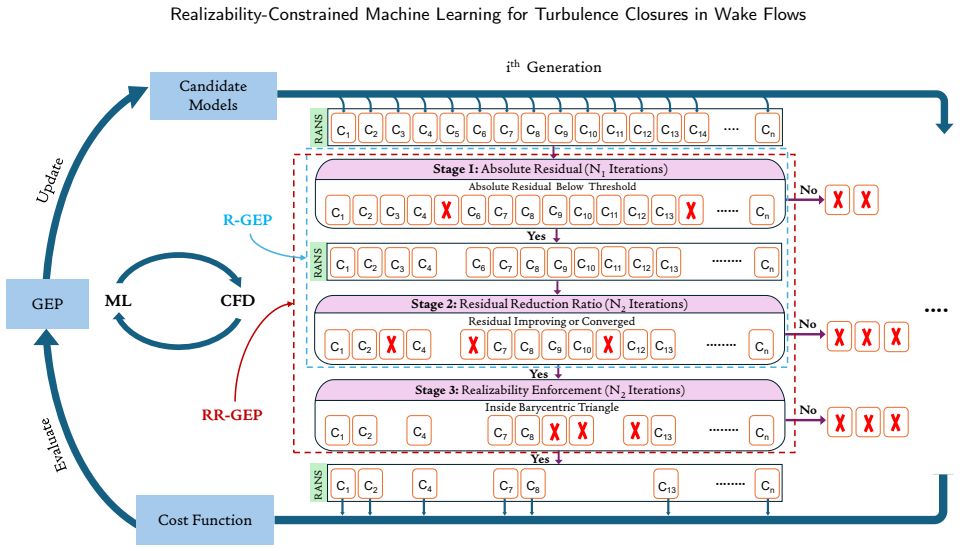
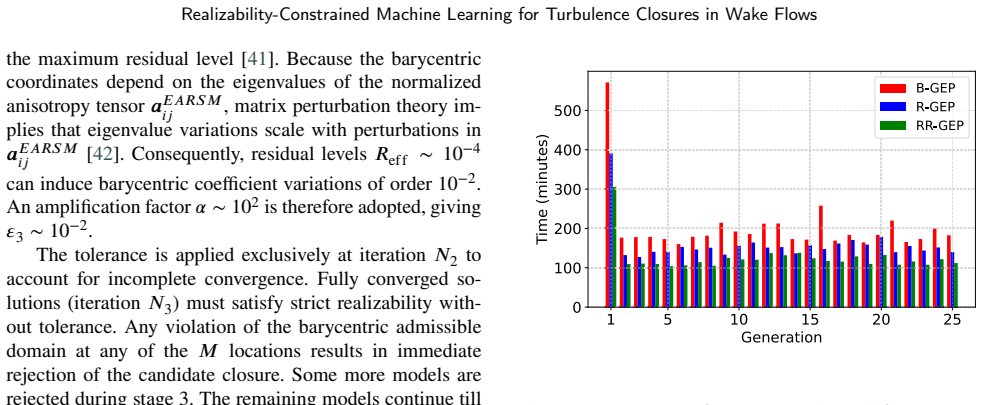
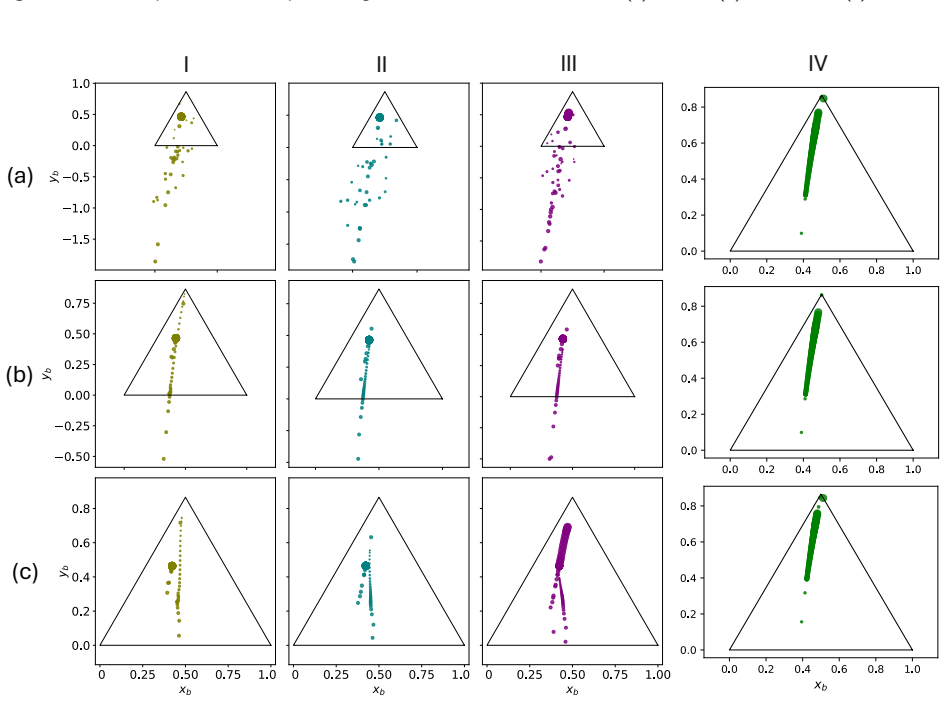
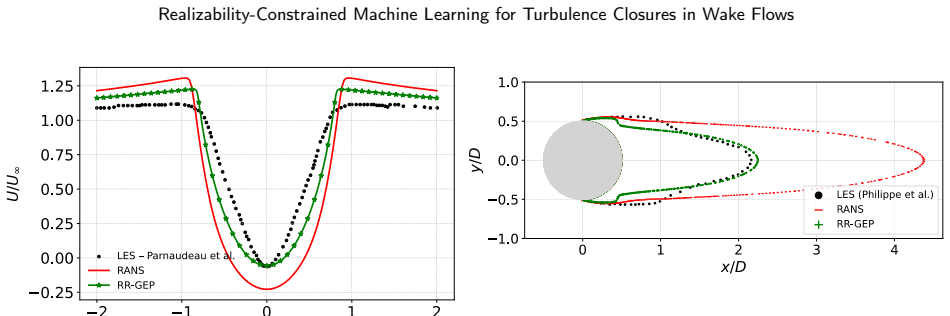
By embedding two residual-based filtering criteria and a barycentric-map-based realizability constraint into the CFD solution loop of a gene expression programming framework, the method identifies and rejects invalid turbulence models early, yielding a 42.3 percent reduction in computational cost relative to the unfiltered baseline, a reduction of non-realizable models at convergence from 58.4 percent to 1.7 percent, and closures that improve mean wake predictions while remaining realizable and generalizable across a cylinder wake, a rectangular cylinder, an airfoil, and an axisymmetric body.
What carries the argument
The residual- and realizability-filtered CFD-driven gene expression programming framework, which applies barycentric-map realizability constraints and residual filters inside the CFD loop to reject invalid candidate models during training.
If this is right
- The resulting turbulence models remain realizable across both training and unseen test cases.
- Mean wake predictions improve while the models generalize to rectangular cylinders, airfoils, and axisymmetric bodies.
- The framework supplies statistics on realizable model coefficients and the conditions that produce physically consistent wake behavior.
- The same filtering approach supplies a scalable route to data-driven turbulence closures that satisfy stability and realizability from the outset.
Where Pith is reading between the lines
- The same early-rejection logic could be ported to other symbolic-regression pipelines for turbulence modeling in boundary layers or jets.
- By keeping nearly all final expressions physically admissible, the method may shorten the validation cycle needed before data-driven closures enter industrial CFD tools.
- Testing whether the discovered closures retain accuracy at Reynolds numbers far above the training range would reveal how far the realizability filter preserves predictive power.
Load-bearing premise
Early rejection of non-realizable or unstable candidates via barycentric-map and residual filters does not unduly restrict the search space or bias the discovered models away from globally optimal closures for the target wake physics.
What would settle it
A demonstration that models discovered with the filters produce inaccurate mean wakes or non-realizable Reynolds stresses on a new geometry or Reynolds number outside the training distribution would show that the constraints have overly narrowed the search.
Figures







read the original abstract
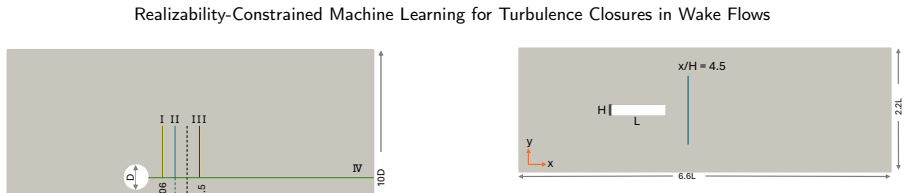
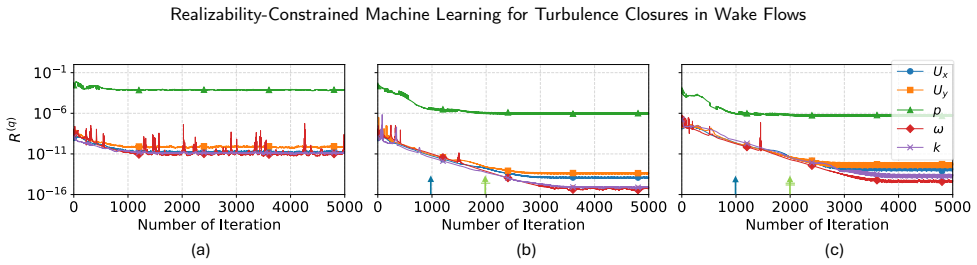
Computational fluid dynamics (CFD)-driven machine learning frameworks based on symbolic regression offer a promising pathway for turbulence model discovery, but are often hindered by numerical instability, residual stagnation, and non-physical model behavior during training. In particular, realizability, which is rarely enforced explicitly during model development, remains a critical yet overlooked requirement, especially for accurate wake prediction. In this work, a residual- and realizability-filtered CFD-driven framework is proposed to enhance both efficiency and robustness within a gene expression programming (GEP) paradigm. The method integrates two residual-based filtering criteria along with a barycentric-map-based realizability constraint directly into the CFD solution loop, enabling early identification and rejection of unstable and non-realizable candidate models. This reduces unnecessary computational effort while guiding the search toward physically admissible solutions. The proposed approach achieves a 42.3% reduction in computational cost relative to the baseline CFD-driven GEP framework and reduces non-realizable models at convergence from 58.4% to 1.7%. The framework is trained on a canonical cylinder wake. The resulting models enhance mean wake prediction and remain realizable across training and test cases, with robust generalization to diverse geometries and operating conditions, including a rectangular cylinder, an airfoil, and an axisymmetric body. The study further provides insights into realizable model statistics, coefficient trends, and conditions governing physically consistent wake behavior. These results demonstrate that incorporating realizability and stability constraints within CFD-driven learning enables efficient and physically consistent turbulence model discovery, offering a scalable pathway toward reliable data-driven closure development.
Editorial analysis
A structured set of objections, weighed in public.
Referee Report
Summary. The paper proposes a residual- and realizability-filtered CFD-driven gene expression programming (GEP) framework for discovering turbulence closures in wake flows. It integrates barycentric-map realizability constraints and residual-based filters into the CFD loop to reject unstable or non-realizable candidates early, claiming a 42.3% reduction in computational cost relative to baseline CFD-driven GEP, a drop in non-realizable models at convergence from 58.4% to 1.7%, improved mean wake predictions on a canonical cylinder, and robust generalization to rectangular cylinder, airfoil, and axisymmetric body cases while maintaining realizability.
Significance. If the central claims hold, the work offers a practical route to more efficient and physically consistent turbulence model discovery by embedding stability and realizability enforcement directly in the search loop. The reported efficiency gains and cross-geometry generalization would be valuable for wake-dominated flows where standard closures often fail, provided the discovered models are not merely the first admissible ones but demonstrably competitive with or superior to unconstrained optima.
major comments (3)
- [Method and Results (filter integration and model statistics)] The load-bearing assumption that early rejection via barycentric-map realizability and residual filters preserves access to globally optimal realizable closures (rather than truncating the search to the first admissible candidates) is not adequately tested. The manuscript should compare the wake-prediction accuracy and generalization performance of models evolved with versus without the early-rejection filters; without this, the 42.3% cost reduction and 1.7% non-realizable fraction could simply reflect aggressive pruning rather than discovery of superior physics.
- [Results (quantitative performance claims)] Quantitative gains are reported without error bars, multiple random seeds, or explicit baseline implementation details (e.g., population size, CFD convergence criteria, or exact definition of the 58.4% baseline non-realizable rate). This weakens the claim that the filtered framework “enhances mean wake prediction” beyond the baseline; a table or figure showing mean and standard deviation of drag/lift coefficients or wake deficit errors across repeated runs is needed.
- [Generalization tests] Verification that the discovered closures satisfy the Navier-Stokes equations beyond mean wake statistics is limited to the training geometry. The paper should report residual norms or higher-order statistics (e.g., Reynolds-stress anisotropy) on the test geometries to confirm that realizability enforcement translates into consistent momentum balance rather than merely admissible but inaccurate closures.
minor comments (2)
- [Method] Notation for the barycentric-map realizability constraint should be defined explicitly (e.g., the mapping from Reynolds-stress invariants to the barycentric triangle) rather than referenced only by name.
- [Results] The abstract and results mention “insights into realizable model statistics, coefficient trends” but no corresponding figure or table is referenced; adding one would improve clarity.
Simulated Author's Rebuttal
We appreciate the referee's thorough review and valuable suggestions for improving the manuscript. We address each of the major comments below, providing clarifications and indicating the revisions we plan to implement.
read point-by-point responses
-
Referee: [Method and Results (filter integration and model statistics)] The load-bearing assumption that early rejection via barycentric-map realizability and residual filters preserves access to globally optimal realizable closures (rather than truncating the search to the first admissible candidates) is not adequately tested. The manuscript should compare the wake-prediction accuracy and generalization performance of models evolved with versus without the early-rejection filters; without this, the 42.3% cost reduction and 1.7% non-realizable fraction could simply reflect aggressive pruning rather than discovery of superior physics.
Authors: We agree that a direct comparison between the filtered and unfiltered frameworks is necessary to substantiate that the early-rejection mechanism does not unduly restrict the search space to suboptimal solutions. In the revised manuscript, we will include additional experiments comparing the wake-prediction accuracy and generalization performance of models evolved with and without the filters. This will demonstrate that the proposed approach not only reduces computational cost but also maintains or improves model quality by focusing on physically admissible candidates. revision: yes
-
Referee: [Results (quantitative performance claims)] Quantitative gains are reported without error bars, multiple random seeds, or explicit baseline implementation details (e.g., population size, CFD convergence criteria, or exact definition of the 58.4% baseline non-realizable rate). This weakens the claim that the filtered framework “enhances mean wake prediction” beyond the baseline; a table or figure showing mean and standard deviation of drag/lift coefficients or wake deficit errors across repeated runs is needed.
Authors: We acknowledge that the quantitative claims would benefit from statistical validation. We will provide explicit details on the baseline implementation, including population size, CFD convergence criteria, and the definition of the non-realizable rate. Additionally, we will conduct multiple runs with different random seeds and report mean values with standard deviations for key metrics such as drag and lift coefficients and wake deficit errors in a new table or figure. revision: yes
-
Referee: [Generalization tests] Verification that the discovered closures satisfy the Navier-Stokes equations beyond mean wake statistics is limited to the training geometry. The paper should report residual norms or higher-order statistics (e.g., Reynolds-stress anisotropy) on the test geometries to confirm that realizability enforcement translates into consistent momentum balance rather than merely admissible but inaccurate closures.
Authors: We thank the referee for highlighting the importance of verifying consistency beyond mean statistics. In the revised version, we will report residual norms of the Navier-Stokes equations and higher-order statistics, including Reynolds-stress anisotropy, for the discovered models on the test geometries (rectangular cylinder, airfoil, and axisymmetric body). This will confirm that the realizability enforcement leads to consistent momentum balance across cases. revision: yes
Circularity Check
No significant circularity; empirical performance metrics from constrained search
full rationale
The paper describes an algorithmic CFD-driven GEP framework augmented with barycentric realizability and residual filters. All quantitative claims (42.3% cost reduction, drop from 58.4% to 1.7% non-realizable models) are measured outcomes of executing the constrained evolutionary search on cylinder-wake training data and testing on other geometries. No derivation chain, fitted parameter renamed as prediction, or self-citation load-bearing uniqueness theorem is present; the method is self-contained against external CFD benchmarks and does not reduce any result to its own inputs by construction.
Axiom & Free-Parameter Ledger
axioms (2)
- domain assumption Realizability of Reynolds stresses is a necessary condition for physical turbulence models in incompressible flows
- domain assumption Gene expression programming can evolve closure expressions that satisfy the filtered Navier-Stokes equations when instability is removed early
Reference graph
Works this paper leans on
-
[1]
R. D. Sandberg, V. Michelassi, Fluid Dynamics of Axial Turboma- chinery: Blade- and Stage-Level Simulations and Models, Annual Review of Fluid Mechanics 54 (2022) 255–285
work page 2022
-
[2]
G. Schmitt, About Boussinesq’s Turbulent Viscosity Hypothesis: Historical Remarks and a Direct Evaluation of its Validity., Comptes Rendus Mecanique, Elsevier Masson 335 (2007) 617–627
work page 2007
-
[3]
M.Leschziner,StatisticalTurbulenceModellingforFluidDynamics- Demystified:anIntroductoryTextforGraduateEngineeringStudents, World Scientific, Oxford, UK, 2015
work page 2015
-
[4]
S. B. Pope, A More General Effective-Viscosity Hypothesis, Journal of Fluid Mechanics 72 (1975) 331–340
work page 1975
-
[5]
J. Ling, J. Templeton, A. Kurzawski, Reynolds Averaged Turbulence Modelling Using Deep Neural Networks with Embedded Invariance, J. Fluid Mech 807 (2016) 155–166
work page 2016
-
[6]
J. Weatheritt, R. D. Sandberg, A Novel Evolutionary Algorithm Applied to Algebraic Modifications of the RANS Stress-Strain Re- lationship, Journal of Computational Physics 325 (2016) 22–37
work page 2016
-
[7]
M.L.Kaandorp,R.P.Dwight,Data-drivenmodellingoftheReynolds stress tensor using random forests with invariance, Computers and Fluids 202 (2020) 104497
work page 2020
-
[8]
M. Schmelzer, R. P. Dwight, P. Cinnella, Discovery of Algebraic Reynolds-Stress Models Using Sparse Symbolic Regression, Flow, Turbulence and Combustion 104 (2020) 579–603
work page 2020
-
[9]
M. Reissmann, Y. Fang, A. S. H. Ooi, R. D. Sandberg, Symbolic tur- bulence model development for complex-geometry flows exploiting language model-based transfer learning, Physics of Fluids 37 (2025) 095180
work page 2025
-
[10]
J. Weatheritt, R. D. Sandberg, The development of algebraic stress models using a novel evolutionary algorithm, International Journal of Heat and Fluid Flow 68 (2017) 298–318
work page 2017
-
[11]
H. D. Akolekar, J. Weatheritt, N. Hutchins, R. D. Sandberg, G. Laskowski, V. Michelassi, Development and Use of Machine- LearntAlgebraicReynoldsStressModelsforEnhancedPredictionof Wake Mixing in Low-Pressure Turbines, J. Turbomach. 141 (2019)
work page 2019
-
[12]
H. D. Akolekar, R. D. Sandberg, N. Hutchins, V. Michelassi, G.Laskowski,Machine-LearntTurbulenceClosuresforLowPressure Turbineswith UnsteadyInflowConditions, Journalof Turbomachin- ery 141 (2019) 101009
work page 2019
-
[13]
H. D. Akolekar, F. Waschkowski, Y. Zhao, R. Pacciani, R. D. Sand- berg, Transition Modeling for Low Pressure Turbines Using CFD- Driven Machine Learning, Energies 14 (2021) 4680
work page 2021
-
[14]
Y. Gu, Y. Fang, H. Akolekar, R. Pacciani, M. Marconcini, A. Ooi, R. Sandberg, Machine-learning strategies for transition/turbulence modelling for low pressure turbines with unsteady inflow conditions, in: ISUAAAT, Melbourne, Australia, 2025, p. 1
work page 2025
-
[15]
J. Weatheritt, R. Pichler, R. D. Sandberg, G. Laskowski, V.Michelassi,MachineLearningforTurbulenceModelDevelopment Using a High Fidelity HPT Cascade Simulation, in: ASME Turbo Expo 2017: Turbomachinery Technical Conference and Exposition, Charlotte, 2017, pp. 2017–63497
work page 2017
-
[16]
Y.Zhao,H.D.Akolekar,J.Weatheritt,V.Michelassi,R.D.Sandberg, RANS Turbulence Model Development Using CFD-Driven Machine Learning, Journal of Computational Physics 411 (2020) 109413
work page 2020
-
[17]
H.D.Akolekar,Y.Zhao,R.D.Sandberg,N.Hutchins,V.Michelassi, Turbulence Model Development for Low & High Pressure Turbines Using a Machine Learning Approach, in: International Society for Air Breathing Engines, Canberra, Australia, 2019, p. 1
work page 2019
-
[18]
M. Schoepplein, J. Weatheritt, R. Sandberg, M. Talei, M. Klein, Ap- plication of an evolutionary algorithm to LES modelling of turbulent transport in premixed flames, Journal of Computational Physics 374 (2018) 1166–1179
work page 2018
-
[19]
A. Haghiri, R. D. Sandberg, Large Eddy Simulations of Wall Jets With Coflow for the Study of Turbulent Prandtl Number Variations and Data-driven Modeling, Phys. Rev. Fluids 5 (2020) 64501
work page 2020
-
[20]
R. D. Sandberg, R. Tan, J. Weatheritt, A. Ooi, A. Haghiri, V. Michelassi, G. Laskowski, Applying Machine Learnt Explicit Algebraic Stress and Scalar Flux Models To a Fundamental Trailing Edge Slot, Journal of Turbomachinery 140 (2018) 101008
work page 2018
-
[21]
S. Parneix, D. Laurence, P. Durbin, A procedure for using DNS databases, ASME. J. Fluids Eng. 120 (1998) 40–47
work page 1998
-
[22]
F. Waschkowski, Y. Zhao, R. Sandberg, J. Klewicki, Multi-objective CFD-driven development of coupled turbulence closure models, J. Comput. Phys 452 (2022) 110922
work page 2022
-
[23]
X. Xu, F. Waschkowski, A. S. Ooi, R. D. Sandberg, Towards robust and accurate Reynolds-averaged closures for natural convection via multi-objective CFD-driven machine learning, Int. J. Heat Mass Transf. 187 (2022) 122557
work page 2022
-
[24]
H. D. Akolekar, F. Waschkowski, R. D. Sandberg, R. Pacciani, Y. Zhao, Integrated Transition and Wake Mixing Predictions in Low Pressure, in:ProceedingsoftheASMETurboExpo2022,Rotterdam, The Netherlands, 2022, pp. 1–13
work page 2022
-
[25]
Y. Fang, Y. Zhao, F. Waschkowski, A. S. Ooi, R. D. Sandberg, To- wardMoreGeneralTurbulenceModelsviaMulticaseComputational- Fluid-Dynamics-Driven Training, AIAA Journal 61 (2023) 2100– 2115
work page 2023
-
[26]
Y.Fang,Y.Zhao,H.D.Akolekar,A.S.Ooi,R.D.Sandberg,R.Pac- ciani, M. Marconcini, A Data-Driven Approach for Generalizing the LaminarKineticEnergyModelforSeparationandBypassTransition inLow-andHigh-PressureTurbines, ASMEJTurbomach146(2024) 091005
work page 2024
-
[27]
Y. Fang, M. Reissmann, R. Pacciani, Y. Zhao, A. S. Ooi, M. Mar- concini, H. D. Akolekar, R. D. Sandberg, Accelerating cfd-driven trainingof transitionandturbulencemodels forturbineflowsby one- shotandreal-timetransformerintegration, ComputersandFluids306 (2026) 106927
work page 2026
-
[28]
J. L. Lumley, Toward a turbulent constitutive relation, Journal of Fluid Mechanics 41 (1970) 413
work page 1970
-
[29]
S.Banerjee,R.Krahl,F.Durst,C.Zenger, Presentationofanisotropy properties of turbulence, invariants versus eigenvalue approaches, Journal of Turbulence 8 (2007) 1–27
work page 2007
-
[30]
thesis, University of Melbourne, 2019
H.D.Akolekar,TurbulenceModelDevelopmentandImplementation For Low Pressure Turbines Using a Machine Learning Approach, Ph.D. thesis, University of Melbourne, 2019
work page 2019
-
[31]
J.-X.Wang,J.-L.Wu,H.Xiao,APhysicsInformedMachineLearning Approach for Reconstructing Reynolds Stress Modeling Discrepan- cies Based on DNS Data, Physical Review Fluids 2 (2017) 034603
work page 2017
-
[32]
J. G. Wnek, C. Schrock, E. M. Wolf, M. Wolff, A polar turbulence invariantmapwithapplicabilitytorealisablemachinelearningturbu- lence models, Journal of Fluid Mechanics 1018 (2025) A36
work page 2025
-
[33]
P. Parnaudeau, J. Carlier, D. Heitz, E. Lamballais, Experimental and numerical studies of the flow over a circular cylinder at reynolds number 3900, Physics of Fluids 20 (2008) 085101. Ansari et al.:Preprint submitted to ElsevierPage 15 of 16 Realizability-Constrained Machine Learning for Turbulence Closures in Wake Flows
work page 2008
-
[34]
C. Mannini, A. Mariotti, L. Siconolfi, M. V. Salvetti, Benchmark on the aerodynamics of a 5:1 rectangular cylinder: Further experimental and les results, in: Proceedings of the 11th Workshop on DLES, Springer International Publishing, 2019, pp. 427–432
work page 2019
-
[35]
Y. Lin, M. Savill, N. R. Vadlamani, R. Jefferson-Loveday, Wall- resolved large eddy simulation over naca0012 airfoil, International Journal of Aerospace Sciences 2 (2013) 149–162
work page 2013
-
[36]
J. M. Jimenez, M. Hultmark, A. J. Smits, The intermediate wake of a body of revolution at high reynolds numbers, Journal of Fluid Mechanics 659 (2010) 516–539
work page 2010
-
[37]
F. R. Menter, Two-equation eddy-viscosity turbulence models for engineering applications, AIAA Journal 32 (1994) 1598–1605
work page 1994
-
[38]
T.Ansari,P.H.Mehta,H.D.Akolekar, Cfd-drivenmachinelearning for improving wake prediction for cylinders, in: Proceedings of the 12thInternationaland52ndNationalFMFPConference,Ahmedabad, India, 2025, pp. FMFP2025–INS–112
work page 2025
-
[39]
S.V.Patankar,NumericalHeatTransferandFluidFlow,Hemisphere Publishing Corporation, Washington, DC, 1980
work page 1980
-
[40]
H. K. Versteeg, W. Malalasekera, An Introduction to Computational Fluid Dynamics: The Finite Volume Method, 2 ed., Pearson Educa- tion, 2007
work page 2007
-
[41]
J.H.Ferziger,M.Perić,ComputationalMethodsforFluidDynamics, Springer, 2020
work page 2020
-
[42]
R. A. Horn, C. R. Johnson, Matrix Analysis, Cambridge University Press, 2013
work page 2013
-
[43]
R. McConkey, N. Kalia, E. Yee, F.-S. Lien, Realisability-informed machine learning for turbulence anisotropy mappings, Journal of Fluid Mechanics 1019 (2025) A49. Ansari et al.:Preprint submitted to ElsevierPage 16 of 16
work page 2025
discussion (0)
Sign in with ORCID, Apple, or X to comment. Anyone can read and Pith papers without signing in.