Recognition: 2 theorem links
· Lean TheoremIn-context learning to predict critical transitions in dynamical systems
Pith reviewed 2026-05-13 07:03 UTC · model grok-4.3
The pith
In-context learning on synthetic bifurcation data detects critical transitions in unseen dynamical systems.
A machine-rendered reading of the paper's core claim, the machinery that carries it, and where it could break.
Core claim
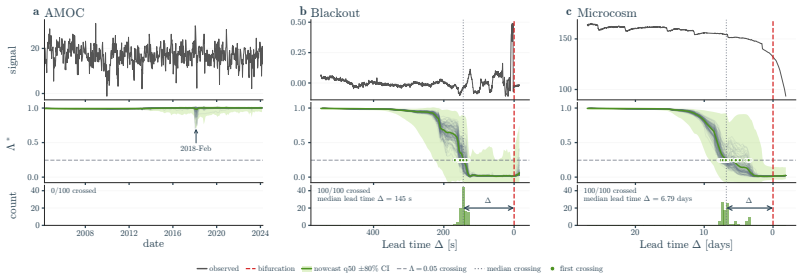
TipPFN, trained on synthetic data from canonical bifurcation scenarios coupled to diverse randomized stochastic dynamics, infers a system's proximity to a critical transition and delivers robust early detection in previously unseen tipping regimes, sim-to-real examples, and real-world observations under both in-context and zero-shot conditions.
What carries the argument
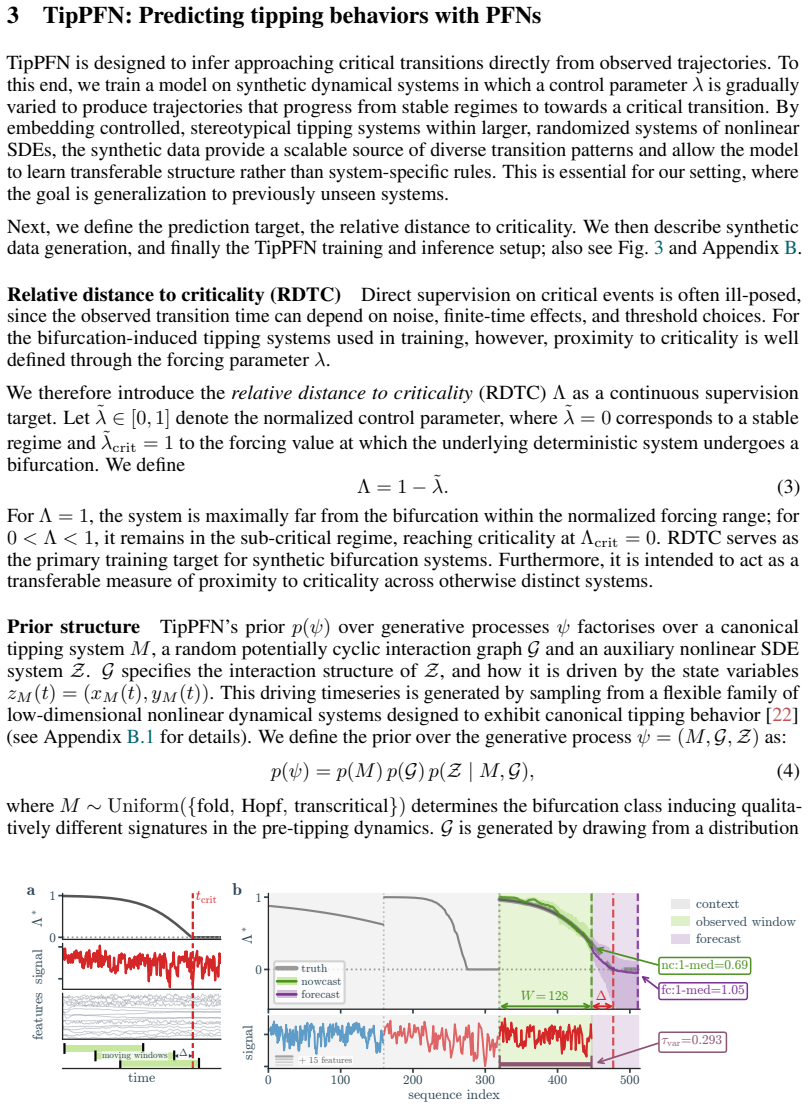
TipPFN, a prior-data fitted network that uses in-context learning to infer proximity to a critical transition from input contexts of varying sizes, complexity, and dimensionalities.
If this is right
- Reliable early warning becomes possible for systems where real transition data are scarce.
- Detection works for tipping regimes absent from the training distribution.
- Performance holds under realistic conditions of limited samples and correlated noise.
- Both in-context learning with examples and pure zero-shot inference are supported.
Where Pith is reading between the lines
- The same synthetic-generator approach might be tested on other rare-event prediction tasks such as financial crashes or epidemic outbreaks.
- Extending the context window or adding multi-scale dynamics to the generator could further improve detection lead time.
- Hybrid use with traditional indicators might provide uncertainty estimates that pure deep-learning outputs lack.
Load-bearing premise
The novel synthetic data generator based on canonical bifurcation scenarios coupled to diverse randomized stochastic dynamics produces training distributions that allow the model to generalize to real-world critical transitions.
What would settle it
A concrete falsifier would be a documented real-world critical transition, such as a specific lake eutrophication or climate regime shift, where TipPFN fails to give an early warning signal even when the underlying bifurcation type matches those used in training.
Figures



read the original abstract
Critical transitions - abrupt, often irreversible changes in system dynamics - arise across human and natural systems, often with catastrophic consequences. Real-world observations of such shifts remain scarce, preventing the development of reliable early warning systems. Conventional statistical and spectral indicators, such as increasing variance, tend to fail under realistic conditions of limited data and correlated noise, whereas existing deep learning classifiers do not extrapolate beyond their training data distribution. In this work, we introduce TipPFN, an in-context learning (ICL) framework that uses a prior-data fitted network to infer a system's proximity to a critical transition. Trained on our novel synthetic data generator, which is based on canonical bifurcation scenarios coupled to diverse, randomized stochastic dynamics, TipPFN flexibly capitalizes on contexts of various sizes, complexity and dimensionalities. We demonstrate robust, state-of-the-art early detection of critical transitions in previously unseen tipping regimes, sim-to-real examples, and real-world observations in both ICL and zero-shot settings.
Editorial analysis
A structured set of objections, weighed in public.
Referee Report
Summary. The paper introduces TipPFN, a prior-data fitted network (PFN) for in-context learning (ICL) that infers proximity to critical transitions from contexts of varying length and dimensionality. It is trained exclusively on a novel synthetic generator consisting of canonical bifurcation scenarios (e.g., fold, Hopf) coupled to randomized stochastic dynamics, and claims state-of-the-art early detection performance on previously unseen tipping regimes, sim-to-real transfers, and selected real-world time series, both in ICL and zero-shot regimes.
Significance. If the generalization claims hold under rigorous validation, the work would be significant: it offers a data-efficient route to early-warning systems for critical transitions where real labeled examples are scarce, and demonstrates that ICL on carefully constructed synthetic priors can outperform both classical indicators (variance, autocorrelation) and standard supervised deep-learning classifiers that fail to extrapolate outside their training distribution.
major comments (3)
- [Abstract and §4] Abstract and §4 (Experiments): the headline claim of 'state-of-the-art' performance on unseen regimes and real observations is load-bearing yet unsupported by any reported quantitative metrics, error bars, exact definitions of success (e.g., lead time, AUC, or false-positive rate), or explicit data-exclusion rules; without these, the generalization statement cannot be evaluated.
- [§3.2] §3.2 (Synthetic data generator): the central sim-to-real and zero-shot claims rest on the assumption that contexts drawn from the bifurcation-plus-randomized-stochastic generator lie sufficiently close to the tested real-world series; no distributional diagnostic (MMD, Wasserstein distance on autocorrelation spectra, variance scaling, or power-law exponents) is supplied to confirm that the reported real/sim-to-real successes are inside the training support rather than selected overlaps.
- [§4.3] §4.3 (Real-world results): the zero-shot and ICL results on real observations are presented without ablation on context length, noise structure, or non-stationary forcing; if these factors lie outside the generator's support, the reported robustness may not generalize, directly undermining the 'robust' claim.
minor comments (2)
- [§3.1] Notation for the PFN prior and the exact form of the in-context prompt (context length, embedding of time series) is introduced without a compact mathematical definition; a single equation or pseudocode block would improve clarity.
- [Figures 5-7] Figure captions for the real-world examples should explicitly state the source dataset, sampling rate, and any preprocessing steps applied before feeding the series to TipPFN.
Simulated Author's Rebuttal
We thank the referee for the constructive and detailed feedback. We appreciate the emphasis on rigorous validation of our generalization claims. We address each major comment below and outline revisions to strengthen the manuscript.
read point-by-point responses
-
Referee: [Abstract and §4] Abstract and §4 (Experiments): the headline claim of 'state-of-the-art' performance on unseen regimes and real observations is load-bearing yet unsupported by any reported quantitative metrics, error bars, exact definitions of success (e.g., lead time, AUC, or false-positive rate), or explicit data-exclusion rules; without these, the generalization statement cannot be evaluated.
Authors: We agree that the abstract and experimental section would benefit from more explicit quantitative support. The manuscript presents comparative results via figures in §4 showing superior performance over baselines on unseen regimes and real data, but we will revise to include dedicated tables with AUC, lead-time metrics, false-positive rates, error bars from repeated runs, precise success definitions, and data-exclusion criteria. This will make the state-of-the-art claims directly evaluable. revision: yes
-
Referee: [§3.2] §3.2 (Synthetic data generator): the central sim-to-real and zero-shot claims rest on the assumption that contexts drawn from the bifurcation-plus-randomized-stochastic generator lie sufficiently close to the tested real-world series; no distributional diagnostic (MMD, Wasserstein distance on autocorrelation spectra, variance scaling, or power-law exponents) is supplied to confirm that the reported real/sim-to-real successes are inside the training support rather than selected overlaps.
Authors: The generator was designed to span diverse bifurcation and stochastic regimes to approximate real-world variability. While qualitative matches are shown, we acknowledge the absence of formal distributional checks. In revision we will add MMD distances, autocorrelation spectrum comparisons, variance scaling, and power-law exponent analyses between synthetic training contexts and the real/sim-to-real test series to quantify overlap and support the generalization claims. revision: yes
-
Referee: [§4.3] §4.3 (Real-world results): the zero-shot and ICL results on real observations are presented without ablation on context length, noise structure, or non-stationary forcing; if these factors lie outside the generator's support, the reported robustness may not generalize, directly undermining the 'robust' claim.
Authors: Some context-length sensitivity was examined internally during development, but we concur that systematic ablations are required to substantiate robustness. The revised §4.3 will incorporate explicit ablations varying context length, noise correlation structures, and non-stationary forcing amplitudes, reporting performance changes to demonstrate where the method remains effective and where limits appear. revision: yes
Circularity Check
No circularity: training on independent synthetic generator and evaluation on external real-world data
full rationale
The paper trains TipPFN on a novel synthetic data generator (canonical bifurcations + randomized stochastic dynamics) and evaluates generalization to previously unseen tipping regimes, sim-to-real transfers, and real-world observations. No derivation, equation, or central claim reduces by construction to fitted parameters, self-citations, or ansatzes within the reported setup. The use of held-out real observations provides an independent external benchmark, so the headline claim of robust early detection does not collapse to a tautology or self-referential fit.
Axiom & Free-Parameter Ledger
free parameters (1)
- network architecture and training hyperparameters
axioms (1)
- domain assumption Canonical bifurcation models plus randomized stochastic dynamics sufficiently approximate real-world critical transition statistics
invented entities (1)
-
TipPFN
no independent evidence
Lean theorems connected to this paper
-
IndisputableMonolith/Cost/FunctionalEquation.leanwashburn_uniqueness_aczel unclear?
unclearRelation between the paper passage and the cited Recognition theorem.
TipPFN is trained on our novel synthetic data generator, which is based on canonical bifurcation scenarios coupled to diverse, randomized stochastic dynamics... primary training target is the relative distance to criticality (RDTC)
-
IndisputableMonolith/Foundation/RealityFromDistinction.leanreality_from_one_distinction unclear?
unclearRelation between the paper passage and the cited Recognition theorem.
Prior-data fitted networks... amortising inference over a large ensemble of synthetic prediction problems
What do these tags mean?
- matches
- The paper's claim is directly supported by a theorem in the formal canon.
- supports
- The theorem supports part of the paper's argument, but the paper may add assumptions or extra steps.
- extends
- The paper goes beyond the formal theorem; the theorem is a base layer rather than the whole result.
- uses
- The paper appears to rely on the theorem as machinery.
- contradicts
- The paper's claim conflicts with a theorem or certificate in the canon.
- unclear
- Pith found a possible connection, but the passage is too broad, indirect, or ambiguous to say the theorem truly supports the claim.
Reference graph
Works this paper leans on
-
[1]
Sheng Fang, Ziyan Wang, Jürgen Kurths, and Jingfang Fan. Tipping points and cascading transitions: Methods, principles, and evidences.arXiv preprint arXiv:2511.01168, 2025
-
[2]
Peter Ashwin, Sebastian Wieczorek, Renato Vitolo, and Peter Cox. Tipping points in open systems: bifurcation, noise-induced and rate-dependent examples in the climate system.Philo- sophical Transactions of the Royal Society A: Mathematical, Physical and Engineering Sciences, 370(1962):1166–1184, 2012
work page 1962
-
[3]
Anastasia Romanou, David Rind, Jeff Jonas, Ron Miller, Maxwell Kelley, Gary Russell, Clara Orbe, Larissa Nazarenko, Rebecca Latto, and Gavin A Schmidt. Stochastic bifurcation of the north atlantic circulation under a midrange future climate scenario with the nasa-giss modele. Journal of Climate, 36(18):6141–6161, 2023
work page 2023
-
[4]
Annelies J Veraart, Elisabeth J Faassen, Vasilis Dakos, Egbert H Van Nes, Miquel Lürling, and Marten Scheffer. Recovery rates reflect distance to a tipping point in a living system.Nature, 481(7381):357–359, 2012
work page 2012
-
[5]
Western systems coordinating council disturbance report, 1996
Western Electricity Coordinating Council. Western systems coordinating council disturbance report, 1996
work page 1996
-
[6]
Luis Gómez-Nava, Robert T. Lange, Pascal P. Klamser, Juliane Lukas, Lenin Arias-Rodriguez, David Bierbach, Jens Krause, Henning Sprekeler, and Pawel Romanczuk. Fish shoals re- semble a stochastic excitable system driven by environmental perturbations.Nature Physics, 19(5):663–669, February 2023
work page 2023
-
[7]
Rate-induced tipping in natural and human systems.Earth System Dynamics, 14(3):669–683, 2023
Paul DL Ritchie, Hassan Alkhayuon, Peter M Cox, and Sebastian Wieczorek. Rate-induced tipping in natural and human systems.Earth System Dynamics, 14(3):669–683, 2023
work page 2023
-
[8]
Yunus Sevinchan, Petro Sarkanych, Abi Tenenbaum, Yurij Holovatch, and Pawel Romanczuk. Collective decision-making with heterogeneous biases: Role of network topology and suscepti- bility.Physical Review Research, 7(1), March 2025
work page 2025
-
[9]
Vasilis Dakos, Egbert H Van Nes, Paolo d’Odorico, and Marten Scheffer. Robustness of variance and autocorrelation as indicators of critical slowing down.Ecology, 93(2):264–271, 2012
work page 2012
-
[10]
A universal law of the characteristic return time near thresholds.Oecologia, 65(1):101– 107, 1984
C Wissel. A universal law of the characteristic return time near thresholds.Oecologia, 65(1):101– 107, 1984
work page 1984
-
[11]
Egbert H Van Nes and Marten Scheffer. Slow recovery from perturbations as a generic indicator of a nearby catastrophic shift.The American Naturalist, 169(6):738–747, 2007
work page 2007
-
[12]
Vasilis Dakos, Marten Scheffer, Egbert H Van Nes, Victor Brovkin, Vladimir Petoukhov, and Hermann Held. Slowing down as an early warning signal for abrupt climate change.Proceedings of the National Academy of Sciences, 105(38):14308–14312, 2008
work page 2008
-
[13]
Rising variance: a leading indicator of ecological transition.Ecology letters, 9(3):311–318, 2006
Stephen R Carpenter and William A Brock. Rising variance: a leading indicator of ecological transition.Ecology letters, 9(3):311–318, 2006
work page 2006
-
[14]
Vishwesha Guttal and Ciriyam Jayaprakash. Changing skewness: an early warning signal of regime shifts in ecosystems.Ecology letters, 11(5):450–460, 2008
work page 2008
-
[15]
Vasilis Dakos, Stephen R Carpenter, Egbert H van Nes, and Marten Scheffer. Resilience indica- tors: prospects and limitations for early warnings of regime shifts.Philosophical Transactions of the Royal Society B: Biological Sciences, 370(1659), 2015
work page 2015
-
[16]
Early warning signals also precede non-catastrophic transitions.Oikos, 122(5):641–648, 2013
Sonia Kéfi, Vasilis Dakos, Marten Scheffer, Egbert H Van Nes, and Max Rietkerk. Early warning signals also precede non-catastrophic transitions.Oikos, 122(5):641–648, 2013
work page 2013
-
[17]
Induja Pavithran and RI Sujith. Effect of rate of change of parameter on early warning signals for critical transitions.Chaos: An Interdisciplinary Journal of Nonlinear Science, 31(1), 2021
work page 2021
-
[18]
Deep learning for predicting rate-induced tipping.Nature Machine Intelligence, 6(12):1556–1565, 2024
Yu Huang, Sebastian Bathiany, Peter Ashwin, and Niklas Boers. Deep learning for predicting rate-induced tipping.Nature Machine Intelligence, 6(12):1556–1565, 2024
work page 2024
-
[19]
Towards out-of-distribution generalization: A survey, 2023
Jiashuo Liu, Zheyan Shen, Yue He, Xingxuan Zhang, Renzhe Xu, Han Yu, and Peng Cui. Towards out-of-distribution generalization: A survey, 2023
work page 2023
-
[20]
Kaiyang Zhou, Ziwei Liu, Yu Qiao, Tao Xiang, and Chen Change Loy. Domain generalization: A survey.IEEE transactions on pattern analysis and machine intelligence, 45(4):4396–4415, 2022. 11
work page 2022
-
[21]
Out-of-distribution generalization in time series: A survey, 2025
Xin Wu, Fei Teng, Xingwang Li, Ji Zhang, Tianrui Li, and Qiang Duan. Out-of-distribution generalization in time series: A survey, 2025
work page 2025
-
[22]
Deep learning for early warning signals of tipping points
Thomas M Bury, RI Sujith, Induja Pavithran, Marten Scheffer, Timothy M Lenton, Mad- hur Anand, and Chris T Bauch. Deep learning for early warning signals of tipping points. Proceedings of the National Academy of Sciences, 118(39):e2106140118, 2021
work page 2021
-
[23]
Ultra- early prediction of tipping points: Integrating dynamical measures with reservoir computing
Xin Li, Qunxi Zhu, Chengli Zhao, Bolin Zhao, Xue Zhang, Xiaojun Duan, and Wei Lin. Ultra- early prediction of tipping points: Integrating dynamical measures with reservoir computing. arXiv preprint arXiv:2603.14944, 2026
-
[24]
Chengzuo Zhuge, Jiawei Li, and Wei Chen. Deep learning for predicting the occurrence of tipping points.Royal Society Open Science, 12(7), 2025
work page 2025
-
[25]
Shirin Panahi, Ling-Wei Kong, Mohammadamin Moradi, Zheng-Meng Zhai, Bryan Glaz, Mulugeta Haile, and Ying-Cheng Lai. Machine learning prediction of tipping in complex dynamical systems.Physical Review Research, 6(4):043194, 2024
work page 2024
-
[26]
Transformers can do bayesian inference
Samuel Müller, Noah Hollmann, Sebastian Pineda Arango, Josif Grabocka, and Frank Hutter. Transformers can do bayesian inference. InInternational Conference on Learning Representa- tions, 2022
work page 2022
-
[27]
Tabpfn: A transformer that solves small tabular classification problems in a second, 2023
Noah Hollmann, Samuel Müller, Katharina Eggensperger, and Frank Hutter. Tabpfn: A transformer that solves small tabular classification problems in a second, 2023
work page 2023
-
[28]
Accurate predictions on small data with a tabular foundation model.Nature, 637(8045):319–326, 2025
Noah Hollmann, Samuel Müller, Lennart Purucker, Arjun Krishnakumar, Max Körfer, Shi Bin Hoo, Robin Tibor Schirrmeister, and Frank Hutter. Accurate predictions on small data with a tabular foundation model.Nature, 637(8045):319–326, 2025
work page 2025
-
[29]
Tabiclv2: A better, faster, scalable, and open tabular foundation model, 2026
Jingang Qu, David Holzmüller, Gaël Varoquaux, and Marine Le Morvan. Tabiclv2: A better, faster, scalable, and open tabular foundation model, 2026
work page 2026
-
[30]
From tables to time: Extending tabpfn-v2 to time series forecasting, 2026
Shi Bin Hoo, Samuel Müller, David Salinas, and Frank Hutter. From tables to time: Extending tabpfn-v2 to time series forecasting, 2026
work page 2026
-
[31]
Do-pfn: In-context learning for causal effect estimation, 2025
Jake Robertson, Arik Reuter, Siyuan Guo, Noah Hollmann, Frank Hutter, and Bernhard Schölkopf. Do-pfn: In-context learning for causal effect estimation, 2025
work page 2025
-
[32]
Vahid Balazadeh, Hamidreza Kamkari, Valentin Thomas, Benson Li, Junwei Ma, Jesse C. Cresswell, and Rahul G. Krishnan. Causalpfn: Amortized causal effect estimation via in-context learning, 2025
work page 2025
-
[33]
Gradient free deep reinforcement learning with tabpfn, 2025
David Schiff, Ofir Lindenbaum, and Yonathan Efroni. Gradient free deep reinforcement learning with tabpfn, 2025
work page 2025
-
[34]
Yuta Miyauchi, Masahiro Ikeda, and Yoshinobu Kawahara. Generalized stochastic resilience for early warning signals based on koopman operator.Nonlinear Dynamics, 114(4):246, 2026
work page 2026
-
[35]
Anticipating the occurrence and type of critical transitions.Science Advances, 9(1):eabq4558, 2023
Florian Grziwotz, Chun-Wei Chang, Vasilis Dakos, Egbert H van Nes, Markus Schwarzländer, Oliver Kamps, Martin Heßler, Isao T Tokuda, Arndt Telschow, and Chih-hao Hsieh. Anticipating the occurrence and type of critical transitions.Science Advances, 9(1):eabq4558, 2023
work page 2023
-
[36]
Étienne Birmelé. A scale-free graph model based on bipartite graphs.Discrete Applied Mathematics, 157(10):2267–2284, 2009
work page 2009
-
[37]
James A Hanley and Barbara J McNeil. The meaning and use of the area under a receiver operating characteristic (roc) curve.Radiology, 143(1):29–36, 1982
work page 1982
-
[38]
An introduction to roc analysis.Pattern recognition letters, 27(8):861–874, 2006
Tom Fawcett. An introduction to roc analysis.Pattern recognition letters, 27(8):861–874, 2006
work page 2006
-
[39]
WWTG Peterson, T Birdsall, and We Fox. The theory of signal detectability.Transactions of the IRE professional group on information theory, 4(4):171–212, 1954
work page 1954
-
[40]
Andrew P Bradley. The use of the area under the roc curve in the evaluation of machine learning algorithms.Pattern recognition, 30(7):1145–1159, 1997
work page 1997
-
[41]
A new measure of rank correlation.Biometrika, 30(1-2):81–93, 1938
Maurice G Kendall. A new measure of rank correlation.Biometrika, 30(1-2):81–93, 1938
work page 1938
-
[42]
W. E. Ricker. Stock and recruitment.Journal of the Fisheries Research Board of Canada, 11(5):559–623, May 1954
work page 1954
-
[43]
Early warning signals of extinction in deteriorating environments.Nature, 467(7314):456–459, 2010
John M Drake and Blaine D Griffen. Early warning signals of extinction in deteriorating environments.Nature, 467(7314):456–459, 2010. 12
work page 2010
-
[44]
Giacomo Bonciolini, Dominik Ebi, Edouard Boujo, and Nicolas Noiray. Experiments and modelling of rate-dependent transition delay in a stochastic subcritical bifurcation.Royal Society open science, 5(3), 2018
work page 2018
-
[45]
Sang-Ki Lee, Dongmin Kim, Fabian A Gomez, Hosmay Lopez, Denis L V olkov, Shenfu Dong, Rick Lumpkin, and Stephen Yeager. A pause in the weakening of the atlantic meridional overturning circulation since the early 2010s.Nature Communications, 15(1):10642, 2024
work page 2024
-
[46]
Juan Nathaniel, Jiangong Liu, and Pierre Gentine. Metaflux: Meta-learning global carbon fluxes from sparse spatiotemporal observations.Scientific Data, 10(1):440, 2023
work page 2023
-
[47]
Siyeon Kim, Juan Nathaniel, Zhewen Hou, Tian Zheng, and Pierre Gentine. Spatiotemporal upscaling of sparse air-sea pco2 data via physics-informed transfer learning.Scientific data, 11(1):1098, 2024
work page 2024
-
[48]
Lora: Low-rank adaptation of large language models.Iclr, 1(2):3, 2022
Edward J Hu, Yelong Shen, Phillip Wallis, Zeyuan Allen-Zhu, Yuanzhi Li, Shean Wang, Liang Wang, Weizhu Chen, et al. Lora: Low-rank adaptation of large language models.Iclr, 1(2):3, 2022
work page 2022
-
[49]
Test-time training with self-supervision for generalization under distribution shifts
Yu Sun, Xiaolong Wang, Zhuang Liu, John Miller, Alexei Efros, and Moritz Hardt. Test-time training with self-supervision for generalization under distribution shifts. InInternational conference on machine learning, pages 9229–9248. PMLR, 2020
work page 2020
-
[50]
End-to-end test-time training for long context.arXiv preprint arXiv:2512.23675, 2025
Arnuv Tandon, Karan Dalal, Xinhao Li, Daniel Koceja, Marcel Rød, Sam Buchanan, Xiaolong Wang, Jure Leskovec, Sanmi Koyejo, Tatsunori Hashimoto, et al. End-to-end test-time training for long context.arXiv preprint arXiv:2512.23675, 2025
-
[51]
Juan Nathaniel, Yongquan Qu, Tung Nguyen, Sungduk Yu, Julius Busecke, Aditya Grover, and Pierre Gentine. Chaosbench: A multi-channel, physics-based benchmark for subseasonal-to- seasonal climate prediction.Advances in Neural Information Processing Systems, 37:43715– 43729, 2024
work page 2024
-
[52]
Auto-07p: Continuation and bifurcation software for ordinary differential equations
Eusebius J Doedel, Alan R Champneys, Fabio Dercole, Thomas F Fairgrieve, Yuri A Kuznetsov, B Oldeman, RC Paffenroth, B Sandstede, XJ Wang, and CH Zhang. Auto-07p: Continuation and bifurcation software for ordinary differential equations. 2007
work page 2007
-
[53]
CausalDynamics: A large-scale benchmark for structural discovery of dynamical causal models
Benjamin Herdeanu, Juan Nathaniel, Carla Roesch, Jatan Buch, Gregor Ramien, Johannes Haux, and Pierre Gentine. CausalDynamics: A large-scale benchmark for structural discovery of dynamical causal models. InAdvances in Neural Information Processing Systems 38 (NeurIPS 2025), Track on Datasets and Benchmarks, 2025. arXiv preprint arxiv:2505.16620
-
[54]
Deep koopman operators for causal discovery.Communications Physics, 8(1):513, 2025
Juan Nathaniel, Carla Roesch, Jatan Buch, Derek DeSantis, Adam Rupe, Kara D Lamb, and Pierre Gentine. Deep koopman operators for causal discovery.Communications Physics, 8(1):513, 2025
work page 2025
-
[55]
Thresholds and breakpoints in ecosystems with a multiplicity of stable states
Robert M May. Thresholds and breakpoints in ecosystems with a multiplicity of stable states. Nature, 269(5628):471–477, 1977
work page 1977
-
[56]
Hassan Alkhayuon, Peter Ashwin, Laura C Jackson, Courtney Quinn, and Richard A Wood. Basin bifurcations, oscillatory instability and rate-induced thresholds for atlantic meridional overturning circulation in a global oceanic box model.Proceedings of the Royal Society A: Mathematical, Physical and Engineering Sciences, 475(2225), 2019
work page 2019
-
[57]
CM Luke and PM Cox. Soil carbon and climate change: from the jenkinson effect to the compost-bomb instability.European journal of soil science, 62(1):5–12, 2011
work page 2011
-
[58]
Sebastian Wieczorek, Peter Ashwin, Catherine M Luke, and Peter M Cox. Excitability in ramped systems: the compost-bomb instability.Proceedings of the Royal Society A: Mathematical, Physical and Engineering Sciences, 467(2129):1243–1269, 2011
work page 2011
-
[59]
Alessio Burrello, Lukas Cavigelli, Kaspar Schindler, Luca Benini, and Abbas Rahimi. Laelaps: An energy-efficient seizure detection algorithm from long-term human iEEG recordings without false alarms. In2019 Design, Automation & Test in Europe Conference & Exhibition (DATE), pages 752–757, 2019
work page 2019
-
[60]
Viktor K. Jirsa, William C. Stacey, Pascale P. Quilichini, Anton I. Ivanov, and Christophe Bernard. On the nature of seizure dynamics.Brain, 137(8):2210–2230, 2014
work page 2014
-
[61]
Patrick Mergell, Hanspeter Herzel, Thomas Wittenberg, Monika Tigges, and Ulrich Eysh- oldt. Phonation onset: vocal fold modeling and high-speed glottography.The Journal of the Acoustical Society of America, 104(1):464–470, 1998. 13
work page 1998
-
[62]
Preston R Murray and Scott L Thomson. Vibratory responses of synthetic, self-oscillating vocal fold models.The Journal of the Acoustical Society of America, 132(5):3428–3438, 2012
work page 2012
-
[63]
Ryo Shimamura and Isao T Tokuda. Effect of level difference between left and right vocal folds on phonation: Physical experiment and theoretical study.Journal of the Acoustical Society of America, 140(4_Supplement):3393–3394, 2016
work page 2016
-
[64]
Stephan Wagner, Janina Steinbeck, Philippe Fuchs, Sophie Lichtenauer, Marlene Elsässer, Jos HM Schippers, Thomas Nietzel, Cristina Ruberti, Olivier Van Aken, Andreas J Meyer, et al. Multiparametric real-time sensing of cytosolic physiology links hypoxia responses to mitochondrial electron transport.New Phytologist, 224(4):1668–1684, 2019
work page 2019
-
[65]
Ben I Moat, David Smeed, Darren Rayner, William E Johns, Ryan H Smith, Denis L V olkov, Shane Elipot, Tillys Petit, Jules B Kajtar, Molly O Baringer, et al. Atlantic meridional overturn- ing circulation observed by the rapid-mocha-wbts (rapid-meridional overturning circulation and heatflux array-western boundary time series) array at 26n from 2004 to 2023...
work page 2004
-
[66]
Michael L Rosenzweig and Robert H MacArthur. Graphical representation and stability conditions of predator-prey interactions.The American Naturalist, 97(895):209–223, 1963
work page 1963
-
[67]
Tamer Oraby, Vivek Thampi, and Chris T Bauch. The influence of social norms on the dynamics of vaccinating behaviour for paediatric infectious diseases.Proceedings of the Royal Society B: Biological Sciences, 281(1780), 2014
work page 2014
-
[68]
A Demetri Pananos, Thomas M Bury, Clara Wang, Justin Schonfeld, Sharada P Mohanty, Brendan Nyhan, Marcel Salathé, and Chris T Bauch. Critical dynamics in population vaccinating behavior.Proceedings of the National Academy of Sciences, 114(52):13762–13767, 2017. 14 Appendix contents A Additional background 15 B Prior-Data Fitted Networks 17 B.1 Driver vari...
work page 2017
discussion (0)
Sign in with ORCID, Apple, or X to comment. Anyone can read and Pith papers without signing in.