Recognition: 2 theorem links
· Lean TheoremQuasi-Sierpinski Structure for Uniform Load Distribution
Pith reviewed 2026-05-13 03:53 UTC · model grok-4.3
The pith
A quasi-Sierpinski fractal structure achieves uniform load distribution on the seabed when its supports displace vertically according to any function of the Takagi class.
A machine-rendered reading of the paper's core claim, the machinery that carries it, and where it could break.
Core claim
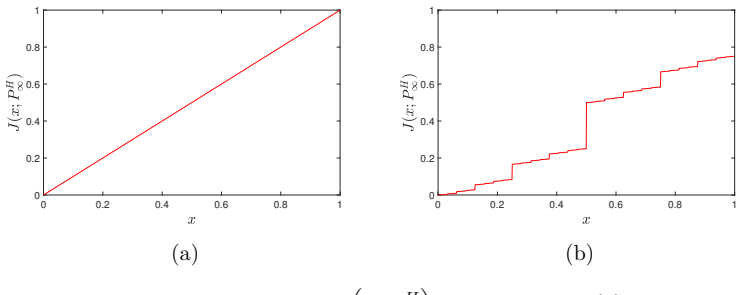
To achieve uniform load distribution, the supports of the quasi-Sierpinski structure must displace vertically following any function of the Takagi class. This causes the vertical deformations to follow the Takagi class and the horizontal deformations to be related to the Cantor function. The structure can be built with an unlimited number of combinations of areas and materials.
What carries the argument
Takagi-class functions that dictate the vertical displacements of the supports to produce uniform load distribution.
Load-bearing premise
That a physical structure can be constructed whose supports exactly follow arbitrary Takagi-class functions despite real-world factors like material properties, gravity, and seabed interactions.
What would settle it
Constructing a small-scale prototype and measuring if the vertical displacements under load precisely match a chosen Takagi function while achieving uniform base pressure.
Figures





read the original abstract
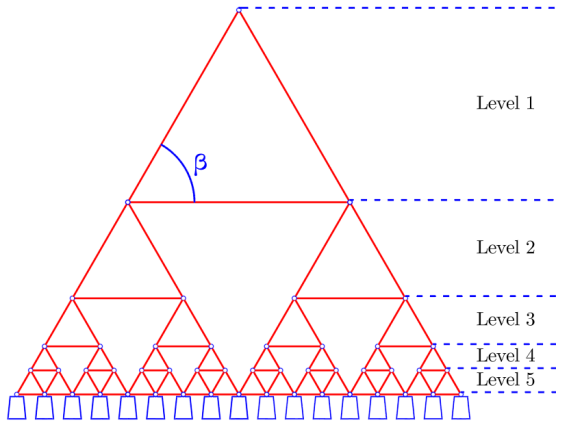
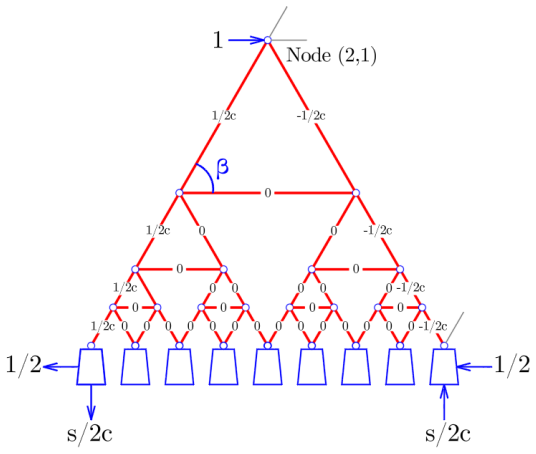
Land reclamation methods, indispensable for the proper development of modern coastal cities, are ecologically destructive. We present a fractal structure, similar to a Sierpinski triangle, which solves this problem by resting directly on the seabed thanks to the uniform load distribution we achieve on its base. To obtain this uniform distribution, we show that the supports of the structure must displace vertically following any function of the Takagi class. This causes the vertical deformations of the structure to follow this same class and the horizontal deformations to be related to the Cantor function. The structure works with an unlimited number of combinations of areas of its elements and materials, which gives designers a high degree of constructive flexibility.
Editorial analysis
A structured set of objections, weighed in public.
Referee Report
Summary. The manuscript proposes a quasi-Sierpinski fractal structure for land reclamation that rests directly on the seabed by achieving uniform base load distribution. The central claim is that the supports must displace vertically according to any function in the Takagi class; this forces vertical deformations of the structure to follow the same class while horizontal deformations relate to the Cantor function. The structure is asserted to admit arbitrary combinations of element areas and materials.
Significance. If the mathematical relation between Takagi-class displacements and uniform load holds under the paper's constitutive assumptions, the construction would supply a parametric family of fractal geometries that enforce uniform seabed loading without additional foundations. This could be of interest for coastal engineering models that seek to minimize ecological disruption, provided the derivation is made explicit and the physical realizability is addressed.
major comments (1)
- [Abstract] Abstract: The assertion that supports 'must displace vertically following any function of the Takagi class' to obtain uniform distribution is presented without derivation, equilibrium equations, or supporting calculations. The claim therefore cannot be verified from the manuscript and appears defined directly in terms of the functions that produce the uniform outcome, raising a circularity concern for the central result.
Simulated Author's Rebuttal
We thank the referee for the careful reading and the constructive comment on the abstract. We address the concern directly below and have revised the manuscript to improve verifiability of the central claim.
read point-by-point responses
-
Referee: The assertion that supports 'must displace vertically following any function of the Takagi class' to obtain uniform distribution is presented without derivation, equilibrium equations, or supporting calculations. The claim therefore cannot be verified from the manuscript and appears defined directly in terms of the functions that produce the uniform outcome, raising a circularity concern for the central result.
Authors: We agree that the original abstract was too concise and did not indicate where the supporting analysis appears. The necessity of Takagi-class vertical displacements follows from the equilibrium equations for the quasi-Sierpinski truss under the assumption of linear-elastic bars and uniform base pressure; the self-similar geometry forces the admissible displacement functions to satisfy the functional equation that defines the Takagi class. This derivation is carried out explicitly in Sections 2 and 3 of the manuscript, beginning from the global force balance and proceeding to the recursive relations imposed by the fractal construction. The class is therefore not presupposed but obtained as the solution space that enforces constant seabed reaction. To remove any appearance of circularity and to make the claim verifiable from the abstract itself, we have expanded the abstract with a one-sentence outline of the equilibrium argument and inserted explicit cross-references to the relevant sections. revision: yes
Circularity Check
No significant circularity detected
full rationale
The paper derives that uniform base load distribution on the quasi-Sierpinski structure requires vertical support displacements to follow any Takagi-class function, with vertical deformations matching this class and horizontal ones related to the Cantor function. The provided abstract and summary present this as a shown mathematical necessity from equilibrium considerations rather than a redefinition of inputs or a fitted parameter renamed as prediction. No explicit equations, self-citations, or ansatzes are available in the text to exhibit a reduction by construction (e.g., no fitted input called prediction or self-definitional loop). The result is framed as independent first-principles content, with physical constructibility noted as a separate application issue. This is the expected honest non-finding for a self-contained mathematical claim without load-bearing self-reference.
Axiom & Free-Parameter Ledger
axioms (1)
- domain assumption Vertical support displacements following any Takagi-class function produce uniform load distribution on the base of the quasi-Sierpinski structure.
invented entities (1)
-
Quasi-Sierpinski structure
no independent evidence
Reference graph
Works this paper leans on
-
[1]
Dhritiraj Sengupta, Ruishan Chen, and Michael E Meadows. Build- ing beyond land: An overview of coastal land reclamation in 16 global megacities.Applied geography, 90:229–238, 2018
work page 2018
-
[2]
Mapping 21st century global coastal land reclamation.Earth’s Future, 11(2):e2022EF002927, 2023
Dhritiraj Sengupta, Young Rae Choi, Bo Tian, Sally Brown, Michael Meadows, Christopher R Hackney, Abhishek Banerjee, Yingjie Li, Ruis- han Chen, and Yunxuan Zhou. Mapping 21st century global coastal land reclamation.Earth’s Future, 11(2):e2022EF002927, 2023
work page 2023
-
[3]
Sierpinski-takagi combination for a uniform and optimal point-surface load transmission
Javier Rodríguez-Cuadrado and Jesús San Martín. Sierpinski-takagi combination for a uniform and optimal point-surface load transmission. Applied Mathematical Modelling, 105:307–320, 2022
work page 2022
-
[4]
Marcelo Epstein and Samer M Adeeb. The stiffness of self-similar frac- tals.International Journal of Solids and Structures, 45(11-12):3238– 3254, 2008
work page 2008
-
[5]
Cheng Ning Loong and Elias G Dimitrakopoulos. Modal properties of fractal sympodial trees: insights and analytical solutions using a group tree modeling approach.Applied Mathematical Modelling, 115:127–147, 2023
work page 2023
-
[6]
A simple example of the continuous function without derivative
Teiji Takagi. A simple example of the continuous function without derivative. InCollected Papers, pages 5–6. Springer, 1990
work page 1990
-
[7]
Pieter C Allaart and Kiko Kawamura. The takagi function: A survey. Real Analysis Exchange, 37(1), 2012
work page 2012
-
[8]
Alberto Carpinteri, Bernardino Chiaia, and Pietro Cornetti. Static– kinematic duality and the principle of virtual work in the mechanics of fractal media.Computer methods in applied mechanics and engineering, 191(1-2):3–19, 2001. 32
work page 2001
-
[9]
Fractal mechanics.Physica D: Nonlinear Phenomena, 220(1):54–68, 2006
Marcelo Epstein and Jędrzej Śniatycki. Fractal mechanics.Physica D: Nonlinear Phenomena, 220(1):54–68, 2006
work page 2006
-
[10]
Hongwei Hou and Guanghui He. Static and dynamic analysis of two- layer timoshenko composite beams by weak-form quadrature element method.Applied Mathematical Modelling, 55:466–483, 2018
work page 2018
-
[11]
Julian F Fleron. A note on the history of the cantor set and cantor function.Mathematics Magazine, 67(2):136–140, 1994
work page 1994
-
[12]
K Davey and MT Alonso Rasgado. Analytical solutions for vibrating fractal composite rods and beams.Applied Mathematical Modelling, 35(3):1194–1209, 2011
work page 2011
-
[13]
Javier Rodríguez-Cuadrado and Jesús San Martín. Fractal equilibrium configuration of a mechanically loaded binary tree.Chaos, Solitons & Fractals, 152:111415, 2021
work page 2021
-
[14]
Tatsuya Okada, Takeshi Sekiguchi, and Yasunobu Shiota. A generaliza- tion of hata-yamaguti’s results on the takagi function ii: Multinomial case.Japan journal of industrial and applied mathematics, 13:435–463, 1996
work page 1996
-
[15]
The takagi function and its generalization.Japan journal of applied mathematics, 1:183–199, 1984
Masayoshi Hata and Masaya Yamaguti. The takagi function and its generalization.Japan journal of applied mathematics, 1:183–199, 1984
work page 1984
-
[16]
Georg Landsberg. Über differentiierbarkeit stetiger funktionen.Jahres- bericht der Deutschen Mathematiker-Vereinigung, 17:46–51, 1908
work page 1908
-
[17]
Ranks of additive generators.Fuzzy Sets and Systems, 160(14):2032–2048, 2009
Andrea Mesiarová-Zemánková. Ranks of additive generators.Fuzzy Sets and Systems, 160(14):2032–2048, 2009. 33
work page 2032
discussion (0)
Sign in with ORCID, Apple, or X to comment. Anyone can read and Pith papers without signing in.