Recognition: no theorem link
The wave nature of a Mott insulator
Pith reviewed 2026-05-13 03:12 UTC · model grok-4.3
The pith
Interference peaks persist and strengthen in a one-dimensional Mott insulator, showing residual wave-like coherence.
A machine-rendered reading of the paper's core claim, the machinery that carries it, and where it could break.
Core claim
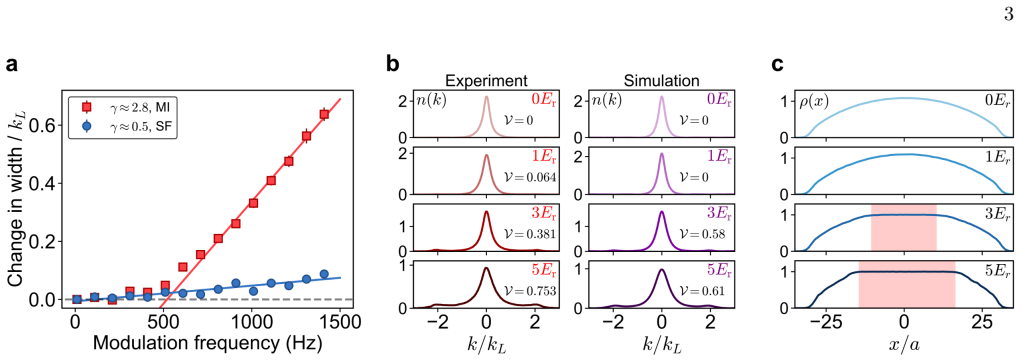
In one-dimensional lattices, a gapped Mott insulator realized by pinning in a shallow potential displays pronounced interference peaks that intensify with rising Mott fraction; the one-body correlation function shows an oscillatory, exponentially decaying coherence over multiple sites that agrees quantitatively with quantum Monte Carlo results, establishing that wave-like properties persist inside the insulating phase.
What carries the argument
The one-body correlation function, which measures coherence by revealing an oscillatory exponential decay across lattice sites in the pinned Mott state.
If this is right
- Interference peaks cannot serve as a unique signature of superfluidity when diagnosing the superfluid-Mott transition in one dimension.
- The Mott insulator in one dimension carries short-range oscillatory coherence that grows with the insulating fraction rather than vanishing.
- Quantitative matching between experiment and quantum Monte Carlo simulations supports that the coherence pattern is intrinsic to the pinned insulating state.
- Phase identification in lattice systems must incorporate correlation-function measurements beyond time-of-flight interference alone.
Where Pith is reading between the lines
- The persistence of coherence may be tied to the strong fluctuations and algebraic correlations characteristic of one-dimensional systems, suggesting the effect weakens in two or three dimensions.
- Similar interference inside insulators could appear in other strongly correlated one-dimensional models, such as doped Hubbard chains, if measured with comparable resolution.
- Future experiments could test whether applying a small perturbation that restores a tiny superfluid fraction further modifies the interference strength in a predictable way.
- The result implies that time-of-flight images alone are insufficient for phase assignment in one-dimensional quantum simulators and should be paired with correlation analysis.
Load-bearing premise
The state produced by pinning atoms in a shallow lattice is a true gapped Mott insulator containing no residual superfluid component, confirmed only by the pinning signature itself.
What would settle it
Spectroscopic detection of a missing energy gap or an independent probe such as noise correlations revealing long-range phase order while interference remains visible would falsify the claim that the observed peaks occur inside a pure insulator.
Figures


read the original abstract
Quantum phases of matter are routinely identified by coherence features, with interference patterns being one of the most directly observable quantities. In lattices, the superfluid-to-Mott-insulator (SF-MI) transition is commonly viewed as a change from wave-like coherence to particle-like localization: interference peaks are taken as a hallmark of superfluidity, whereas their disappearance is used to diagnose insulating behavior. Here, we challenge this picture for one-dimensional (1D) strongly interacting gases subject to a lattice potential. We realize a gapped Mott insulator through pinning in a shallow lattice and find that pronounced interference peaks persist deep in the insulating regime. Strikingly, the interference becomes stronger as the Mott fraction increases, demonstrating that a certain degree of coherence still exists in the insulator state. Measurements of the one-body correlation function reveal an oscillatory, exponentially decaying coherence pattern across several lattice sites, in quantitative agreement with quantum Monte Carlo (QMC) simulations. Our work shows that interference does not uniquely diagnose superfluidity and it exposes the unexpected wave nature of a 1D Mott insulator.
Editorial analysis
A structured set of objections, weighed in public.
Referee Report
Summary. The paper reports an experimental realization of a one-dimensional Mott insulator in a shallow lattice via pinning, observing that interference peaks in time-of-flight images persist and strengthen as the Mott fraction increases. One-body correlation functions are measured to show oscillatory, exponentially decaying coherence over several lattice sites, with quantitative agreement to quantum Monte Carlo simulations. The central claim is that this demonstrates intrinsic wave-like coherence in the gapped Mott phase, implying that interference patterns do not uniquely diagnose superfluidity.
Significance. If the phase identification as a true gapped Mott insulator with vanishing superfluid density holds, the result would be significant for quantum gases and strongly correlated systems: it challenges the standard diagnostic use of interference for superfluidity and reveals unexpected coherence properties in the 1D MI, supported by direct QMC comparison that provides a concrete, falsifiable benchmark.
major comments (2)
- [Experimental realization] Experimental realization section: The assignment of the realized state as a deep gapped Mott insulator (with no residual superfluid component) rests on pinning in a shallow lattice and the observed strengthening of interference with Mott fraction, without independent diagnostics such as lattice-modulation spectroscopy for the gap energy or compressibility/momentum-width measurements for superfluid fraction. This is load-bearing for the central claim, as 1D SF-MI transitions are Kosterlitz-Thouless and near-critical states can exhibit power-law correlations capable of producing similar interference; the reported exponential decay in correlations is only consistent with a gapped MI if parameters are confirmed to lie inside the MI lobe with gap exceeding temperature.
- [One-body correlation measurements] Results on correlation functions and QMC comparison: While quantitative agreement with QMC is reported for the oscillatory exponential decay of the one-body correlation function, the manuscript does not specify how the experimental parameters (lattice depth, interaction strength, temperature) are mapped onto the QMC phase diagram or whether finite-temperature effects and residual superfluid density are controlled in the simulations. This weakens the support for interpreting the persistence of peaks as intrinsic to the insulator rather than a crossover regime.
minor comments (2)
- [Results] The determination of the 'Mott fraction' (used to show strengthening interference) should be detailed with error bars and controls for possible confounding parameters such as total atom number or trap inhomogeneity.
- [Figures and Methods] Figure captions and methods should clarify the fitting procedure for the exponential decay length and any assumptions about the functional form of the correlation function.
Simulated Author's Rebuttal
We thank the referee for their thorough review and valuable feedback on our manuscript. We address the major comments point by point below, providing clarifications and indicating revisions where applicable.
read point-by-point responses
-
Referee: [Experimental realization] Experimental realization section: The assignment of the realized state as a deep gapped Mott insulator (with no residual superfluid component) rests on pinning in a shallow lattice and the observed strengthening of interference with Mott fraction, without independent diagnostics such as lattice-modulation spectroscopy for the gap energy or compressibility/momentum-width measurements for superfluid fraction. This is load-bearing for the central claim, as 1D SF-MI transitions are Kosterlitz-Thouless and near-critical states can exhibit power-law correlations capable of producing similar interference; the reported exponential decay in correlations is only consistent with a gapped MI if parameters are confirmed to lie inside the MI lobe with gap exceeding temperature.
Authors: We agree that independent diagnostics such as lattice-modulation spectroscopy would strengthen the phase identification. Our central evidence, however, is the direct control of Mott fraction via pinning at fixed shallow lattice depth together with the observation that interference peaks strengthen (rather than weaken or saturate) as the Mott fraction grows. This trend is incompatible with a near-critical superfluid or KT regime, where increasing the insulating character would reduce coherence. The measured exponential (not power-law) decay of the one-body correlations, together with quantitative QMC agreement at the experimental parameters, further supports that the system lies inside the gapped MI lobe. We have revised the manuscript to expand the discussion of these points, to include explicit estimates of the gap from the lattice parameters and measured temperature, and to clarify why compressibility measurements are not required for the 1D pinned geometry. revision: partial
-
Referee: [One-body correlation measurements] Results on correlation functions and QMC comparison: While quantitative agreement with QMC is reported for the oscillatory exponential decay of the one-body correlation function, the manuscript does not specify how the experimental parameters (lattice depth, interaction strength, temperature) are mapped onto the QMC phase diagram or whether finite-temperature effects and residual superfluid density are controlled in the simulations. This weakens the support for interpreting the persistence of peaks as intrinsic to the insulator rather than a crossover regime.
Authors: We thank the referee for highlighting this omission. In the revised manuscript we have added a dedicated methods subsection that explicitly states the experimental lattice depth, interaction strength, and temperature (extracted from independent time-of-flight thermometry) and describes how these values are used as direct inputs to the QMC simulations. The simulations are performed at finite temperature with the same parameters; within the reported statistical precision the superfluid density is zero throughout the Mott regime. This direct mapping confirms that the observed oscillatory exponential coherence and the strengthening interference peaks are intrinsic to the gapped phase rather than a crossover artifact. revision: yes
Circularity Check
No circularity: experimental observations compared to independent QMC
full rationale
The paper is an experimental study reporting interference patterns in a pinned 1D lattice gas, with the Mott-insulator assignment based on pinning diagnostics and the coherence measurements compared quantitatively to external quantum Monte Carlo simulations. No mathematical derivation chain, fitted-parameter predictions, or self-citation load-bearing steps are present in the provided text. The central claims rest on direct measurements and external benchmarks rather than any reduction to the paper's own inputs by construction. The skeptic's concerns address phase-assignment assumptions and verification completeness, which fall under correctness or experimental rigor rather than circularity per the defined patterns.
Axiom & Free-Parameter Ledger
axioms (2)
- domain assumption The system is one-dimensional and strongly interacting under the applied lattice potential
- domain assumption Pinning in a shallow lattice produces a gapped Mott insulator without residual superfluidity
Reference graph
Works this paper leans on
-
[1]
M. Andrews, C. Townsend, H.-J. Miesner, D. Durfee, D. Kurn, and W. Ketterle, Observation of interference between two Bose condensates, Science275, 637 (1997)
work page 1997
-
[2]
P. W. Anderson, Special topics in condensed matter physics, Rev. Mod. Phys.38, 298 (1966)
work page 1966
-
[3]
A. J. Leggett, Bose-Einstein condensation in the alkali gases: Some fundamental concepts, Rev. Mod. Phys.73, 307 (2001)
work page 2001
-
[4]
M. Greiner, O. Mandel, T. Esslinger, T. W. H¨ ansch, and I. Bloch, Quantum phase transition from a superfluid to a Mott insulator in a gas of ultracold atoms, Nature (Lon- don)415, 39 (2002)
work page 2002
- [5]
-
[6]
N. F. Mott, The basis of the electron theory of met- als, with special reference to the transition metals, Proc. Phys. Soc. A62, 416 (1949)
work page 1949
-
[7]
Mott,Metal-Insulator Transitions(CRC Press, 2004)
N. Mott,Metal-Insulator Transitions(CRC Press, 2004)
work page 2004
- [8]
-
[9]
H. Yao, T. Giamarchi, and L. Sanchez-Palencia, Lieb- Liniger bosons in a shallow quasiperiodic potential: Bose glass phase and fractal Mott lobes, Phys. Rev. Lett.125, 060401 (2020)
work page 2020
- [10]
-
[11]
R. Gautier, H. Yao, and L. Sanchez-Palencia, Strongly interacting bosons in a two-dimensional quasicrystal lat- tice, Phys. Rev. Lett.126, 110401 (2021)
work page 2021
-
[12]
J.-C. Yu, S. Bhave, L. Reeve, B. Song, and U. Schneider, 6 Observing the two-dimensional Bose glass in an optical quasicrystal, Nature (London)633, 338 (2024)
work page 2024
-
[13]
M. Boninsegni and N. V. Prokof´ ev, Colloquium: Super- solids: What and where are they?, Rev. Mod. Phys.84, 759 (2012)
work page 2012
- [14]
-
[15]
F. B¨ ottcher, J.-N. Schmidt, M. Wenzel, J. Hertkorn, M. Guo, T. Langen, and T. Pfau, Transient supersolid properties in an array of dipolar quantum droplets, Phys. Rev. X9, 011051 (2019)
work page 2019
- [16]
-
[17]
Sachdev,Quantum Phase Transitions(Cambridge University Press, Cambridge, UK, 2001)
S. Sachdev,Quantum Phase Transitions(Cambridge University Press, Cambridge, UK, 2001)
work page 2001
-
[18]
S. L. Sondhi, S. M. Girvin, J. P. Carini, and D. Shahar, Continuous quantum phase transitions, Rev. Mod. Phys. 69, 315 (1997)
work page 1997
-
[19]
T. St¨ oferle, H. Moritz, C. Schori, M. K¨ ohl, and T. Esslinger, Transition from a strongly interacting 1D superfluid to a Mott insulator, Phys. Rev. Lett.92, 130403 (2004)
work page 2004
-
[20]
M. Lewenstein, A. Sanpera, V. Ahufinger, B. Damski, A. Sen, and U. Sen, Ultracold atomic gases in optical lat- tices: mimicking condensed matter physics and beyond, Adv. Phys.56, 243 (2007)
work page 2007
-
[21]
Giamarchi, Mott transition in one dimension, Physica B230, 975 (1997)
T. Giamarchi, Mott transition in one dimension, Physica B230, 975 (1997)
work page 1997
-
[22]
N. Gemelke, X. Zhang, C.-L. Hung, and C. Chin, In situ observation of incompressible Mott-insulating domains in ultracold atomic gases, Nature (London)460, 995 (2009)
work page 2009
-
[23]
W. S. Bakr, A. Peng, M. E. Tai, R. Ma, J. Simon, J. I. Gillen, S. F¨ olling, L. Pollet, and M. Greiner, Probing the Superfluid–to–Mott insulator transition at the single- atom level, Science329, 547 (2010)
work page 2010
-
[24]
F. Haldane, Effective harmonic-fluid approach to low- energy properties of one-dimensional quantum fluids, Phys. Rev. Lett.47, 1840 (1981)
work page 1981
-
[25]
Giamarchi,Quantum physics in one dimension, Vol
T. Giamarchi,Quantum physics in one dimension, Vol. 121 (Clarendon press, 2003)
work page 2003
-
[26]
M. A. Cazalilla, R. Citro, T. Giamarchi, E. Orignac, and M. Rigol, One dimensional bosons: From condensed mat- ter systems to ultracold gases, Rev. Mod. Phys.83, 1405 (2011)
work page 2011
- [27]
-
[28]
G. Bo´ eris, L. Gori, M. D. Hoogerland, A. Kumar, E. Lu- cioni, L. Tanzi, M. Inguscio, T. Giamarchi, C. D’Errico, G. Carleo,et al., Mott transition for strongly interacting one-dimensional bosons in a shallow periodic potential, Phys. Rev. A93, 011601 (2016)
work page 2016
-
[29]
T. Kraemer, J. Herbig, M. Mark, T. Weber, C. Chin, H.-C. N¨ agerl, and R. Grimm, Optimized production of a cesium Bose–Einstein condensate, Appl. Phys. B79, 1013 (2004)
work page 2004
-
[30]
J. F. Sherson, C. Weitenberg, M. Endres, M. Cheneau, I. Bloch, and S. Kuhr, Single-atom-resolved fluorescence imaging of an atomic Mott insulator, Nature (London) 467, 68 (2010)
work page 2010
- [31]
-
[32]
H. Yao, L. Pizzino, and T. Giamarchi, Strongly- interacting bosons at 2D-1D dimensional crossover, Sci- Post Phys.15, 050 (2023)
work page 2023
-
[33]
See Supplemental Materials for details
-
[34]
Y. Guo, H. Yao, S. Ramanjanappa, S. Dhar, M. Hor- vath, L. Pizzino, T. Giamarchi, M. Landini, and H.-C. N¨ agerl, Observation of the 2D–1D crossover in strongly interacting ultracold bosons, Nat. Phys.20, 934 (2024)
work page 2024
-
[35]
Y. Guo, H. Yao, S. Dhar, L. Pizzino, M. Horvath, T. Gi- amarchi, M. Landini, and H.-C. N¨ agerl, Anomalous cool- ing of bosons by dimensional reduction, Science Advances 10, eadk6870 (2024)
work page 2024
- [36]
-
[37]
J.-S. Bernier, R. Citro, C. Kollath, and E. Orignac, Cor- relation dynamics during a slow interaction quench in a one-dimensional bose gas, Phys. Rev. Lett.112, 065301 (2014)
work page 2014
-
[38]
M. Cheneau, P. Barmettler, D. Poletti, M. Endres, P. Schauß, T. Fukuhara, C. Gross, I. Bloch, C. Kollath, and S. Kuhr, Light-cone-like spreading of correlations in a quantum many-body system, Nature (London)481, 484 (2012)
work page 2012
-
[39]
T. Giamarchi and H. J. Schulz, Anderson localization and interactions in one-dimensional metals, Phys. Rev. B37, 325 (1988)
work page 1988
-
[40]
G. Chauveau, C. Maury, F. Rabec, C. Heintze, G. Brochier, S. Nascimbene, J. Dalibard, J. Beugnon, S. Roccuzzo, and S. Stringari, Superfluid fraction in an interacting spatially modulated Bose-Einstein conden- sate, Phys. Rev. Lett.130, 226003 (2023)
work page 2023
-
[41]
J. Tao, M. Zhao, and I. B. Spielman, Observation of anisotropic superfluid density in an artificial crystal, Phys. Rev. Lett.131, 163401 (2023)
work page 2023
-
[42]
Data set is available from Zenodo at 10.5281/zen- odo.20067233
- [43]
-
[44]
A. F. Albuquerque, F. Alet, P. Corboz, P. Dayal, A. Feiguin, S. Fuchs, L. Gamper, E. Gull, S. G¨ urtler, A. Honecker,et al., The ALPS project release 1.3: Open- source software for strongly correlated systems, Journal of Magnetism and Magnetic Materials310, 1187 (2007)
work page 2007
-
[45]
B. Bauer, L. Carr, H. G. Evertz, A. Feiguin, J. Freire, S. Fuchs, L. Gamper, J. Gukelberger, E. Gull, S. Guertler,et al., The ALPS project release 2.0: open source software for strongly correlated systems, Journal of Statistical Mechanics: Theory and Experiment2011, P05001 (2011)
work page 2011
-
[46]
R. Vatr´ e, G. Morettini, J. Beugnon, R. Lopes, L. Mazza, and F. Gerbier, Phase coherence of strongly interacting bosons in one-dimensional optical lattices, arXiv preprint arXiv:2603.26118 (2026)
-
[47]
Y. Yan and D. Blume, Incorporating exact two-body 7 propagators for zero-range interactions intoN-body Monte Carlo simulations, Phys. Rev. A91, 043607 (2015). 8 SUPPLEMENTAL MATERIALS A: Experimental Parameters The BEC is produced in an optical dipole trap with trapping frequenciesω x,y,z =(11.3(6),10.0(5),14.2(8))× 2π,Hz. To prepare a near-unit-filling i...
work page 2015
discussion (0)
Sign in with ORCID, Apple, or X to comment. Anyone can read and Pith papers without signing in.