Recognition: 2 theorem links
· Lean TheoremGraphene lattice recoil in hard X-ray photoemission: Experiment and Theory
Pith reviewed 2026-05-13 04:02 UTC · model grok-4.3
The pith
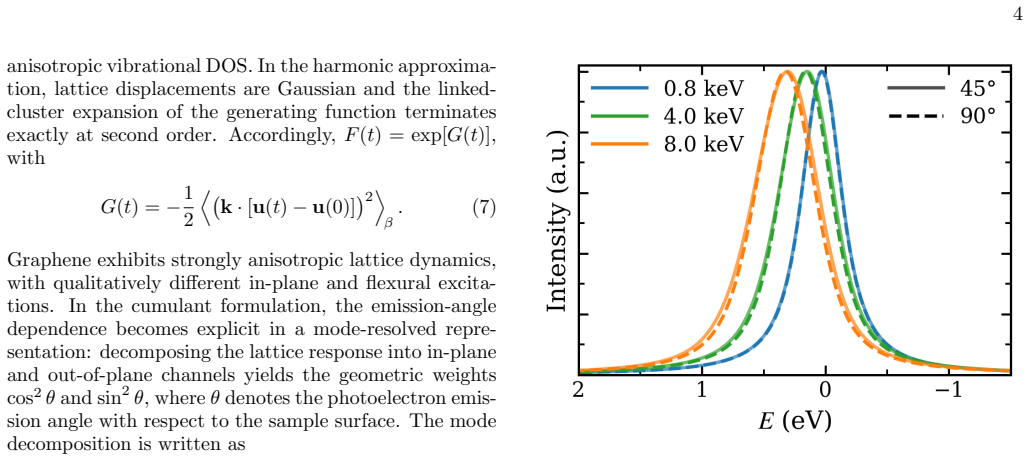
A fixed intrinsic electronic line shape convolved with a photon-energy-dependent phonon recoil kernel reproduces the full evolution of graphene C 1s hard X-ray spectra from 0.8 keV to 8 keV.
A machine-rendered reading of the paper's core claim, the machinery that carries it, and where it could break.
Core claim
The central claim is that the observed photon-energy dependence of the C 1s line shape arises entirely from convolution of a photon-energy-independent intrinsic electronic response (taken from 0.8 keV spectra) with a graphene-specific phonon recoil kernel whose strength scales with photon energy and emission geometry; the Fujikawa-Takata cumulant treatment of recoil alone fails to produce the measured asymmetric tails, while the convolution succeeds for both line shape and centroid position up to 8 keV.
What carries the argument
The electronic convolution model: an intrinsic, fixed C 1s electronic line shape extracted at low energy is convolved with a phonon recoil kernel derived from an anisotropic vibrational density of states constrained by first-principles calculations.
If this is right
- The recoil contribution must be combined with the many-body electronic response rather than added to symmetric lifetime broadening alone.
- Line-shape evolution and centroid shifts across the 0.8-8 keV range are fully accounted for by the photon-energy dependence of the recoil kernel.
- No refitting of electronic parameters is required at higher photon energies once the low-energy intrinsic shape is fixed.
- The treatment is geometry-dependent through the anisotropic phonon spectrum and the emission angle.
Where Pith is reading between the lines
- The same fixed-shape-plus-recoil convolution could be applied to other 2D materials or core levels where recoil and electronic asymmetry compete on comparable scales.
- Subtracting the recoil kernel from high-energy spectra may yield cleaner access to the intrinsic many-body response for comparison with theory.
- Angle-resolved measurements at fixed high photon energy could test whether the model correctly captures the predicted geometric variation of the recoil kernel.
Load-bearing premise
The intrinsic electronic line shape determined at 0.8 keV stays unchanged when the photon energy is raised.
What would settle it
Spectra recorded above 8 keV that show additional asymmetry, width, or centroid deviation that cannot be removed by adjusting only the recoil kernel strength while keeping the electronic shape fixed.
Figures



read the original abstract
Hard-x-ray C 1s photoemission from monolayer graphene probes a regime in which nuclear recoil and intrinsic electronic asymmetry contribute on comparable energy scales to the observed spectral line shape. Here we combine experiment and modeling over the photon-energy range 0.8 keV--8 keV to resolve this interplay quantitatively. A graphene-specific implementation of the Fujikawa--Takata cumulant formalism, based on an anisotropic vibrational density of states constrained by first-principles phonon calculations, captures the expected recoil scaling with photon energy and emission geometry but fails to reproduce the pronounced asymmetric tails of the measured spectra. To overcome this limitation, we introduce an explicit electronic convolution model in which an intrinsic, photon-energy-independent electronic line shape extracted from near-recoilless 0.8 keV data is convolved with a phonon recoil kernel carrying the full dependence on photon energy and emission angle. This approach reproduces both the measured line-shape evolution and the observed centroid shifts across the explored energy range without refitting the spectra at higher photon energies. The results show that recoil in graphene cannot be described by a baseline treatment in which the phonon recoil kernel is combined only with symmetric lifetime broadening, but must be treated together with the intrinsic many-body electronic response of the C 1s line.
Editorial analysis
A structured set of objections, weighed in public.
Referee Report
Summary. The paper claims that hard X-ray C 1s photoemission spectra from monolayer graphene (0.8–8 keV) arise from the convolution of a photon-energy-independent intrinsic electronic line shape (extracted from near-recoilless 0.8 keV data) with a recoil kernel derived from a graphene-specific Fujikawa–Takata cumulant expansion. The kernel incorporates an anisotropic vibrational density of states from first-principles phonon calculations and carries the full dependence on photon energy and emission geometry. This fixed-parameter model is reported to reproduce both the evolution of asymmetric line shapes and the observed centroid shifts without refitting at higher energies, whereas a baseline treatment using only symmetric lifetime broadening fails to capture the tails.
Significance. If the central result holds, the work is significant for quantitative XPS analysis of light-element 2D materials, where recoil and many-body electronic effects become comparable. It supplies a predictive, first-principles-based route to separate nuclear and electronic contributions and demonstrates that recoil must be treated jointly with the intrinsic C 1s asymmetry rather than added to symmetric broadening. The no-refit prediction across nearly an order of magnitude in photon energy constitutes a strong internal test of the framework.
major comments (1)
- Results section on the convolution model: the central claim that the fixed electronic line shape convolved with the recoil kernel reproduces line shapes and centroid shifts 'without refitting' is presented without quantitative goodness-of-fit metrics (e.g., reduced χ², RMS residuals, or uncertainty on extracted shifts). This omission weakens the ability to judge whether the agreement is within experimental precision across the full energy range.
minor comments (3)
- Theory section: the description of the anisotropic vibrational density of states would benefit from an explicit statement of the k-point sampling density and the number of phonon branches retained in the cumulant expansion to allow independent verification of kernel convergence.
- Figure captions (e.g., those showing experimental vs. modeled spectra): inclusion of the precise emission angles and analyzer acceptance used in both experiment and calculation would clarify how geometry dependence is tested.
- The manuscript could add a brief paragraph discussing the expected validity range of the sudden approximation for the electronic line shape between 0.8 and 8 keV, even if deviations are anticipated to be small.
Simulated Author's Rebuttal
We thank the referee for the positive assessment of our work and the constructive comment. We address the point below and will revise the manuscript to incorporate quantitative metrics as suggested.
read point-by-point responses
-
Referee: Results section on the convolution model: the central claim that the fixed electronic line shape convolved with the recoil kernel reproduces line shapes and centroid shifts 'without refitting' is presented without quantitative goodness-of-fit metrics (e.g., reduced χ², RMS residuals, or uncertainty on extracted shifts). This omission weakens the ability to judge whether the agreement is within experimental precision across the full energy range.
Authors: We agree that quantitative goodness-of-fit metrics will strengthen the presentation and allow readers to assess the agreement more rigorously. In the revised manuscript we will add reduced χ² values, RMS residuals, and uncertainties on the extracted centroid shifts for each photon energy, computed from the experimental error bars on the measured spectra. These additions will confirm that the fixed-parameter convolution reproduces the data within experimental precision across 0.8–8 keV without refitting, while leaving the central conclusions unchanged. revision: yes
Circularity Check
No significant circularity; low-energy extraction tested at high energies via independent first-principles kernel
full rationale
The central construction extracts an intrinsic electronic line shape solely from near-recoilless 0.8 keV spectra (where recoil broadening is negligible at ~0.022 eV) and convolves it with a phonon recoil kernel whose energy and angular dependence is fixed by first-principles phonon calculations and the Fujikawa-Takata cumulant formalism. This fixed combination is then applied to higher-energy data (up to 8 keV) without any refitting of parameters to those spectra. Because the kernel is not adjusted to the target data and the electronic component is taken from a regime where recoil is demonstrably small, the reproduction of line-shape evolution and centroid shifts constitutes an independent test rather than a self-consistent fit. No load-bearing self-citation, self-definitional loop, or renaming of fitted quantities occurs in the derivation chain.
Axiom & Free-Parameter Ledger
free parameters (1)
- electronic line shape parameters
axioms (1)
- domain assumption Intrinsic electronic line shape of C 1s is independent of photon energy in the 0.8-8 keV range
Lean theorems connected to this paper
-
IndisputableMonolith/Foundation/RealityFromDistinction.leanreality_from_one_distinction unclear?
unclearRelation between the paper passage and the cited Recognition theorem.
baseline recoil model uses symmetric Lorentzian lifetime broadening plus phonon kernel; explicit model adds fixed DS asymmetry
What do these tags mean?
- matches
- The paper's claim is directly supported by a theorem in the formal canon.
- supports
- The theorem supports part of the paper's argument, but the paper may add assumptions or extra steps.
- extends
- The paper goes beyond the formal theorem; the theorem is a base layer rather than the whole result.
- uses
- The paper appears to rely on the theorem as machinery.
- contradicts
- The paper's claim conflicts with a theorem or certificate in the canon.
- unclear
- Pith found a possible connection, but the passage is too broad, indirect, or ambiguous to say the theorem truly supports the claim.
Reference graph
Works this paper leans on
-
[1]
C. S. Fadley, J. Electron Spectrosc. Relat. Phenom.178– 179, 2 (2010)
work page 2010
-
[2]
C. S. Fadley, inHard X-ray Photoelectron Spectroscopy (HAXPES), Springer Series in Surface Sciences, Vol. 59, edited by J. C. Woicik (Springer, Cham, 2016) pp. 1–34
work page 2016
-
[3]
T. Fujikawa, R. Suzuki, and L. K¨ ov´ er, Journal of Electron Spectroscopy and Related Phenomena151, 170 (2006)
work page 2006
- [4]
- [5]
-
[6]
M. Vos, M. R. Went, Y. Kayanuma, S. Tanaka, Y. Takata, and J. Mayers, Phys. Rev. B78, 024301 (2008)
work page 2008
-
[7]
E. Kukk, T. D. Thomas, D. C´ eolin, S. Granroth, O. Travnikova, M. Berholts, T. Marchenko, R. Guillemin, L. Journel, I. Ismail, R. P¨ uttner, M. N. Piancastelli, K. Ueda, and M. Simon, Phys. Rev. Lett.121, 073002 (2018)
work page 2018
- [8]
-
[9]
Falkovsky, Physics Letters A372, 5189 (2008)
L. Falkovsky, Physics Letters A372, 5189 (2008)
work page 2008
-
[10]
S. Viola Kusminskiy, D. K. Campbell, and A. H. Cas- tro Neto, Phys. Rev. B80, 035401 (2009)
work page 2009
-
[11]
W. L. Z. Zhao, K. S. Tikhonov, and A. M. Finkel’stein, Scientific Reports8, 16256 (2018)
work page 2018
-
[12]
A. Al Taleb and D. Far´ ıas, Journal of Physics: Condensed Matter28, 103005 (2016)
work page 2016
-
[13]
A. Politano, A. R. Marino, and G. Chiarello, Journal of Physics: Condensed Matter24, 104025 (2012)
work page 2012
-
[14]
K. H. Michel and B. Verberck, Phys. Rev. B78, 085424 (2008)
work page 2008
-
[15]
S. Doniach and M. Sunjic, Journal of Physics C: Solid State Physics3, 285 (1970)
work page 1970
- [16]
- [17]
-
[18]
Apponiet al., Carbon 10.1016/j.carbon.2023.118502 (2024)
A. Apponiet al., Carbon 10.1016/j.carbon.2023.118502 (2024)
-
[19]
Kayanuma, inHard X-ray Photoelectron Spectroscopy (HAXPES), Springer Series in Surface Sciences, Vol
Y. Kayanuma, inHard X-ray Photoelectron Spectroscopy (HAXPES), Springer Series in Surface Sciences, Vol. 59, edited by J. C. Woicik (Springer, Cham, 2016) pp. 175– 195
work page 2016
- [20]
-
[21]
V. Miseikis, D. Convertino, N. Mishra, M. Gemmi, T. Mashoff, S. Heun, N. Haghighian, F. Bisio, M. Canepa, V. Piazza, and C. Coletti, 2D Materials2, 014006 (2015)
work page 2015
-
[22]
D. Convertino, F. Fabbri, N. Mishra, M. Mainardi, V. Cappello, G. Testa, S. Capsoni, L. Albertazzi, S. Luin, L. Marchetti, and C. Coletti, Nano Letters20, 3633 (2020), pMID: 32208704
work page 2020
-
[23]
X. Li, W. Cai, J. An, S. Kim, J. Nah, D. Yang, R. Piner, A. Velamakanni, I. Jung, E. Tutuc, S. K. Banerjee, L. Colombo, and R. S. Ruoff, Science324, 1312 (2009)
work page 2009
-
[24]
A. J. Marsden, M. Skilbeck, M. Healey, H. R. Thomas, M. Walker, R. S. Edwards, N. A. Garcia, V. Filip, H. Jabraoui, T. R. Walsh, J. P. Rourke, and N. R. Wil- son, Phys. Chem. Chem. Phys.24, 2318 (2022)
work page 2022
-
[25]
D. A. Shirley, Phys. Rev. B5, 4709 (1972)
work page 1972
-
[26]
S. M. Story, J. J. Kas, F. D. Vila, M. J. Verstraete, and J. J. Rehr, Phys. Rev. B90, 195135 (2014)
work page 2014
-
[27]
T. Fujikawa, H. Arai, R. Suzuki, H. Shinotsuka, L. K¨ ov´ er, and N. Ueno, Journal of Electron Spectroscopy and Re- lated Phenomena162, 146 (2008)
work page 2008
- [28]
- [29]
-
[30]
J.-A. Yan, W. Y. Ruan, and M. Y. Chou, Phys. Rev. B 77, 125401 (2008)
work page 2008
- [31]
-
[32]
D. L. Nika and A. A. Balandin, J. Phys.: Condens. Mat- ter24, 233203 (2012)
work page 2012
-
[33]
E. N. Koukaras, G. Kalosakas, C. Galiotis, and K. Pa- pagelis, Scientific Reports5, 12923 (2015)
work page 2015
- [34]
-
[35]
A. Politano, G. Chiarello, and C. Spinella, Materials Science in Semiconductor Processing65, 88 (2017), ad- vanced transmission electron microscopy for semiconduc- tor and materials science
work page 2017
-
[36]
S. Yuan, R. Rold´ an, and M. I. Katsnelson, Phys. Rev. B 84, 035439 (2011)
work page 2011
- [37]
-
[38]
J. A. Leiro, M. H. Heinonen, T. Laiho, and I. G. Batirev, J. Electron Spectrosc. Relat. Phenom.128, 205 (2003)
work page 2003
-
[39]
Y. Kayanuma, I. Fukahori, S. Tanaka, and Y. Takata, Journal of Electron Spectroscopy and Related Phenom- ena184, 468 (2011)
work page 2011
discussion (0)
Sign in with ORCID, Apple, or X to comment. Anyone can read and Pith papers without signing in.