Recognition: no theorem link
Information Thermodynamics in Generalized Probabilistic Theories
Pith reviewed 2026-05-13 04:46 UTC · model grok-4.3
The pith
No work can be extracted in contradiction with the second law from measurements in generalized probabilistic theories if those measurements respect entropy nondecrease.
A machine-rendered reading of the paper's core claim, the machinery that carries it, and where it could break.
Core claim
We construct information thermodynamics in GPTs and provide a unified framework for analyzing the relationship between measurement, feedback, information erasure, and the second law of thermodynamics. We also formulate a general framework for SPM models and analyze the thermodynamic cost of measurements implemented by SPMs. As a result, we show that no work can be extracted in contradiction with the second law as long as the measurement processes are consistent with entropy nondecrease, and derive sufficient conditions for this property for several entropy definitions proposed in GPTs. Moreover, by considering measurement processes violating these conditions, we construct explicit GPTs in 1D
What carries the argument
The semipermeable-membrane (SPM) implementation of measurements, which converts the thermodynamic cost of a measurement into an explicit work term tied to entropy change.
If this is right
- Any GPT measurement obeying entropy nondecrease automatically satisfies the second law for feedback and erasure protocols.
- Several proposed entropy functions in the GPT literature already meet the derived sufficient conditions.
- GPTs can be constructed in which entropy-decreasing measurements produce isothermal SPM cycles that extract positive work.
- The framework supplies a single language for checking thermodynamic consistency across classical, quantum, and post-quantum theories.
Where Pith is reading between the lines
- Thermodynamic consistency could function as an additional physical filter that rules out certain GPTs as unphysical.
- The same SPM analysis could be extended to other thermodynamic tasks such as heat-engine cycles inside generalized theories.
- If any laboratory system is found to realize a non-quantum GPT, its entropy behavior under measurement could be checked directly against the second-law bound.
Load-bearing premise
The semipermeable-membrane models faithfully represent the actual thermodynamic cost of performing a measurement in these abstract theories.
What would settle it
An explicit calculation or simulation inside a GPT in which a measurement leaves entropy unchanged or increased yet still permits net positive work extraction in a closed isothermal cycle would falsify the central claim.
Figures
read the original abstract
Generalized Probabilistic Theories (GPTs) provide a unified framework for describing probabilistic physical theories, encompassing classical and quantum theories as well as hypothetical theories beyond quantum mechanics. Since most GPTs are highly unrealistic and far removed from known physical theories, it is important to constrain them by physically reasonable principles. One of the most important such principles is consistency with thermodynamics, which has been extensively studied through toy models involving semipermeable membranes (SPMs) implementing measurements. On the other hand, information thermodynamics, which plays a central role in understanding the relationship between measurement and thermodynamics in classical and quantum theory, has remained largely undeveloped in GPTs. In this work, we construct information thermodynamics in GPTs and provide a unified framework for analyzing the relationship between measurement, feedback, information erasure, and the second law of thermodynamics. We also formulate a general framework for SPM models and analyze the thermodynamic cost of measurements implemented by SPMs. As a result, we show that no work can be extracted in contradiction with the second law as long as the measurement processes are consistent with entropy nondecrease, and derive sufficient conditions for this property for several entropy definitions proposed in GPTs. Moreover, by considering measurement processes violating these conditions, we construct explicit GPT systems realizing isothermal SPM cycles from which positive work can be extracted. These results demonstrate that violations of the second law can arise from the lack of fundamental entropy properties or discrepancies between entropy definitions, and provide a unified and model-independent foundation for understanding the relationship between thermodynamics and measurement in GPTs.
Editorial analysis
A structured set of objections, weighed in public.
Referee Report
Summary. The paper develops information thermodynamics within generalized probabilistic theories (GPTs) by constructing a framework based on semipermeable-membrane (SPM) implementations of measurements. It proves that no work can be extracted from isothermal cycles in violation of the second law whenever the measurement processes are consistent with non-decrease of a chosen entropy, derives sufficient conditions on several GPT entropy proposals (including generalizations of von Neumann entropy) that guarantee this consistency, and supplies explicit counterexample GPTs in which the conditions fail and positive work extraction becomes possible.
Significance. If the derivations hold, the work supplies a unified, model-independent foundation for relating measurement, feedback, information erasure, and the second law in GPTs. This is valuable for constraining physically reasonable GPTs via thermodynamic consistency and for clarifying how different entropy definitions affect the possibility of second-law violations. The explicit counterexamples delineate the boundary of the no-violation result and strengthen the conditional character of the main claim. The paper also gives credit to reproducible constructions by providing concrete GPT state spaces and SPM protocols.
major comments (2)
- [§4.2] §4.2, the statement of sufficient conditions for entropy non-decrease: the derivation assumes that the SPM measurement can be represented by a convex combination of extremal effects whose entropy change is controlled by the chosen entropy function; it is not shown whether this representation is always available for arbitrary GPT measurements or only for those satisfying additional tomographic completeness.
- [§5.1] §5.1, Eq. (28): the work-extraction formula for the SPM cycle is derived under the assumption that the free-energy difference is given exactly by the entropy term; if the underlying GPT admits non-trivial affine transformations of the state space, this identification may require an additional normalization step that is not explicitly verified.
minor comments (3)
- The notation for the various entropy functions (e.g., S_vN, S_R, S_α) is introduced piecemeal; a single consolidated table listing each definition together with its sufficient condition would improve readability.
- [§6] In the counterexample constructions of §6, the explicit state-space geometry is described in text only; a diagram showing the convex set and the SPM partition would make the violation of entropy non-decrease easier to visualize.
- The abstract claims that the results 'provide a unified and model-independent foundation'; the manuscript should add a short paragraph in the introduction or conclusion clarifying which aspects remain model-dependent (e.g., the choice of SPM implementation) versus fully general.
Simulated Author's Rebuttal
We thank the referee for their careful reading, positive assessment, and recommendation for minor revision. We address the two major comments point by point below.
read point-by-point responses
-
Referee: [§4.2] §4.2, the statement of sufficient conditions for entropy non-decrease: the derivation assumes that the SPM measurement can be represented by a convex combination of extremal effects whose entropy change is controlled by the chosen entropy function; it is not shown whether this representation is always available for arbitrary GPT measurements or only for those satisfying additional tomographic completeness.
Authors: We agree that the argument in §4.2 proceeds by expressing the SPM measurement as a convex combination of extremal effects whose entropy increments are bounded by the chosen entropy function. In the standard GPT setting, effects are defined on the dual cone and measurements are tomographically complete by construction so that every effect admits such a decomposition into extremal elements. We will revise the text to state this assumption explicitly at the beginning of §4.2 and to note that the sufficient conditions therefore apply to tomographically complete measurements, which is the usual framework in which GPT entropies are defined. This clarification does not change the stated theorems or the counterexamples. revision: partial
-
Referee: [§5.1] §5.1, Eq. (28): the work-extraction formula for the SPM cycle is derived under the assumption that the free-energy difference is given exactly by the entropy term; if the underlying GPT admits non-trivial affine transformations of the state space, this identification may require an additional normalization step that is not explicitly verified.
Authors: We thank the referee for highlighting this point. In the normalized GPTs we consider, the unit effect is fixed and the free-energy difference reduces directly to the entropy term because any affine transformation preserving the probabilistic structure leaves both the normalization and the entropy difference invariant. Nevertheless, to remove any ambiguity we will insert a short paragraph after Eq. (28) that explicitly verifies the identification under affine reparameterizations of the state space and confirms that no additional normalization is required. The revised version will contain this verification. revision: yes
Circularity Check
No significant circularity; derivation self-contained
full rationale
The paper constructs a general SPM-based framework for information thermodynamics in GPTs and derives sufficient conditions for entropy nondecrease from the axioms of the chosen entropy functions. The central result is explicitly conditional: no work extraction violating the second law holds precisely when measurements satisfy entropy nondecrease. No load-bearing step reduces by the paper's own equations to a fitted parameter, self-citation chain, or definitional renaming; the counterexample GPTs when conditions fail are constructed explicitly within the model. Assumptions about SPM fidelity and entropy relevance are stated as inputs rather than smuggled in as derivations.
Axiom & Free-Parameter Ledger
axioms (2)
- domain assumption Generalized Probabilistic Theories provide a unified framework encompassing classical and quantum theories
- domain assumption Measurement processes consistent with entropy non-decrease obey the second law
Reference graph
Works this paper leans on
-
[1]
clarified the essence of this problem through a simple model involving measurement and feedback, thereby sug- gesting a deep connection between thermodynamics and information. Motivated by this idea, Brillouin [39] and Gabor [40] argued that acquiring information through measurement necessarily requires thermodynamic cost, while Landauer [41] and Bennett ...
-
[2]
If an entropySis consistent with the direct sum, thenS ′ andS ∞ are also consistent with the direct sum. B. Measurement processes satisfying entropy nondecrease In this subsection, we consider measurement processes satisfying entropy nondecrease. As we will see in later sections, whether processes involving measurements de- crease entropies becomes a cent...
-
[3]
The initial state is given by ρAM B1B2B3 (0) :=ρ A (0) ⊗ρ M (0) ⊗γ B1 β ⊗γ B2 β ⊗γ B3 β .(31)
-
[4]
We additionally re- quire thatM⊗id B2B3 is a valid process
A measurement processM:AM B 1 →KAM B 1 is performed, whereKis a classical system represent- ing the measurement outcome. We additionally re- quire thatM⊗id B2B3 is a valid process. (The same 8 convention will be adopted below.) We denote the resulting state byρ KAM B1B2B3 (1)
-
[5]
More precisely, we apply the processF=P k∈K(Fk ⊗δ kϵk) on systemKAB 2
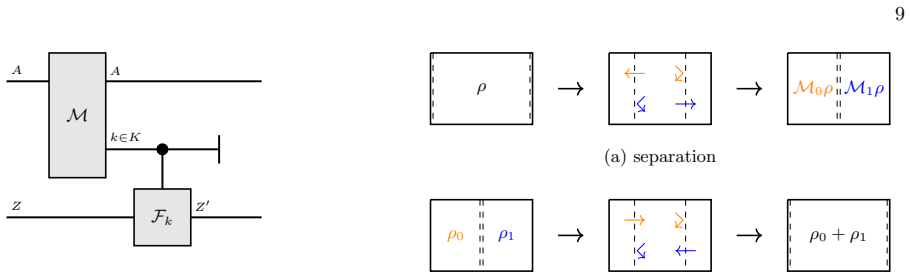
A feedback processF k :AB 2 →AB 2 depend- ing on the measurement outcomek∈Kis per- formed. More precisely, we apply the processF=P k∈K(Fk ⊗δ kϵk) on systemKAB 2. We denote the resulting state byρ KAM B1B2B3 (2)
-
[6]
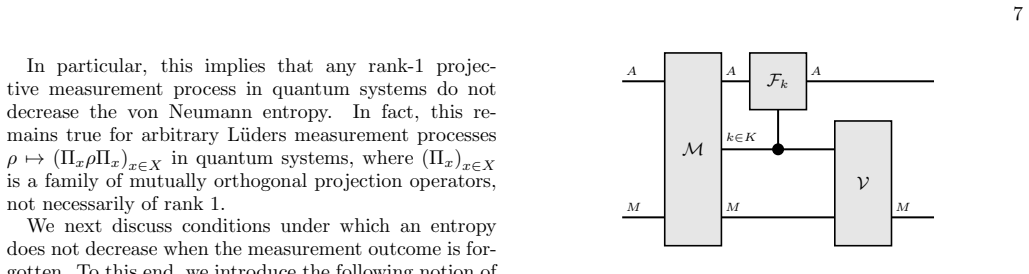
Finally, a processV:KM B 3 →M B 3 is performed to erase the measurement outcome. We denote the resulting state byρ AM B1B2B3 (3) . After this process, the state of the memory device returns to its initial state, namely,ρ M (3) =ρ M (0), where we use the short- hand notationρ M (3) := tr AB1B2B3 ρAM B1B2B3 (3) , and similarly for other reduced states. We d...
- [7]
-
[8]
Divide each container (z, k)∈ZKaccording to the proportions transferred to eachz ′ ∈Z ′
-
[9]
Merge the containers differing only inz∈Z
-
[10]
The work extracted during this protocol coincides with Eq
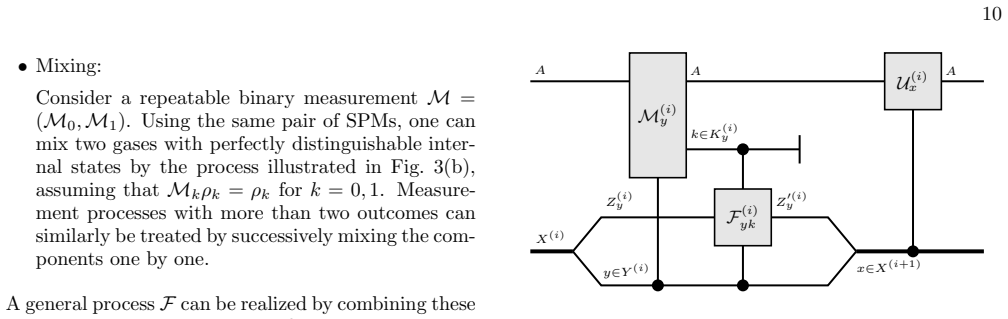
Perform “mixing” independently for eachz ′ ∈Z ′. The work extracted during this protocol coincides with Eq. (39). We consider an isothermal cycle composed of opera- tions implemented by SPMs as described above and refer to such a cycle as anSPM cycle. The general form of an SPM cycle is illustrated in Fig. 4. The cycle consists of nsteps, and thei-th step...
-
[11]
The initial state is a stateρ (i,0) of the composite system of a classical systemX (i) and an internal GPT systemA
-
[12]
A reversible processX (i) → L y∈Y (i) Z (i) y is per- formed
-
[13]
Depending on the valuey∈Y (i), an operation im- plemented by SPMs is applied to the systemZ (i) y A: X(i) A y∈Y (i) Z(i) y M(i) y k∈K (i) y A F (i) yk Z′(i) y x∈X(i+1) U (i) x A FIG. 4. Thei-th step in the general form of an SPM cycle, namely, an isothermal cycle implemented using SPMs. 3-1. A repeatable measurement processM (i) y : A→K (i) y Ais performe...
-
[14]
A reversible process L y∈Y (i) Z ′(i) y →X (i+1) is per- formed
-
[15]
A reversible processU (i) x :A→Adepending on the valuex∈X (i+1) is performed. We denote the resulting state of the systemX (i+1)Abyρ (i+1,0), which serves as the initial state for the next step. Afternsteps, the final state returns to the initial state: X (n) =X (0) andρ (n,0) =ρ (0,0). Here, the reversible processX (i) →L y∈Y (i) Z (i) y rep- resents rel...
-
[16]
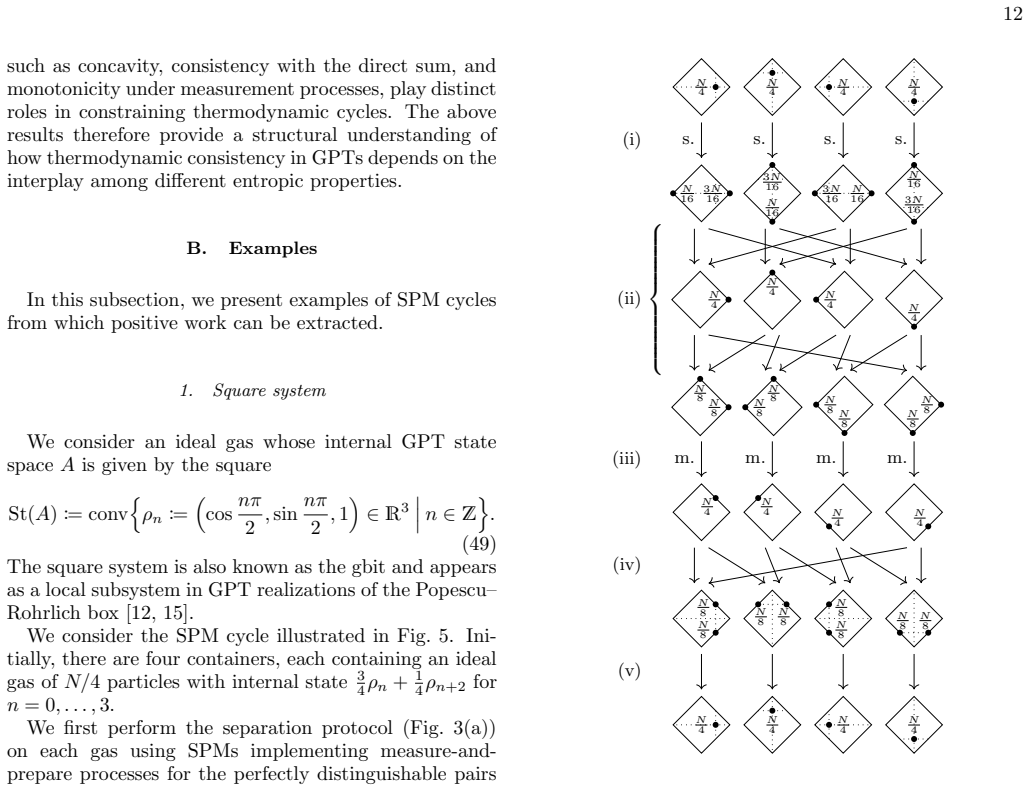
Square system We consider an ideal gas whose internal GPT state spaceAis given by the square St(A) := conv n ρn := cos nπ 2 ,sin nπ 2 ,1 ∈R 3 n∈Z o . (49) The square system is also known as the gbit and appears as a local subsystem in GPT realizations of the Popescu– Rohrlich box [12, 15]. We consider the SPM cycle illustrated in Fig. 5. Ini- tially, ther...
-
[17]
(53) We consider the SPM cycle illustrated in Fig
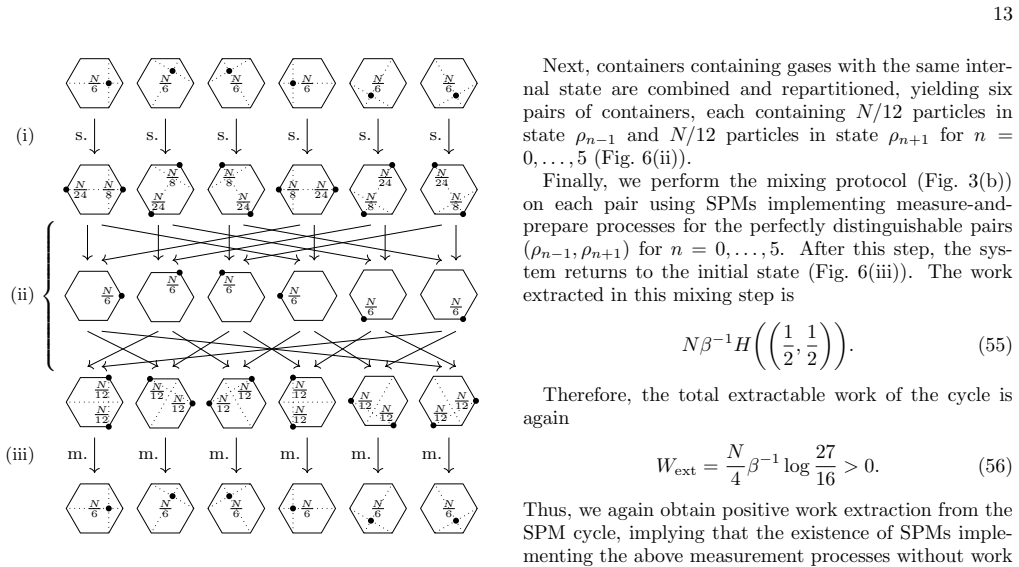
Regular hexagon system We next consider the regular hexagon system [16], St(A) := conv n ρn := cos nπ 3 ,sin nπ 3 ,1 ∈R 3 n∈Z o . (53) We consider the SPM cycle illustrated in Fig. 6. Ini- tially, there are six containers, each containing an ideal gas ofN/6 particles with internal state 1 2 ρn−1 + 1 2 ρn+1 forn= 0, . . . ,5. We first perform the separatio...
-
[18]
Von Neumann [28–30] Research on SPM models originates from the thought experiments of von Neumann [28, 29]. He derived the von Neumann entropy as the thermodynamic entropy of quantum systems by considering the following process. Consider an ideal gas consisting ofN λ x particles whose internal quantum states are given by mutually orthogonal pure states|φ ...
-
[19]
H¨ anggi and Wehner [24] H¨ anggi and Wehner [24] considered the following cycle. First, they considered two gases whose internal states are distinct mixed states, and mixed them using SPMs imple- menting a rank-1 L¨ uders measurement process, until the internal state became uniform. Next, they used another SPM to decompose the gases into perfectly distin...
-
[20]
Krumm et al. [25, 26, 31, 32] By generalizing von Neumann’s thought experiment, Krummet al.[25, 26] derived conditions that the “ther- modynamic entropy” of an internal GPT system must satisfy. Following von Neumann’s argument, they as- sumeed that the decomposition into PDP states can be implemented by an SPM without thermodynamic cost. Under this assump...
-
[21]
extended this result to all non-classical regular poly- gon systems. 15 Krummet al.[25, 26] also argued that the thermody- namic entropy must be concave by considering the free mixing process. Furthermore, assuming PDP decomposability and a stronger version of pure transitivity, they showed that the entropy defined by Eq. (58) is well defined, satisfies t...
-
[22]
Minagawa et al. [27] Minagawa et al. [27] considered systems that are pure transitive and that admit at least one state possessing a PDP decomposition. Following von Neumann’s argu- ment, they assumed that decompositions into PDP states can be implemented by an SPM without any thermody- namic cost. In such systems, they showed that if there exists a state...
work page 2025
-
[23]
This implies that ifeis indecomposable, then there exists somex∈Xsuch thate ρAx x x∈X =e xρAx x
Every effecte∈Eff XA can be written in the forme ρAx x x∈X = P x∈X exρAx x wheree x ∈Eff(A x). This implies that ifeis indecomposable, then there exists somex∈Xsuch thate ρAx x x∈X =e xρAx x . Thus, any fine-grained measurementE ∈Meas fg XA can be written asE ρAx x x∈X = P x∈X ExρAx x using fine-grained measurementsE x ∈Meas fg(Ax) (x∈X). Therefore, we ob...
-
[24]
For an arbitrary classical systemZ, we have I Z:XA acc ρZXA = sup E:XA→Y I Z:Y (idX ′ ⊗ E)ρ ZXA = sup (Ex:Ax→Yx)x∈X I Z:L x∈X Yx (idZ ⊗ Ex)ρZAx x x∈X = sup (Ex:Ax→Yx)x∈X I Z:X ρZX + I Z:Yx x∈X (idZ ⊗ Ex)ρZAx x x∈X =I Z:X ρZX + X x∈X ρZAx x sup Ex:Ax→Yx I Z:Yx (idZ ⊗ Ex)bρZAx x =I Z:X ρZX + I Z:Ax acc x∈X ρZXA . Therefore, we obtain S′XA ρXA = sup ρZXA ∈En...
-
[25]
If the entropySis consistent with the direct sum, we find S′XA ρXA = sup ρZXA ∈Ens(ρXA) I Z:XA acc ρZXA + D SXA E Z ρZXA = sup ρZXA ∈Ens(ρXA) I Z:X ρZX + I Z:Ax acc x∈X ρZXA + H X Z ρZX + D SAx x∈X E Z ρZXA =H X ρX + X x∈X ρAx x sup ρZx Axx ∈Ens(bρAxx ) I Zx:Ax acc ρZxAx x + SAx Zx ρZxAx x =H X ρX + D S′Ax E x∈X ρXA . 18 Proof of Proposition 2.We denoteM=...
-
[26]
Araki, On a characterization of the state space of quantum mechanics, Commun
H. Araki, On a characterization of the state space of quantum mechanics, Commun. Math. Phys.75, 1 (1980)
work page 1980
-
[27]
Hardy, Quantum theory from five reasonable axioms (2001), arXiv:quant-ph/0101012 [quant-ph]
L. Hardy, Quantum theory from five reasonable axioms (2001), arXiv:quant-ph/0101012 [quant-ph]
-
[28]
L. Masanes and M. P. M¨ uller, A derivation of quantum theory from physical requirements, New J. Phys.13, 063001 (2011)
work page 2011
-
[29]
G. Chiribella, G. M. D’Ariano, and P. Perinotti, Informational derivation of quantum theory, Phys. Rev. A84, 012311 (2011)
work page 2011
-
[30]
M. P. M¨ uller and C. Ududec, Structure of reversible computation determines the self-duality of quantum theory, Phys. Rev. Lett.108, 130401 (2012)
work page 2012
- [31]
-
[32]
M. P. M¨ uller, J. Oppenheim, and O. C. Dahlsten, The black hole information problem beyond quantum theory, J. High Energ. Phys.2012(9), 116
work page 2012
-
[33]
M. Pl´ avala, S. Nimmrichter, and M. Kleinmann, Probing the nonclassical dynamics of a quantum particle in a gravitational field, Class. Quantum Grav.42, 225023 (2025)
work page 2025
-
[34]
G. Ludwig, Versuch einer axiomatischen Grundlegung der Quantenmechanik und allgemeinerer physikalischer Theorien, Z. Phys.181, 233 (1964)
work page 1964
-
[35]
E. B. Davies and J. T. Lewis, An operational approach to quantum probability, Commun. Math. Phys.17, 239 (1970)
work page 1970
-
[36]
Gudder, Convex structures and operational quantum mechanics, Commun
S. Gudder, Convex structures and operational quantum mechanics, Commun. Math. Phys.29, 249 (1973)
work page 1973
-
[37]
Barrett, Information processing in generalized probabilistic theories, Phys
J. Barrett, Information processing in generalized probabilistic theories, Phys. Rev. A75, 032304 (2007)
work page 2007
-
[38]
P. Janotta and H. Hinrichsen, Generalized probability theories: what determines the structure of quantum theory?, J. Phys. A: Math. Theor.47, 323001 (2014)
work page 2014
-
[39]
Pl´ avala, General probabilistic theories: An introduction, Phys
M. Pl´ avala, General probabilistic theories: An introduction, Phys. Rep.1033, 1 (2023)
work page 2023
-
[40]
S. Popescu and D. Rohrlich, Quantum nonlocality as an axiom, Found. Phys.24, 379 (1994)
work page 1994
-
[41]
P. Janotta, C. Gogolin, J. Barrett, and N. Brunner, Limits on nonlocal correlations from the structure of the local state space, New J. Phys.13, 063024 (2011)
work page 2011
- [42]
- [43]
-
[44]
Y. Yoshida, H. Arai, and M. Hayashi, Perfect discrimination in approximate quantum theory of general probabilistic theories, Phys. Rev. Lett.125, 150402 (2020)
work page 2020
-
[45]
M. Pl´ avala and M. Kleinmann, Operational theories in phase space: Toy model for the harmonic oscillator, Phys. Rev. Lett.128, 040405 (2022)
work page 2022
-
[46]
M. Pl´ avala and M. Kleinmann, Generalized dynamical theories in phase space and the hydrogen atom, Phys. Rev. A108, 052212 (2023). 21
work page 2023
- [47]
-
[48]
A. Einstein and P. Schilpp,Autobiographical Notes, Library of living philosophers (Open Court, 1979)
work page 1979
-
[49]
E. H¨ anggi and S. Wehner, A violation of the uncertainty principle implies a violation of the second law of thermodynamics, Nat. Commun.4, 1670 (2013)
work page 2013
-
[50]
M. Krumm, Thermodynamics and the structure of quantum theory as a generalized probabilistic theory (2015), arXiv:1508.03299 [quant-ph]
- [51]
-
[52]
S. Minagawa, H. Arai, and F. Buscemi, Von Neumann’s information engine without the spectral theorem, Phys. Rev. Res. 4, 033091 (2022)
work page 2022
-
[53]
J. v. Neumann, Thermodynamik quantenmechanischer Gesamtheiten, Nachr. Ges. Wiss. G¨ ottingen Math.-Phys. Kl.1927, 273 (1927)
work page 1927
-
[54]
J. v. Neumann,Mathematische Grundlagen der Quantenmechanik(Springer, 1932)
work page 1932
-
[55]
D. Petz, Entropy, von Neumann and the von Neumann entropy, inJohn von Neumann and the Foundations of Quantum Physics(Springer Netherlands, 2001) pp. 83–96
work page 2001
- [56]
-
[57]
R. Takakura, Entropy of mixing exists only for classical and quantum-like theories among the regular polygon theories, J. Phys. A: Math. Theor.52, 465302 (2019)
work page 2019
- [58]
-
[59]
A. J. Short and S. Wehner, Entropy in general physical theories, New J. Phys.12, 033023 (2010)
work page 2010
- [60]
- [61]
-
[62]
J. C. Maxwell,Theory of Heat, Text-books of science (D. Appleton and Company, 1872)
-
[63]
L. Szilard, ¨Uber die Entropieverminderung in einem thermodynamischen System bei Eingriffen intelligenter Wesen, Z. Phys.53, 840 (1929)
work page 1929
-
[64]
Brillouin, Maxwell’s demon cannot operate: Information and entropy
L. Brillouin, Maxwell’s demon cannot operate: Information and entropy. i, J. Appl. Phys.22, 334 (1951)
work page 1951
-
[65]
Gabor, Light and information, Prog
D. Gabor, Light and information, Prog. Opt.1, 109 (1961)
work page 1961
-
[66]
Landauer, Irreversibility and heat generation in the computing process, IBM J
R. Landauer, Irreversibility and heat generation in the computing process, IBM J. Res. Dev.5, 183 (1961)
work page 1961
-
[67]
C. H. Bennett, The thermodynamics of computation—a review, Int. J. Theor. Phys.21, 905 (1982)
work page 1982
-
[68]
K. Maruyama, ˇC. Brukner, and V. Vedral, Thermodynamical cost of accessing quantum information, Journal of Physics A: Mathematical and General38, 7175 (2005)
work page 2005
-
[69]
T. Sagawa and M. Ueda, Second law of thermodynamics with discrete quantum feedback control, Phys. Rev. Lett.100, 080403 (2008)
work page 2008
-
[70]
T. Sagawa and M. Ueda, Minimal energy cost for thermodynamic information processing: Measurement and information erasure, Phys. Rev. Lett.102, 250602 (2009)
work page 2009
-
[71]
T. Sagawa and M. Ueda, Erratum: Minimal energy cost for thermodynamic information processing: Measurement and information erasure [Phys. Rev. Lett. 102, 250602 (2009)], Phys. Rev. Lett.106, 189901 (2011)
work page 2009
-
[72]
K. Jacobs, Second law of thermodynamics and quantum feedback control: Maxwell’s demon with weak measurements, Phys. Rev. A80, 012322 (2009)
work page 2009
-
[73]
T. Sagawa and M. Ueda, Generalized Jarzynski equality under nonequilibrium feedback control, Phys. Rev. Lett.104, 090602 (2010)
work page 2010
- [74]
-
[75]
A. B´ erut, A. Arakelyan, A. Petrosyan, S. Ciliberto, R. Dillenschneider, and E. Lutz, Experimental verification of Landauer’s principle linking information and thermodynamics, Nature483, 187 (2012)
work page 2012
-
[76]
Tajima, Second law of information thermodynamics with entanglement transfer, Phys
H. Tajima, Second law of information thermodynamics with entanglement transfer, Phys. Rev. E88, 042143 (2013)
work page 2013
-
[77]
K. Funo, Y. Watanabe, and M. Ueda, Integral quantum fluctuation theorems under measurement and feedback control, Phys. Rev. E88, 052121 (2013)
work page 2013
-
[78]
J. M. R. Parrondo, J. M. Horowitz, and T. Sagawa, Thermodynamics of information, Nat. Phys.11, 131 (2015)
work page 2015
-
[79]
Y. Morikuni, H. Tajima, and N. Hatano, Quantum jarzynski equality of measurement-based work extraction, Phys. Rev. E95, 032147 (2017)
work page 2017
-
[80]
K. Abdelkhalek, Y. Nakata, and D. Reeb, Fundamental energy cost for quantum measurement (2018), arXiv:1609.06981 [quant-ph]
discussion (0)
Sign in with ORCID, Apple, or X to comment. Anyone can read and Pith papers without signing in.