Recognition: no theorem link
Proof Theory for Bimodal Provability Logics
Pith reviewed 2026-05-13 02:42 UTC · model grok-4.3
The pith
Bimodal provability logics CS, CSM and ER now have non-labelled sequent calculi that prove uniform Lyndon interpolation.
A machine-rendered reading of the paper's core claim, the machinery that carries it, and where it could break.
Core claim
We provide the first non-labelled sequent calculi for the bimodal provability logics CS, CSM and ER. We present non-wellfounded versions of our calculi to establish a cut-elimination procedure. Finally, we prove that these logics enjoy the uniform Lyndon interpolation property.
What carries the argument
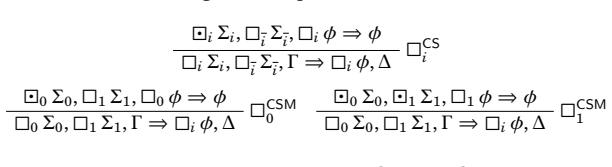
Non-labelled sequent calculi for bimodal provability logics with usual provability predicates, together with their non-wellfounded extensions that support cut-elimination.
If this is right
- The logics CS, CSM and ER admit cut-free proofs through their non-wellfounded sequent calculi.
- Uniform Lyndon interpolation holds for all three logics, preserving variable polarities in interpolants.
- These calculi give a syntactic basis for studying proof properties in bimodal provability logics.
- Cut-elimination and interpolation results apply uniformly across CS, CSM and ER.
Where Pith is reading between the lines
- The calculi could be adapted to support proof search or decision procedures for statements involving two provability predicates.
- Non-wellfounded techniques for cut-elimination may transfer to other modal logics that lack ordinary wellfounded derivations.
- The interpolation property might imply further structural results, such as variable dependencies in arithmetic realizations of the logics.
Load-bearing premise
The sequent rules correctly encode the semantics of the usual provability predicates in CS, CSM and ER, and the non-wellfounded rules do not create new inconsistencies.
What would settle it
A sequent that is valid under the intended semantics of one of the logics but is not derivable in the corresponding calculus, or a counterexample to uniform Lyndon interpolation in CS, CSM or ER.
Figures



read the original abstract
We provide the first (non-labelled) sequent calculi for bimodal provability logics with "usual" provability predicates. In particular, we introduce calculi for the logics CS, CSM and ER. Additionally, we present non-wellfounded versions of our calculi, and use them to establish a cut-elimination procedure. Finally, we prove the first interpolation results for these logics showing that they all enjoy the uniform Lyndon interpolation property.
Editorial analysis
A structured set of objections, weighed in public.
Referee Report
Summary. The paper introduces the first non-labelled sequent calculi for the bimodal provability logics CS, CSM, and ER (with usual provability predicates). It defines non-wellfounded extensions of these calculi and uses them to prove cut-elimination. It further establishes the first interpolation theorems for these logics, specifically that they satisfy the uniform Lyndon interpolation property.
Significance. If the syntactic rules are shown to be sound and complete for the intended semantics and the cut-elimination and interpolation arguments go through, this constitutes a solid advance in the proof theory of provability logics. The explicit construction of non-labelled systems (rather than labelled ones) and the uniform Lyndon interpolation results are the main contributions; the non-wellfounded technique is a recognized tool in the field and is applied here to obtain cut-elimination without additional semantic machinery.
major comments (2)
- §3 (sequent rules for CS/CSM/ER): the paper must explicitly verify that each modal rule preserves the intended fixed-point semantics of the usual provability predicates; without a direct soundness lemma relating the rules to the bimodal Kripke models or arithmetical interpretations, the claim that these are the 'first' adequate calculi remains provisional.
- §4 (non-wellfounded cut-elimination): the argument that every infinite branch is 'progressing' (and therefore admissible) needs a precise measure or ordinal assignment; if the progress condition is only stated informally, the cut-elimination theorem does not yet follow from the standard non-wellfounded proof theory results cited.
minor comments (2)
- Notation for the two modalities is introduced without a dedicated table; a small table listing the rules for □ and ◇ (or their bimodal counterparts) would improve readability.
- The statement of uniform Lyndon interpolation in §5 should include an explicit definition of the polarity condition on the interpolant, as the term 'uniform' is used in several non-equivalent ways in the interpolation literature.
Simulated Author's Rebuttal
We thank the referee for the thorough review and valuable suggestions. We address the two major comments point by point below, indicating the revisions we will make to strengthen the manuscript.
read point-by-point responses
-
Referee: §3 (sequent rules for CS/CSM/ER): the paper must explicitly verify that each modal rule preserves the intended fixed-point semantics of the usual provability predicates; without a direct soundness lemma relating the rules to the bimodal Kripke models or arithmetical interpretations, the claim that these are the 'first' adequate calculi remains provisional.
Authors: We agree that an explicit soundness argument is required to substantiate the adequacy of the calculi. In the revised manuscript we will insert a new subsection in §3 that states and proves a direct soundness lemma for each modal rule. The lemma will relate the rules to the fixed-point semantics of the provability predicates and to the corresponding bimodal Kripke models, thereby confirming that the systems are sound for the intended interpretations. This addition will also support the claim that the calculi are the first non-labelled ones for CS, CSM and ER. revision: yes
-
Referee: §4 (non-wellfounded cut-elimination): the argument that every infinite branch is 'progressing' (and therefore admissible) needs a precise measure or ordinal assignment; if the progress condition is only stated informally, the cut-elimination theorem does not yet follow from the standard non-wellfounded proof theory results cited.
Authors: The referee correctly identifies that the progress condition must be made fully precise. Although the manuscript defines progressing branches via a decrease in a modal-depth measure, we will revise §4 to introduce an explicit ordinal assignment (based on the lexicographic order of formula complexity and modal nesting along each branch). We will then prove that every infinite branch is progressing if and only if the associated ordinal sequence is strictly decreasing, allowing a direct appeal to the cited non-wellfounded cut-elimination theorems. This formalization will be added without altering the overall proof strategy. revision: yes
Circularity Check
No significant circularity detected
full rationale
The paper defines new non-labelled sequent calculi for CS, CSM and ER from explicit syntactic rules, then proves cut-elimination via non-wellfounded extensions and uniform Lyndon interpolation directly from those rules. No step reduces a claimed result to a fitted parameter, self-referential definition, or load-bearing self-citation whose content is presupposed; the derivations are self-contained syntactic constructions whose adequacy is established by independent semantic and proof-theoretic arguments.
Axiom & Free-Parameter Ledger
axioms (2)
- domain assumption Standard Hilbert-Bernays-Löb conditions for provability predicates
- standard math Classical sequent calculus rules for propositional connectives
Reference graph
Works this paper leans on
-
[1]
B. Afshari, G. E. Leigh, and G. Menéndez Turata. Uniform interpolation from cyclic proofs: The case of modal mu-calculus. InAutomated Reasoning with Analytic Tableaux and Related Methods: 30th International Conference, TABLEAUX 2021, Birmingham, UK, September 6–9, 2021, Proceedings, Berlin, Heidelberg, 2021. Springer-Verlag
work page 2021
-
[2]
B. Afshari, G. E. Leigh, and G. Menéndez Turata. A cyclic proof system for full computation tree logic. In B. Klin and E. Pimentel, editors,31st EACSL Annual Conference on Computer Science Logic (CSL 2023), volume 252 ofLeibniz International Proceedings in Informatics (LIPIcs), pages 5:1–5:19, Dagstuhl, Germany, 2023. Schloss Dagstuhl – Leibniz-Zentrum fü...
work page 2023
-
[3]
B. Afshari, L. Grotenhuis G. E. Leigh, and L. Zenger. Ill-founded proof systems for intuitionistic linear- time temporal logic. In R. Ramanayake and J. Urban, editors,Automated Reasoning with Analytic Tableaux and Related Methods, pages 223–241, Cham, 2023. Springer Nature Switzerland
work page 2023
- [4]
-
[5]
A non-wellfounded and labelled sequent calculus for bimodal provability logic, 2025
Justus Becker. A non-wellfounded and labelled sequent calculus for bimodal provability logic, 2025
work page 2025
-
[6]
Springer Berlin Heidelberg, Berlin, Heidelberg, 1984
Hans Bekić.Definable operations in general algebras, and the theory of automata and flowcharts, pages 30–55. Springer Berlin Heidelberg, Berlin, Heidelberg, 1984
work page 1984
-
[7]
Lev D. Beklemishev. On bimodal logics of provability.Annals of Pure and Applied Logic, 68(2):115–159, 1994
work page 1994
-
[8]
Lev D. Beklemishev. Bimodal logics for extensions of arithmetical theories.Journal of Symbolic Logic, 61(1):91–124, 1996
work page 1996
-
[9]
G. Boolos. On systems of modal logic with provability interpretations.Theoria, 46:7–18, 2008
work page 2008
-
[10]
M. Borzechowski, M. Gattinger, H. H. Hansen, R. Ramanayake, V. Trucco Dalmas, and Y. Venema. Propositional dynamic logic has Craig interpolation: a tableau-based proof, 2025
work page 2025
-
[11]
Jude Brighton. Cut elimination for GLS using the terminability of its regress process.Journal of Philosophical Logic, 45, 03 2015
work page 2015
-
[12]
J. Brotherston and A. Simpson. Complete sequent calculi for induction and infinite descent. In22nd Annual IEEE Symposium on Logic in Computer Science (LICS 2007), pages 51–62, 2007
work page 2007
-
[13]
S. Bucheli, R. Kuznets, and Thomas Studer. Two ways to common knowledge.Electronic Notes in Theoretical Computer Science, 262:83–98, 2010. Proceedings of the 6th Workshop on Methods for Modalities (M4M-6 2009)
work page 2010
-
[14]
Timothy J. Carlson. Modal logics with several operators and provability interpretations.Israel Journal of Mathematics, 54:14–24, 1986
work page 1986
-
[15]
Lev D. Beklemishev. Normalization of deductions and interpolation for some logics of provability. Russian Math. Surveys, 42(6):223–224, 1987
work page 1987
-
[16]
A. Das and D. Pous. Non-wellfounded proof theory for (kleene+action)(algebras+lattices). In D. R. Ghica and A. Jung, editors,27th EACSL Annual Conference on Computer Science Logic, CSL 2018, Birmingham, UK, September 4-7, 2018, volume 119 ofLIPIcs, pages 19:1–19:18. Schloss Dagstuhl - Leibniz-Zentrum für Informatik, 2018
work page 2018
-
[17]
Dick de Jongh, Marc Jumelet, and Franco Montagna. On the proof of solovay’s theorem.Studia Logica: An International Journal for Symbolic Logic, 50(1):51–69, 1991
work page 1991
-
[18]
Cam- bridge Tracts in Theoretical Computer Science
Stéphane Demri, Valentin Goranko, and Martin Lange.The Modal Mu-Calculus, page 271–328. Cam- bridge Tracts in Theoretical Computer Science. Cambridge University Press, 2016
work page 2016
-
[19]
Untersuchungen über das logische Schließen I.Mathematische Zeitschrift, 39:176– 210, 1935
Gerhard Gentzen. Untersuchungen über das logische Schließen I.Mathematische Zeitschrift, 39:176– 210, 1935
work page 1935
-
[20]
Rajeev Goré, Revantha Ramanayake, and Ian Shillito. Cut-elimination for provability logic by ter- minating proof-search: Formalised and deconstructed using Coq. In Anupam Das and Sara Negri, editors,Automated Reasoning with Analytic Tableaux and Related Methods, pages 299–313, Cham,
-
[21]
Springer International Publishing. 41
-
[22]
Non-wellfounded proof theory for inter- pretability logic
Sebastijan Horvat, Borja Sierra Miranda, and Thomas Studer. Non-wellfounded proof theory for inter- pretability logic. InAutomated Reasoning with Analytic Tableaux and Related Methods: 34th Interna- tional Conference, TABLEAUX 2025, Reykjavik, Iceland, September 27–29, 2025, Proceedings, Berlin, Heidelberg, 2025. Springer-Verlag
work page 2025
-
[23]
Uniform interpolation for interpretabil- ity logic, 2025
Sebastijan Horvat, Borja Sierra Miranda, and Thomas Studer. Uniform interpolation for interpretabil- ity logic, 2025. arXiv:2511.01428
-
[24]
Giorgi Japaridze and Dick de Jongh. The logic of provability. In Samuel R. Buss, editor,Handbook of Proof Theory, volume 137 ofStudies in Logic and the Foundations of Mathematics, pages 475–546. Elsevier, 1998
work page 1998
-
[25]
J. Kloibhofer, V. Trucco Dalmas, and Y. Venema. Interpolation for converse PDL. In G. L. Pozzato and T. Uustalu, editors,Automated Reasoning with Analytic Tableaux and Related Methods, pages 258–277, Cham, 2026. Springer Nature Switzerland
work page 2026
-
[26]
Cyclic proofs for linear temporal logic
Ioannis Kokkinis and Thomas Studer. Cyclic proofs for linear temporal logic. In Dieter Probst and Peter Schuster, editors,Concepts of Proof in Mathematics, Philosophy, and Computer Science, pages 171–192, Berlin, Boston, 2016. De Gruyter
work page 2016
-
[27]
H. Kushida. A proof theory for the logic of provability in true arithmetic.Studia Logica, 108, 2020
work page 2020
-
[28]
Note on some fixed point constructions in provability logic.J Philos Logic, 35:225–230, 2006
Per Lindström. Note on some fixed point constructions in provability logic.J Philos Logic, 35:225–230, 2006
work page 2006
-
[29]
Paul Lorenzen.Einführung in die operative Logik und Mathematik. Springer, 1955
work page 1955
-
[30]
Franco Montagna. Provability in finite subtheories of PA and relative interpretability: A modal inves- tigation.The Journal of Symbolic Logic, 52(2):494–511, 1987
work page 1987
-
[31]
Vladimir Rybakov.Admissibility of Logical Inference Rules. Elsevier, 1997
work page 1997
-
[32]
Non-well-founded proofs for the Grzegorczyk modal logic.The Review of Symbolic Logic, 14(1), 2021
Yuri Savateev and Daniyar Shamkanov. Non-well-founded proofs for the Grzegorczyk modal logic.The Review of Symbolic Logic, 14(1), 2021
work page 2021
-
[33]
Cut elimination for the weak modal Grzegorczyk logic via non-well-founded proofs
Yury Savateev and Daniyar Shamkanov. Cut elimination for the weak modal Grzegorczyk logic via non-well-founded proofs. In Rosalie Iemhoff, Michael Moortgat, and Ruy de Queiroz, editors,Logic, Language, Information, and Computation, pages 569–583. Springer, 2019
work page 2019
- [34]
-
[35]
Circular proofs for the Gödel-Löb provability logic.Mathematical Notes, 96, 2014
Daniyar Shamkanov. Circular proofs for the Gödel-Löb provability logic.Mathematical Notes, 96, 2014
work page 2014
-
[36]
Nested sequents for provability logic GLP.Logic Journal of the IGPL, 23(5):789– 815, 2015
Daniyar Shamkanov. Nested sequents for provability logic GLP.Logic Journal of the IGPL, 23(5):789– 815, 2015
work page 2015
-
[37]
Borja Sierra Miranda and Thomas Studer. Cut elimination for a non-wellfounded system for the master modality.Journal of Symbolic Logic, to appear. arXiv:2505.02700
-
[38]
Uniform Lyndon interpolation via non-wellfounded proofs
Borja Sierra Miranda and Thomas Studer. Uniform Lyndon interpolation via non-wellfounded proofs. InAdvances in Modal Logic 2026, to appear
work page 2026
-
[39]
Coalgebraic proof translations for non- wellfounded proofs
Borja Sierra Miranda, Thomas Studer, and Lukas Zenger. Coalgebraic proof translations for non- wellfounded proofs. In A. Ciabattoni, D. Gabelaia, and I. Sedlár, editors,Advances in Modal Logic 2024, pages 527–548, 2024
work page 2024
-
[40]
Craig Smoryński.Self-Reference and Modal Logic. Universitext. Springer New York, NY, 1985
work page 1985
-
[41]
R. M. Solovay. Provability interpretations of modal logic.Israel Journal of Mathematics, 25, 1976. 42
work page 1976
-
[42]
W. W. Tait. A nonconstructive proof of Gentzen’s Hauptsatz for second order predicate logic.Bulletin of the American Mathematical Society, 72(6):980–983, 1966
work page 1966
-
[43]
Moto-o Takahashi. A proof of cut-elimination theorem in simple type-theory.Journal of the Mathe- matical Society of Japan, 19(4):399–410, 1967
work page 1967
-
[44]
The modal logic of provability: Cut-elimination.Journal of Philosophical Logic, 12(4):471–476, 1983
Silvio Valentini. The modal logic of provability: Cut-elimination.Journal of Philosophical Logic, 12(4):471–476, 1983
work page 1983
-
[45]
A course on bimodal provability logic.Annals of Pure and Applied Logic, 73(1):109–142, 1995
Albert Visser. A course on bimodal provability logic.Annals of Pure and Applied Logic, 73(1):109–142, 1995. 43
work page 1995
discussion (0)
Sign in with ORCID, Apple, or X to comment. Anyone can read and Pith papers without signing in.