Recognition: no theorem link
Tangent-Plane Evidential Uncertainty in Active Learning for Magnetic Interatomic Potentials
Pith reviewed 2026-05-13 02:36 UTC · model grok-4.3
The pith
Defining spin-force uncertainty in the tangent plane produces a reliable guide for active learning of magnetic interatomic potentials
A machine-rendered reading of the paper's core claim, the machinery that carries it, and where it could break.
Core claim
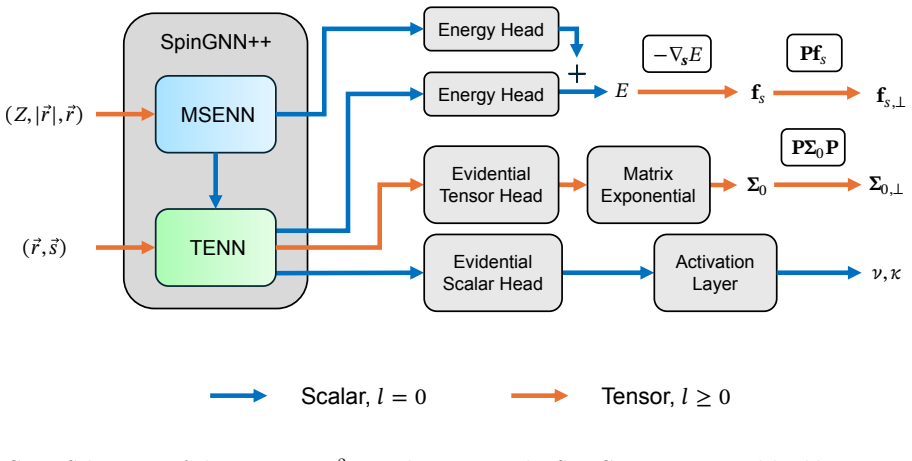
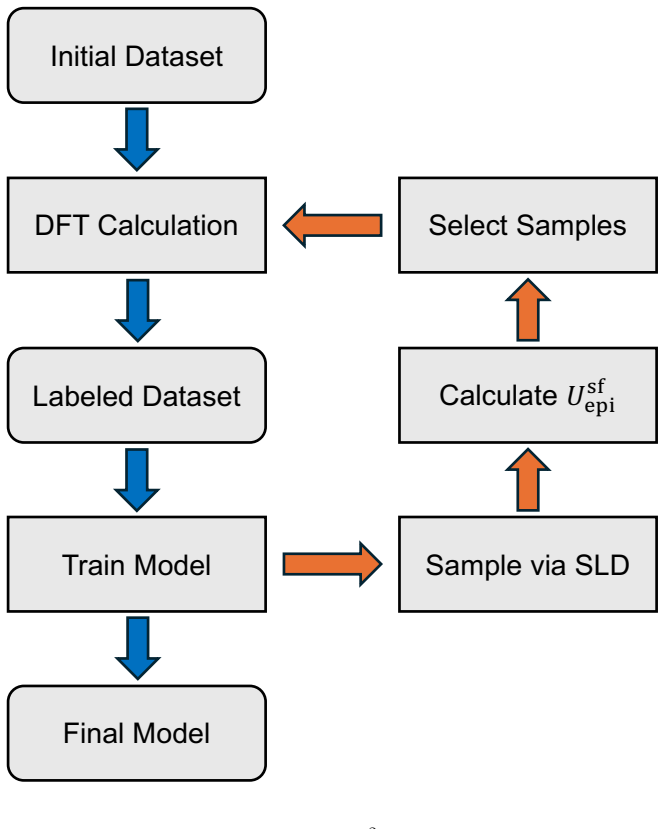
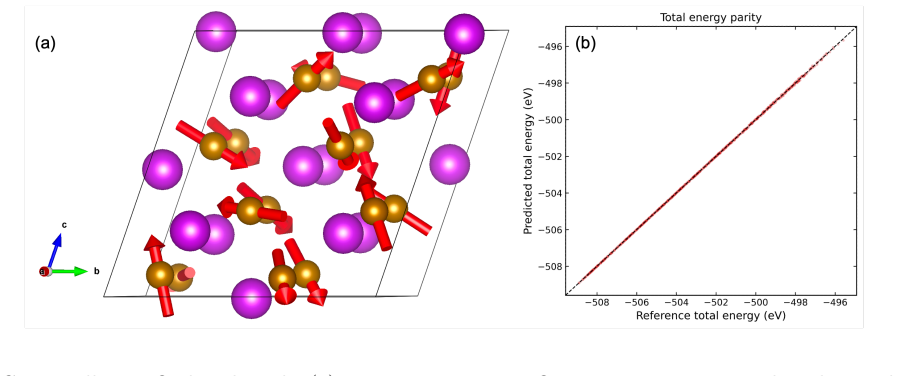
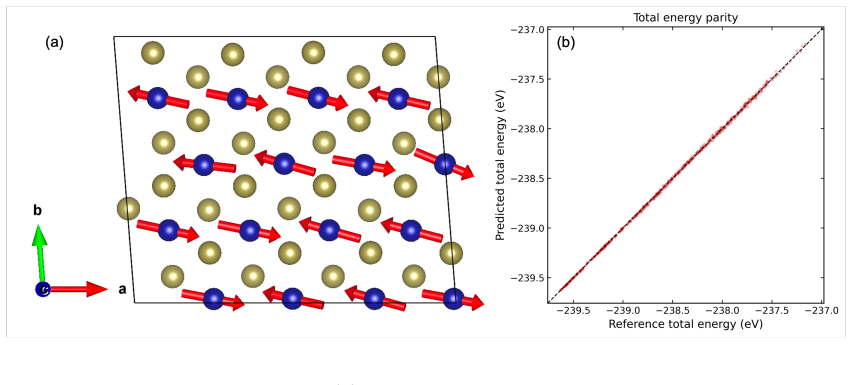
By formulating the projected spin-force likelihood in the tangent plane orthogonal to the local spin direction, the extended evidential framework yields an epistemic uncertainty indicator U_epi^sf that correlates strongly with prediction error. In active-learning loops on bulk BiFeO3 and monolayer CrTe2, this indicator selects more informative configurations than random sampling and simultaneously raises accuracy on energy, atomic forces, and projected spin forces.
What carries the argument
The tangent-plane epistemic uncertainty indicator U_epi^sf obtained from the projected spin-force likelihood in the plane orthogonal to the local spin direction.
If this is right
- U_epi^sf correlates strongly with actual prediction errors on energy, force, and spin-force targets.
- Active learning driven by U_epi^sf selects more informative configurations than random sampling.
- Models trained with this selection achieve simultaneous gains in energy, force, and projected spin-force accuracy.
Where Pith is reading between the lines
- The same tangent-plane projection could be applied to other vector quantities whose magnitude is fixed by supervision.
- Fewer noncollinear first-principles calculations would be needed to reach target accuracy for magnetic materials.
- Tests on additional magnetic systems would reveal whether the error correlation persists beyond the two reported benchmarks.
Load-bearing premise
Formulating the projected spin-force likelihood and epistemic uncertainty in the tangent plane orthogonal to the local spin direction produces a physically meaningful uncertainty estimate for magnetic-response targets.
What would settle it
An active-learning experiment on BiFeO3 or CrTe2 in which U_epi^sf-selected data shows no stronger error correlation or no accuracy gain over random sampling would falsify the central claim.
Figures

read the original abstract
Magnetic interatomic potentials need to account for coupled lattice and spin degrees of freedom, yet constructing reliable training sets remains costly because noncollinear first-principles labels are expensive. Active learning can mitigate this cost, provided that the uncertainty estimate is physically meaningful for the magnetic-response targets that drive spin reorientation. Here we extend the $\mathrm{e}^2\mathrm{IP}$ evidential framework to magnetic machine-learning interatomic potentials by formulating the projected spin-force likelihood and the corresponding epistemic uncertainty in the tangent plane orthogonal to the local spin direction. This construction prevents the uncertainty model from allocating probability mass to a radial spin component that is absent from the constrained-moment supervision. Using bulk BiFeO$_3$ and monolayer CrTe$_2$ as benchmark systems, we show that the resulting tangent-plane epistemic uncertainty indicator $U_{\mathrm{epi}}^{\mathrm{sf}}$ correlates strongly with prediction error and selects more informative configurations than random sampling, simultaneously improving energy, force, and projected spin-force accuracy. These results demonstrate a physically interpretable and data-efficient route for constructing uncertainty-aware magnetic machine-learning interatomic potentials.
Editorial analysis
A structured set of objections, weighed in public.
Referee Report
Summary. The paper extends the e²IP evidential framework to magnetic machine-learning interatomic potentials by formulating the projected spin-force likelihood and epistemic uncertainty in the tangent plane orthogonal to the local spin direction. This geometric projection is intended to avoid allocating probability mass to radial spin components absent from constrained-moment supervision. On benchmarks with bulk BiFeO₃ and monolayer CrTe₂, the resulting tangent-plane epistemic uncertainty indicator U_epi^sf is reported to correlate strongly with prediction error and to enable active learning that selects more informative configurations than random sampling, yielding simultaneous gains in energy, force, and projected spin-force accuracy.
Significance. If the tangent-plane construction is shown to produce a physically meaningful and well-calibrated uncertainty estimate, the work would provide a targeted, data-efficient route for uncertainty-aware training of magnetic interatomic potentials, addressing the high cost of noncollinear first-principles data. The simultaneous improvement across energy, force, and spin-force targets on two chemically distinct systems is a positive feature; however, the absence of quantitative correlation metrics and statistical controls in the reported results limits the immediate impact.
major comments (2)
- [Benchmark results on BiFeO₃ and CrTe₂] Benchmark results on BiFeO₃ and CrTe₂: the abstract asserts that U_epi^sf 'correlates strongly with prediction error' and 'selects more informative configurations than random sampling,' yet no quantitative metrics (Pearson or Spearman coefficients, R² values, improvement percentages, or error bars from repeated trials) are provided. These numbers are load-bearing for the central claim and must be reported with statistical tests to substantiate the 'strongly' qualifier and the superiority over random sampling.
- [Methods - tangent-plane formulation] Tangent-plane formulation: the physical justification that projecting the spin-force likelihood into the plane orthogonal to the local spin direction yields a meaningful epistemic uncertainty for magnetic-response targets (e.g., spin reorientation) is stated but not derived in detail. An explicit derivation or sensitivity analysis showing how this projection alters the uncertainty estimate relative to an unprojected formulation would be required to confirm it is not an ad-hoc geometric choice.
minor comments (1)
- Notation: ensure the definition of U_epi^sf and the distinction between projected spin-force and full spin-force quantities are introduced with equations at first use and used consistently throughout.
Simulated Author's Rebuttal
We thank the referee for the constructive feedback and positive assessment of the work's potential impact. We address each major comment below and will incorporate the suggested revisions to strengthen the quantitative support and methodological clarity.
read point-by-point responses
-
Referee: Benchmark results on BiFeO₃ and CrTe₂: the abstract asserts that U_epi^sf 'correlates strongly with prediction error' and 'selects more informative configurations than random sampling,' yet no quantitative metrics (Pearson or Spearman coefficients, R² values, improvement percentages, or error bars from repeated trials) are provided. These numbers are load-bearing for the central claim and must be reported with statistical tests to substantiate the 'strongly' qualifier and the superiority over random sampling.
Authors: We agree that quantitative metrics and statistical controls are essential to support the claims. In the revised manuscript we will report Pearson and Spearman correlation coefficients between U_epi^sf and the absolute prediction errors for energy, forces, and projected spin forces on both BiFeO₃ and CrTe₂. We will also quantify the active-learning improvement as percentage reductions in test-set error relative to random sampling, include error bars from at least five independent trials, and apply paired statistical tests (e.g., Wilcoxon signed-rank) to establish significance. These additions will appear in the Results section and the abstract will be updated to reference the specific coefficients and improvement factors. revision: yes
-
Referee: Tangent-plane formulation: the physical justification that projecting the spin-force likelihood into the plane orthogonal to the local spin direction yields a meaningful epistemic uncertainty for magnetic-response targets (e.g., spin reorientation) is stated but not derived in detail. An explicit derivation or sensitivity analysis showing how this projection alters the uncertainty estimate relative to an unprojected formulation would be required to confirm it is not an ad-hoc geometric choice.
Authors: The projection is required because constrained-moment DFT supplies no radial spin-force information; an unprojected model would therefore assign spurious probability mass to an unphysical degree of freedom. In the revised Methods section we will provide a full derivation beginning from the evidential likelihood for the spin-force vector, applying the orthogonal projection onto the local tangent plane, and obtaining the closed-form expression for the tangent-plane epistemic uncertainty U_epi^sf. We will also add a sensitivity comparison that recomputes the uncertainty without the projection, quantifies the resulting change in magnitude and ranking, and shows the effect on active-learning selection performance. revision: yes
Circularity Check
No significant circularity in derivation chain
full rationale
The paper's central construction defines the tangent-plane epistemic uncertainty U_epi^sf by projecting the spin-force likelihood onto the plane orthogonal to the local spin direction, which is a deliberate modeling choice to respect the constrained-moment supervision (preventing radial probability mass). This is not self-definitional or a fitted input renamed as prediction; the resulting indicator is then validated empirically via correlation with prediction error and active-learning curves on BiFeO3 and CrTe2 benchmarks. The extension of the cited e²IP framework is presented as an independent geometric adaptation, with no load-bearing self-citation chain or uniqueness theorem reducing the result to prior inputs by construction. The performance gains over random sampling are shown through direct comparison, keeping the derivation self-contained against external benchmarks.
Axiom & Free-Parameter Ledger
axioms (1)
- domain assumption The evidential e2IP framework can be extended to magnetic potentials via a projected spin-force likelihood that respects constrained-moment supervision
Reference graph
Works this paper leans on
-
[1]
E. Y. Vedmedenko, R. K. Kawakami, D. D. Sheka, P. Gambardella, A. Kirilyuk, A. Hirohata, C. Binek, O. Chubykalo-Fesenko, S. Sanvito, B. J. Kirby, J. Grollier, K. Everschor-Sitte, T. Kampfrath, C.-Y. You, and A. Berger, The 2020 magnetism roadmap, Journal of Physics D: Applied Physics53, 453001 (2020)
work page 2020
-
[2]
A. Hirohata, K. Yamada, Y. Nakatani, I.-L. Prejbeanu, B. Di´ eny, P. Pirro, and B. Hillebrands, Review on spintronics: Principles and device applications, Journal of Magnetism and Magnetic Materials509, 166711 (2020)
work page 2020
- [3]
-
[4]
P.-W. Ma, C. H. Woo, and S. L. Dudarev, Large-scale simulation of the spin-lattice dynamics in ferromagnetic iron, Physical Review B78, 024434 (2008)
work page 2008
-
[5]
P.-W. Ma, S. L. Dudarev, and C. H. Woo, Spin-lattice-electron dynamics simulations of mag- netic materials, Physical Review B85, 184301 (2012). 16
work page 2012
-
[7]
T. Yang, Z. Cai, Z. Huang, W. Tang, R. Shi, A. Godfrey, H. Liu, Y. Lin, C.-W. Nan, M. Ye, L. Zhang, K. Wang, H. Wang, and B. Xu, Deep learning illuminates spin and lattice interaction in magnetic materials, Physical Review B110, 064427 (2024)
work page 2024
-
[8]
A. S. Kotykhov, M. Hodapp, C. Tantardini, K. Kravtsov, I. Kruglov, A. V. Shapeev, and I. S. Novikov, Actively trained magnetic moment tensor potentials for mechanical, dynamical, and thermal properties of paramagnetic CrN, Physical Review B111, 094438 (2025)
work page 2025
-
[9]
M. Rinaldi, M. Mrovec, A. Bochkarev, Y. Lysogorskiy, and R. Drautz, Non-collinear magnetic atomic cluster expansion for iron, npj Computational Materials10, 12 (2024)
work page 2024
-
[12]
J. Behler and M. Parrinello, Generalized Neural-Network Representation of High-Dimensional Potential-Energy Surfaces, Physical Review Letters98, 146401 (2007)
work page 2007
-
[13]
A. P. Bart´ ok, M. C. Payne, R. Kondor, and G. Cs´ anyi, Gaussian approximation potentials: The accuracy of quantum mechanics, without the electrons, Physical Review Letters104, 136403 (2010)
work page 2010
-
[14]
A. V. Shapeev, Moment Tensor Potentials: a class of systematically improvable interatomic potentials, Multiscale Modeling & Simulation14, 1153 (2016)
work page 2016
-
[15]
S. Batzner, A. Musaelian, L. Sun, M. Geiger, J. P. Mailoa, M. Kornbluth, N. Molinari, T. E. Smidt, and B. Kozinsky, E(3)-equivariant graph neural networks for data-efficient and accurate interatomic potentials, Nature Communications13, 2453 (2022)
work page 2022
-
[16]
I. Batatia, D. P. Kovacs, G. Simm, C. Ortner, and G. Csanyi, MACE: Higher Order Equivari- ant Message Passing Neural Networks for Fast and Accurate Force Fields, Advances in Neural Information Processing Systems35, 11423 (2022)
work page 2022
-
[17]
B. Deng, P. Zhong, K. Jun, J. Riebesell, K. Han, C. J. Bartel, and G. Ceder, CHGNet as a pretrained universal neural network potential for charge-informed atomistic modelling, Nature 17 Machine Intelligence5, 1031 (2023)
work page 2023
-
[18]
I. S. Novikov, B. Grabowski, F. K¨ ormann, and A. V. Shapeev, Magnetic Moment Tensor Potentials for collinear spin-polarized materials reproduce different magnetic states of bcc Fe, npj Computational Materials8, 13 (2022)
work page 2022
-
[19]
J. B. J. Chapman and P.-W. Ma, A machine-learned spin-lattice potential for dynamic simu- lations of defective magnetic iron, Scientific Reports12, 22451 (2022)
work page 2022
-
[20]
H. Yu, Y. Zhong, L. Hong, C. Xu, W. Ren, X. Gong, and H. Xiang, Spin-dependent graph neural network potential for magnetic materials, Physical Review B109, 144426 (2024)
work page 2024
-
[21]
A. S. Kotykhov, K. Gubaev, V. Sotskov, C. Tantardini, M. Hodapp, A. V. Shapeev, and I. S. Novikov, Fitting to magnetic forces improves the reliability of magnetic Moment Tensor Potentials, Computational Materials Science245, 113331 (2024)
work page 2024
-
[22]
W. Xu, R. Y. Sanspeur, A. Kolluru, B. Deng, P. Harrington, S. Farrell, K. Reuter, and J. R. Kitchin, Spin-informed universal graph neural networks for simulating magnetic order- ing, Proceedings of the National Academy of Sciences of the United States of America122, e2422973122 (2025)
work page 2025
-
[24]
A. S. Kotykhov, K. Gubaev, M. Hodapp, C. Tantardini, A. V. Shapeev, and I. S. Novikov, Constrained DFT-based magnetic machine-learning potentials for magnetic alloys: a case study of Fe-Al, Scientific Reports13, 19728 (2023)
work page 2023
-
[25]
D. Zheng, X. Peng, Y. Huang, Y. Wang, D. Zhang, Z. Huang, Z. Cai, L. Zhang, M. Chen, B. Xu, and W. Zhou, Integrating deep-learning-based magnetic model and non-collinear spin- constrained method: methodology, implementation and application, npj Computational Ma- terials12, 52 (2026)
work page 2026
-
[26]
J. Chen, T. Wan, H. Geng, L. Xiong, G. Wang, Y. Zhao, L. Deng, Z. Gao, S. Fang, Z. Luo, H. Wang, S. Wang, and K. Xu, Data-driven active learning approaches for accelerating mate- rials discovery (2026)
work page 2026
-
[27]
E. V. Podryabinkin and A. V. Shapeev, Active learning of linearly parametrized interatomic potentials, Computational Materials Science140, 171 (2017)
work page 2017
- [28]
-
[29]
Q. Lin, L. Zhang, Y. Zhang, and B. Jiang, Searching Configurations in Uncertainty Space: Active Learning of High-Dimensional Neural Network Reactive Potentials, Journal of Chemical Theory and Computation17, 2691 (2021)
work page 2021
-
[30]
G. S. Jung, J. Y. Choi, and S. M. Lee, Active learning of neural network potentials for rare events, Digital Discovery3, 514 (2024)
work page 2024
-
[31]
D. Bidoggia, N. Manko, M. Peressi, and A. Marrazzo, Automated training of neural-network interatomic potentials (2025)
work page 2025
- [32]
- [33]
-
[34]
G. Imbalzano, Y. Zhuang, V. Kapil, K. Rossi, E. A. Engel, F. Grasselli, and M. Ceriotti, Uncertainty estimation for molecular dynamics and sampling, The Journal of Chemical Physics 154, 074102 (2021)
work page 2021
-
[35]
T. Wollschl¨ ager, N. Gao, B. Charpentier, M. A. Ketata, and S. G¨ unnemann, Uncertainty Estimation for Molecules: Desiderata and Methods, inProceedings of the 40th International Conference on Machine Learning(PMLR, 2023) pp. 37133–37156
work page 2023
-
[38]
N. Meinert and A. Lavin, Multivariate Deep Evidential Regression (2022)
work page 2022
-
[39]
H. Xu, T. Cui, C. Tang, J. Ma, D. Zhou, Y. Li, X. Gao, X. Gong, W. Ouyang, S. Zhang, and M. Su, Evidential deep learning for interatomic potentials, Nature Communications17, 937 (2025)
work page 2025
-
[40]
J. Wang, J. B. Neaton, H. Zheng, V. Nagarajan, S. B. Ogale, B. Liu, D. Viehland, V. Vaithyanathan, D. G. Schlom, U. V. Waghmare, N. A. Spaldin, K. M. Rabe, M. Wut- tig, and R. Ramesh, Epitaxial BiFeO3 Multiferroic Thin Film Heterostructures, Science299, 1719 (2003). 19
work page 2003
-
[41]
X. Sun, W. Li, X. Wang, Q. Sui, T. Zhang, Z. Wang, L. Liu, D. Li, S. Feng, S. Zhong, H. Wang, V. Bouchiat, M. Nunez Regueiro, N. Rougemaille, J. Coraux, A. Purbawati, A. Hadj-Azzem, Z. Wang, B. Dong, X. Wu, T. Yang, G. Yu, B. Wang, Z. Han, X. Han, and Z. Zhang, Room temperature ferromagnetism in ultra-thin van der Waals crystals of 1T-CrTe2, Nano Research...
work page 2020
-
[42]
X. Zhang, Q. Lu, W. Liu, W. Niu, J. Sun, J. Cook, M. Vaninger, P. F. Miceli, D. J. Singh, S.- W. Lian, T.-R. Chang, X. He, J. Du, L. He, R. Zhang, G. Bian, and Y. Xu, Room-temperature intrinsic ferromagnetism in epitaxial CrTe2 ultrathin films, Nature Communications12, 2492 (2021)
work page 2021
-
[43]
A. Musaelian, S. Batzner, A. Johansson, L. Sun, C. J. Owen, M. Kornbluth, and B. Kozinsky, Learning local equivariant representations for large-scale atomistic dynamics, Nature Com- munications14, 579 (2023)
work page 2023
-
[44]
See Supplemental Material at [url] for first-principles reference data, dataset construction, magnetic interatomic-potential model details, and additional uncertainty–error correlations
-
[48]
S. L. Dudarev, G. A. Botton, S. Y. Savrasov, C. J. Humphreys, and A. P. Sutton, Electron- energy-loss spectra and the structural stability of nickel oxide: An LSDA+U study, Physical Review B57, 1505 (1998)
work page 1998
- [49]
-
[51]
J. L. Garc´ ıa-Palacios and F. J. L´ azaro, Langevin-dynamics study of the dynamical properties of small magnetic particles, Physical Review B58, 14937 (1998). 20 Supplemental Material: Tangent-Plane Evidential Uncertainty in Active Learning for Magnetic Interatomic Potentials Yang Cheng, Hongyu Yu, ∗ and Hongjun Xiang † Key Laboratory of Computational Ph...
work page 1998
-
[52]
G. Kresse and J. Furthm¨ uller, Efficiency of ab-initio total energy calculations for metals and semiconductors using a plane-wave basis set, Computational Materials Science6, 15 (1996)
work page 1996
-
[53]
P. E. Bl¨ ochl, Projector augmented-wave method, Physical Review B50, 17953 (1994)
work page 1994
-
[54]
J. P. Perdew, K. Burke, and M. Ernzerhof, Generalized Gradient Approximation Made Simple, Physical Review Letters77, 3865 (1996)
work page 1996
-
[55]
H. Yu, B. Liu, Y. Zhong, L. Hong, J. Ji, C. Xu, X. Gong, and H. Xiang, Physics-informed time-reversal equivariant neural network potential for magnetic materials, Physical Review B 110, 104427 (2024)
work page 2024
- [56]
- [57]
-
[58]
A. I. Liechtenstein, V. I. Anisimov, and J. Zaanen, Density-functional theory and strong interactions: Orbital ordering in Mott-Hubbard insulators, Physical Review B52, R5467 (1995)
work page 1995
-
[59]
J. Tranchida, S. J. Plimpton, P. Thibaudeau, and A. P. Thompson, Massively parallel sym- plectic algorithm for coupled magnetic spin dynamics and molecular dynamics, Journal of Computational Physics372, 406 (2018)
work page 2018
-
[60]
A. P. Thompson, H. M. Aktulga, R. Berger, D. S. Bolintineanu, W. M. Brown, P. S. Crozier, P. J. in ’t Veld, A. Kohlmeyer, S. G. Moore, T. D. Nguyen, R. Shan, M. J. Stevens, J. Tranchida, C. Trott, and S. J. Plimpton, LAMMPS - a flexible simulation tool for particle- based materials modeling at the atomic, meso, and continuum scales, Computer Physics Com- ...
work page 2022
-
[61]
J. L. Garc´ ıa-Palacios and F. J. L´ azaro, Langevin-dynamics study of the dynamical properties of small magnetic particles, Physical Review B58, 14937 (1998)
work page 1998
-
[62]
A. Musaelian, S. Batzner, A. Johansson, L. Sun, C. J. Owen, M. Kornbluth, and B. Kozinsky, Learning local equivariant representations for large-scale atomistic dynamics, Nature Com- munications14, 579 (2023). 9
work page 2023
-
[63]
Z. Wang, T. Cui, J. Zou, S. Zhang, B. Yan, W. Ouyang, W. Tan, and M. Su, Equivariant Evidential Deep Learning for Interatomic Potentials (2026)
work page 2026
- [64]
-
[65]
N. Meinert and A. Lavin, Multivariate Deep Evidential Regression (2022). 10
work page 2022
discussion (0)
Sign in with ORCID, Apple, or X to comment. Anyone can read and Pith papers without signing in.