Recognition: no theorem link
Optical Response of a screw dislocated GaAs Quantum Wire: Temperature and Pressure Effects
Pith reviewed 2026-05-13 03:09 UTC · model grok-4.3
The pith
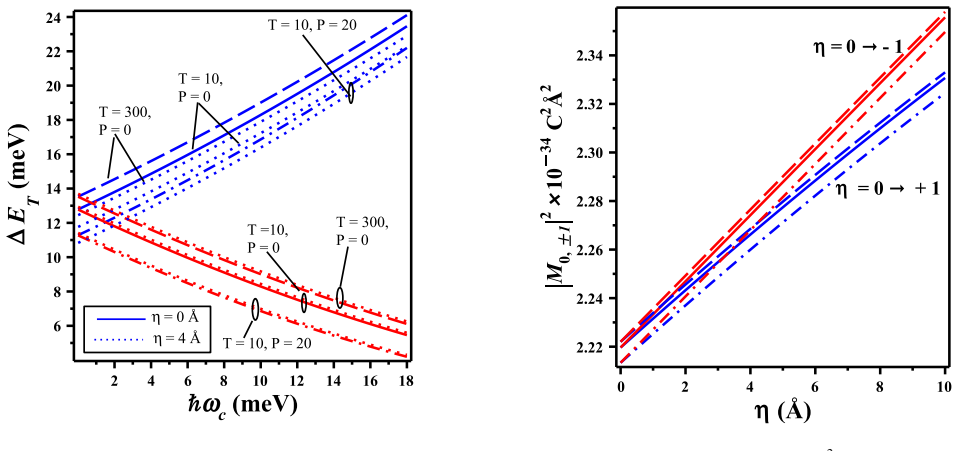
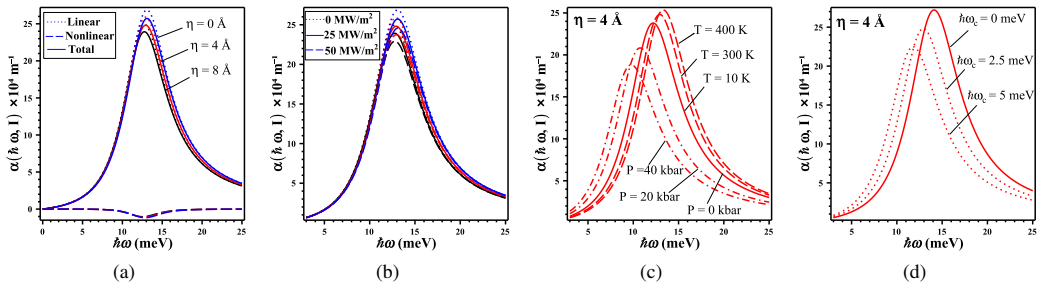
Screw dislocation in a GaAs quantum wire breaks symmetry between m and -m states, redshifting the m=0 to +1 optical transition while blueshifting the m=0 to -1 transition.
A machine-rendered reading of the paper's core claim, the machinery that carries it, and where it could break.
Core claim
Using a torsion-modified metric together with pressure- and temperature-dependent effective mass and dielectric permittivity, the Schrödinger equation yields exact Whittaker-function solutions. The dislocation introduces a kz-dependent coupling that breaks the symmetry between the angular-momentum states m and -m and modifies the centrifugal term. For the m=0 to +1 transition, increasing the dislocation parameter produces a pronounced redshift and suppresses the resonance amplitude; for the m=0 to -1 transition the same increase produces a blueshift and enhances the peak. Temperature shifts both resonances to higher photon energies and increases their amplitudes, while hydrostatic pressure紅移
What carries the argument
Torsion-modified metric that introduces a kz-dependent coupling breaking m ↔ -m symmetry and modifying the effective centrifugal barrier, allowing exact Whittaker-function solutions for the pressure- and temperature-dependent Hamiltonian.
If this is right
- Increasing the dislocation parameter redshifts and suppresses the m=0→+1 absorption peak while blueshifting and enhancing the m=0→-1 peak.
- Raising temperature moves both resonances to higher photon energies and increases their amplitudes.
- Hydrostatic pressure redshifts both transitions and lowers their peak intensities.
- Axial magnetic field strengthens the overall optical response, blueshifting the +1 transition and producing the opposite shift for the -1 transition.
- Refractive-index changes exhibit the same asymmetric dependence on the dislocation parameter as the absorption coefficients.
Where Pith is reading between the lines
- The opposite shifts could be exploited to create polarization-selective filters in nanowire optoelectronics.
- Exact solvability with Whittaker functions suggests the same approach can be applied to other topological defects in cylindrical nanostructures.
- Material-specific tuning ranges for optical response might be mapped by repeating the calculation for different semiconductor hosts.
Load-bearing premise
The torsion-modified metric accurately represents the geometry and potential created by the screw dislocation, and the chosen functional forms for effective mass and dielectric permittivity permit exact Whittaker-function solutions.
What would settle it
Absorption spectra measured on GaAs quantum wires with increasing controlled screw-dislocation density at fixed temperature and pressure, showing a clear redshift of the lower-energy resonance and a blueshift of the higher-energy resonance.
Figures





read the original abstract
We investigate the influence of a screw dislocation, characterized by the dislocation parameter, on the optical response of a parabolic GaAs cylindrical quantum wire under the combined effects of temperature, hydrostatic pressure, and the axial magnetic field. Using a torsion-modified metric together with pressure- and temperature-dependent material properties, namely the effective mass and dielectric permittivity, we obtain exact solutions of the Schr\"odinger equation in terms of Whittaker functions. The screw dislocation introduces a \(k_z\)-dependent coupling that breaks the symmetry between the angular momentum states \(m\) and \(-m\) and modifies the centrifugal term in the effective potential. Based on the resulting eigenstates, we evaluate the linear and third-order nonlinear optical absorption coefficients, as well as the corresponding refractive index changes, for the dipole-allowed transitions \(m = 0 \to +1\) and \(m = 0 \to -1\). Our results show that increasing the dislocation parameter produces a pronounced redshift and suppresses the resonance amplitude for the \(m = 0 \to +1\) transition, whereas the \(m = 0 \to -1\) transition exhibits a blueshift accompanied by peak enhancement. We further find that increasing temperature shifts the resonances toward higher photon energies and enhances their amplitudes, while hydrostatic pressure causes a redshift and reduces the peak intensity for both transitions. In addition, the magnetic field strengthens the optical response and induces a blueshift for the \(m = 0 \to +1\) transition, whereas the opposite behavior is obtained for the \(m = 0 \to -1\) transition. We have also examined the behavior of the refractive index changes, which exhibit analogous asymmetric dependence on the dislocation parameter.
Editorial analysis
A structured set of objections, weighed in public.
Referee Report
Summary. The manuscript investigates the optical response (linear and third-order nonlinear absorption coefficients and refractive index changes) of a parabolic GaAs cylindrical quantum wire containing a screw dislocation, under combined temperature, hydrostatic pressure, and axial magnetic field. A torsion-modified metric is used to incorporate the dislocation parameter, which introduces a k_z-dependent coupling that breaks m ↔ -m symmetry in the effective potential. With pressure- and temperature-dependent effective mass and dielectric permittivity chosen to allow exact solutions, the Schrödinger equation is solved in terms of Whittaker functions. Eigenstates are then used to compute dipole-allowed transitions m=0 → +1 and m=0 → -1, yielding reported trends: increasing dislocation parameter produces redshift and amplitude suppression for +1 but blueshift and enhancement for -1; temperature blueshifts and strengthens resonances while pressure redshifts and weakens them; magnetic field effects are opposite for the two transitions.
Significance. If the torsion-modified metric and the chosen m*(T,P), ε(T,P) forms accurately represent physical screw dislocations in GaAs wires, the exactly solvable model provides a clean platform for exploring geometric and topological effects on optical spectra. The explicit asymmetry between +m and -m channels and the parameter trends could inform device modeling. The use of Whittaker functions for closed-form eigenenergies is a technical strength that enables precise analytic expressions for the optical coefficients.
major comments (3)
- [theoretical model and Schrödinger equation solution] The central claim of asymmetric optical response (redshift/suppression for m=0→+1 versus blueshift/enhancement for m=0→-1) rests on the torsion-modified metric producing a specific k_z-dependent term in the effective potential. However, no derivation of this metric from the Burgers vector geometry, no explicit expression for the resulting effective potential (including the modified centrifugal term), and no comparison to a conventional elastic-strain Hamiltonian or numerical diagonalization are provided. Without these, it is impossible to assess whether the reported asymmetry is physical or an artifact of the ansatz (theoretical model section and Schrödinger-equation solution).
- [material parameters subsection] The functional forms adopted for m*(T,P) and ε(T,P) are stated to permit exact Whittaker solutions, yet the manuscript supplies neither the explicit expressions used nor any error estimate or sensitivity analysis showing how deviations from these forms would alter the T/P trends. This choice is load-bearing for all reported temperature and pressure dependencies (material parameters subsection).
- [results section on optical coefficients] No convergence checks, basis-size tests, or comparison of the Whittaker solutions against direct numerical integration of the radial equation are reported. Given that the optical coefficients depend on the precise eigenenergies and dipole matrix elements, the absence of such verification undermines in the quantitative trends (results section on optical coefficients).
minor comments (2)
- [introduction] The abstract and introduction cite the dislocation parameter but do not define its relation to the Burgers vector magnitude or the wire radius; a brief explicit definition would improve clarity.
- [figure captions] Figure captions for the absorption and refractive-index plots should include the specific values of T, P, B, and dislocation parameter used in each panel to allow direct reproduction.
Simulated Author's Rebuttal
We thank the referee for the thorough review and insightful comments on our manuscript. We address each of the major comments below and have made revisions to the manuscript to incorporate the suggested improvements.
read point-by-point responses
-
Referee: The central claim of asymmetric optical response (redshift/suppression for m=0→+1 versus blueshift/enhancement for m=0→-1) rests on the torsion-modified metric producing a specific k_z-dependent term in the effective potential. However, no derivation of this metric from the Burgers vector geometry, no explicit expression for the resulting effective potential (including the modified centrifugal term), and no comparison to a conventional elastic-strain Hamiltonian or numerical diagonalization are provided. Without these, it is impossible to assess whether the reported asymmetry is physical or an artifact of the ansatz (theoretical model section and Schrödinger-equation solution).
Authors: We agree that providing a derivation of the torsion-modified metric would strengthen the manuscript. In the revised version, we will add a subsection deriving the metric from the screw dislocation geometry characterized by the Burgers vector. We will explicitly present the effective potential, highlighting the k_z-dependent coupling and the modification to the centrifugal term. Regarding comparison to conventional models, the torsion metric is a standard approach in the literature for topological effects in dislocated quantum structures, and we will include a brief discussion noting its equivalence to certain strain-induced terms in the limit of small dislocation parameters. Since our solutions are analytic, we will also add a comparison showing that for zero dislocation parameter, our results reduce to the standard parabolic wire case, and provide a note on agreement with numerical solutions of the radial equation for selected cases. revision: yes
-
Referee: The functional forms adopted for m*(T,P) and ε(T,P) are stated to permit exact Whittaker solutions, yet the manuscript supplies neither the explicit expressions used nor any error estimate or sensitivity analysis showing how deviations from these forms would alter the T/P trends. This choice is load-bearing for all reported temperature and pressure dependencies (material parameters subsection).
Authors: We acknowledge the need for explicit expressions. We will insert the explicit functional forms for m*(T,P) and ε(T,P) in the material parameters subsection. Furthermore, we will add a short paragraph discussing the sensitivity of the results to small variations in these parameters, confirming that the qualitative trends remain robust. revision: yes
-
Referee: No convergence checks, basis-size tests, or comparison of the Whittaker solutions against direct numerical integration of the radial equation are reported. Given that the optical coefficients depend on the precise eigenenergies and dipole matrix elements, the absence of such verification undermines in the quantitative trends (results section on optical coefficients).
Authors: As the eigenfunctions are obtained exactly via Whittaker functions, there are no convergence or basis-size issues associated with numerical diagonalization methods. To address the referee's concern and enhance confidence in the quantitative results, we will include in the revised manuscript a comparison between the analytic eigenenergies and those computed via numerical integration of the radial Schrödinger equation for representative values of the parameters. This will verify the accuracy of the energies and the resulting dipole matrix elements used in the optical coefficients. revision: yes
Circularity Check
No significant circularity in the derivation chain
full rationale
The paper starts from the Schrödinger equation in a torsion-modified metric with the dislocation parameter as an external geometric input, adopts effective-mass and dielectric forms from prior literature to enable exact Whittaker-function solutions, and then computes the linear and nonlinear optical coefficients directly from the resulting eigenstates and dipole matrix elements for the m=0 to ±1 transitions. No equation or result is obtained by fitting to the target spectra, no output is renamed as a prediction of itself, and no load-bearing premise reduces to a self-citation whose content is the present claim. The reported redshift/blueshift asymmetry follows from the explicit k_z-dependent coupling term in the effective potential; all subsequent T, P, and B-field trends are likewise forward evaluations of the same closed-form expressions.
Axiom & Free-Parameter Ledger
free parameters (1)
- dislocation parameter
axioms (2)
- domain assumption Torsion-modified metric correctly represents the geometry and boundary conditions of a screw dislocation in the cylindrical wire.
- domain assumption Effective mass and dielectric permittivity follow established empirical or theoretical dependencies on temperature and hydrostatic pressure.
Reference graph
Works this paper leans on
-
[1]
Q. Hua, G. Shen, Low-dimensional nanostructures for monolithic 3d-integrated flexible and stretchable electron- ics, Chemical Society Reviews 53 (3) (2024) 1316–1353
work page 2024
- [2]
- [3]
-
[4]
J. C. Foster, S. V arlas, B. Couturaud, Z. Coe, R. K. OR- eilly, Getting into shape: reflections on a new generation of cylindrical nanostructures self-assembly using polymer building blocks, Journal of the American Chemical Soci- ety 141 (7) (2019) 2742–2753. 7
work page 2019
-
[5]
K. Hasanirokh, A. Asgari, S. Mohammadi, Fabrication of a light-emitting device based on the cds /zns spherical quantum dots, Journal of the European Optical Society- Rapid Publications 17 (1) (2021) 26
work page 2021
- [6]
- [7]
-
[8]
M. Tshipa, Second and third harmonic generation in lin- ear, concave and convex conical gaas quantum dots, Su- perlattices and Microstructures 159 (2021) 107031
work page 2021
-
[9]
P . Harrison, A. V alavanis, Quantum wells, wires and dots: theoretical and computational physics of semiconductor nanostructures, John Wiley & Sons, 2016
work page 2016
-
[10]
M. R. Monnaatsheko, M. Tshipa, Z. G. Keolopile, Ef- fects of temperature and hydrostatic pressure on the op- tical absorption coefficients of a gaas cylindrical quantum wire with intrinsic inverse parabolic potential in the pres- ence of a magnetic field, Micro and Nanostructures (2025) 208532
work page 2025
-
[11]
A. Turker Tuzemen, H. Dakhlaoui, F. Ungan, E ffects of hydrostatic pressure and temperature on the nonlinear op- tical properties of gaas/gaalas zigzag quantum well, Philo- sophical Magazine 102 (23) (2022) 2428–2443
work page 2022
-
[12]
R. Arraoui, M. Jaouane, A. Ed-Dahmouny, K. El-Bakkari, A. Fakkahi, H. Azmi, H. El Ghazi, A. Sali, E ffects of hy- drostatic pressure, temperature, and magnetic field on the binding energy and diamagnetic susceptibility of a four- quantum-dot nanosystem, Journal of Physics and Chem- istry of Solids 202 (2025) 112670
work page 2025
- [13]
-
[14]
L. Lu, W. Xie, Z. Shu, Combined e ffects of hydrostatic pressure and temperature on nonlinear properties of an exciton in a spherical quantum dot under the applied elec- tric field, Physica B: Condensed Matter 406 (19) (2011) 3735–3740
work page 2011
-
[15]
M. O. Katanaev, Geometric theory of defects, Physics- Uspekhi 48 (7) (2005) 675–701
work page 2005
-
[16]
M. K. Bahar, P . Ba¸ ser, Nonlinear optical specifications of the mathieu quantum dot with screw dislocation, The Eu- ropean Physical Journal Plus 138 (8) (2023) 724
work page 2023
- [17]
-
[18]
W. da Silva, K. Bakke, Quantum aspects of a quantum particle in a cylindrical wire in the presence of a screw dislocation, The European Physical Journal Plus 134 (4) (2019) 131
work page 2019
-
[19]
K. Bakke, Discrete energy spectrum for a spin-1 /2 quan- tum particle under the influence of a constant force field due to the presence of topological defects, Brazilian Jour- nal of Physics 41 (2) (2011) 167–170
work page 2011
- [20]
-
[21]
C. Furtado, F. Moraes, Landau levels in the presence of a screw dislocation, EPL (Europhysics Letters) 45 (3) (1999) 279–282
work page 1999
- [22]
-
[23]
H. Hassanabadi, K. Guo, L. Lu, E. O. Silva, Spiral dis- location as a tunable geometric parameter for optical responses in quantum rings, Annals of Physics (2026) 170346
work page 2026
-
[24]
R. W. Boyd, A. L. Gaeta, E. Giese, Nonlinear optics, in: Springer handbook of atomic, molecular, and optical physics, Springer, 2008, pp. 1097–1110
work page 2008
-
[25]
M. Tshipa, Optical properties of gaas nanowires with an electric potential that varies inversely with the square of the radial distance, Advances in Condensed Matter Physics 2019 (1) (2019) 3478506
work page 2019
-
[26]
N. Arunachalam, A. J. Peter, C. K. Y oo, Exciton optical absorption coe fficients and refractive index changes in a strained inas /gaas quantum wire: The e ffect of the mag- netic field, Journal of luminescence 132 (6) (2012) 1311– 1317
work page 2012
-
[27]
M. Kavitha, A. Naifar, A. J. Peter, V . Raja, Comparison of razavy and pöschl-teller confined potentials on the opto- electronic properties in a znse /cdse/znse quantum well, Optical and Quantum Electronics 56 (9) (2024) 1451
work page 2024
-
[28]
M. ¸ Sahin, Photoionization cross section and intersub- level transitions in a one-and two-electron spherical quan- tum dot with a hydrogenic impurity, Physical Review BCondensed Matter and Materials Physics 77 (4) (2008) 045317. 8
work page 2008
- [29]
-
[30]
O. Olendski, T. Barakat, Magnetic field control of the in- traband optical absorption in two-dimensional quantum rings, Journal of Applied Physics 115 (8) (2014)
work page 2014
-
[31]
C. M. O. Pereira, E. O. Silva, Nonlinear optical behavior of confined electrons under torsion and magnetic fields, Physica E: Low-dimensional Systems and Nanostructures (2026) 116497. 9
work page 2026
discussion (0)
Sign in with ORCID, Apple, or X to comment. Anyone can read and Pith papers without signing in.