Recognition: no theorem link
Quasi Parton Distribution Functions in Covariant Quark Models
Pith reviewed 2026-05-13 03:35 UTC · model grok-4.3
The pith
In gauge-free quark models, quasi-PDFs converge to standard PDFs and obey sum rules for both gamma0 and gamma3 choices.
A machine-rendered reading of the paper's core claim, the machinery that carries it, and where it could break.
Core claim
In the absence of gauge degrees of freedom, quasi parton distribution functions defined in terms of QCD fields at spacelike separations in matrix elements of hadrons moving with velocity v converge to the standard parton distribution functions when v approaches the speed of light. General proofs establish that the unpolarized quark and antiquark QPDFs satisfy sum rules for both choices of γ⁰ and γ³. In the covariant parton model, analytical results are obtained for the small-x_v behavior of the QPDFs and for the energy-momentum tensor form factor c̄^q(t) at zero momentum transfer, which correspond to a Wandzura-Wilczek-type approximation.
What carries the argument
Quasi parton distribution functions (QPDFs) in covariant quark models without gauge degrees of freedom; they allow general proofs of convergence to PDFs and satisfaction of sum rules independent of the Dirac structure choice.
Load-bearing premise
The models completely lack gauge degrees of freedom, so that if gauge-field dynamics in QCD alter convergence or sum-rule properties, the general proofs would not apply.
What would settle it
A direct computation of QPDF sum rules in a lattice QCD simulation or in a model that includes dynamical gauge fields, checking if they match the expected values independent of velocity.
Figures
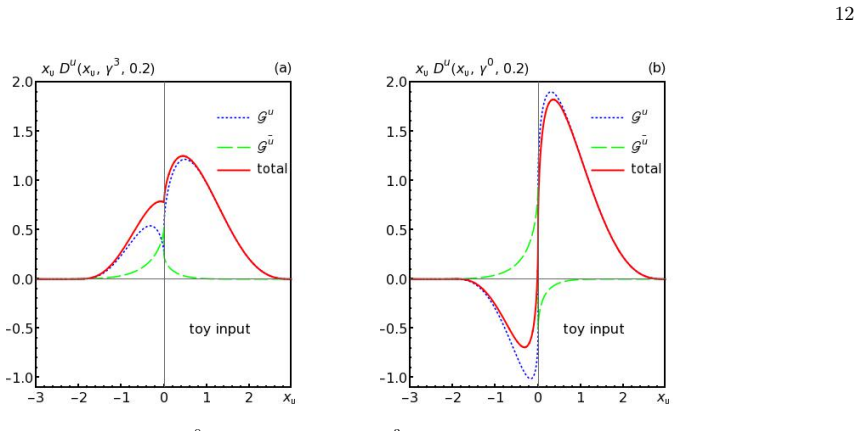


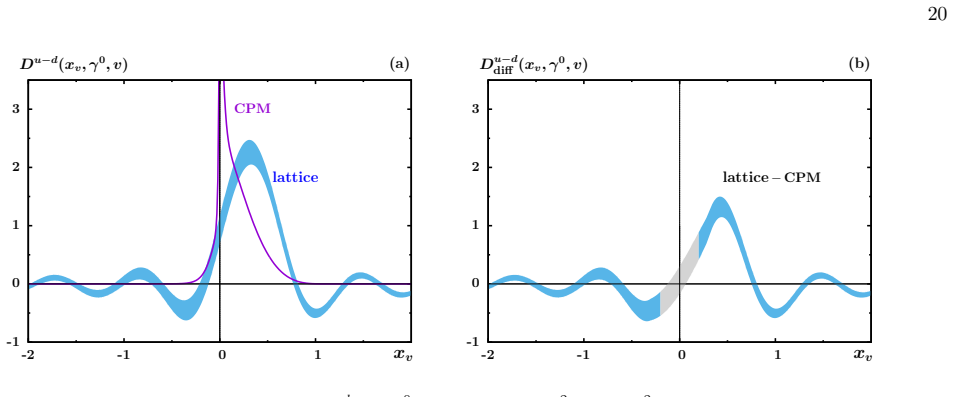
read the original abstract
Quasi parton distribution functions (QPDFs) are defined in terms of QCD fields at spacelike separations evaluated in matrix elements of hadrons moving with velocity $v$. These objects can be studied in lattice QCD. In the limit when $v$ approaches the speed of light, QPDFs converge to PDFs. It is insightful to study QPDFs and their convergence in models. In this work, we first study the QPDFs in a broad class of quark models characterized by one common feature, namely the absence of gauge degrees of freedom. We provide general proofs for the convergence and sum rules of the unpolarized quark and antiquark QPDFs for both choices $\gamma^0$ and $\gamma^3$. We choose the Covariant Parton Model (CPM) as an illustration. We derive analytical results for the small-$x_v$ behavior of QPDFs and the energy-momentum tensor form factor $\bar{c}^q(t)$ at zero momentum transfer. These results are of interest as they correspond to a Wandzura-Wilczek-type approximation.
Editorial analysis
A structured set of objections, weighed in public.
Referee Report
Summary. The paper claims to establish general proofs of convergence to PDFs and associated sum rules for unpolarized quark and antiquark QPDFs within a broad class of covariant quark models that contain no gauge degrees of freedom; the proofs are stated to hold for both the γ⁰ and γ³ choices of the Dirac structure. The Covariant Parton Model is used as a concrete illustration, where closed-form expressions are derived for the small-x_v behavior of the QPDFs and for the energy-momentum tensor form factor c̄^q(t) evaluated at zero momentum transfer; these expressions are identified with a Wandzura-Wilczek-type approximation.
Significance. Within the stated model class the results supply an exactly solvable laboratory in which the approach of QPDFs to light-cone PDFs, the validity of sum rules, and the emergence of Wandzura-Wilczek relations can be examined analytically. Such controlled benchmarks are useful for interpreting lattice-QCD extractions of QPDFs and for testing numerical methods that aim to recover PDFs from finite-velocity matrix elements.
minor comments (3)
- §2: the precise definition of the velocity parameter v and the relation between the quasi-momentum fraction x_v and the light-cone fraction x should be stated explicitly before the general proofs are presented, to avoid ambiguity when the two γ choices are compared.
- §4 (CPM illustration): the analytic small-x_v expressions are given, but the range of validity (e.g., the regime of x_v where higher-order corrections in the model remain negligible) is not quantified; a brief statement or plot would strengthen the claim that the results correspond to a Wandzura-Wilczek approximation.
- References: the discussion of the Wandzura-Wilczek approximation would benefit from citing the original Wandzura-Wilczek paper and at least one recent lattice-QCD study that employs the same approximation for comparison.
Simulated Author's Rebuttal
We thank the referee for the positive assessment of our work, the accurate summary of the claims, and the recommendation for minor revision. The report correctly identifies the scope of the general proofs for QPDF convergence and sum rules in gauge-free covariant quark models, as well as the analytic results obtained in the Covariant Parton Model. Since the report contains no specific major comments or criticisms, we provide no point-by-point rebuttals below. We will implement minor editorial improvements in the revised manuscript.
Circularity Check
No significant circularity; derivations are self-contained within model definitions
full rationale
The paper defines a broad class of quark models by the explicit absence of gauge degrees of freedom and derives general proofs of convergence and sum rules for unpolarized QPDFs (both quark and antiquark, for γ⁰ and γ³ choices) directly from Lorentz invariance and the model kinematics. The CPM is introduced only as an illustration, with analytical small-x_v behavior and the EMT form factor c̄^q(0) obtained as exact consequences inside that model; the Wandzura-Wilczek-type correspondence is stated as an emergent outcome rather than an input ansatz. No load-bearing step reduces to a fitted parameter renamed as prediction, a self-citation chain, or a self-definitional loop. The central claims remain internal to the stated assumptions and do not rely on external data fits or prior author results for their validity.
Axiom & Free-Parameter Ledger
axioms (1)
- domain assumption Quark models are defined by the complete absence of gauge degrees of freedom
Reference graph
Works this paper leans on
-
[1]
=N q which coincides with the above-encountered integral expressions and completes the proof. 6 F. Momentum sum rule Next we investigate the second Mellin moment sum rule. For PDFs it corresponds to the momentum sum rule. For QPDFs there is no direct correspondence to momentum carried by partons, but we shall nevertheless loosely refer to this sum rule by...
-
[2]
= 2P 3 Z ∞ −∞ dxv eiνxv Dq(xv, γ3, v) (41) which can be inverted and simplified usingz 3 = ν P 3 as follows v Dq(xv, γ0, v) = Z ∞ −∞ dν 2π e−iνxv Mq(ν,−z 2 3) Dq(xv, γ3, v) = Z ∞ −∞ dν 2π e−iνxv Mq(ν,−z 2
-
[3]
+ M2 P 2 3 νJ q(ν,−z 2 3) (42) where we have included for comparison the result forD q(xv, γ0, v) discussed already in Sec. II G. SinceD q(xv, γ3, v) contains the power-suppressed term M 2 P 2 3 νJ q(ν,−z 2 3), the choice Γ =γ 0 appears preferable because inD q(xv, γ0, v) this power-suppressed term is absent to begin with [34, 35]. To investigate this que...
-
[4]
yields Mq(ν, z2) = 2 Z d4k e−ik·z Aq 2 − (k·z)ν+ (P·k)z 2 ν2 +M 2z2 Aq 3 (44a) J q(ν, z2) = 2 Z d4k e−ik·z − (P·k)ν+ (k·z)M 2 M2(ν2 +M 2z2) Aq 3 (44b) whereA q i =A q i (P·k, k 2). We make a first interesting observation. The amplitudeJ q(ν, z2) receives a contribution fromA q 3 just asM q(ν, z2) does. BothA q 2 andA q 3 enter the description of the twist...
-
[5]
= 2 Z d4k eiν k3 P 3 Aq 2 + k3 P 3 + P·k P 2 3 1 + M 2 P 2 3 Aq 3 | {z } Mq(ν,− ν2 P 2 3 ) + k3 P 3 M 2 P 2 3 − P·k P 2 3 1 + M 2 P 2 3 Aq 3 | {z } M 2 P 2 3 νJ q(ν,− ν2 P 2 3 ) (45b) The ratio k3 P 3 corresponds tox v which asymptotically approachesx. The frame-independent factorP·kappears always in a ratio with respect toP 2 3 which makes it a power cor...
-
[6]
= 2 Z d4k eiν k3 P 3 Aq 2 + k3 P 3 Aq 3 ,(45c) which is rather remarkable. Inserting the results from Eq. (45) in Eq. (42) and taking theν-integrals we obtain Dq(xv, γ0, v) = 2 Z d4k δ xv − k3 P 3 Aq 2 + xv + P·k P 2 3 1 + M 2 P 2 3 Aq 3 q 1 + M 2 P 2 3 (46a) Dq(xv, γ3, v) = 2 Z d4k δ xv − k3 P 3 Aq 2 +x v Aq 3 (46b) The expressions in Eq. (46) coincide w...
-
[7]
in the case of Γ =γ 3 has actually a positive side effect: it cancels out power corrections present in the term proportional toM q(ν,−z 2
-
[8]
mimic” antiquarks [5]. This corresponds in the CPM to the “leaking
which remain uncompensated inD q(xv, γ0, v), see Eqs. (46). This in turn suggests thatD q(xv, γ3, v) might be a better candidate for faster convergence towards PDFs. The power corrections which enter inD q(xv, γ0, v) in Eq. (46a) and are absent inD q(xv, γ3, v) in Eqs. (46b) are of the type P·k P 2 3 or M 2 P 2 3 and can be referred to as a type of kinema...
-
[9]
J. C. Collins and D. E. Soper, Nucl. Phys. B194, 445 (1982)
work page 1982
-
[10]
J. C. Collins, D. E. Soper and G. F. Sterman, Adv. Ser. Direct. High Energy Phys.5, 1 (1989) [hep-ph/0409313]
work page Pith review arXiv 1989
-
[11]
Ji,Parton physics on a euclidean lattice,Phys
X. Ji, Phys. Rev. Lett.110, 262002 (2013) [arXiv:1305.1539 [hep-ph]]
- [12]
-
[13]
D. Diakonov, V. Y. Petrov, P. V. Pobylitsa, M. V. Polyakov and C. Weiss, Phys. Rev. D56, 4069-4083 (1997) [arXiv:hep- ph/9703420 [hep-ph]]
- [14]
- [15]
-
[16]
T. Izubuchi, X. Ji, L. Jin, I. W. Stewart and Y. Zhao, Phys. Rev. D98, 056004 (2018) [arXiv:1801.03917 [hep-ph]]. 24
- [17]
- [18]
-
[19]
C. Alexandrou, K. Cichy, V. Drach, E. Garcia-Ramos, K. Hadjiyiannakou, K. Jansen, F. Steffens and C. Wiese, Phys. Rev. D92, 014502 (2015) [arXiv:1504.07455 [hep-lat]]
- [20]
-
[21]
C. Alexandrou, K. Cichy, M. Constantinou, K. Hadjiyiannakou, K. Jansen, F. Steffens and C. Wiese, Phys. Rev. D96, 014513 (2017) [arXiv:1610.03689 [hep-lat]]
-
[22]
C. Alexandrou, K. Cichy, M. Constantinou, K. Hadjiyiannakou, K. Jansen, H. Panagopoulos and F. Steffens, Nucl. Phys. B923, 394 (2017) [arXiv:1706.00265 [hep-lat]]
- [23]
- [24]
- [25]
-
[26]
C. Alexandrou, K. Cichy, M. Constantinou, K. Jansen, A. Scapellato and F. Steffens, Phys. Rev. Lett.121, 112001 (2018) [arXiv:1803.02685 [hep-lat]]
- [27]
-
[28]
C. Alexandrou, K. Cichy, M. Constantinou, K. Jansen, A. Scapellato and F. Steffens, Phys. Rev. D98, 091503 (2018) [arXiv:1807.00232 [hep-lat]]
- [29]
- [30]
- [31]
-
[32]
C. Alexandrou, K. Cichy, M. Constantinou, K. Hadjiyiannakou, K. Jansen, A. Scapellato and F. Steffens, Phys. Rev. D 99, 114504 (2019) [arXiv:1902.00587 [hep-lat]]
-
[33]
T. Izubuchi, L. Jin, C. Kallidonis, N. Karthik, S. Mukherjee, P. Petreczky, C. Shugert and S. Syritsyn, Phys. Rev. D100, no.3, 034516 (2019) [arXiv:1905.06349 [hep-lat]]
-
[34]
S. Bhattacharya, K. Cichy, M. Constantinou, A. Metz, A. Scapellato and F. Steffens, Phys. Rev. D102, no.11, 111501 (2020) [arXiv:2004.04130 [hep-lat]]
-
[35]
S. Bhattacharya, K. Cichy, M. Constantinou, A. Metz, A. Scapellato and F. Steffens, Phys. Rev. D104, no.11, 114510 (2021) [arXiv:2107.02574 [hep-lat]]
- [36]
- [37]
- [38]
-
[39]
Deep-inelastic scattering and the operator product expansion in lattice QCD
W. Detmold and C. J. D. Lin, Phys. Rev. D73, 014501 (2006) [hep-lat/0507007]
work page Pith review arXiv 2006
-
[40]
V. Braun and D. Mueller, Eur. Phys. J. C55, 349 (2008) [arXiv:0709.1348 [hep-ph]]
- [41]
- [42]
- [43]
- [44]
- [45]
-
[46]
M. T. Hansen, H. B. Meyer and D. Robaina, Phys. Rev. D96, 094513 (2017) [arXiv:1704.08993 [hep-lat]]
work page Pith review arXiv 2017
-
[47]
K. Orginos, A. Radyushkin, J. Karpie and S. Zafeiropoulos, Phys. Rev. D96, 094503 (2017) [arXiv:1706.05373 [hep-ph]]
- [48]
-
[49]
H. W. Lin,et al.Prog. Part. Nucl. Phys.100, 107-160 (2018) [arXiv:1711.07916 [hep-ph]]
work page Pith review arXiv 2018
-
[50]
Monahan, PoS LATTICE2018, 018 (2018) [arXiv:1811.00678 [hep-lat]]
C. Monahan, PoS LATTICE2018, 018 (2018) [arXiv:1811.00678 [hep-lat]]
-
[51]
K. Cichy and M. Constantinou, Adv. High Energy Phys.2019, 3036904 (2019) [arXiv:1811.07248 [hep-lat]]
-
[52]
Y. Zhao, Int. J. Mod. Phys. A33, 1830033 (2019) [arXiv:1812.07192 [hep-ph]]
-
[53]
M. Constantinou, Eur. Phys. J. A57, no.2, 77 (2021) [arXiv:2010.02445 [hep-lat]]
-
[54]
M. Constantinou, L. Del Debbio, X. Ji, H. W. Lin, K. F. Liu, C. Monahan, K. Orginos, P. Petreczky, J. W. Qiu and D. Richards,et al.[arXiv:2202.07193 [hep-lat]]
-
[55]
L. Gamberg, Z. B. Kang, I. Vitev and H. Xing, Phys. Lett. B743, 112 (2015) [arXiv:1412.3401 [hep-ph]]
-
[56]
A. Bacchetta, M. Radici, B. Pasquini and X. Xiong, Phys. Rev. D95, 014036 (2017) [arXiv:1608.07638 [hep-ph]]
-
[57]
W. Broniowski and E. Ruiz Arriola, Phys. Lett. B773, 385 (2017) [arXiv:1707.09588 [hep-ph]]
- [58]
-
[59]
W. Broniowski and E. Ruiz Arriola, Phys. Rev. D97, 034031 (2018) [arXiv:1711.03377 [hep-ph]]
- [60]
-
[61]
S. Bhattacharya, C. Cocuzza and A. Metz, Phys. Lett. B788, 453 (2019) [arXiv:1808.01437 [hep-ph]]
-
[62]
S. Bhattacharya, C. Cocuzza and A. Metz, Phys. Rev. D102(2020) no.5, 054021 [arXiv:1903.05721 [hep-ph]]
- [63]
- [64]
- [65]
- [66]
-
[67]
V. Shastry, W. Broniowski and E. Ruiz Arriola, Phys. Rev. D106, no.11, 114035 (2022) [arXiv:2209.02619 [hep-ph]]
- [68]
-
[69]
R. P. Feynman, Phys. Rev. Lett.23, 1415-1417 (1969)
work page 1969
-
[70]
R. P. Feynman, “Photon-hadron interactions,” (Reading, 1972)
work page 1972
- [71]
- [72]
- [73]
-
[74]
A. V. Efremov, O. V. Teryaev and P. Zavada, Phys. Rev. D70, 054018 (2004) [hep-ph/0405225]
work page internal anchor Pith review arXiv 2004
-
[75]
P. Zavada, Eur. Phys. J. C52, 121 (2007) [arXiv:0706.2988 [hep-ph]]
- [76]
-
[77]
U. D’Alesio, E. Leader and F. Murgia, Phys. Rev. D81, 036010 (2010) [arXiv:0909.5650 [hep-ph]]
-
[78]
P. Zavada, Phys. Rev. D83, 014022 (2011) [arXiv:0908.2316 [hep-ph]]
- [79]
- [80]
discussion (0)
Sign in with ORCID, Apple, or X to comment. Anyone can read and Pith papers without signing in.