Recognition: no theorem link
Lower overhead fault-tolerant building blocks for noisy quantum computers
Pith reviewed 2026-05-13 04:31 UTC · model grok-4.3
The pith
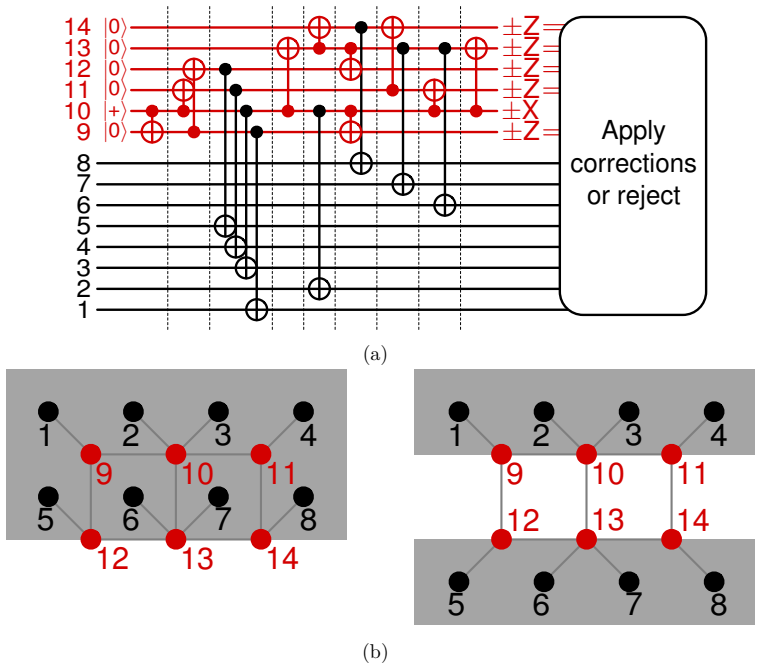
A distance-four code encoding six logical qubits matches the error protection of the distance-five surface code using one-tenth as many physical qubits.
A machine-rendered reading of the paper's core claim, the machinery that carries it, and where it could break.
Core claim
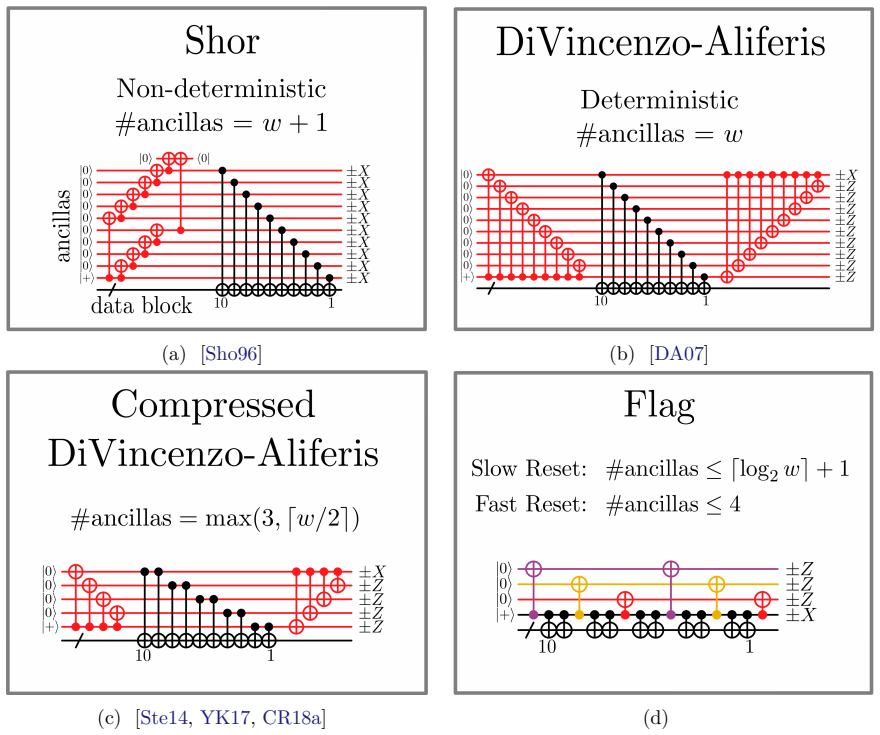
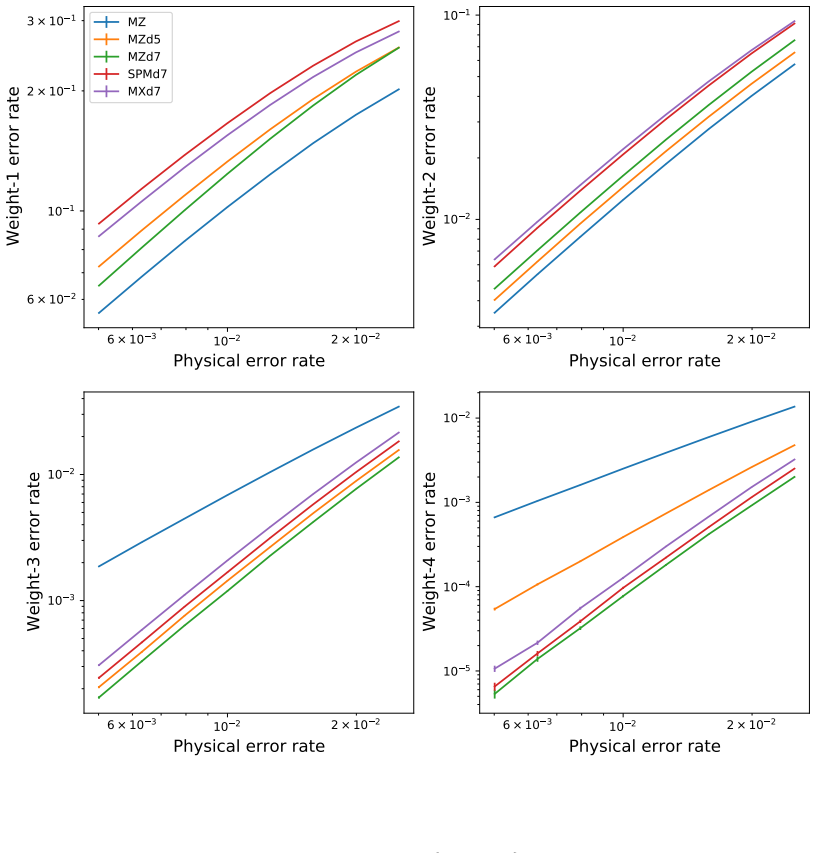
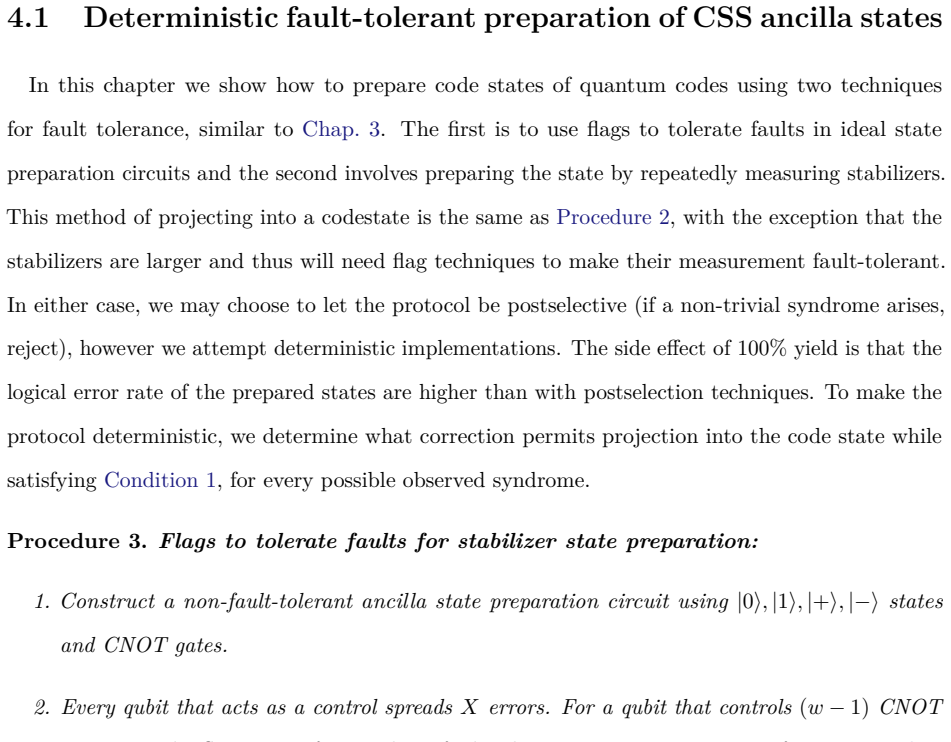
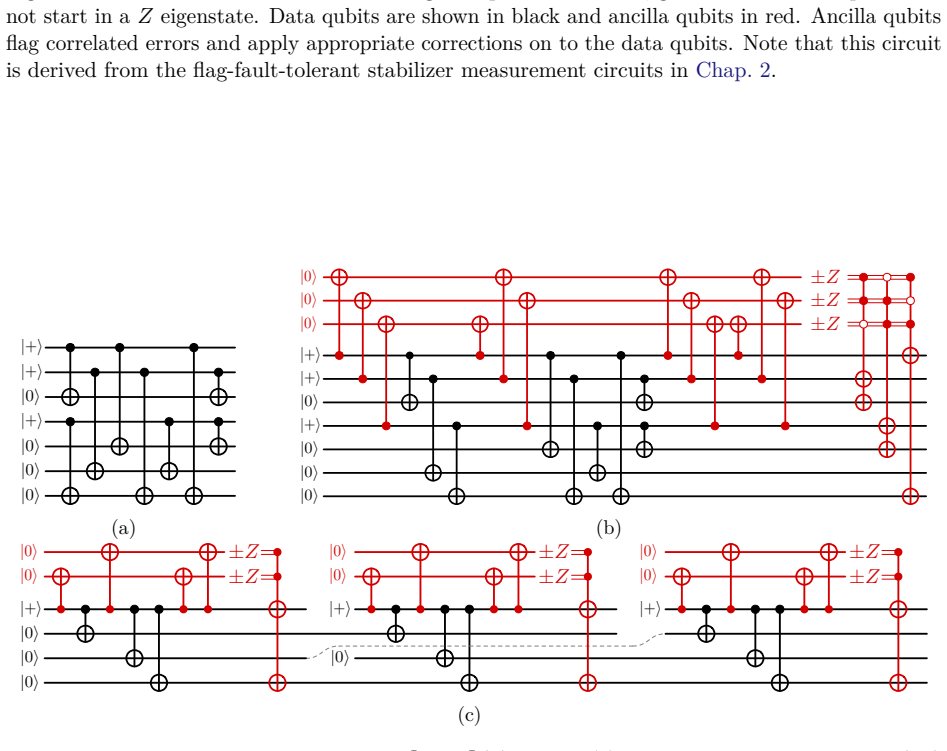
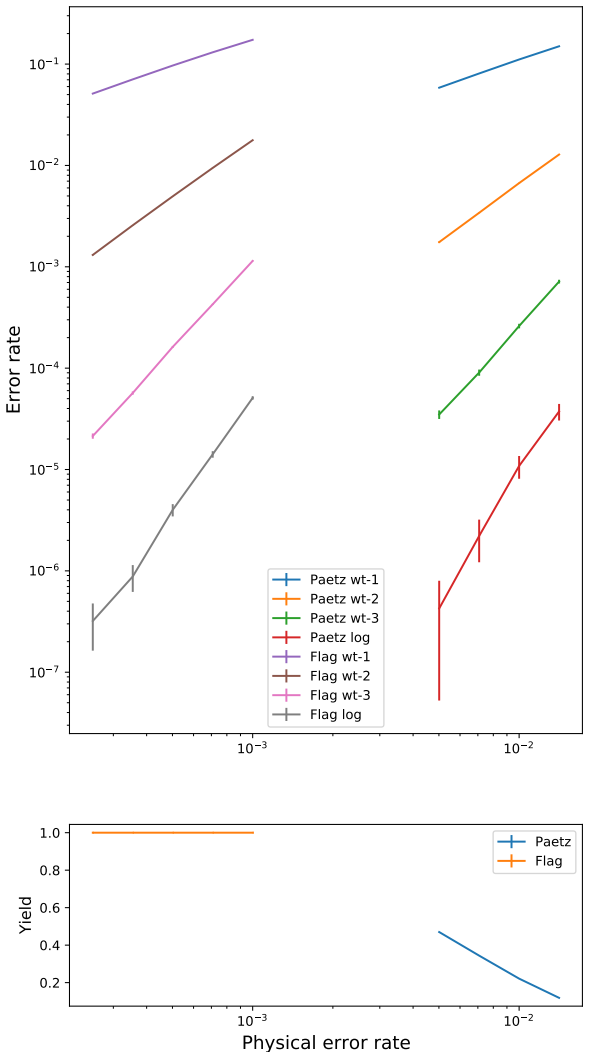
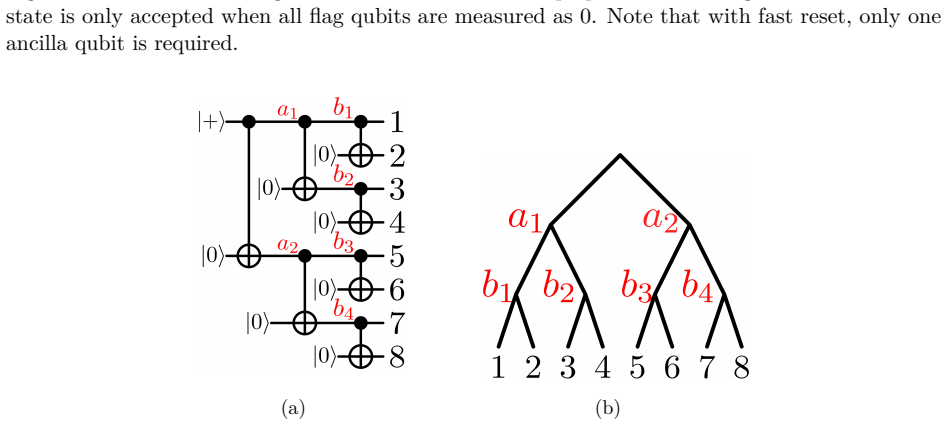
We develop a combinatorial proof with flag fault tolerance that exponentially reduces the extra qubits needed to measure a stabilizer of any size, while tolerating one fault. We leverage these proofs to design state preparation circuits for the Steane and Golay codes with 100% yield. A distance-four code encoding six logical qubits protects information as well as the distance-five surface code, using one-tenth as many physical qubits. Finally, protecting measurement results with a classical code cuts the time overhead of logical gates by a factor of two to six.
What carries the argument
Flag fault tolerance combined with combinatorial counting arguments that bound the number of ancilla qubits required for single-fault-tolerant stabilizer measurement of arbitrary weight.
If this is right
- Stabilizer measurements of any size need only exponentially fewer ancilla qubits while remaining single-fault tolerant.
- State preparation for the Steane and Golay codes can achieve 100 percent success rate with no post-selection overhead.
- Equivalent distance protection on a planar layout becomes possible with roughly one-tenth the physical qubits previously required by the surface code.
- Logical gate execution time in surface-code architectures drops by a factor between two and six when measurement outcomes are protected classically.
Where Pith is reading between the lines
- The same flag-plus-combinatorial technique could be applied to reduce overhead in other stabilizer codes beyond the Steane and Golay examples given.
- If the six-logical-qubit block scales without introducing new correlated errors, it could be tiled to build larger logical processors with lower total qubit count than surface-code patches of equivalent distance.
- The classical-code protection of measurement results might combine with other time-optimization methods such as lattice surgery to produce still larger speedups.
Load-bearing premise
The combinatorial counting argument with flag qubits actually produces circuits that measure any stabilizer while tolerating exactly one fault and without leaving any undetected errors that would require extra qubits or assumptions.
What would settle it
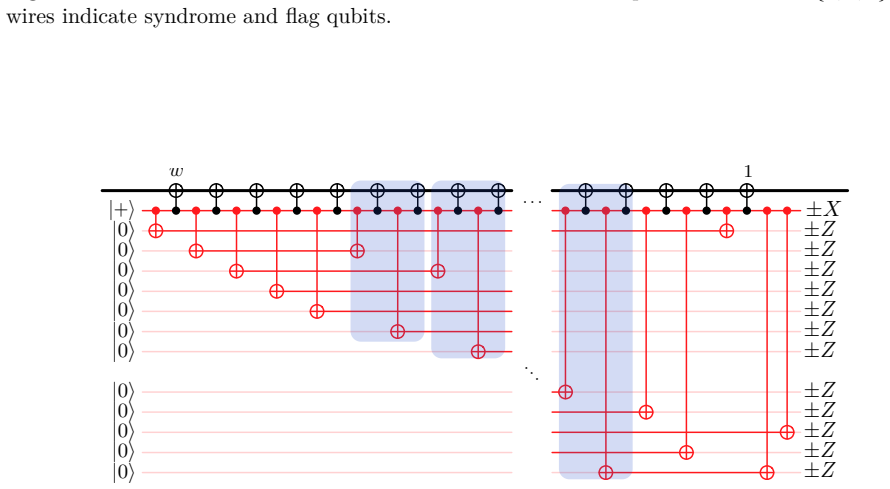
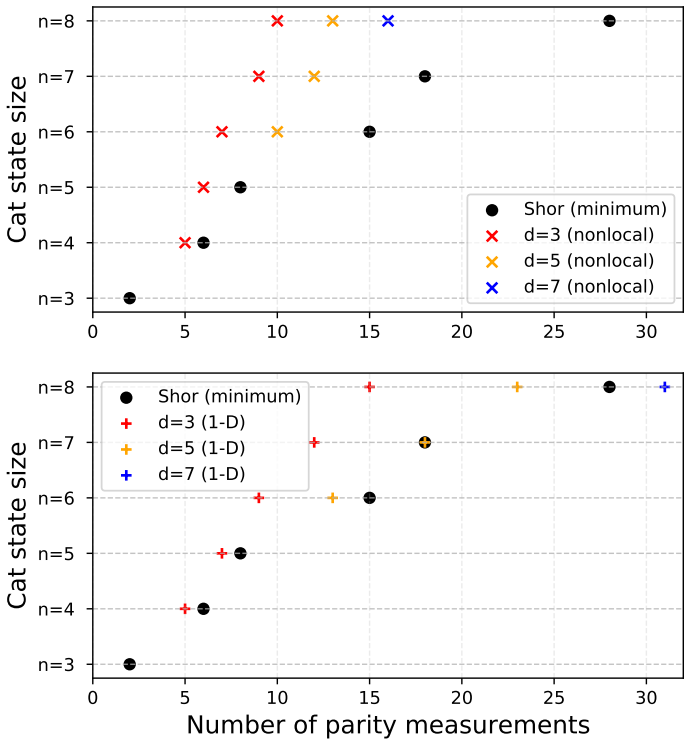
An explicit circuit diagram or fault-simulation result for a weight-8 stabilizer showing the claimed ancilla count and confirming that every single-fault pattern is detected, or a direct comparison of logical error rates between the proposed six-qubit distance-four code and a distance-five surface-code patch under the same noise model.
Figures




































read the original abstract
Quantum computation holds the promise of solving certain complex problems exponentially faster than classical computers. However, the high prevalent noise in current quantum devices impedes the accurate execution of even basic algorithms. This can be remedied by protecting quantum information with a quantum error-correcting code, where the logical information of an algorithmic qubit is spread across multiple physical qubits. Individual quantum errors are then located and corrected by the fault-tolerant measurement of multi-qubit stabilizer operators (parity checks). Unfortunately, error correction and fault tolerance both impose large demands on the qubit overhead: hundreds to thousands of physical qubits per logical qubit. We reduce the spacetime cost of fault tolerance by redesigning key building blocks of an error-corrected quantum computer. First, we develop a combinatorial proof with flag fault tolerance that exponentially reduces the extra qubits needed to measure a stabilizer of any size, while tolerating one fault. We leverage these proofs to then design state preparation circuits for the Steane and Golay codes with 100% yield. Next, we improve error correction on a planar layout by showing that a distance-four code encoding six logical qubits protects information as well as the distance-five surface code, using one-tenth as many physical qubits. Finally, we optimize the time overhead of logical gates in surface code quantum computers by protecting measurement results with a classical code, cutting computation time by a factor of two to six. Our hardware-agnostic optimizations of fault tolerance overheads thus suggest new routes to advance the timeline of error-free quantum computing.
Editorial analysis
A structured set of objections, weighed in public.
Referee Report
Summary. The manuscript claims four main overhead reductions for fault-tolerant quantum computing: a combinatorial construction with flag qubits that exponentially cuts ancilla overhead for measuring arbitrary-weight stabilizers while tolerating one fault; 100% yield state-preparation circuits for the Steane and Golay codes; a distance-4 code encoding six logical qubits that matches the protection of the distance-5 surface code at one-tenth the physical-qubit cost; and a classical-code protection of measurement outcomes that reduces surface-code logical-gate time by a factor of 2–6.
Significance. If the central constructions hold, the work would materially lower both qubit and spacetime overheads for error correction on near-term hardware, offering concrete routes to earlier fault-tolerant operation. The flag-based combinatorial method and the six-logical-qubit planar code are the most load-bearing claims; reproducible verification of either would constitute a notable advance.
major comments (2)
- [Abstract / main construction] The headline exponential ancilla reduction rests on the combinatorial proof with flag fault tolerance asserted in the abstract. No derivation, circuit diagram, or explicit error-propagation analysis is supplied, so it is impossible to confirm that the construction remains fault-tolerant for arbitrary stabilizer weight, introduces no undetected error channels that reach the data, or scales without additional size-dependent verification qubits.
- [Distance-4 code section] The distance-4 six-logical-qubit code is claimed to protect information equivalently to the distance-5 surface code while using one-tenth the physical qubits. No distance calculation, logical-error-rate comparison, or layout diagram is provided, leaving the quantitative claim unsupported.
minor comments (2)
- [Abstract] The abstract states 'combinatorial proofs' and 'precise performance numbers' yet contains neither equations nor tables; the manuscript should include at least one explicit small-weight example with circuit and fault table.
- [State-preparation section] The 100% yield claim for Steane and Golay state preparation is stated without the corresponding circuit diagrams or yield calculation.
Simulated Author's Rebuttal
We thank the referee for their careful reading of our manuscript and for highlighting areas where additional details would improve clarity. We respond to the major comments point-by-point below. We will revise the manuscript to incorporate more explicit derivations, diagrams, and analyses as requested.
read point-by-point responses
-
Referee: [Abstract / main construction] The headline exponential ancilla reduction rests on the combinatorial proof with flag fault tolerance asserted in the abstract. No derivation, circuit diagram, or explicit error-propagation analysis is supplied, so it is impossible to confirm that the construction remains fault-tolerant for arbitrary stabilizer weight, introduces no undetected error channels that reach the data, or scales without additional size-dependent verification qubits.
Authors: We agree that the presentation of the combinatorial proof can be strengthened with more explicit details. The construction is described in the main body of the paper, but we will add a full step-by-step derivation of the flag qubit selection for arbitrary stabilizer weights, include example circuit diagrams, and provide an error-propagation analysis. This analysis will demonstrate that the method tolerates one fault without undetected errors propagating to the data qubits, and that the number of flag qubits does not grow with stabilizer size due to the combinatorial covering. We believe this will address the concerns regarding verification qubits and scalability. revision: yes
-
Referee: [Distance-4 code section] The distance-4 six-logical-qubit code is claimed to protect information equivalently to the distance-five surface code while using one-tenth the physical qubits. No distance calculation, logical-error-rate comparison, or layout diagram is provided, leaving the quantitative claim unsupported.
Authors: The distance-4 code and its comparison to the surface code are discussed in the relevant section, but we acknowledge the need for supporting calculations and visuals. In the revised manuscript, we will include an explicit proof or calculation of the code distance, numerical simulations or bounds on logical error rates under standard noise models, and a clear layout diagram illustrating the physical qubit arrangement and the factor of ten reduction in overhead compared to a distance-5 surface code patch. This will substantiate the equivalence in protection. revision: yes
Circularity Check
No circularity: novel combinatorial constructions and code designs stand independently
full rationale
The paper advances new designs for fault-tolerant quantum error correction, including a combinatorial proof using flag qubits for stabilizer measurement with exponential ancilla reduction, 100% yield state-preparation circuits for Steane/Golay codes, a distance-4 code encoding six logical qubits, and classical-code protection for measurement results. No equations, fitted parameters, or self-referential definitions appear in the provided text. Claims do not reduce by construction to inputs (e.g., no 'prediction' that is a renamed fit, no ansatz smuggled via self-citation, no uniqueness theorem imported from prior author work). The derivation chain consists of original constructions presented as independent contributions, making the paper self-contained against external benchmarks with no load-bearing circular steps.
Axiom & Free-Parameter Ledger
axioms (1)
- domain assumption Standard assumptions of quantum mechanics, stabilizer formalism, and fault-tolerant quantum computation
Reference graph
Works this paper leans on
-
[1]
Acharya, Rajeev and Aleiner, Igor and Allen, Richard and Andersen, Trond I. and Ansmann, Markus and Arute, Frank and Arya, Kunal and Asfaw, Abraham and Atalaya, Juan and Babbush, Ryan and Bacon, Dave and Bardin, Joseph C. and Basso, Joao and Bengtsson, Andreas and Boixo, Sergio and Bortoli, Gina and Bourassa, Alexandre and Bovaird, Jenna and Brill, Leon a...
-
[2]
Quantum Science and Technology , abstract =
Yi-Cong Zheng and Ching-Yi Lai and Todd A Brun and Leong-Chuan Kwek , title =. Quantum Science and Technology , abstract =. 2020 , month =. doi:10.1088/2058-9565/aba34d , url =
-
[3]
Building a Fault-Tolerant Quantum Computer Using Concatenated Cat Codes , author =. PRX Quantum , volume =. 2022 , month =. doi:10.1103/PRXQuantum.3.010329 , url =
-
[4]
New magic state distillation factories optimized by temporally encoded lattice surgery , publisher =
Prabhu, Prithviraj and Chamberland, Christopher , keywords =. New magic state distillation factories optimized by temporally encoded lattice surgery , publisher =. 2022 , copyright =. doi:10.48550/ARXIV.2210.15814 , url =
-
[5]
Greenberger, Daniel M. and Horne, Michael A. and Zeilinger, Anton. Going Beyond Bell's Theorem , bookTitle=. 1989. doi:10.1007/978-94-017-0849-4_10 , archivePrefix =. 0712.0921 , primaryClass =
-
[6]
Gisin, Nicolas and Thew, Rob , title=. Nature Photonics , year=. quant-ph/0703255 , doi=
-
[7]
Multiphoton entanglement and interferometry , author =. Rev. Mod. Phys. , volume =. 2012 , publisher =. doi:10.1103/RevModPhys.84.777 , url =
-
[8]
doi:10.22331/q-2017-04-25-2 , url =
The surface code with a twist , author =. doi:10.22331/q-2017-04-25-2 , url =
-
[9]
New Journal of Physics , abstract =
Christopher Chamberland and Aleksander Kubica and Theodore J Yoder and Guanyu Zhu , title =. New Journal of Physics , abstract =. doi:10.1088/1367-2630/ab68fd , url =
-
[10]
Quantum Error Correction with Only Two Extra Qubits , author =. Phys. Rev. Lett. , volume =. 2018 , month =. doi:10.1103/PhysRevLett.121.050502 , url =
-
[11]
Chao, Rui and Reichardt, Ben W. , title=. npj Quantum Information , year=. doi:10.1038/s41534-018-0085-z , url=
-
[12]
Shor, P. W. , title =. Proceedings of the 37th Annual Symposium on Foundations of Computer Science , pages =. 1996 , publisher =. doi:10.1109/SFCS.1996.548464 , eprint =
-
[13]
Effective Fault-Tolerant Quantum Computation with Slow Measurements , author =. Phys. Rev. Lett. , volume =. 2007 , month =. doi:10.1103/PhysRevLett.98.020501 , url =
-
[14]
Efficient fault-tolerant decoding of topological color codes , author=. 2014 , eprint=
work page 2014
- [15]
-
[16]
Pulse code communication , url =
Frank Gray , month = Mar, date = 17, year =. Pulse code communication , url =
-
[17]
Flag fault-tolerant error correction for any stabilizer code,
Flag Fault-Tolerant Error Correction for any Stabilizer Code , author =. PRX Quantum , volume =. 2020 , month =. doi:10.1103/PRXQuantum.1.010302 , url =. 1912.09549 , archivePrefix=
-
[19]
Scalable quantum computing in the presence of large detected-error rates , author =. Phys. Rev. A , volume =. 2005 , month =. doi:10.1103/PhysRevA.71.042322 , url =
-
[20]
Delfosse, Nicolas and Reichardt, Ben W. and Svore, Krysta M. , journal=. Beyond Single-Shot Fault-Tolerant Quantum Error Correction , year=. doi:10.1109/TIT.2021.3120685 , eprint=
-
[21]
Daniel Gottesman , Date-Added =. The. arXiv:quant-ph/9807006 , Howpublished =
work page internal anchor Pith review Pith/arXiv arXiv
-
[22]
Kitaev, A. Yu. , Booktitle =. Quantum Error Correction with Imperfect Gates , Url =. 1997 , Bdsk-Url-1 =. doi:10.1007/978-1-4615-5923-8_19 , Editor =
-
[23]
Andrew J. Landahl and Jonas T. Anderson and Patrick R. Rice , Date-Added =. arXiv:1108.5738 [quant-ph] , Title =
-
[24]
arXiv , Author =:quant-ph/9811052 , Primaryclass =
-
[25]
Shor, Peter W. , Date-Added =. Scheme for reducing decoherence in quantum computer memory , Url =. Phys. Rev. A , Month =. 1995 , eprint=. doi:10.1103/PhysRevA.52.R2493 , Issue =
-
[26]
Encoding a qubit in an oscillator , volume=
Daniel Gottesman and Alexei Kitaev and John Preskill , Date-Added =. Encoding a qubit in an oscillator , Year =. doi:10.1103/PhysRevA.64.012310 , Eprint =
-
[27]
Quantum Error Correction and Fault Tolerant Quantum Computing , Year =
Gaitan, Frank , Date-Added =. Quantum Error Correction and Fault Tolerant Quantum Computing , Year =
-
[28]
Christopher Chamberland and Michael E. Beverland , Date-Added =. Flag fault-tolerant error correction with arbitrary distance codes , Volume =. Quantum , Pages =. 2018 , Bdsk-File-1 =. doi:10.22331/q-2018-02-08-53 , Eprint =
-
[29]
Topological quantum distillation , Volume =
H. Topological quantum distillation , Volume =. Phys. Rev. Lett. , Pages =. 2006 , Bdsk-File-1 =. doi:10.1103/PhysRevLett.97.180501 , Eprint =
- [30]
-
[31]
Rui Chao and Ben W. Reichardt , Date-Added =. Simulation source code , Url =. 2017 , Bdsk-Url-1 =
work page 2017
-
[32]
Andrew W. Cross and David P. DiVincenzo and Barbara M. Terhal , Date-Added =. A comparative code study for quantum fault-tolerance , Volume =. 2009 , Bdsk-File-1 =. arXiv:0711.1556 [quant-ph] , Journal =
-
[33]
An introduction to quantum error correction and fault-tolerant quantum computation , Volume =
Daniel Gottesman , Booktitle =. An introduction to quantum error correction and fault-tolerant quantum computation , Volume =. 2010 , Bdsk-File-1 =. doi:10.1090/psapm/068 , Eprint =
-
[34]
Charles D. Hill and Austin G. Fowler and David S. Wang and Lloyd C. L. Hollenberg , Date-Added =. Fault-tolerant quantum error correction code conversion , Volume =. 2013 , Bdsk-File-1 =. arXiv:1112.2417 [quant-ph] , Journal =
-
[35]
Clare Horsman and Austin G. Fowler and Simon Devitt and. Surface code quantum computing by lattice surgery , Volume =. New J. Phys. , Pages =. 2012 , Bdsk-File-1 =. doi:10.1088/1367-2630/14/12/123011 , Eprint =
-
[36]
Optimal resources for topological two-dimensional stabilizer codes:
H. Optimal resources for topological two-dimensional stabilizer codes:. Phys. Rev. A , Pages =. 2007 , Bdsk-File-1 =. doi:10.1103/PhysRevA.76.012305 , Eprint =
-
[37]
Chong and John Kubiatowicz , Date-Added =
Martin Suchara and Arvin Faruque and Ching-Yi Lai and Gerardo Paz and Frederic T. Chong and John Kubiatowicz , Date-Added =. Comparing the overhead of topological and concatenated quantum error correction , Year =. Proc. doi:10.1109/ICCD.2013.6657074 , Eprint =
-
[38]
Yoder and Ryuji Takagi and Isaac L
Theodore J. Yoder and Ryuji Takagi and Isaac L. Chuang , Date-Added =. Universal fault-tolerant gates on concatenated stabilizer codes , Volume =. Phys. Rev. X , Pages =. 2016 , Bdsk-File-1 =. doi:10.1103/PhysRevX.6.031039 , Eprint =
-
[39]
Wieb Bosma and John Cannon and Catherine Playoust , Date-Added =. The. 1997 , Bdsk-Url-1 =. doi:10.1006/jsco.1996.0125 , Journal =
-
[40]
Steane and Ben Ibinson , Date-Added =
Andrew M. Steane and Ben Ibinson , Date-Added =. Fault-tolerant logical gate networks for. Phys. Rev. A , Number =. 2005 , Bdsk-File-1 =. doi:10.1103/PhysRevA.72.052335 , Eprint =
-
[41]
Jim Harrington and Ben W. Reichardt , Date-Added =. Addressable multi-qubit logic via permutations , Year =
-
[42]
Leveraging automorphisms of quantum codes for fault-tolerant quantum computation , Url =
Grassl, Markus and Roetteler, Martin , Booktitle =. Leveraging automorphisms of quantum codes for fault-tolerant quantum computation , Url =. 2013 , Bdsk-File-1 =. doi:10.1109/ISIT.2013.6620283 , Eprint =
-
[43]
Eric M. Rains , Date-Added =. Quantum codes of minimum distance two , Url =. 1997 , Bdsk-Url-1 =. doi:10.1109/18.746807 , Eprint =
-
[44]
Bounds on the minimum distance of linear codes and quantum codes , Year =
Grassl, Markus , Date-Added =. Bounds on the minimum distance of linear codes and quantum codes , Year =
-
[45]
Andrew M. Steane , Date-Added =. Simple quantum error-correcting codes , Url =. Phys. Rev. A , Pages =. 1996 , Bdsk-Url-1 =. doi:10.1103/PhysRevA.54.4741 , Eprint =
-
[46]
Class of quantum error-correcting codes saturating the quantum
Daniel Gottesman , Date-Added =. Class of quantum error-correcting codes saturating the quantum. Phys. Rev. A , Number =. 1996 , Bdsk-File-1 =. doi:10.1103/PhysRevA.54.1862 , Eprint =
- [47]
-
[48]
Error prevention scheme with four particles , Volume =
Lev Vaidman and Lior Goldenberg and Stephen Wiesner , Date-Added =. Error prevention scheme with four particles , Volume =. Phys. Rev. A , Pages =. 1996 , Bdsk-Url-1 =. doi:10.1103/PhysRevA.54.R1745 , Eprint =
-
[49]
A. R. Calderbank and Eric M. Rains and Peter W. Shor and N. J. A. Sloane , Date-Added =. Quantum error correction and orthogonal geometry , Url =. Phys. Rev. Lett. , Pages =. 1997 , Bdsk-Url-1 =. doi:10.1103/PhysRevLett.78.405 , Eprint =
-
[50]
Codes for the quantum erasure channel , Volume =
Markus Grassl and Thomas Beth and Thomas Pellizzari , Date-Added =. Codes for the quantum erasure channel , Volume =. Phys. Rev. A , Number =. 1997 , Bdsk-Url-1 =. doi:10.1103/PhysRevA.56.33 , Eprint =
-
[51]
Daniel Gottesman , Date-Added =. 2016 , Bdsk-File-1 =. arXiv:1610.03507 [quant-ph] , Title =
-
[52]
arXiv:1609.01652 [quant-ph] , Title =
Ostrev, Dimiter and Vidick, Thomas , Date-Added =. arXiv:1609.01652 [quant-ph] , Title =
-
[53]
Incompatible results of quantum measurements , Volume =
Asher Peres , Date-Added =. Incompatible results of quantum measurements , Volume =. 1990 , Bdsk-File-1 =. doi:10.1016/0375-9601(90)90172-K , Journal =
-
[54]
N. David Mermin , Date-Added =. Simple unified form for the major no-hidden-variables theorems , Volume =. 1990 , Bdsk-File-1 =. doi:10.1103/PhysRevLett.65.3373 , Journal =
-
[55]
Andrea W. Coladangelo , Date-Added =. 2016 , Bdsk-File-1 =. arXiv:1609.03687 [quant-ph] , Title =
-
[56]
Matthew Coudron and Anand Natarajan , Date-Added =. 2016 , Bdsk-File-1 =. arXiv:1609.06306 [quant-ph] , Title =
-
[57]
Mark M. Wilde , Date-Added =. Quantum information theory , Year =. arXiv:1106.1445 [quant-ph] , Publisher =
-
[58]
Secure quantum key distribution , Volume =
Hoi-Kwong Lo and Marcos Curty and Kiyoshi Tamaki , Date-Added =. Secure quantum key distribution , Volume =. Nature Photonics , Pages =. 2014 , Bdsk-File-1 =. doi:10.1038/nphoton.2014.149 , Eprint =
-
[59]
Marissa Giustina and Marijn A. M. Versteegh and S. Significant-loophole-free test of. Phys. Rev. Lett. , Pages =. 2015 , Bdsk-File-1 =. doi:10.1103/PhysRevLett.115.250401 , Eprint =
-
[60]
Shalm, Evan Meyer-Scott, Bradley G
Lynden K. Shalm and Evan Meyer-Scott and Bradley G. Christensen and Peter Bierhorst and Michael A. Wayne and Martin J. Stevens and Thomas Gerrits and Scott Glancy and Deny R. Hamel and Michael S. Allman and Kevin J. Coakley and Shellee D. Dyer and Carson Hodge and Adriana E. Lita and Varun B. Verma and Camilla Lambrocco and Edward Tortorici and Alan L. Mi...
-
[61]
B. Hensen and H. Bernien and A. E. Dr. Loophole-free. Nature , Pages =. 2015 , Bdsk-File-1 =. doi:10.1038/nature15759 , Eprint =
-
[62]
B. Hensen and N. Kalb and M. S. Blok and A. E. Dr. 2016 , Bdsk-File-1 =. arXiv:1603.05705 [quant-ph] , Title =
-
[63]
Reichardt and Chris Sutherland and Thomas Vidick , Date-Added =
Rui Chao and Ben W. Reichardt and Chris Sutherland and Thomas Vidick , Date-Added =. Overlapping qubits , Year =
-
[64]
Tameem Albash and Itay Hen and Federico M. Spedalieri and Daniel A. Lidar , Date-Added =. Reexamination of the evidence for entanglement in the. Phys. Rev. A , Pages =. 2015 , Bdsk-Url-1 =. doi:10.1103/PhysRevA.92.062328 , Eprint =
-
[65]
Self-testing in parallel , Volume =
Matthew McKague , Date-Added =. Self-testing in parallel , Volume =. New J. Phys. , Pages =. 2016 , Bdsk-File-1 =. doi:10.1088/1367-2630/18/4/045013 , Eprint =
-
[66]
Reichardt and Falk Unger and Umesh Vazirani , Date-Added =
Ben W. Reichardt and Falk Unger and Umesh Vazirani , Date-Added =. 2012 , Bdsk-File-1 =. arXiv:1209.0448 [quant-ph] , Title =
-
[67]
Some inequalities for commutators and an application to spectral variation , Volume =
Rajendra Bhatia and Chandler Davis and Fuad Kittaneh , Date-Added =. Some inequalities for commutators and an application to spectral variation , Volume =. 1991 , Bdsk-File-1 =. doi:10.1007/BF02227441 , Journal =
-
[68]
Johnson and Joram Lindenstrauss , Booktitle =
William B. Johnson and Joram Lindenstrauss , Booktitle =. Extensions of. 1984 , Bdsk-Url-1 =. doi:10.1090/conm/026/737400 , Pages =
-
[69]
Random Structures & Algorithms22(1), 60–65 (2003) https://doi.org/10.1002/rsa.10073
Sanjoy Dasgupta and Anupam Gupta , Date-Added =. An elementary proof of a theorem of. 2003 , Bdsk-File-1 =. doi:10.1002/rsa.10073 , Journal =
-
[70]
Terence Tao , Date-Added =. A cheap version of the. 2013 , Bdsk-Url-1 =
work page 2013
-
[71]
G. A. Kabatjanski. Bounds for packings on the sphere and in space , Volume =. Problemy Pereda
-
[72]
Problems and results in extremal combinatorics---
Noga Alon , Date-Added =. Problems and results in extremal combinatorics---. 2003 , Bdsk-File-1 =. doi:10.1016/S0012-365X(03)00227-9 , Journal =
-
[73]
Optimal lower bounds for quantum automata and random access codes , Year =
Ashwin Nayak , Booktitle =. Optimal lower bounds for quantum automata and random access codes , Year =. doi:10.1109/SFFCS.1999.814608 , Eprint =
-
[74]
Personal communication , Year =
Andris Ambainis , Date-Added =. Personal communication , Year =
-
[75]
Theoretical Computer Science , Note =
John Watrous , Date-Added =. Theoretical Computer Science , Note =. 2003 , Bdsk-File-1 =. doi:10.1016/S0304-3975(01)00375-9 , Eprint =
-
[76]
Fully device independent quantum key distribution , Year =
Umesh Vazirani and Thomas Vidick , Date-Added =. Fully device independent quantum key distribution , Year =. arXiv:1210.1810 [quant-ph] , Keywords =
-
[77]
Reusing devices with memory in device independent quantum key distribution , Year =
Matthew McKague and Lana Sheridan , Date-Added =. Reusing devices with memory in device independent quantum key distribution , Year =. arXiv:1209.4696 [quant-ph] , Keywords =
-
[78]
Prisoners of their own device:
Jonathan Barrett and Roger Colbeck and Adrian Kent , Date-Added =. Prisoners of their own device:. 2012 , Bdsk-File-1 =. arXiv:1201.4407 [quant-ph] , Keywords =
-
[79]
Alexander S. Holevo , Date-Added =. Bounds for the quantity of information transmitted by a quantum communication channel , Volume =. Problems Inform. Transmission , Number =
-
[80]
Reichardt and Falk Unger and Umesh Vazirani , Date-Added =
Ben W. Reichardt and Falk Unger and Umesh Vazirani , Date-Added =. 2012 , Bdsk-File-1 =. arXiv:1209.0449 [quant-ph] , Title =
-
[81]
Reichardt and Falk Unger and Umesh Vazirani , Date-Added =
Ben W. Reichardt and Falk Unger and Umesh Vazirani , Date-Added =. Classical command of quantum systems , Volume =. 2013 , Bdsk-File-1 =. doi:10.1038/nature12035 , Journal =
discussion (0)
Sign in with ORCID, Apple, or X to comment. Anyone can read and Pith papers without signing in.