Recognition: 1 theorem link
· Lean TheoremImpact of Calibration Systematics on Dark Energy Constraints from LSST Type Ia Supernovae
Pith reviewed 2026-05-13 03:00 UTC · model grok-4.3
The pith
LSST passband calibration tilts shift best-fit w0 and wa by 0.025 sigma per 1%/100nm and enlarge the contour area by 5%.
A machine-rendered reading of the paper's core claim, the machinery that carries it, and where it could break.
Core claim
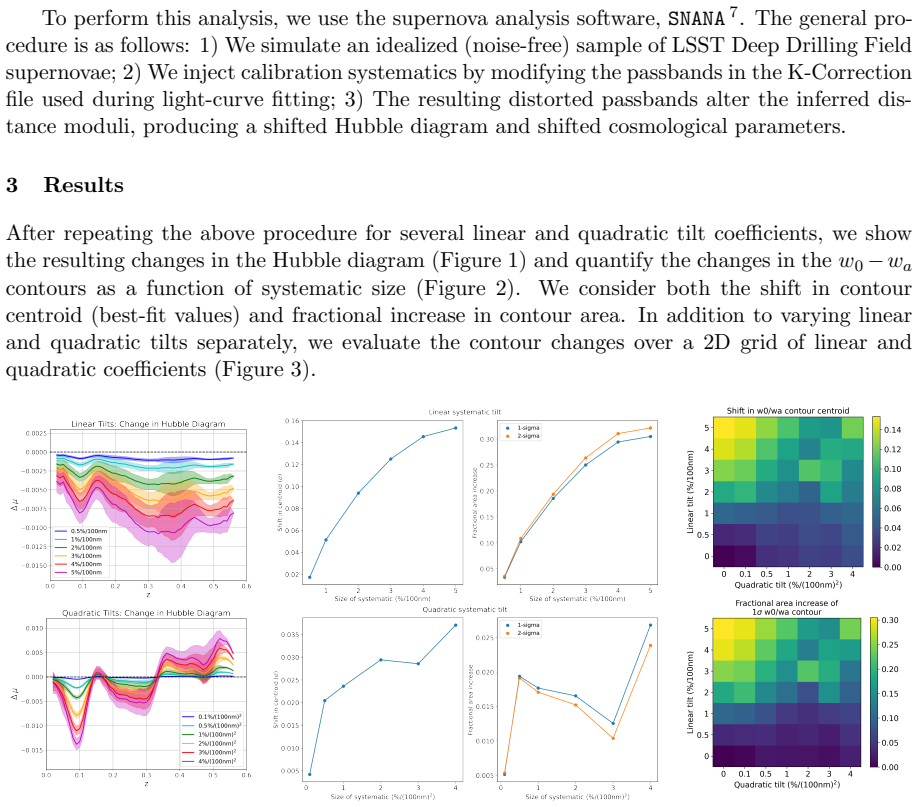
For linear passband tilts, the best-fit (w0, wa) shifts by ∼0.025σ and the w0−wa contour area increases by ∼5% for each 1%/100nm increase in tilt amplitude. Results for quadratic passband tilts are less conclusive and require further exploration.
What carries the argument
Simulation of linear and quadratic passband tilt errors, their effect on supernova distance moduli, and the resulting changes in cosmological parameter fits.
Load-bearing premise
The actual LSST passband calibration errors are adequately represented by the linear and quadratic tilt models used in the simulations.
What would settle it
Measure the real LSST passband response curves, apply the observed tilts to the supernova photometry, and check whether the resulting shifts in w0 and wa match the predicted 0.025 sigma per 1%/100nm scaling.
Figures
read the original abstract
The Vera C. Rubin Observatory's Legacy Survey of Space and Time (LSST) will deliver an unprecedented Type Ia supernova (SN) sample, making photometric calibration systematics a dominant source of uncertainty in dark energy constraints. We perform a comprehensive analysis of calibration systematic effects in LSST, quantifying how uncertainties in the LSST passbands propagate into biases in SN distance moduli and, consequently, the dark energy equation of state parameters. Specifically, we examine how the inferred values and uncertainties of $w_0$ and $w_a$ shift as a function of the amplitude of passband systematics. For linear passband tilts, we find that the best-fit ($w_0$,$w_a$) shifts by $\sim$0.025$\sigma$ and the $w_0-w_a$ contour area increases by $\sim$5% for each 1%/100nm increase in tilt, while for quadratic passband tilts, our results are less conclusive and warrant further exploration. This analysis will help inform the calibration accuracy required for LSST to achieve its goals in constraining dark energy.
Editorial analysis
A structured set of objections, weighed in public.
Referee Report
Summary. The manuscript presents a simulation study of how uncertainties in LSST passbands, modeled as linear and quadratic tilts, propagate into biases and uncertainty inflation in Type Ia supernova distance moduli and the dark energy parameters w0 and wa. It reports that linear tilts produce a best-fit (w0, wa) shift of ~0.025σ and a ~5% increase in w0-wa contour area per 1%/100 nm tilt amplitude, while quadratic tilts yield less conclusive results.
Significance. If the tilt models and simulation assumptions hold, the work supplies concrete, quantitative targets for passband calibration accuracy needed to keep systematic biases sub-dominant in LSST dark energy analyses. The controlled injection of systematics into simulated photometry is a clear methodological strength that allows direct mapping from calibration error amplitude to cosmological impact.
major comments (3)
- [Abstract] Abstract: the headline quantitative result (0.025σ shift and 5% area increase per 1%/100 nm linear tilt) is obtained exclusively from linear and quadratic tilt injections. The abstract itself states that quadratic results are “less conclusive,” indicating that the reported numbers are already sensitive to the choice of basis functions and may not bound the effect of realistic, higher-order or filter-correlated LSST calibration residuals.
- [Simulation methodology] Simulation methodology: the propagation to distance moduli and (w0, wa) assumes that passband tilts act in isolation and that supernova sample properties and other systematics do not interact with them. No tests of this isolation assumption are described, yet it is load-bearing for the claim that the quoted shifts and area increases are representative of actual LSST data.
- [Results] Results section: the specific numerical values (0.025σ and 5%) are presented without accompanying tables or figures showing the full dependence on tilt amplitude, the number of realizations, or the covariance between linear and quadratic components. This makes it impossible to assess the statistical robustness or to reproduce the exact mapping from tilt amplitude to cosmological bias.
minor comments (2)
- Define the precise units and wavelength range over which the 1%/100 nm tilt amplitude is applied, and state whether the same tilt is applied uniformly across all filters or allowed to vary.
- Add a brief description of the cosmological likelihood and priors used when fitting w0 and wa, including whether the supernova covariance matrix includes the calibration systematic or treats it as an external shift.
Simulated Author's Rebuttal
We thank the referee for their careful and constructive review of our manuscript. We address each of the major comments point by point below, providing clarifications and indicating revisions where the manuscript will be updated to improve clarity and address the concerns raised.
read point-by-point responses
-
Referee: [Abstract] Abstract: the headline quantitative result (0.025σ shift and 5% area increase per 1%/100 nm linear tilt) is obtained exclusively from linear and quadratic tilt injections. The abstract itself states that quadratic results are “less conclusive,” indicating that the reported numbers are already sensitive to the choice of basis functions and may not bound the effect of realistic, higher-order or filter-correlated LSST calibration residuals.
Authors: We agree that the headline numbers derive from the specific linear and quadratic tilt models and that the abstract already flags the quadratic results as less conclusive. This sensitivity to basis choice is inherent to our controlled simulation approach. In the revised manuscript we have updated the abstract to explicitly state that the reported shifts and area increases are indicative values for these simplified tilt models rather than comprehensive bounds on all possible calibration residuals. We have also added a short paragraph in the discussion section noting that higher-order or filter-correlated errors would require more complex models and are left for future work. revision: partial
-
Referee: [Simulation methodology] Simulation methodology: the propagation to distance moduli and (w0, wa) assumes that passband tilts act in isolation and that supernova sample properties and other systematics do not interact with them. No tests of this isolation assumption are described, yet it is load-bearing for the claim that the quoted shifts and area increases are representative of actual LSST data.
Authors: We acknowledge that the analysis treats passband tilts in isolation and does not include explicit tests for interactions with other systematics or variations in supernova sample properties. This controlled isolation was chosen to provide a direct mapping from tilt amplitude to cosmological impact. In the revised manuscript we have expanded the simulation methodology section to state this assumption explicitly, discuss its implications, and note that full interaction studies would require a more comprehensive end-to-end simulation framework beyond the present scope. revision: yes
-
Referee: [Results] Results section: the specific numerical values (0.025σ and 5%) are presented without accompanying tables or figures showing the full dependence on tilt amplitude, the number of realizations, or the covariance between linear and quadratic components. This makes it impossible to assess the statistical robustness or to reproduce the exact mapping from tilt amplitude to cosmological bias.
Authors: The results section contains figures that display the dependence of shifts and contour areas on tilt amplitude. The number of Monte Carlo realizations (1000 per amplitude) is stated in the methods. To improve transparency and reproducibility we have added a new summary table in the results section that tabulates the best-fit shifts, area increases, and uncertainties for the full range of tilt amplitudes examined, together with the realization count. We have also added text clarifying that linear and quadratic components were injected separately to avoid degeneracy and that any covariance in realistic residuals is not captured by the current models. revision: yes
Circularity Check
No significant circularity; results from controlled forward simulation of passband perturbations
full rationale
The paper derives its quantitative claims by injecting controlled linear and quadratic passband tilt amplitudes into simulated LSST supernova photometry, propagating the perturbed fluxes through the distance-modulus pipeline, and measuring the resulting shifts in best-fit (w0, wa) and contour area. These output metrics are computed directly from the simulation ensemble and do not reduce to any re-expression of the input tilt parameters or to a fit performed on the same data that generated the inputs. No self-citation is invoked as a uniqueness theorem or load-bearing premise, and the derivation chain remains independent of the target cosmological parameters.
Axiom & Free-Parameter Ledger
free parameters (1)
- passband tilt amplitude
axioms (1)
- domain assumption Standard flat Lambda-CDM or w0-wa cosmological model used to convert distance moduli to cosmological parameters
Lean theorems connected to this paper
-
IndisputableMonolith/Foundation/RealityFromDistinction.leanreality_from_one_distinction unclear?
unclearRelation between the paper passage and the cited Recognition theorem.
We distort the LSST passbands directly via linear and quadratic tilts... inject calibration systematics by modifying the passbands in the K-Correction file
What do these tags mean?
- matches
- The paper's claim is directly supported by a theorem in the formal canon.
- supports
- The theorem supports part of the paper's argument, but the paper may add assumptions or extra steps.
- extends
- The paper goes beyond the formal theorem; the theorem is a base layer rather than the whole result.
- uses
- The paper appears to rely on the theorem as machinery.
- contradicts
- The paper's claim conflicts with a theorem or certificate in the canon.
- unclear
- Pith found a possible connection, but the passage is too broad, indirect, or ambiguous to say the theorem truly supports the claim.
Reference graph
Works this paper leans on
- [1]
- [2]
- [3]
- [4]
-
[5]
doi:10.1142/S021773231530030X , archivePrefix =
Precise astronomical flux calibration. doi:10.1142/S021773231530030X , archivePrefix =. 1601.04052 , primaryClass =
-
[6]
DES Supernova Program: Reanalysis Of Cosmology Results. doi:10.48550/arXiv.2511.07517 , archivePrefix =. 2511.07517 , primaryClass =
work page internal anchor Pith review Pith/arXiv arXiv doi:10.48550/arxiv.2511.07517
-
[7]
The Bayesian view of DESI DR2
-
[8]
doi:10.48550/arXiv.2512.06319 , archivePrefix =
Photometric Approach to SN Ia Cosmology in LSST Era. doi:10.48550/arXiv.2512.06319 , archivePrefix =. 2512.06319 , primaryClass =
-
[9]
2018, arXiv e-prints, arXiv:1809.01669
The LSST DESC Science Requirements Document. doi:10.48550/arXiv.1809.01669 , archivePrefix =. 1809.01669 , primaryClass =
-
[10]
SNANA: A Public Software Package for Supernova Analysis. doi:10.1086/605984 , archivePrefix =. 0908.4280 , primaryClass =
- [11]
discussion (0)
Sign in with ORCID, Apple, or X to comment. Anyone can read and Pith papers without signing in.