Recognition: 2 theorem links
· Lean TheoremNovel Machine Learning Methods to Improve Z Pole Integrated Luminosity at Future Colliders
Pith reviewed 2026-05-13 03:09 UTC · model grok-4.3
The pith
Machine learning techniques enable the required 10^{-4} precision in luminosity measurement for future Z-pole electron-positron colliders.
A machine-rendered reading of the paper's core claim, the machinery that carries it, and where it could break.
Core claim
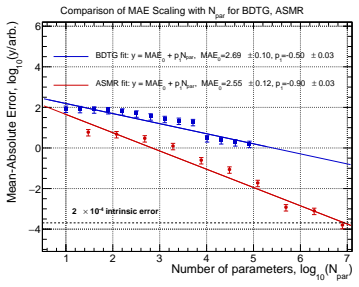
The paper demonstrates that gradient boosted decision trees classify events to reject neutral hadron backgrounds in the diphoton luminosity channel using existing and upgraded detectors, but only the upgraded luminosity calorimeter rejects small angle Bhabha scattering at the required δL/L < 10^{-4}. A newly developed Adaptive Symbolic Memetic Regression (ASMR) algorithm outperforms boosted decision trees for event-by-event beam deflection correction, reducing the uncertainty to 5×10^{-6}.
What carries the argument
Gradient boosted decision tree classification for particle ID in forward trackers and LumiCal, combined with Adaptive Symbolic Memetic Regression for beam deflection correction.
Load-bearing premise
Machine learning models trained on simulated background and beam deflection data will generalize to real future collider conditions with the same performance, and that all relevant backgrounds have been correctly modeled in simulation.
What would settle it
A comparison of the ML-corrected luminosity value against an independent calibration such as Z boson production rates on actual future collider data, checking whether the total uncertainty stays below 10^{-4}.
Figures


read the original abstract
Future $e^+e^-$ colliders at the Z pole place strong demands of $\frac{\delta L}{L}<10^{-4}$ on the integrated luminosity measurement. Small angle Bhabha scattering (SABS) remains the standard channel, while diphoton ($\gamma\gamma$) events provide a complementary measurement. This contribution summarizes recent work on two dominant uncertainties. First, we investigate backgrounds to the diphoton channel and find that SABS and low-invariant-mass neutral hadrons are the most significant backgrounds. A gradient boosted decision tree (BDTG) is used to classify events by particle ID. The classification results show the existing and upgraded forward tracker and luminosity calorimeter (LumiCal) designs reject neutral hadrons but only the LumiCal upgrade can reject SABS at $\frac{\delta L}{L}<10^{-4}$. Second, we solve the beam deflection bias problem on an event-by-event basis using two machine learning algorithms. A BDTG and the newly written Adaptive Symbolic Memetic Regression (ASMR) are trained on beam deflection data. ASMR outperforms BDTG and provides a reduced uncertainty of $5\times10^{-6}$ for beam deflection.
Editorial analysis
A structured set of objections, weighed in public.
Referee Report
Summary. The manuscript proposes machine learning methods to reduce uncertainties in Z-pole integrated luminosity measurements at future e+e- colliders. It applies a gradient boosted decision tree (BDTG) to classify and reject backgrounds (SABS and low-mass neutral hadrons) to the diphoton channel using existing and upgraded forward tracker/LumiCal designs, claiming that only the LumiCal upgrade achieves the required δL/L < 10^{-4}. It further introduces Adaptive Symbolic Memetic Regression (ASMR) alongside BDTG to correct beam deflection bias event-by-event on simulated data, reporting that ASMR outperforms BDTG and yields a beam-deflection uncertainty of 5×10^{-6}.
Significance. If the reported background rejection and uncertainty reductions hold under realistic conditions, the work could supply concrete tools for meeting the stringent luminosity precision needed for Z-pole programs at future colliders. The introduction of ASMR as a novel regression technique is a methodological contribution that may offer advantages over standard BDTG in this domain.
major comments (1)
- [Abstract and results] Abstract and results sections: The quantitative claims (neutral-hadron rejection, SABS rejection at δL/L < 10^{-4}, and beam-deflection uncertainty of 5×10^{-6}) rest entirely on Monte Carlo samples whose generation, size, training/validation splits, and particle-ID response modeling are not described. No cross-checks against LEP or other existing e+e- data are reported, and no systematic variations (generator tunes, misalignment, beam-parameter uncertainties) are propagated into the final δL/L figures. This is load-bearing because the central claim is that these ML methods achieve the required precision for a future collider.
minor comments (2)
- [Abstract] The acronym ASMR is introduced without an explicit definition or reference to its algorithmic details at first use.
- [Abstract] Notation for the luminosity uncertainty δL/L is used inconsistently in the abstract without a clear definition of how it is computed from the classification or regression outputs.
Simulated Author's Rebuttal
We thank the referee for the careful and constructive review. We address the major comment on the description and validation of our Monte Carlo results below.
read point-by-point responses
-
Referee: [Abstract and results] Abstract and results sections: The quantitative claims (neutral-hadron rejection, SABS rejection at δL/L < 10^{-4}, and beam-deflection uncertainty of 5×10^{-6}) rest entirely on Monte Carlo samples whose generation, size, training/validation splits, and particle-ID response modeling are not described. No cross-checks against LEP or other existing e+e- data are reported, and no systematic variations (generator tunes, misalignment, beam-parameter uncertainties) are propagated into the final δL/L figures. This is load-bearing because the central claim is that these ML methods achieve the required precision for a future collider.
Authors: We agree that the manuscript requires expanded documentation of the Monte Carlo setup to substantiate the reported performance. In the revised version we will add a dedicated methods subsection specifying the event generators and tunes employed, the total number of simulated events, the training/validation/test splits for both the BDTG and ASMR algorithms, and the detailed modeling of particle-ID response in the forward tracker and LumiCal. We will also perform and report additional systematic studies by varying generator tunes, introducing realistic misalignment scenarios, and scanning beam-parameter uncertainties, then propagating these variations into the final δL/L values. Cross-checks with LEP data are feasible only for the existing detector geometries and standard SABS/diphoton selections; we will include such comparisons where they exist. For the proposed LumiCal upgrade, however, no equivalent real data are available, so validation necessarily remains simulation-based. revision: partial
- Direct experimental cross-checks of the upgraded LumiCal design against LEP or other existing data, since no such upgraded detector has been operated.
Circularity Check
No circularity; ML results are empirical outputs from simulated data
full rationale
The paper applies standard supervised ML (BDTG classification for particle ID and BDTG/ASMR regression for beam deflection) to Monte Carlo samples of SABS, neutral-hadron, and beam-deflection events. Reported figures (neutral-hadron rejection, SABS rejection at δL/L < 10^{-4}, and 5×10^{-6} deflection uncertainty) are direct evaluation metrics on held-out test events, not quantities defined in terms of themselves or obtained by renaming fitted parameters. No equations, self-citations, or ansatzes appear that would make any central claim tautological with its inputs. The derivation chain is therefore self-contained as conventional ML benchmarking.
Axiom & Free-Parameter Ledger
Lean theorems connected to this paper
-
IndisputableMonolith/Cost/FunctionalEquation.leanwashburn_uniqueness_aczel unclearA BDTG was trained on kinematic, spatial, and cluster observables... ASMR... learned that θ− − θ+ / 2 is a good leading order predictor
-
IndisputableMonolith/Foundation/AbsoluteFloorClosure.leanabsolute_floor_iff_bare_distinguishability unclearTables 1–2: particle-ID confusion matrices for ILD/GLIP LumiCal
Reference graph
Works this paper leans on
- [1]
-
[2]
Abramowicz et al.,A linear collider vision for the future of particle physics, 2503.05437
H. Abramowicz et al.,A linear collider vision for the future of particle physics, 2503.05437
-
[3]
ILD collaboration, H. Abramowicz et al.,The ILD Detector: A V ersatile Detector for an Electron-Positron Collider at Energies up to 1 TeV,2506.06030
-
[4]
Abramowicz et al.,International Large Detector: Interim Design Report,2003.01116
ILD ConceptGroupcollaboration, H. Abramowicz et al.,International Large Detector: Interim Design Report,2003.01116
- [5]
-
[6]
B. Madison and G. Wilson,Novel position reconstruction methods for highly granular electromagnetic calorimeters,EPJ Web Conf.315(2024) 03007
work page 2024
- [7]
- [8]
-
[9]
G. Wilson and B. Madison,Reimagining e +e− collider precision luminosity measurements,EPJ Web Conf.315(2024) 01024
work page 2024
- [10]
-
[11]
G. V outsinas, E. Perez, M. Dam and P. Janot,Beam-beam effects on the luminosity measurement at LEP and the number of light neutrino species,Phys. Lett. B800 (2020) 135068, [1908.01704]
-
[12]
WHIZARD: Simulating Multi-Particle Processes at LHC and ILC
W. Kilian, T. Ohl and J. Reuter,WHIZARD: Simulating Multi-Particle Processes at LHC and ILC,Eur . Phys. J. C71(2011) 1742, [0708.4233]
work page Pith review arXiv 2011
-
[13]
A Brief Introduction to PYTHIA 8.1
T. Sjostrand, S. Mrenna and P. Z. Skands,A Brief Introduction to PYTHIA 8.1, Comput. Phys. Commun.178(2008) 852–867, [0710.3820]
work page internal anchor Pith review arXiv 2008
-
[14]
Agostinelli et al.,GEANT4—a simulation toolkit,Nucl
S. Agostinelli et al.,GEANT4—a simulation toolkit,Nucl. Instrum. Meth. A506(2003) 250–303
work page 2003
-
[15]
Schulte,Beam-beam simulations with GUINEA-PIG,
D. Schulte,Beam-beam simulations with GUINEA-PIG,
-
[16]
F. James and M. Roos,Minuit: A System for Function Minimization and Analysis of the Parameter Errors and Correlations,Comput. Phys. Commun.10(1975) 343–367
work page 1975
-
[17]
M. V . Berry and Z. V . Lewis,On the weierstrass–mandelbrot fractal function, Proceedings of the Royal Society of London. Series A, Mathematical and Physical Sciences370(1980) 459–484
work page 1980
-
[18]
Madison,Beam polarization precision requirements for future e +e− Higgs factories, 2511.09851
B. Madison,Beam polarization precision requirements for future e +e− Higgs factories, 2511.09851
-
[19]
I. B. Jelisav ˇci´c, S. Luki´c, G. M. Dumbelovi´c, M. Pandurovi´c and I. Smiljani´c, Luminosity measurement at ilc,Journal of Instrumentation8(Aug., 2013) P08012–P08012
work page 2013
discussion (0)
Sign in with ORCID, Apple, or X to comment. Anyone can read and Pith papers without signing in.