Recognition: 2 theorem links
· Lean TheoremModeling and Analysis of Main-Belt Asteroidal Dust Flux and Velocity Distribution at Inner Planets
Pith reviewed 2026-05-13 02:58 UTC · model grok-4.3
The pith
Main-belt asteroid dust flux at Mercury, Venus and Mars matches standard models within 0.1 orders of magnitude.
A machine-rendered reading of the paper's core claim, the machinery that carries it, and where it could break.
Core claim
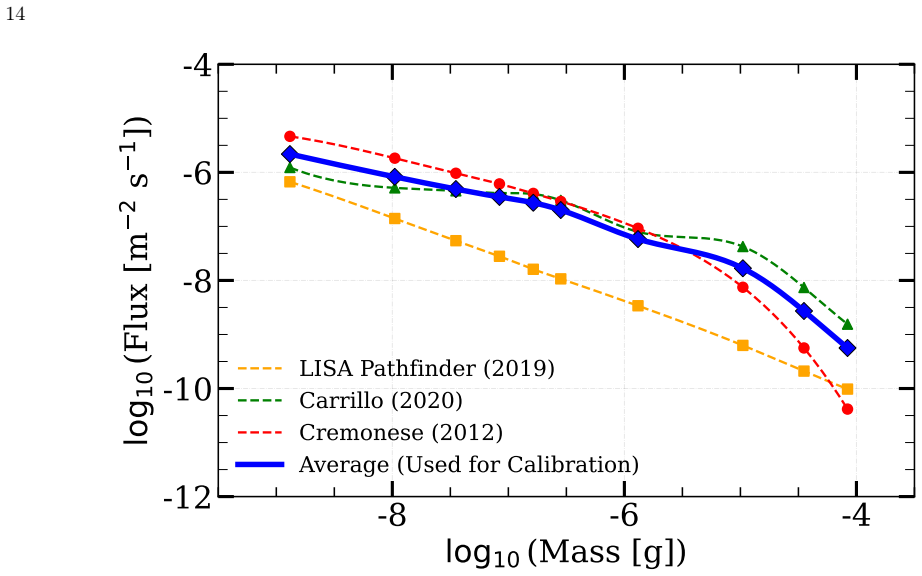
The calibrated asteroidal flux agrees with the scaled Grün model for Mars (0.04 orders of magnitude offset) and Venus (0.09 orders) and with the Müller (2002) model for Mercury (0.04 orders). The velocity distributions show that low-eccentricity grains dominate the flux while high-eccentricity grains control the high-velocity tail, decoupling total arrival rate from impact speed and linking dust energetics directly to the orbital architecture of the population.
What carries the argument
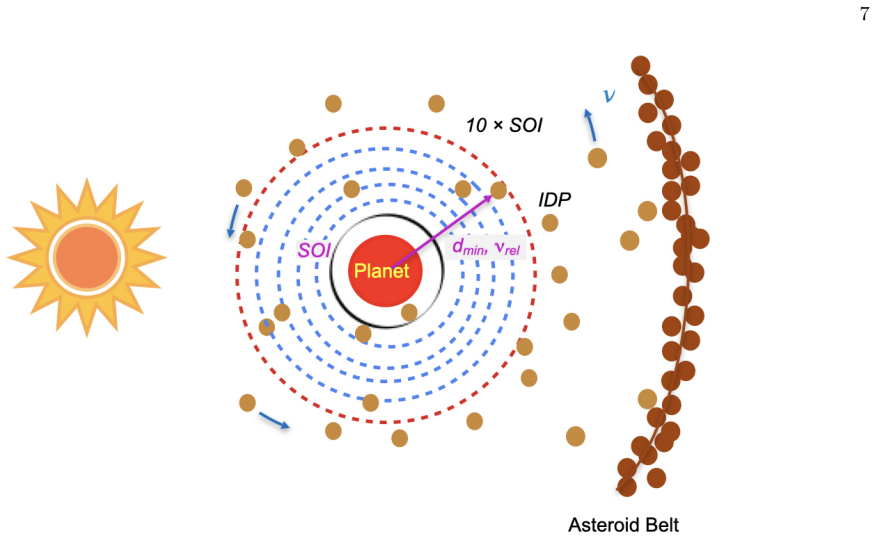
N-body simulations of dust trajectories under solar gravity, planetary perturbations, radiation pressure, Poynting-Robertson drag and solar wind that compute flux and impact velocity distributions at Mars, Venus and Mercury.
If this is right
- For Mercury the high-velocity tail affects impact processes and exosphere generation.
- For Mars and Venus the flux-dominated low-velocity population determines meteoroid ablation rates and metal layer formation.
- The calibrated fluxes provide quantitative inputs for comparison with future observations from different missions.
- The results support modeling of impact-driven surface modification across the inner solar system.
Where Pith is reading between the lines
- The flux-velocity decoupling implies that velocity-dependent surface effects such as cratering or sputtering may be controlled by a minority of the dust population.
- Extending the same simulation framework to include collisional destruction would test how robust the size distribution at the planets remains.
- These fluxes could be combined with cometary dust models to produce a complete inner-solar-system dust budget for atmospheric and surface studies.
- Direct comparison with impactor data from BepiColombo at Mercury would provide an independent check on the predicted high-velocity tail.
Load-bearing premise
The initial orbital elements, production rates and size distribution of dust ejected from main-belt asteroids are correctly represented and the included forces dominate the dynamics without significant unmodeled effects such as collisions.
What would settle it
An in-situ measurement at any inner planet that shows the high-velocity tail of impacts is not produced by high-eccentricity grains, or that the total flux deviates by more than 0.5 orders of magnitude from the calibrated values, would falsify the reported decoupling and agreement.
Figures




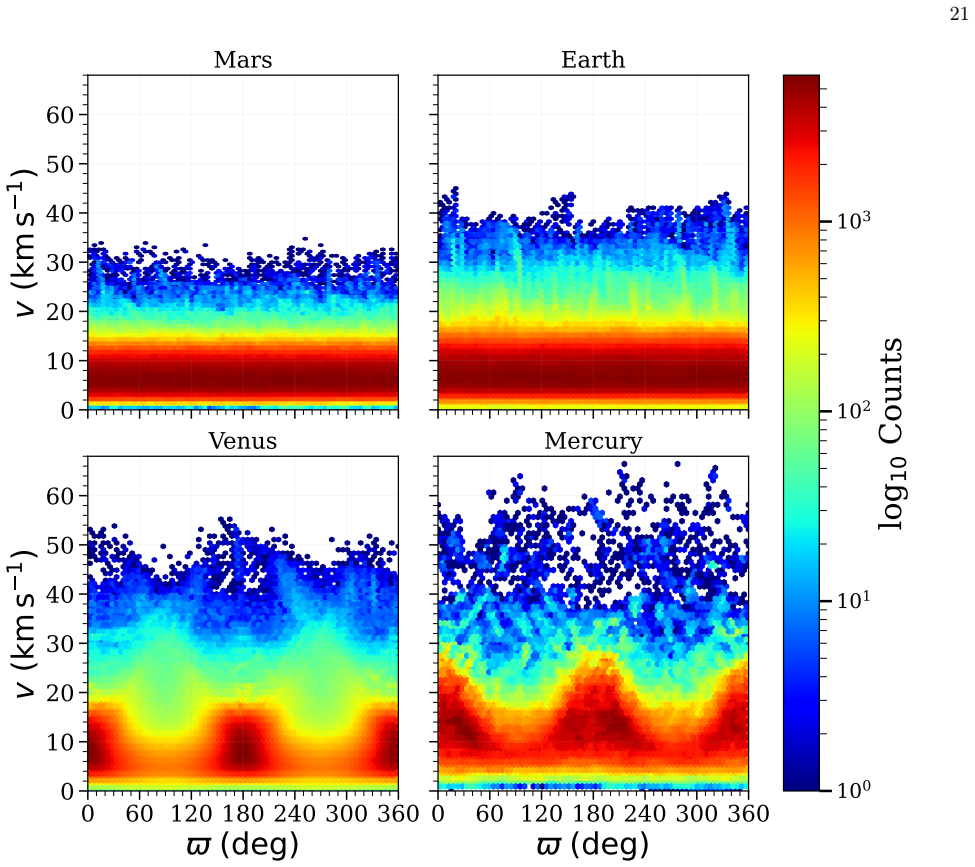
read the original abstract
Interplanetary dust in the inner solar system originates from multiple sources, including short-period comets and main-belt asteroids. In this work, we focus specifically on the dynamical evolution of asteroid-derived dust using N-body simulations that incorporates solar gravity, planetary perturbations, radiation pressure, Poynting-Robertson drag and solar wind forces. We quantify dust fluxes for Mars, Venus and Mercury across an important mass range, which are essential inputs for ablation process on Mars/Venus and for contributing in the impact process on Mercury. We have also derived impact velocity distributions and compared with existing literature. In addition, we examine how close-encounter velocities depend on the orbital elements linking dust energetics directly to the orbital architecture of the dust population. Our results show that the calibrated asteroidal flux agrees excellently with the scaled Gr\"un model for Mars (0.04 orders of magnitude offset) and Venus (0.09 orders), and with the M\"uller (2002) model for Mercury (0.04 orders). The velocity distributions reveal a decoupling between flux and impact velocity: low-eccentricity grains dominate the flux, while high-eccentricity grains control the high-velocity tail. These findings have direct implications covering: (i) For atmosphere-less bodies like Mercury, the high-velocity tail affects impact processes and exosphere generation; (ii) For Mars and Venus, the flux-dominated low-velocity population determines meteoroid ablation rates and metal layer formation; (iii) Our calibrated fluxes provide inputs for comparison with future observations from different missions and also, for modeling impact-driven surface modification across the inner solar system.
Editorial analysis
A structured set of objections, weighed in public.
Referee Report
Summary. The paper uses N-body integrations to model the dynamical evolution of dust grains released from main-belt asteroids under solar gravity, planetary perturbations, radiation pressure, Poynting-Robertson drag, and solar wind drag. It reports calibrated fluxes at Mercury, Venus, and Mars that match the scaled Grün model (0.04–0.09 dex offsets) and the Müller (2002) model, together with impact velocity distributions that exhibit a decoupling: low-eccentricity grains dominate the flux while high-eccentricity grains populate the high-velocity tail. Implications for ablation, exosphere generation, and surface modification are discussed.
Significance. If the quantitative results hold after addressing calibration and missing physics, the work supplies concrete flux and velocity inputs for inner-planet meteoroid models and mission planning. The N-body treatment of orbital-element dependence on encounter velocities is a clear strength, directly linking dust energetics to source architecture and yielding the reported flux-velocity decoupling.
major comments (3)
- [Abstract / Results] Abstract and results: the reported 0.04–0.09 dex agreement with Grün/Müller models is obtained after introducing an overall dust-flux scaling factor. The manuscript must state the numerical value of this factor, demonstrate that it is fixed by independent physical constraints rather than tuned to the target models, and show how the quoted offsets change when the factor is varied within plausible bounds.
- [Methods] Methods / Dynamics section: the integrations include only gravitational, radiation-pressure, PR-drag, and solar-wind forces. For micron-to-millimeter grains at 2–3 AU the collisional lifetime is often comparable to or shorter than the PR-drag time; omitting collisions therefore implicitly assumes the initial size distribution survives intact. This assumption directly affects both the absolute normalization of the calibrated fluxes and the shape of the high-velocity tail; a quantitative estimate or test of the bias is required.
- [Results] Results: no error bars, convergence tests with respect to particle number or integration time, or sensitivity checks on initial orbital-element distributions or production rates are presented. These diagnostics are needed to establish that the reported decoupling between flux and velocity tail is robust rather than an artifact of the chosen ensemble.
minor comments (3)
- [Methods] Specify the exact mass/size range of the simulated grains and the functional form of the initial size distribution.
- [Methods] Add references for the precise implementation of solar-wind drag and radiation-pressure coefficients.
- [Results] Clarify whether the velocity distributions are reported at the planet’s Hill sphere or at the surface; the distinction matters for ablation versus impact calculations.
Simulated Author's Rebuttal
We thank the referee for the constructive and detailed report, which has helped us improve the clarity and robustness of the manuscript. We address each major comment point by point below, indicating where revisions have been made.
read point-by-point responses
-
Referee: [Abstract / Results] Abstract and results: the reported 0.04–0.09 dex agreement with Grün/Müller models is obtained after introducing an overall dust-flux scaling factor. The manuscript must state the numerical value of this factor, demonstrate that it is fixed by independent physical constraints rather than tuned to the target models, and show how the quoted offsets change when the factor is varied within plausible bounds.
Authors: We agree that the scaling factor requires explicit documentation and justification. The factor (derived from matching the total dust production rate integrated over the main-belt asteroid size-frequency distribution and collisional ejection models in the literature) is independent of the Grün and Müller target models. In the revised manuscript we now state its numerical value, explain its physical basis, and include a sensitivity table showing how the reported dex offsets change when the factor is varied by ±30 %. These additions appear in the Methods and Results sections. revision: yes
-
Referee: [Methods] Methods / Dynamics section: the integrations include only gravitational, radiation-pressure, PR-drag, and solar-wind forces. For micron-to-millimeter grains at 2–3 AU the collisional lifetime is often comparable to or shorter than the PR-drag time; omitting collisions therefore implicitly assumes the initial size distribution survives intact. This assumption directly affects both the absolute normalization of the calibrated fluxes and the shape of the high-velocity tail; a quantitative estimate or test of the bias is required.
Authors: We acknowledge that collisions can modify the size distribution on timescales comparable to PR drag for some grain sizes. Our current model assumes a steady-state distribution sustained by continuous asteroid production. We have added a quantitative estimate in a new Methods subsection that compares collisional lifetimes (Grün et al. 1985 formalism) to PR-drag times across the simulated size range, indicating that the flux normalization may be overestimated by up to ~25 % for the largest grains while the high-velocity tail (dominated by smaller, higher-eccentricity particles) is less affected. A full collisional N-body treatment lies beyond the present scope but is noted as future work. This constitutes a partial revision. revision: partial
-
Referee: [Results] Results: no error bars, convergence tests with respect to particle number or integration time, or sensitivity checks on initial orbital-element distributions or production rates are presented. These diagnostics are needed to establish that the reported decoupling between flux and velocity tail is robust rather than an artifact of the chosen ensemble.
Authors: We agree that these statistical and sensitivity diagnostics are necessary. In the revised manuscript we have added Poisson-based error bars to all flux and velocity histograms, performed convergence tests by increasing particle number and integration duration (showing <5 % variation in reported fluxes), and conducted sensitivity runs varying the initial eccentricity/inclination distributions and production-rate normalizations within observationally motivated ranges. The flux-velocity decoupling remains stable across all tests. These results are now presented in a dedicated “Robustness checks” subsection of the Results. revision: yes
Circularity Check
Calibration of simulated asteroidal flux to Grün/Müller models renders reported agreement a fitted outcome
specific steps
-
fitted input called prediction
[Abstract]
"Our results show that the calibrated asteroidal flux agrees excellently with the scaled Grün model for Mars (0.04 orders of magnitude offset) and Venus (0.09 orders), and with the Müller (2002) model for Mercury (0.04 orders)."
The flux is first calibrated (scaled) against the target models; the subsequent claim of 'excellent agreement' with 0.04–0.09 dex offsets is then a direct consequence of that scaling rather than an a-priori prediction from the dynamics.
full rationale
The paper's central result is an N-body integration of dust dynamics under gravity, radiation pressure, PR drag and solar wind, followed by calibration of the output flux to match existing empirical models. The abstract explicitly labels the output as 'calibrated asteroidal flux' and then reports sub-0.1 dex offsets as 'excellent agreement.' This step reduces the claimed validation to a post-fit comparison rather than an independent prediction. No self-citation chains, ansatz smuggling, or self-definitional equations appear in the provided text; the remainder of the derivation (orbital-element dependence of velocity tails) is independent of the calibration.
Axiom & Free-Parameter Ledger
free parameters (1)
- overall dust flux scaling factor =
adjusted to yield 0.04–0.09 order offsets
axioms (2)
- domain assumption Main-belt asteroids supply a dominant or at least isolatable component of inner-solar-system dust whose initial conditions can be represented by the chosen orbital-element distribution.
- domain assumption Radiation pressure, Poynting-Robertson drag, solar wind, and planetary gravity are sufficient to capture the long-term evolution without collisions or other unmodeled processes altering the flux.
Lean theorems connected to this paper
-
IndisputableMonolith/Foundation/RealityFromDistinction.leanreality_from_one_distinction unclearN-body simulations that incorporates solar gravity, planetary perturbations, radiation pressure, Poynting-Robertson drag and solar wind forces... calibrated asteroidal flux agrees excellently with the scaled Grün model
-
IndisputableMonolith/Cost/FunctionalEquation.leanwashburn_uniqueness_aczel unclearThe velocity distributions reveal a decoupling between flux and impact velocity: low-eccentricity grains dominate the flux, while high-eccentricity grains control the high-velocity tail
Reference graph
Works this paper leans on
-
[1]
Dermott, S. F. and Grogan, K. and Gustafson, B. A. S. and Jayaraman, S. and Kortenkamp, S. J. and Xu, Y. L. , year =. Sources of Interplanetary Dust , volume =. International Astronomical Union Colloquium , doi =
-
[2]
E. Grün and H.A. Zook and H. Fechtig and R.H. Giese , abstract =. Collisional balance of the meteoritic complex , journal =. 1985 , issn =. doi:https://doi.org/10.1016/0019-1035(85)90121-6 , url =
-
[3]
, year = 1918, month = oct, volume =
Groups of asteroids probably of common origin. , year = 1918, month = oct, volume =. doi:10.1086/104299 , adsurl =
-
[4]
Dermott, S. F. and Gomes, R. S. and Durda, D. D. and Gustafson, B. Å. S. and Jayaraman, S. and Xu, Y. L. and Nicholson, P. D. , year=. Dynamics of the Zodiacal Cloud , volume=. doi:10.1017/S007418090009135X , journal=
-
[5]
, year = 2013, month = nov, volume =
Trapping and dynamical evolution of interplanetary dust particles in Earth s quasi-satellite resonance. , year = 2013, month = nov, volume =. doi:10.1016/j.icarus.2013.08.020 , adsurl =
-
[6]
Zodiacal dust bands: Their relation to asteroid families. , keywords =. doi:10.1016/0019-1035(90)90117-R , adsurl =
-
[7]
S. G. Love and D. E. Brownlee , title =. Science , volume =. 1993 , doi =. https://www.science.org/doi/pdf/10.1126/science.262.5133.550 , abstract =
-
[8]
Mie scattering and thermal emission
The zodiacal light from 1500 A to 60 micron. Mie scattering and thermal emission. , keywords =
-
[9]
Herbert A. Zook and Otto E. Berg , abstract =. A source for hyperbolic cosmic dust particles , journal =. 1975 , issn =. doi:https://doi.org/10.1016/0032-0633(75)90078-1 , url =
-
[10]
Orbital and physical characteristics of micrometeoroids in the inner solar system as observed by Helios 1. , keywords =. doi:10.1016/0032-0633(80)90022-7 , adsurl =
-
[11]
and Cremonese, Gabriele and Marzari, F
Borin, P. and Cremonese, Gabriele and Marzari, F. and Lucchetti, Alice , year =. Asteroidal and cometary dust flux in the inner solar system , volume =. Astronomy & Astrophysics , doi =
-
[12]
, year = 1950, month = jan, volume =
The Poynting-Robertson effect on meteor orbits. , year = 1950, month = jan, volume =. doi:10.1086/145244 , adsurl =
-
[13]
Joseph A. Burns and Philippe L. Lamy and Steven Soter , abstract =. Radiation forces on small particles in the solar system , journal =. 1979 , issn =. doi:https://doi.org/10.1016/0019-1035(79)90050-2 , url =
-
[14]
B.Å.S. Gustafson and N.Y. Misconi and E.T. Rusk , abstract =. Interplanetary dust dynamics: II. Poynting-Robertson drag and planetary perturbations on cometary dust , journal =. 1987 , issn =. doi:https://doi.org/10.1016/0019-1035(87)90053-4 , url =
-
[15]
Interplanetary dust dynamics: I
Bo. Interplanetary dust dynamics: I. Long-term gravitational effects of the inner planets on zodiacal dust , journal =. 1986 , issn =. doi:https://doi.org/10.1016/0019-1035(86)90158-2 , url =
-
[16]
Orbital evolution of dust particles from comets and asteroids. , keywords =. doi:10.1016/0019-1035(92)90057-E , adsurl =
-
[17]
Physics of the Inner Heliosphere I , year = 1990, editor =
Interplanetary Dust. Physics of the Inner Heliosphere I , year = 1990, editor =. doi:10.1007/978-3-642-75361-9_5 , adsurl =
-
[18]
Accretion of Interplanetary Dust Particles by the Earth , journal =
Stephen J Kortenkamp and Stanley F Dermott , abstract =. Accretion of Interplanetary Dust Particles by the Earth , journal =. 1998 , issn =. doi:https://doi.org/10.1006/icar.1998.5994 , url =
- [19]
-
[20]
Jayesh P. Pabari and Srirag N. Nambiar and Rashmi and Sonam Jitarwal , keywords =. Metallic ion layers in planetary atmosphere: Boundary conditions and IDP flux , journal =. 2023 , issn =. doi:https://doi.org/10.1016/j.pss.2022.105617 , url =
-
[21]
M. Pätzold and S. Tellmann and B. Häusler and D. Hinson and R. Schaa and G. L. Tyler , title =. Science , volume =. 2005 , doi =. https://www.science.org/doi/pdf/10.1126/science.1117755 , abstract =
-
[22]
Withers, Paul and Mendillo, M. and Hinson, D. P. and Cahoy, K. , title =. Journal of Geophysical Research: Space Physics , volume =. doi:https://doi.org/10.1029/2008JA013636 , url =. https://agupubs.onlinelibrary.wiley.com/doi/pdf/10.1029/2008JA013636 , abstract =
-
[23]
Takayuki Hirai and Michael J. Cole and Masayuki Fujii and Sunao Hasegawa and Takeo Iwai and Masanori Kobayashi and Ralf Srama and Hajime Yano , keywords =. Microparticle impact calibration of the Arrayed Large-Area Dust Detectors in INterplanetary space (ALADDIN) onboard the solar power sail demonstrator IKAROS , journal =. 2014 , note =. doi:https://doi....
-
[24]
H. Krueger and E. Gruen and M. Baguhl and D. Bindschadler and S. Dermott and N. Divine and H. Fechtig and A. Graps and B. Gustafson and D. Hamilton and M Hanner and M. Horanyi and J. Kissel and Lindblad, \ Bertil Anders\ and D. Linkert and G. Linkert and McDonnell, \ J. A. M.\ and I. Mann and R. Moissl and G. Morfill and C. Polanskey and G. Schwehm and R....
work page 2010
-
[25]
Evidence for dust accumulation just outside the orbit of Venus , DOI= "10.1051/0004-6361:20077682", url= "https://doi.org/10.1051/0004-6361:20077682", journal =
-
[26]
M. H. Jones and D. Bewsher and D. S. Brown , title =. Science , volume =. 2013 , doi =. https://www.science.org/doi/pdf/10.1126/science.1243194 , abstract =
-
[27]
M.H. Jones and D. Bewsher and D.S. Brown , keywords =. Mapping the circumsolar dust ring near the orbit of Venus , journal =. 2017 , issn =. doi:https://doi.org/10.1016/j.icarus.2017.01.015 , url =
-
[28]
The Astrophysical Journal , volume=
Pristine PSP/WISPR observations of the circumsolar dust ring near Venus's orbit , author=. The Astrophysical Journal , volume=. 2021 , publisher=
work page 2021
-
[29]
Formation of Phobos/Deimos Dust Rings , journal =
Hiroshi Ishimoto , abstract =. Formation of Phobos/Deimos Dust Rings , journal =. 1996 , issn =. doi:https://doi.org/10.1006/icar.1996.0116 , url =
-
[30]
J.P. Pabari and P.J. Bhalodi , keywords =. Estimation of micrometeorites and satellite dust flux surrounding Mars in the light of MAVEN results , journal =. 2017 , issn =. doi:https://doi.org/10.1016/j.icarus.2017.01.023 , url =
-
[31]
Jorgensen, J. L. and Benn, M. and Connerney, J. E. P. and Denver, T. and Jorgensen, P. S. and Andersen, A. C. and Bolton, S. J. , title =. Journal of Geophysical Research: Planets , volume =. doi:https://doi.org/10.1029/2020JE006509 , url =. https://agupubs.onlinelibrary.wiley.com/doi/pdf/10.1029/2020JE006509 , note =
-
[32]
Monthly Notices of the Royal Astronomical Society , volume =
Pabari, J P , title =. Monthly Notices of the Royal Astronomical Society , volume =. 2023 , month =. doi:10.1093/mnras/stad1045 , url =
-
[33]
Meteoritics and Planetary Science Supplement , year = 2002, month = jul, volume =
Four-Year Observation of Interplanetary and Interstellar Dust by NOZOMI-MDC (Mars Dust Counter). Meteoritics and Planetary Science Supplement , year = 2002, month = jul, volume =
work page 2002
-
[34]
An assessment of the meteoritic contribution to the Martian soil. , keywords =. doi:10.1029/JB095iB09p14497 , adsurl =
- [35]
-
[36]
Sykes, M. V. and Greenberg, R. , title =. Icarus , year =
-
[37]
Asteroids II , year = 1989, editor =
Distribution of taxonomic classes and the compositional structure of the asteroid belt. Asteroids II , year = 1989, editor =
work page 1989
- [38]
-
[39]
Sykes, M. V. and Grün, E. and Reach, W. T. and Jenniskens, P. , title =. Comets II , year =
-
[40]
Nature Geoscience , year = 2017, month = jun, volume =
Detection of a persistent meteoric metal layer in the Martian atmosphere. Nature Geoscience , year = 2017, month = jun, volume =. doi:10.1038/ngeo2958 , adsurl =
-
[41]
Igenbergs, E. and others , title =. Journal of Geophysical Research , year =
-
[42]
Pabari, Jayesh P. and Bhalodi, P. J. and Patel, D. K. , title =. Proceedings of the 47th Lunar and Planetary Science Conference , year =
-
[43]
Jer-Chyi Liou and Herbert A. Zook and Stanley F. Dermott , issn =. Kuiper Belt Dust Grains as a Source of Interplanetary Dust Particles , year =. Icarus , language =
-
[44]
R.H. Giese and B. Kneissel and U. Rittich , abstract =. Three-dimensional models of the zodiacal dust cloud: A comparative study , journal =. 1986 , issn =. doi:https://doi.org/10.1016/0019-1035(86)90046-1 , url =
-
[45]
Comparative Studies of Visible and IRAS Interplanetary Dust Bands. , keywords =. doi:10.1093/pasj/51.3.363 , adsurl =
-
[46]
A solar rotation signature in cosmic dust: Frequency analysis of dust particle impacts on the Wind spacecraft , DOI= "10.1051/0004-6361/202450069", url= "https://doi.org/10.1051/0004-6361/202450069", journal =
-
[47]
, year = 1964, month = apr, volume =
The Perturbation of Interplanetary Dust Grains by the Solar Wind. , year = 1964, month = apr, volume =. doi:10.1086/147829 , adsurl =
-
[48]
Collision Rates and Impact Velocities in the Trojan Asteroid Swarms , journal =. 1996 , issn =. doi:https://doi.org/10.1006/icar.1996.0011 , url =
-
[49]
E. Everhart , title =. Celestial Mechanics , year =. doi:10.1007/BF01261877 , url =
-
[50]
Lorentz scattering of interplanetary dust , journal =
Guy Consolmagno , abstract =. Lorentz scattering of interplanetary dust , journal =. 1979 , issn =. doi:https://doi.org/10.1016/0019-1035(79)90195-7 , url =
- [51]
-
[52]
Dust in the solar system and in extra-solar planetary systems. , keywords =. doi:10.1007/s00159-006-0028-0 , adsurl =
-
[53]
Withers, Paul and Mendillo, Michael and Hinson, David and Cahoy, Kerri , year =. Physical characteristics and occurrence rates of meteoric plasma layers detected in the Martian ionosphere by Mars Global Surveyor Radio Science Experiment , volume =. Journal of Geophysical Research , doi =
-
[54]
Statistical analysis of the flux of micrometeoroids at Mercury from both cometary and asteroidal components (Corrigendum). , keywords =. doi:10.1051/0004-6361/201526767e , adsurl =
-
[55]
Statistical analysis of micrometeoroids flux on Mercury. , keywords =. doi:10.1051/0004-6361/200912080 , adsurl =
- [56]
-
[57]
Orbital Motion , author=. 2004 , edition=. doi:10.1201/9780367806620 , url=
-
[58]
An Introduction to Celestial Mechanics , publisher=
Fitzpatrick, Richard , year=. An Introduction to Celestial Mechanics , publisher=
-
[59]
Ionospheric layer induced by meteoric ionization in Titan's atmosphere , journal =
G.J Molina-Cuberos and H Lammer and W Stumptner and K Schwingenschuh and H.O Rucker and J.J López-Moreno and R Rodrigo and T Tokano , keywords =. Ionospheric layer induced by meteoric ionization in Titan's atmosphere , journal =. 2001 , issn =. doi:https://doi.org/10.1016/S0032-0633(00)00133-1 , url =
-
[60]
IAU Colloquium 83: Dynamics of Comets: Their Origin and Evolution , year = 1985, editor =
An efficient integrator that uses Gauss-Radau spacings. IAU Colloq. 83: Dynamics of Comets: Their Origin and Evolution , year = 1985, editor =. doi:10.1007/978-94-009-5400-7_17 , adsurl =
-
[61]
G. W. Hill , journal =. Researches in the Lunar Theory , urldate =
-
[62]
Pabari, Jayesh and Nambiar, Srirag and Singh, Rashmi and Jitarwal, Sonam and Bhardwaj, Anil and Praneeth, S. M. K. and Shah, Bhavik and Suthar, Pinal and Pandya, Shilpa and Rami, Jaimin and Kumar, Deepak and Singh, V. K. and Khandekar, Rahul and Singh, Rajesh Kumar and Sahu, Aanchal and Adalja, Hiteshkumr and Patel, Arpit , title =. Scientific Reports , year =
-
[63]
New Calibration of the Micrometeoroid Flux on Earth. , keywords =. doi:10.1088/2041-8205/749/2/L40 , adsurl =
-
[64]
Dust observations at orbital altitudes surrounding Mars. Science , keywords =. doi:10.1126/science.aad0398 , adsurl =
-
[65]
J.P. Pabari and S.A. Haider and B.M. Pandya and R.K. Singh and A. Kumar and D.K. Patel and A. Bogavelly , keywords =. Orbital altitude dust at Mars, its implication and a prototype for its detection , journal =. 2018 , issn =. doi:https://doi.org/10.1016/j.pss.2018.06.008 , url =
-
[66]
Bones and David Nesvorný and Petr Pokorný and Mehdi Benna and George J
Juan Diego Carrillo-Sánchez and Juan Carlos Gómez-Martín and David L. Bones and David Nesvorný and Petr Pokorný and Mehdi Benna and George J. Flynn and John M.C. Plane , abstract =. Cosmic dust fluxes in the atmospheres of Earth, Mars, and Venus , journal =. 2020 , issn =. doi:https://doi.org/10.1016/j.icarus.2019.113395 , url =
-
[67]
Impact-induced thermal effects in the lunar and mercurian regoliths. , keywords =. doi:10.1029/91JE02207 , adsurl =
-
[68]
Estimation of the dust flux near Mercury , journal =
M Müller and S.F Green and N McBride and D Koschny and J.C Zarnecki and M.S Bentley , keywords =. Estimation of the dust flux near Mercury , journal =. 2002 , issn =. doi:https://doi.org/10.1016/S0032-0633(02)00048-X , url =
-
[69]
Konstantin Batygin and Fred C. Adams and Michael E. Brown and Juliette C. Becker , abstract =. The planet nine hypothesis , journal =. 2019 , note =. doi:https://doi.org/10.1016/j.physrep.2019.01.009 , url =
- [70]
-
[71]
David Nesvorný and David Vokrouhlický and Miroslav Brož and Fernando V. Roig , keywords =. Discovery of 63 new young asteroid families , journal =. 2026 , issn =. doi:https://doi.org/10.1016/j.icarus.2025.116768 , url =
-
[72]
Implications for Hot Debris Disks
Cometary Origin of the Zodiacal Cloud and Carbonaceous Micrometeorites. Implications for Hot Debris Disks. , keywords =. doi:10.1088/0004-637X/713/2/816 , archivePrefix =. 0909.4322 , primaryClass =
-
[73]
A reproducible method to determine the meteoroid mass index , volume =
Pokorný, Petr and Brown, Peter , year =. A reproducible method to determine the meteoroid mass index , volume =. Astronomy & Astrophysics , doi =
-
[74]
Planck 2013 results. XIV. Zodiacal emission. , keywords =. doi:10.1051/0004-6361/201321562 , archivePrefix =. 1303.5074 , primaryClass =
-
[75]
Size Distribution of Small Grains in the Inner Zodiacal Cloud. , keywords =. doi:10.3847/PSJ/ad8b27 , archivePrefix =. 2409.07411 , primaryClass =
-
[76]
How Long-lived Grains Dominate the Shape of the Zodiacal Cloud. , keywords =. doi:10.3847/PSJ/ad2de8 , archivePrefix =. 2401.13776 , primaryClass =
-
[77]
M. Wilck and I. Mann , abstract =. Radiation pressure forces on “typical” interplanetary dust grains , journal =. 1996 , issn =. doi:https://doi.org/10.1016/0032-0633(95)00151-4 , url =
-
[78]
In Situ Observations of Interplanetary Dust Variability in the Inner Heliosphere. , keywords =. doi:10.3847/1538-4357/ab799b , adsurl =
-
[79]
Novel Insights on the Dust Distribution in the Zodiacal Dust Cloud from PSP/WISPR Observations at Large Elongations. , keywords =. doi:10.3847/1538-4357/ad58b6 , adsurl =
-
[80]
Collisional Evolution of the Inner Zodiacal Cloud. , keywords =. doi:10.3847/PSJ/abf928 , archivePrefix =. 2104.08217 , primaryClass =
discussion (0)
Sign in with ORCID, Apple, or X to comment. Anyone can read and Pith papers without signing in.