Recognition: 2 theorem links
· Lean TheoremEntangling Superconducting Qubits via Energy-Selective Local Reservoirs
Pith reviewed 2026-05-13 04:11 UTC · model grok-4.3
The pith
Parametric driving of readout resonators creates energy-selective reservoirs that autonomously stabilize entangled single-excitation states in coupled superconducting qubits to 90.8% fidelity.
A machine-rendered reading of the paper's core claim, the machinery that carries it, and where it could break.
Core claim
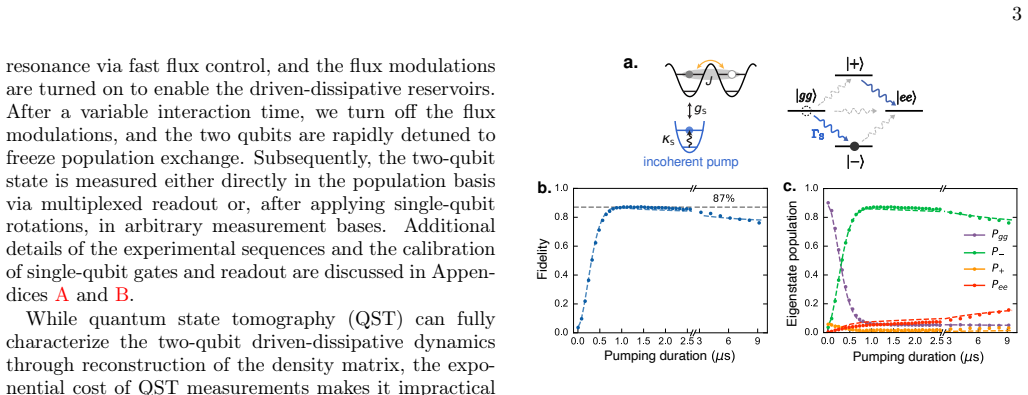
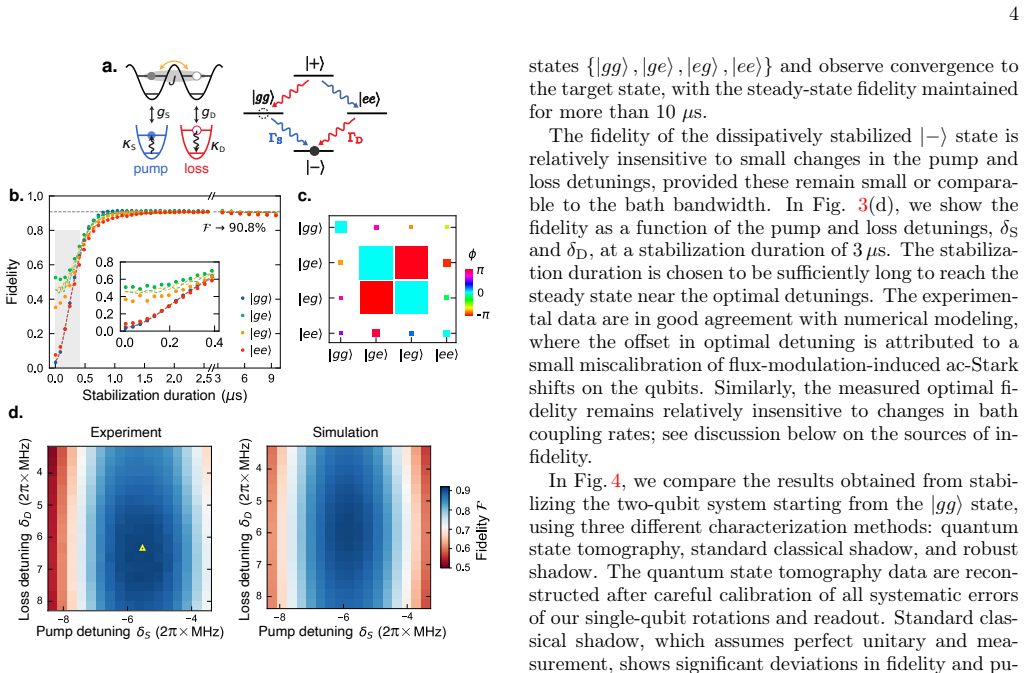
Using parametrically driven coupling to readout resonators, we create programmable energy-selective incoherent pump and loss channels for superconducting qubits. With two coupled qubits, this autonomously stabilizes the entangled single-excitation state with fidelity up to 90.8%. The stabilization dynamics are characterized under varying initial conditions and bath parameters. Classical shadow estimation is implemented for accurate and scalable state characterization. Numerical study of a shared dissipative mode shows reservoir-mediated interference that produces classically correlated steady states.
What carries the argument
Energy-selective local reservoirs created by parametrically driven coupling to readout resonators, which supply incoherent pumping and loss tuned to the qubit excitation energies.
If this is right
- The stabilization remains effective across a range of initial qubit states and reservoir parameters.
- Classical shadow estimation enables accurate, scalable characterization of the prepared entangled states.
- When the engineered pump and loss share a common dissipative mode, reservoir-mediated interference appears and produces classically correlated steady states.
Where Pith is reading between the lines
- The same reservoir engineering could be applied to larger arrays to autonomously prepare more complex many-body entangled states.
- Hardware-efficient control of quantum correlations becomes possible without continuous active feedback.
- Interference effects in shared reservoirs may offer a route to engineer additional classically correlated or partially coherent steady states.
Load-bearing premise
The parametric drive produces only energy-selective incoherent pumping and loss without significant coherent cross-talk, unwanted correlations, or measurement-induced effects that would lower the observed fidelity.
What would settle it
Direct spectroscopy or correlation measurements under the parametric drive that reveal coherent qubit-resonator coupling terms whose strength scales with the observed drop in state fidelity below 90%.
Figures



read the original abstract
Engineered dissipation provides a powerful route to controlling and stabilizing quantum states in open systems. Superconducting circuits are particularly suited to this approach due to their tunable coupling to dissipative environments. Here we realize programmable local reservoirs for superconducting qubits through parametrically driven coupling to readout resonators, creating energy-selective incoherent pump and loss. Using coupled superconducting qubits, we autonomously stabilize entangled single-excitation states with fidelity up to 90.8%. We probe the stabilization dynamics under varying initial conditions and bath parameters, and implement robust classical shadow estimation for accurate and scalable state characterization. Finally, we numerically study a configuration where the engineered pump and loss share a common dissipative mode, leading to reservoir-mediated interference and classically correlated steady states. Our results demonstrate a scalable and hardware-efficient framework for dissipative preparation and control of correlated many-body states in superconducting circuits.
Editorial analysis
A structured set of objections, weighed in public.
Referee Report
Summary. The manuscript demonstrates an experimental realization of programmable local reservoirs for superconducting qubits via parametrically driven coupling to readout resonators, which engineer energy-selective incoherent pump and loss. Using this approach on coupled qubits, the authors report autonomous stabilization of entangled single-excitation states with fidelity up to 90.8%, along with characterization of stabilization dynamics under varying initial conditions and bath parameters, implementation of classical shadow estimation, and a numerical study of reservoir-mediated interference when pump and loss share a mode.
Significance. If the central claim holds, the work provides a hardware-efficient and scalable method for dissipative preparation of correlated quantum states in superconducting circuits, with potential relevance to quantum error correction and many-body simulations. The numerical analysis of interference effects and the application of classical shadows for scalable tomography are strengths that enhance the manuscript's utility and reproducibility.
major comments (2)
- [Experimental methods and results sections] The abstract and main results claim that the parametrically driven coupling produces purely energy-selective incoherent pump and loss without significant coherent cross-talk or measurement back-action. However, the experimental methods section provides no explicit bounds on residual coherent Hamiltonian terms (e.g., via driven spectroscopy or Ramsey fringes under the parametric tone), which is load-bearing for unambiguously attributing the 90.8% fidelity to the engineered dissipation.
- [Fidelity and state characterization results] The reported peak fidelity of 90.8% for the stabilized entangled state lacks accompanying statistical details such as error bars from repeated measurements, baseline comparisons to undriven cases, or explicit exclusion criteria for post-selection effects, undermining the strength of the central experimental claim.
minor comments (2)
- [Abstract] The abstract states 'fidelity up to 90.8%' without specifying the precise initial conditions, drive amplitudes, or qubit parameters that achieve this maximum; this should be clarified with a reference to the relevant figure or table.
- [Numerical study section] In the numerical study of shared-mode interference, a direct side-by-side comparison plot to the local-reservoir experimental data would improve clarity on the distinction between the two regimes.
Simulated Author's Rebuttal
We thank the referee for their thoughtful review and for highlighting areas where the experimental evidence can be presented more rigorously. We address each major comment below and will revise the manuscript to incorporate the requested details, strengthening the attribution of our results to the engineered dissipation.
read point-by-point responses
-
Referee: [Experimental methods and results sections] The abstract and main results claim that the parametrically driven coupling produces purely energy-selective incoherent pump and loss without significant coherent cross-talk or measurement back-action. However, the experimental methods section provides no explicit bounds on residual coherent Hamiltonian terms (e.g., via driven spectroscopy or Ramsey fringes under the parametric tone), which is load-bearing for unambiguously attributing the 90.8% fidelity to the engineered dissipation.
Authors: We agree that explicit experimental bounds on residual coherent terms are important for a fully unambiguous interpretation. In the revised manuscript we will add a dedicated paragraph and supplementary figure in the methods section reporting driven spectroscopy and Ramsey fringe data acquired while the parametric tone is applied. These measurements bound any residual coherent cross-talk to less than 5% of the engineered dissipative rates and confirm that measurement back-action remains negligible on the relevant timescales. This addition directly supports the claim that the observed stabilization arises from the energy-selective reservoirs. revision: yes
-
Referee: [Fidelity and state characterization results] The reported peak fidelity of 90.8% for the stabilized entangled state lacks accompanying statistical details such as error bars from repeated measurements, baseline comparisons to undriven cases, or explicit exclusion criteria for post-selection effects, undermining the strength of the central experimental claim.
Authors: We accept that the statistical characterization of the 90.8% fidelity should be expanded. The revised results section and figure captions will include (i) error bars obtained from 15 independent experimental runs, (ii) direct comparison to the undriven case (fidelity < 50%), and (iii) an explicit statement that no post-selection beyond standard readout thresholding was applied. These additions will be placed alongside the existing data so that readers can assess the robustness of the central claim. revision: yes
Circularity Check
No significant circularity: experimental demonstration with no self-referential derivation
full rationale
This is an experimental paper reporting hardware realization of energy-selective reservoirs via parametric drives on readout resonators, followed by measurement of autonomous stabilization of entangled states at 90.8% fidelity. The abstract and provided text contain no derivation chain, fitted parameters renamed as predictions, or load-bearing self-citations. Numerical studies of reservoir interference are presented as supplementary exploration, not as the foundation for the main fidelity claim. All reported results are grounded in physical implementation and direct tomography/shadow estimation rather than any equation that reduces to its own inputs by construction.
Axiom & Free-Parameter Ledger
free parameters (1)
- parametric drive amplitudes and frequencies
axioms (1)
- domain assumption The qubit-resonator system is accurately described by a Lindblad master equation with engineered dissipation terms from parametric driving.
Lean theorems connected to this paper
-
IndisputableMonolith/Cost/FunctionalEquation.leanwashburn_uniqueness_aczel unclear?
unclearRelation between the paper passage and the cited Recognition theorem.
We engineer programmable local reservoirs that incoherently add or remove excitations from the qubit array... effective Hamiltonian HD/ℏ ≈ δ_D b†b + g_D (a†b + a b†) ... Γ_D(δ_D) = g_D² κ_r / (δ_D² + (κ_r/2)²)
-
IndisputableMonolith/Foundation/RealityFromDistinction.leanreality_from_one_distinction unclear?
unclearRelation between the paper passage and the cited Recognition theorem.
stabilize entangled single-excitation states with fidelity up to 90.8%
What do these tags mean?
- matches
- The paper's claim is directly supported by a theorem in the formal canon.
- supports
- The theorem supports part of the paper's argument, but the paper may add assumptions or extra steps.
- extends
- The paper goes beyond the formal theorem; the theorem is a base layer rather than the whole result.
- uses
- The paper appears to rely on the theorem as machinery.
- contradicts
- The paper's claim conflicts with a theorem or certificate in the canon.
- unclear
- Pith found a possible connection, but the passage is too broad, indirect, or ambiguous to say the theorem truly supports the claim.
Reference graph
Works this paper leans on
-
[1]
provides an alternative approach in which a large number of observables can be predicted efficiently us- ing relatively few measurements. Superconducting cir- cuit experiments are particularly well suited for shadow techniques due to the available local control, high-fidelity readout, and fast experimental cycles. However, stan- dard shadow estimation is ...
-
[2]
The steady state therefore exhibits perfect classical correlations in the transverse basis, despite containing no entanglement, with ⟨Y1Y2⟩=−1,⟨X 1X2⟩=⟨Z 1Z2⟩= 0. When the pump and loss detunings are mismatched (|δS| ̸=|δ D|), the two-photon Raman process connecting |00⟩and|11⟩becomes off-resonant and the even-parity coherence is suppressed. In this regim...
- [3]
- [4]
-
[5]
I. Carusotto, A. A. Houck, A. J. Kollár, P. Roushan, D.I.Schuster,andJ.Simon,Photonicmaterialsincircuit quantum electrodynamics, Nat. Phys.16, 268 (2020)
work page 2020
-
[6]
F. Verstraete, M. M. Wolf, and J. I. Cirac, Quantum computation and quantum-state engineering driven by dissipation, Nat. Phys.5, 633 (2009)
work page 2009
-
[7]
E. Kapit, The upside of noise: engineered dissipation as a resource in superconducting circuits, Quantum Sci. Tech- nol.2, 033002 (2017)
work page 2017
-
[8]
P. M. Harrington, E. J. Mueller, and K. W. Murch, Engi- neered dissipation for quantum information science, Na- ture Reviews Physics4, 660 (2022)
work page 2022
-
[9]
S. O. Valenzuela, W. D. Oliver, D. M. Berns, K. K. Berggren, L. S. Levitov, and T. P. Orlando, Microwave- induced cooling of a superconducting qubit, Science314, 1589 (2006)
work page 2006
-
[10]
K. Geerlings, Z. Leghtas, I. M. Pop, S. Shankar, L. Frun- zio, R. J. Schoelkopf, M. Mirrahimi, and M. H. Devoret, Demonstrating a driven reset protocol for a supercon- ducting qubit, Phys. Rev. Lett.110, 120501 (2013)
work page 2013
-
[11]
P. Magnard, P. Kurpiers, B. Royer, T. Walter, J.-C. Besse, S. Gasparinetti, M. Pechal, J. Heinsoo, S. Storz, A. Blais, and A. Wallraff, Fast and unconditional all- microwave reset of a superconducting qubit, Phys. Rev. Lett.121, 060502 (2018)
work page 2018
-
[12]
Y. Zhou, Z. Zhang, Z. Yin, S. Huai, X. Gu, X. Xu, J. Allcock, F. Liu, G. Xi, Q. Yu, H. Zhang, M. Zhang, H. Li, X. Song, Z. Wang, D. Zheng, S. An, Y. Zheng, and S. Zhang, Rapid and unconditional parametric reset pro- tocol for tunable superconducting qubits, Nat. Commun. 12, 5924 (2021)
work page 2021
-
[13]
X. Cao, M. Mucci, G. Liu, D. Pekker, and M. Hatridge, Engineering a multilevel bath for transmons with three- wavemixingandparametricdrives,Phys.Rev.Lett.135, 230403 (2025)
work page 2025
-
[14]
R. Ma, B. Saxberg, C. Owens, N. Leung, Y. Lu, J. Si- mon, and D. I. Schuster, A dissipatively stabilized mott insulator of photons, Nature566, 51 (2019)
work page 2019
-
[15]
K. W. Murch, U. Vool, D. Zhou, S. J. Weber, S. M. Girvin, and I. Siddiqi, Cavity-assisted quantum bath en- gineering, Phys. Rev. Lett.109, 183602 (2012)
work page 2012
-
[16]
Y. Lu, S. Chakram, N. Leung, N. Earnest, R. K. Naik, Z. Huang, P. Groszkowski, E. Kapit, J. Koch, and D. I. Schuster, Universal stabilization of a parametrically cou- pled qubit, Phys. Rev. Lett.119, 150502 (2017)
work page 2017
-
[17]
S. Shankar, M. Hatridge, Z. Leghtas, K. M. Sliwa, A. Narla, U. Vool, S. M. Girvin, L. Frunzio, M. Mir- rahimi, and M. H. Devoret, Autonomously stabilized en- tanglement between two superconducting quantum bits, Nature504, 419 (2013)
work page 2013
-
[18]
Z. Li, T. Roy, Y. Lu, E. Kapit, and D. I. Schuster, Autonomous stabilization with programmable stabilized state, Nat. Commun.15, 6978 (2024)
work page 2024
- [19]
-
[20]
S. Hacohen-Gourgy, V. V. Ramasesh, C. De Grandi, I. Siddiqi, and S. M. Girvin, Cooling and autonomous feedback in a bose-hubbard chain with attractive inter- actions, Phys. Rev. Lett.115, 240501 (2015)
work page 2015
-
[21]
C. Chen, K. Tang, Y. Zhou, K. Yi, X. Zhang, X. Zhang, H. Guo, S. Liu, Y. Chen, T. Yan, and D. Yu, Hardware- efficient stabilization of entanglement via engineered dis- sipation in superconducting circuits, Phys. Rev. Res.7 (2025)
work page 2025
-
[22]
P. S. Shah, F. Yang, C. Joshi, and M. Mirhosseini, Sta- bilizing remote entanglement via waveguide dissipation, 11 PRX quantum5, 030346 (2024)
work page 2024
- [23]
-
[24]
J. M. Gertler, B. Baker, J. Li, S. Shirol, J. Koch, and C. Wang, Protecting a bosonic qubit with autonomous quantum error correction, Nature590, 243 (2021)
work page 2021
- [25]
- [26]
-
[27]
J. Lebreuilly, A. Biella, F. Storme, D. Rossini, R. Fazio, C. Ciuti, and I. Carusotto, Stabilizing strongly correlated photon fluids with non-markovian reservoirs, Phys. Rev. A96, 033828 (2017)
work page 2017
-
[28]
B. Du, R. Suresh, S. López, J. Cadiente, and R. Ma, Probing site-resolved current in strongly interacting su- perconducting circuit lattices, Phys. Rev. Lett.133, 060601 (2024)
work page 2024
-
[29]
B. Du, Q. Guo, S. López, and R. Ma, Tunneling spec- troscopy in superconducting circuit lattices, Phys. Rev. Res.7, L022038 (2025)
work page 2025
- [30]
-
[31]
S. Chen, W. Yu, P. Zeng, and S. T. Flammia, Robust shadow estimation, PRX Quantum2, 030348 (2021)
work page 2021
-
[32]
B. Vermersch, A. Rath, B. Sundar, C. Branciard, J. Preskill, and A. Elben, Enhanced estimation of quan- tum properties with common randomized measurements, PRX quantum5, 010352 (2024)
work page 2024
- [33]
- [34]
-
[35]
A. Chu, M. Mamaev, M. Koppenhöfer, M. Yuan, and A. A. Clerk, Reconfigurable dissipative entanglement be- tween many spin ensembles: from robust quantum sens- ing to many-body state engineering, arXiv [quant-ph] (2025)
work page 2025
-
[36]
J. Guo, O. Hart, C.-F. Chen, A. J. Friedman, and A. Lu- cas, Designing open quantum systems with known steady states: Davies generators and beyond, Quantum9, 1612 (2025)
work page 2025
-
[37]
X. Mi, A. A. Michailidis, S. Shabani, K. C. Miao, P. V. Klimov, J. Lloyd, E. Rosenberg, R. Acharya, I. Aleiner, T. I. Andersen,et al., Stable quantum-correlated many- body states through engineered dissipation, Science383, 1332 (2024)
work page 2024
-
[38]
Y. Zhan, Z. Ding, J. Huhn, J. Gray, J. Preskill, G. K.-L. Chan, and L. Lin, Rapid quantum ground state prepara- tion via dissipative dynamics, arXiv [quant-ph] (2025)
work page 2025
- [39]
-
[40]
J. Lebreuilly, M. Wouters, and I. Carusotto, Towards strongly correlated photons in arrays of dissipative non- linear cavities under a frequency-dependent incoherent pumping, C. R. Phys.17, 836 (2016)
work page 2016
-
[41]
R.Ma, C.Owens, A.Houck, D.I.Schuster,andJ.Simon, Autonomous stabilizer for incompressible photon fluids and solids, Phys. Rev. A95, 043811 (2017)
work page 2017
-
[42]
P. Kurilovich, V. D. Kurilovich, J. Lebreuilly, and S. Girvin, Stabilizing the laughlin state of light: Dynam- ics of hole fractionalization, SciPost Phys.13(2022)
work page 2022
-
[43]
A. Shabani and H. Neven, Artificial quantum thermal bath: Engineering temperature for a many-body quan- tum system, Phys. Rev. A (Coll. Park.)94, 052301 (2016)
work page 2016
-
[44]
R. J. Lewis-Swan, A. Safavi-Naini, A. M. Kaufman, and A. M. Rey, Dynamics of quantum information, Nature Reviews Physics1, 627 (2019)
work page 2019
-
[45]
Y. Yanay and A. A. Clerk, Reservoir engineering with localized dissipation: Dynamics and prethermalization, Physical Review Research2, 023177 (2020)
work page 2020
-
[46]
F. Ares, P. Calabrese, and S. Murciano, The quantum mpemba effects, Nat. Rev. Phys.7, 451 (2025)
work page 2025
-
[47]
S. Campbell, I. D’Amico, M. A. Ciampini, J. Anders, N. Ares, S. Artini, A. Auffèves, L. B. Oftelie, L. P. Bettmann, M. V. S. Bonança,et al., Roadmap on quan- tum thermodynamics, Quantum Sci. Technol.11, 012501 (2025)
work page 2025
-
[48]
M. A. Aamir, P. Jamet Suria, J. A. Marín Guzmán, C. Castillo-Moreno, J. M. Epstein, N. Yunger Halpern, and S. Gasparinetti, Thermally driven quantum refriger- ator autonomously resets a superconducting qubit, Nat. Phys.21, 318 (2025)
work page 2025
-
[49]
T. Uusnäkki, T. Mörstedt, W. Teixeira, M. Rasola, and M. Möttönen, Initial demonstration of a quantum heat engine based on dissipation-engineered superconducting circuits, Nat. Commun. (2026)
work page 2026
-
[50]
S. S. Elder, C. S. Wang, P. Reinhold, C. T. Hann, K. S. Chou, B. J. Lester, S. Rosenblum, L. Frunzio, L.Jiang,andR.J.Schoelkopf,High-fidelitymeasurement of qubits encoded in multilevel superconducting circuits, Phys. Rev. X.10, 011001 (2020)
work page 2020
-
[51]
RandomMeas.jl: A Julia Package for Randomized Measurements in Quantum Devices
A. Elben and B. Vermersch, Randommeas.jl: A julia package for randomized measurements in quantum de- vices (2025), arXiv:2509.12749 [quant-ph]
work page internal anchor Pith review Pith/arXiv arXiv 2025
-
[52]
J. A. Smolin, J. M. Gambetta, and G. Smith, Efficient method for computing the maximum-likelihood quantum state from measurements with additive gaussian noise, Phys. Rev. Lett.108, 070502 (2012)
work page 2012
discussion (0)
Sign in with ORCID, Apple, or X to comment. Anyone can read and Pith papers without signing in.