Recognition: no theorem link
Equivariant Space Group and Hamiltonian for Collinear Magnetic Systems
Pith reviewed 2026-05-13 03:33 UTC · model grok-4.3
The pith
Collinear magnetic systems acquire effective Hamiltonians with explicit dependence on magnetic order orientation via equivariant space groups.
A machine-rendered reading of the paper's core claim, the machinery that carries it, and where it could break.
Core claim
We develop a symmetry-based framework, built on the equivariant space group, for constructing effective Hamiltonians with explicit n-dependence, termed equivariant magnetic Hamiltonians (EMHs). The resulting EMH lives in a higher-dimensional k-n space and exhibits unconventional symmetry actions and topological features. Using a 1D ferromagnetic chain and a 3D antiferromagnet as examples, we demonstrate that explicit n-dependence in EMHs enables the study of magnetic-dynamics-driven topological pumping, including even-integer charge pumping and a second-Chern-number-induced quantized pumping of surface anomalous Hall conductivity. Beyond model systems, we incorporate the framework into first
What carries the argument
The equivariant space group, a symmetry group that acts jointly on crystal momentum and the magnetic orientation vector n, which is used to derive the form of the effective Hamiltonian ensuring all symmetries are preserved.
If this is right
- Explicit n-dependence allows direct study of how magnetic dynamics induce topological charge pumping in one dimension.
- In three-dimensional antiferromagnets, it predicts quantized pumping of surface anomalous Hall conductivity linked to the second Chern number.
- The framework supports building accurate n-dependent band structures from first-principles for real collinear magnets.
- Generalization to non-collinear magnetic systems becomes possible with the same symmetry approach.
Where Pith is reading between the lines
- This method could permit modeling of adiabatic magnetic processes that change topological invariants without full dynamical simulations.
- Applications might include designing spintronic devices where slow magnetic reorientation controls quantized transport.
- Similar constructions could apply to other order parameters like ferroelectric polarization in extended parameter spaces.
Load-bearing premise
The equivariant space group construction captures every symmetry and interaction relevant to collinear magnetic order in a parameter-free manner.
What would settle it
Performing first-principles calculations of band structures for a real collinear magnetic material at multiple magnetic orientations and verifying if the EMH reproduces the same n-dependence without additional fitting.
Figures


read the original abstract
Condensed matter physics increasingly focuses on exploiting the magnetic order parameter orientation n as a tuning knob for properties of collinear magnetic materials, but a general method for constructing effective Hamiltonians with explicit n-dependence has been lacking. Here, we develop a symmetry-based framework, built on the equivariant space group, for constructing such Hamiltonians, termed equivariant magnetic Hamiltonians (EMHs). The resulting EMH lives in a higher-dimensional k-n space and exhibits unconventional symmetry actions and topological features. Using a 1D ferromagnetic chain and a 3D antiferromagnet as examples, we demonstrate that explicit n-dependence in EMHs enables the study of magnetic-dynamics-driven topological pumping, including even-integer charge pumping and a second-Chern-number-induced quantized pumping of surface anomalous Hall conductivity. Beyond model systems, we incorporate the framework into first-principles calculations to construct ab-initio EMHs that accurately capture the n-dependent band structures of real materials. The approach can also be generalized to non-collinear magnetic systems. Our work establishes a general framework for constructing EMHs and for exploring the rich physics arising from magnetic anisotropy and magnetic dynamics.
Editorial analysis
A structured set of objections, weighed in public.
Referee Report
Summary. The manuscript develops a symmetry-based framework using the equivariant space group to construct equivariant magnetic Hamiltonians (EMHs) that explicitly depend on the collinear magnetic order parameter n. It applies this to a 1D ferromagnetic chain and 3D antiferromagnet to demonstrate magnetic-dynamics-driven topological pumping (even-integer charge pumping and second-Chern-number-induced quantized surface anomalous Hall conductivity), and integrates the approach into first-principles calculations to obtain ab-initio EMHs that capture n-dependent band structures of real materials. Generalization to non-collinear cases is suggested.
Significance. If the framework holds, it supplies a general, symmetry-derived route to n-dependent effective Hamiltonians, enabling systematic exploration of magnetic anisotropy, dynamics, and associated topological effects in collinear magnets. The concrete demonstrations of pumping phenomena and the ab-initio implementation are useful strengths that move beyond purely model-based studies.
minor comments (3)
- [§3.2] §3.2: the explicit construction of the equivariant group action on the basis functions is only sketched; adding one or two worked matrix representations for the 1D chain example would clarify how the n-dependence enters the Hamiltonian matrix elements.
- [Figure 4] Figure 4: the color scale and axis labels for the surface anomalous Hall conductivity are difficult to read at the printed size; increasing font size and adding a quantitative comparison to the expected quantized value would improve clarity.
- [§5] The abstract states that ab-initio EMHs 'accurately capture' n-dependent bands, yet no RMS error, band-structure overlay, or comparison table is provided in §5; a short quantitative statement or supplementary table would strengthen the claim.
Simulated Author's Rebuttal
We thank the referee for the positive summary, significance assessment, and recommendation of minor revision. No specific major comments were raised in the report.
Circularity Check
No significant circularity detected
full rationale
The paper develops a symmetry-based framework for equivariant magnetic Hamiltonians (EMHs) by applying the equivariant space group to collinear magnetic systems. The derivation chain relies on group-theoretic construction rules applied to the magnetic order parameter n, with explicit demonstrations on model systems (1D ferromagnetic chain, 3D antiferromagnet) and extension to ab-initio calculations that reproduce n-dependent band structures. No load-bearing steps reduce by construction to fitted inputs, self-definitions, or unverified self-citations; the central claims rest on independent symmetry analysis and numerical verification rather than tautological renaming or parameter fitting presented as prediction. The framework is presented as general and extensible without hidden dependencies on the target results.
Axiom & Free-Parameter Ledger
axioms (1)
- domain assumption Symmetries of collinear magnetic systems can be captured by an equivariant extension of ordinary space groups that acts jointly on crystal coordinates and magnetic direction n.
invented entities (2)
-
Equivariant space group
no independent evidence
-
Equivariant magnetic Hamiltonian (EMH)
no independent evidence
Reference graph
Works this paper leans on
-
[1]
Blundell,Magnetism in Condensed Matter(Oxford University Press, 2001)
S. Blundell,Magnetism in Condensed Matter(Oxford University Press, 2001)
work page 2001
-
[2]
Auerbach,Interacting Electrons and Quantum Mag- netism(Springer, New York, 1994)
A. Auerbach,Interacting Electrons and Quantum Mag- netism(Springer, New York, 1994)
work page 1994
-
[3]
I. ˇZuti´ c, J. Fabian, and S. Das Sarma, Spintronics: Fun- damentals and applications, Rev. Mod. Phys.76, 323 (2004)
work page 2004
-
[4]
Y. Tserkovnyak, A. Brataas, G. E. W. Bauer, and B. I. Halperin, Nonlocal magnetization dynamics in ferromag- netic heterostructures, Rev. Mod. Phys.77, 1375 (2005)
work page 2005
-
[5]
C. Chappert, A. Fert, and F. N. Van Dau, The emergence of spin electronics in data storage, Nature Materials6, 813 (2007)
work page 2007
-
[6]
D. Ralph and M. Stiles, Spin transfer torques, Journal of Magnetism and Magnetic Materials320, 1190 (2008)
work page 2008
- [7]
-
[8]
A. Manchon, J. ˇZelezn´ y, I. M. Miron, T. Jungwirth, J. Sinova, A. Thiaville, K. Garello, and P. Gambardella, Current-induced spin-orbit torques in ferromagnetic and antiferromagnetic systems, Rev. Mod. Phys.91, 035004 (2019)
work page 2019
-
[9]
A. Kirilyuk, A. V. Kimel, and T. Rasing, Ultrafast optical manipulation of magnetic order, Rev. Mod. Phys.82, 2731 (2010)
work page 2010
-
[10]
A. Fert, R. Ramesh, V. Garcia, F. Casanova, and M. Bibes, Electrical control of magnetism by electric field and current-induced torques, Rev. Mod. Phys.96, 015005 (2024)
work page 2024
-
[11]
Z. Zhou, X. Cheng, M. Hu, R. Chu, H. Bai, L. Han, J. Liu, F. Pan, and C. Song, Manipulation of the alter- magnetic order in crsb via crystal symmetry, Nature638, 645 (2025)
work page 2025
-
[12]
Z. Zhou, Y. Cao, Z. Pan, Y. Zhang, S. Liang, F. Pan, and C. Song, Field-free full switching of chiral antiferro- magnetic order, Nature651, 341 (2026)
work page 2026
-
[13]
O. J. Amin, A. Dal Din, E. Golias, Y. Niu, A. Za- kharov, S. C. Fromage, C. J. B. Fields, S. L. Heywood, R. B. Cousins, F. Maccherozzi, J. Krempask´ y, J. H. Dil, D. Kriegner, B. Kiraly, R. P. Campion, A. W. Rushforth, K. W. Edmonds, S. S. Dhesi, L. ˇSmejkal, T. Jungwirth, and P. Wadley, Nanoscale imaging and control of alter- magnetism in mnte, Nature636...
work page 2024
-
[14]
L. Han, X. Fu, R. Peng, X. Cheng, J. Dai, L. Liu, Y. Li, Y. Zhang, W. Zhu, H. Bai, Y. Zhou, S. Liang, C. Chen, Q. Wang, X. Chen, L. Yang, Y. Zhang, C. Song, J. Liu, and F. Pan, Electrical 180°switching of n´ eel vec- tor in spin-splitting antiferromagnet, Science Advances 10, eadn0479 (2024)
work page 2024
-
[15]
A. Hirsch and Y. Weissman, Anisotropy of the hall effect in iron, Physics Letters A44, 239 (1973)
work page 1973
-
[16]
B. C. Sales, R. Jin, and D. Mandrus, Orientation depen- dence of the anomalous hall resistivity in single crystals of yb14Mnsb11, Phys. Rev. B77, 024409 (2008)
work page 2008
-
[17]
J. Stankiewicz and K. P. Skokov, Anomalous hall effect in y 2fe17−xcox single crystals, Phys. Rev. B78, 214435 (2008)
work page 2008
-
[18]
H. Koizumi, Y. Yamasaki, and H. Yanagihara, Quadrupole anomalous hall effect in magnetically in- duced electron nematic state, Nature Communications 14, 8074 (2023)
work page 2023
- [19]
-
[20]
Z. Liu, M. Wei, W. Peng, D. Hou, Y. Gao, and Q. Niu, Multipolar anisotropy in anomalous hall effect from spin- group symmetry breaking, Phys. Rev. X15, 031006 (2025). 6
work page 2025
-
[21]
R.-C. Xiao, H. Li, H. Han, W. Gan, M. Yang, D.- F. Shao, S.-H. Zhang, Y. Gao, M. Tian, and J. Zhou, Anomalous-hall n´ eel textures in altermagnetic materi- als, Science China Physics, Mechanics & Astronomy69, 217511 (2025)
work page 2025
-
[22]
P. Q. J. Nederpel and J. W. D. Martens, Magneto-optical ellipsometer, Review of Scientific Instruments56, 687 (1985)
work page 1985
-
[23]
D. A. Allwood, G. Xiong, M. D. Cooke, and R. P. Cow- burn, Magneto-optical kerr effect analysis of magnetic nanostructures, Journal of Physics D: Applied Physics 36, 2175 (2003)
work page 2003
- [24]
-
[25]
I. Fina, X. Marti, D. Yi, J. Liu, J. H. Chu, C. Rayan- Serrao, S. Suresha, A. B. Shick, J. ˇZelezn´ y, T. Jungwirth, J. Fontcuberta, and R. Ramesh, Anisotropic magnetore- sistance in an antiferromagnetic semiconductor, Nature Communications5, 4671 (2014)
work page 2014
-
[26]
Y. Yang, Z. Luo, H. Wu, Y. Xu, R.-W. Li, S. J. Pen- nycook, S. Zhang, and Y. Wu, Anomalous hall magne- toresistance in a ferromagnet, Nature Communications 9, 2255 (2018)
work page 2018
-
[27]
R. D. Gonzalez Betancourt, J. Zub´ aˇ c, K. Geishen- dorf, P. Ritzinger, B. R˚ uˇ ziˇ ckov´ a, T. Kotte, J.ˇZelezn´ y, K. Olejn´ ık, G. Springholz, B. B¨ uchner, A. Thomas, K. V´ yborn´ y, T. Jungwirth, H. Reichlov´ a, and D. Krieg- ner, Anisotropic magnetoresistance in altermagnetic mnte, npj Spintronics2, 45 (2024)
work page 2024
-
[28]
W. Roland, Spin-orbit coupling effects in two- dimensional electron and hole systems, Springer Tracts in Modern Physiscs: Springer, Berlin, Heidelberg 191(2003)
work page 2003
-
[29]
Z.-M. Yu, Z. Zhang, G.-B. Liu, W. Wu, X.-P. Li, R.-W. Zhang, S. A. Yang, and Y. Yao, Encyclopedia of emergent particles in three-dimensional crystals, Science Bulletin 67, 375 (2022)
work page 2022
-
[30]
wannier90: A tool for obtaining maximally-localised wannier functions, Computer Physics Communications 178, 685 (2008)
work page 2008
-
[31]
N. Marzari, A. A. Mostofi, J. R. Yates, I. Souza, and D. Vanderbilt, Maximally localized wannier functions: Theory and applications, Rev. Mod. Phys.84, 1419 (2012)
work page 2012
-
[32]
L. ˇSmejkal, J. Sinova, and T. Jungwirth, Emerging re- search landscape of altermagnetism, Phys. Rev. X12, 040501 (2022)
work page 2022
-
[33]
Z. Zhang, Z.-M. Yu, G.-B. Liu, Z. Li, S. A. Yang, and Y. Yao, Magnetickp: A package for quickly constructing kp models of magnetic and non-magnetic crystals, Com- puter Physics Communications290, 108784 (2023)
work page 2023
-
[34]
C. J. Bradley and A. P. Cracknell,The Mathematical Theory of Symmetry in Solids: Representation Theory for Point Groups and Space Groups(Oxford University Press, Oxford, 2009)
work page 2009
-
[35]
D. B. Litvin,Magnetic Group Tables: 1-, 2- and 3- Dimensional Magnetic Subperiodic Groups and Magnetic Space Groups(International Union of Crystallography, Chester, 2013)
work page 2013
-
[36]
W. F. Brinkman and R. J. Elliott, Theory of Spin-Space Groups, Proceedings of the Royal Society of London Se- ries A294, 343 (1966)
work page 1966
- [37]
-
[38]
Z. Xiao, J. Zhao, Y. Li, R. Shindou, and Z.-D. Song, Spin space groups: Full classification and applications, Phys. Rev. X14, 031037 (2024)
work page 2024
-
[39]
X. Chen, J. Ren, Y. Zhu, Y. Yu, A. Zhang, P. Liu, J. Li, Y. Liu, C. Li, and Q. Liu, Enumeration and representa- tion theory of spin space groups, Phys. Rev. X14, 031038 (2024)
work page 2024
-
[41]
X. Chen, Y. Liu, P. Liu, Y. Yu, J. Ren, J. Li, A. Zhang, and Q. Liu, Unconventional magnons in collinear mag- nets dictated by spin space groups, Nature640, 349 (2025)
work page 2025
-
[42]
See Supplemental Material for explicit real spherical har- monics andSmatrices, model derivations of 1D ferro- magnetic chain, construction of the first-principles EMH, and the construction of the ESG from spin space group, which includes Refs. [43–51]
-
[44]
G. Kresse and J. Furthm¨ uller, Efficiency of ab-initio total energy calculations for metals and semiconductors using a plane-wave basis set, Computational Materials Science 6, 15 (1996)
work page 1996
-
[46]
G. Kresse and D. Joubert, From ultrasoft pseudopoten- tials to the projector augmented-wave method, Phys. Rev. B59, 1758 (1999)
work page 1999
-
[47]
J. P. Perdew, K. Burke, and M. Ernzerhof, Generalized gradient approximation made simple, Phys. Rev. Lett. 77, 3865 (1996)
work page 1996
-
[50]
S. L. Dudarev, G. A. Botton, S. Y. Savrasov, C. J. Humphreys, and A. P. Sutton, Electron-energy-loss spec- tra and the structural stability of nickel oxide: An lsda+u study, Phys. Rev. B57, 1505 (1998)
work page 1998
-
[51]
N. Marzari and D. Vanderbilt, Maximally localized gen- eralized wannier functions for composite energy bands, Phys. Rev. B56, 12847 (1997)
work page 1997
-
[52]
Here, the translation part has trivial action onH(k, ˆn)
-
[53]
D. J. Thouless, Quantization of particle transport, Phys. Rev. B27, 6083 (1983)
work page 1983
-
[54]
D. Vanderbilt,Berry Phases in Electronic Structure Theory: Electric Polarization, Orbital Magnetization and Topological Insulators(Cambridge University Press, 2018)
work page 2018
-
[55]
D. S. Lee, T.-H. Kim, C.-H. Park, C.-Y. Chung, Y. S. Lim, W.-S. Seo, and H.-H. Park, Crystal structure, properties and nanostructuring of a new layered chalco- genide semiconductor, bi2mnte4, CrystEngComm15, 5532 (2013)
work page 2013
-
[56]
M. M. Otrokov, I. I. Klimovskikh, H. Bentmann, D. Es- tyunin, A. Zeugner, Z. S. Aliev, S. Gaß, A. U. B. Wolter, A. V. Koroleva, A. M. Shikin, M. Blanco-Rey, M. Hoff- 7 mann, I. P. Rusinov, A. Y. Vyazovskaya, S. V. Ere- meev, Y. M. Koroteev, V. M. Kuznetsov, F. Freyse, J. S´ anchez-Barriga, I. R. Amiraslanov, M. B. Babanly, N. T. Mamedov, N. A. Abdullayev,...
work page 2019
-
[57]
P.-X. Qin, H. Yan, X.-N. Wang, Z.-X. Feng, H.-X. Guo, X.-R. Zhou, H.-J. Wu, X. Zhang, Z.-G.-G. Leng, H.- Y. Chen, and Z.-Q. Liu, Noncollinear spintronics and electric-field control: a review, Rare Metals39, 95 (2020)
work page 2020
-
[58]
B. H. Rimmler, B. Pal, and S. S. P. Parkin, Non-collinear antiferromagnetic spintronics, Nature Reviews Materials 10, 109 (2025)
work page 2025
-
[59]
M. Taherinejad and D. Vanderbilt, Adiabatic pumping of chern-simons axion coupling, Phys. Rev. Lett.114, 096401 (2015)
work page 2015
- [60]
-
[61]
Equivariant Space Group and Hamiltonian for Collinear Magnetic Systems
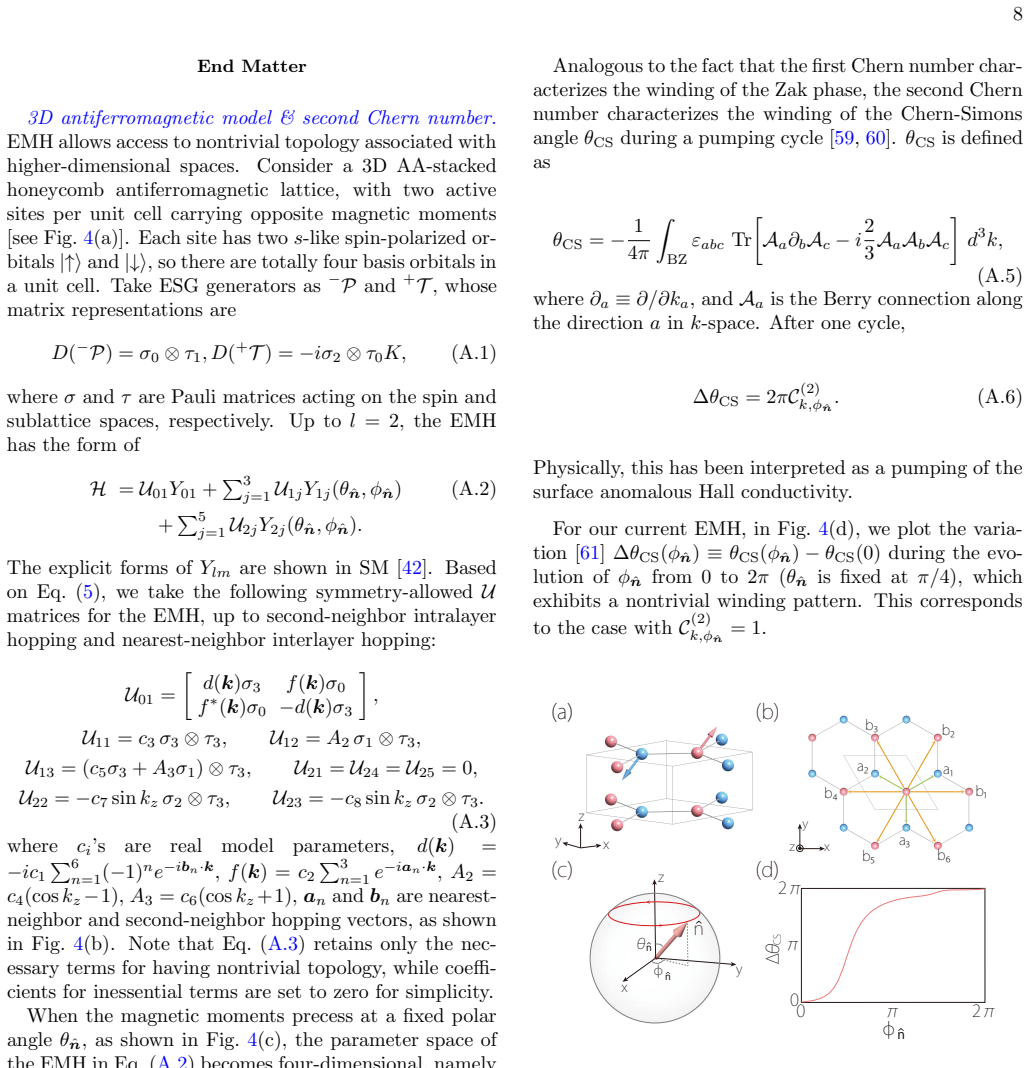
Y. Ren, W. Chen, C. Wang, T. Cao, and D. Xiao, Adi- abatic pumping of orbital magnetization by spin preces- sion, Phys. Rev. Lett.134, 176702 (2025). 8 End Matter 3D antiferromagnetic model & second Chern number. EMH allows access to nontrivial topology associated with higher-dimensional spaces. Consider a 3D AA-stacked honeycomb antiferromagnetic lattice...
work page 2025
-
[62]
Z. Xiao, J. Zhao, Y. Li, R. Shindou, and Z.-D. Song, Spin space groups: Full classification and applications, Phys. Rev. X 14, 031037 (2024)
work page 2024
-
[63]
X. Chen, J. Ren, Y. Zhu, Y. Yu, A. Zhang, P. Liu, J. Li, Y. Liu, C. Li, and Q. Liu, Enumeration and representation theory of spin space groups, Phys. Rev. X14, 031038 (2024)
work page 2024
- [64]
-
[65]
X. Chen, Y. Liu, P. Liu, Y. Yu, J. Ren, J. Li, A. Zhang, and Q. Liu, Unconventional magnons in collinear magnets dictated by spin space groups, Nature640, 349 (2025)
work page 2025
-
[66]
G. Kresse and J. Furthm¨ uller, Efficient iterative schemes for ab initio total-energy calculations using a plane-wave basis set, Phys. Rev. B54, 11169 (1996)
work page 1996
-
[67]
G. Kresse and J. Furthm¨ uller, Efficiency of ab-initio total energy calculations for metals and semiconductors using a plane-wave basis set, Computational Materials Science6, 15 (1996)
work page 1996
-
[68]
P. E. Bl¨ ochl, Projector augmented-wave method, Phys. Rev. B50, 17953 (1994)
work page 1994
-
[69]
G. Kresse and D. Joubert, From ultrasoft pseudopotentials to the projector augmented-wave method, Phys. Rev. B59, 1758 (1999)
work page 1999
-
[70]
J. P. Perdew, K. Burke, and M. Ernzerhof, Generalized gradient approximation made simple, Phys. Rev. Lett.77, 3865 (1996)
work page 1996
-
[71]
J. P. Perdew, K. Burke, and M. Ernzerhof, Perdew, burke, and ernzerhof reply:, Phys. Rev. Lett.80, 891 (1998)
work page 1998
-
[72]
H. J. Monkhorst and J. D. Pack, Special points for brillouin-zone integrations, Phys. Rev. B13, 5188 (1976)
work page 1976
-
[73]
S. L. Dudarev, G. A. Botton, S. Y. Savrasov, C. J. Humphreys, and A. P. Sutton, Electron-energy-loss spectra and the structural stability of nickel oxide: An lsda+u study, Phys. Rev. B57, 1505 (1998)
work page 1998
-
[74]
N. Marzari and D. Vanderbilt, Maximally localized generalized wannier functions for composite energy bands, Phys. Rev. B56, 12847 (1997)
work page 1997
-
[75]
A. A. Mostofi, J. R. Yates, Y.-S. Lee, I. Souza, D. Vanderbilt, and N. Marzari, wannier90: A tool for obtaining maximally- localised wannier functions, Computer Physics Communications178, 685 (2008)
work page 2008
discussion (0)
Sign in with ORCID, Apple, or X to comment. Anyone can read and Pith papers without signing in.