Recognition: 1 theorem link
· Lean TheoremDesigning Coulombic Contact Interactions between Polarizable Particles through Asymmetry
Pith reviewed 2026-05-13 02:37 UTC · model grok-4.3
The pith
Tuning size, charge, and dielectric asymmetries in dielectric spheres reduces their contact electrostatic interaction to the bare Coulomb form.
A machine-rendered reading of the paper's core claim, the machinery that carries it, and where it could break.
Core claim
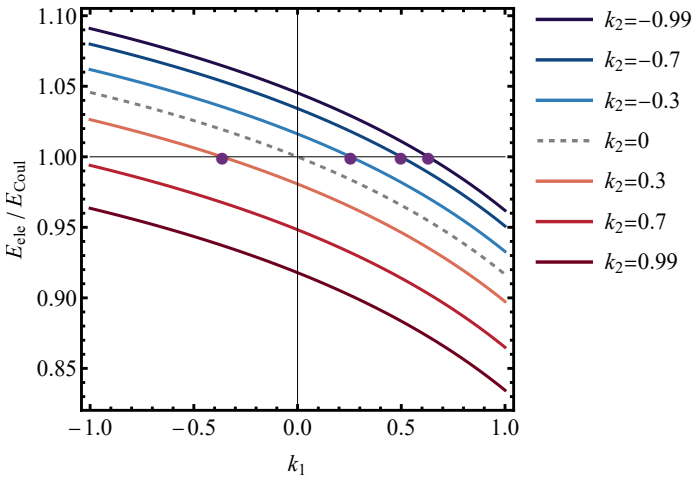
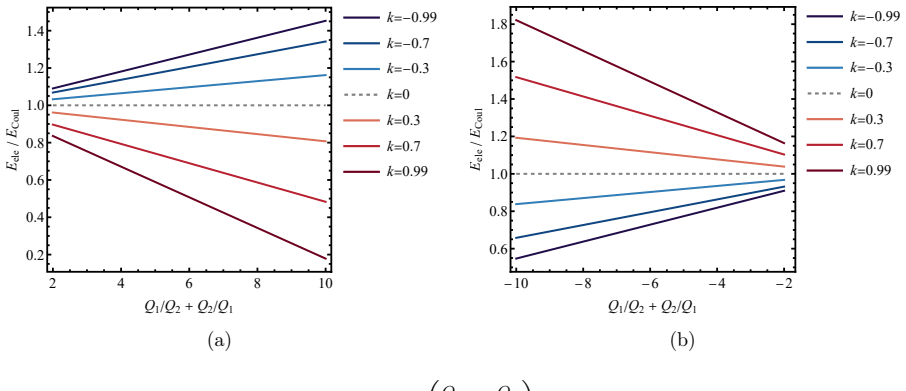
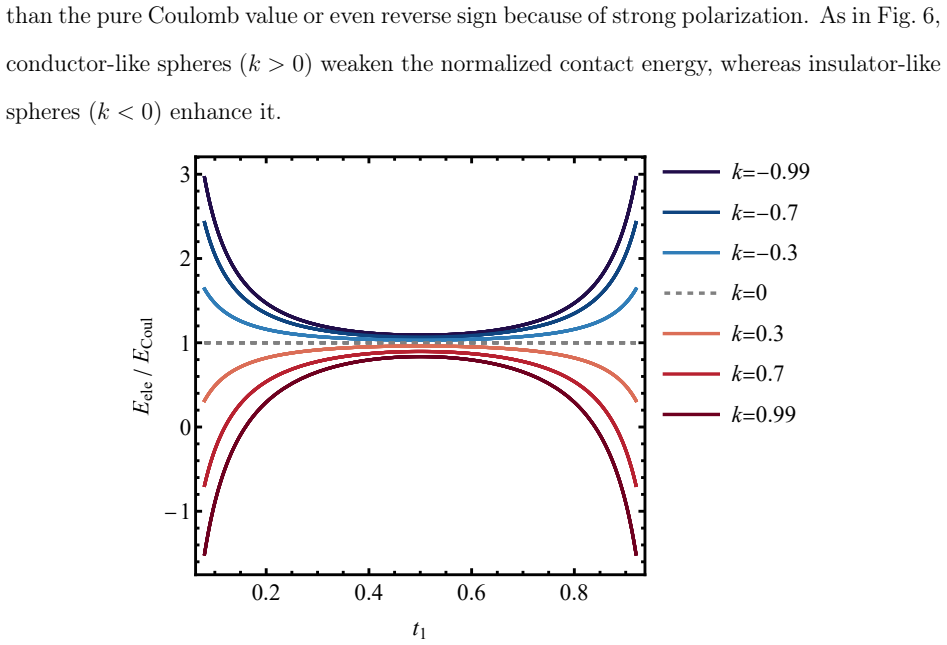
By extending the image-charge formula to two contacting dielectric spheres, analytical conditions are obtained on the radius ratio, charge ratio, and permittivity contrast that make all polarization corrections to the contact force vanish. Under these conditions the electrostatic interaction at contact reduces identically to the Coulomb interaction between point charges placed at the sphere centers. Direct numerical checks on isolated pairs give relative errors below 3 percent, while molecular-dynamics runs of many-particle systems obeying the same two-body rules produce equilibrium structures that match those of the corresponding non-polarizable Coulomb reference systems.
What carries the argument
The set of analytical asymmetry conditions (radius ratio, charge ratio, and dielectric contrast) obtained from the image-charge solution for touching spheres, which nullify induced multipole contributions exactly at contact.
If this is right
- Two-sphere contact forces match the bare Coulomb form within 3 percent relative error.
- Many-particle systems satisfying the two-body rules self-assemble into structures that match pure-Coulomb references.
- Asymmetry engineering provides a route to replace complex polarization with simple Coulombic behavior at contact.
- The design rules apply directly to charged colloids, polarizable ions, and soft nanomaterials.
Where Pith is reading between the lines
- The same cancellation principle might be tested at small but nonzero separations to check how rapidly higher-order terms grow.
- Analogous asymmetry conditions could be sought for non-spherical particles or for systems under external fields.
- Simulations of tuned asymmetric particles could safely employ simple Coulomb potentials, lowering computational cost.
- The approach may extend to biomolecular assemblies where polarization effects are routinely present but often undesirable.
Load-bearing premise
The image-charge formula extended to contacting dielectric spheres captures the complete polarization response without higher-order many-body corrections that would appear at finite separations or in clusters.
What would settle it
A direct numerical evaluation of the electrostatic force between two spheres obeying the derived asymmetry ratios at contact, or a many-body simulation in which the self-assembled structures deviate from the pure-Coulomb reference, would falsify the claimed reduction to bare Coulomb behavior.
Figures



read the original abstract
Polarizable particle systems, including charged colloids, polarizable ions, biomolecular assemblies, and soft nanomaterials, can exhibit contact electrostatic interactions that depart strongly from Coulomb behavior when dielectric mismatch and geometric singularities amplify polarization effects. Here we use charged dielectric spheres as a model system and show that these polarization contributions can be canceled by jointly tuning size, charge, and dielectric asymmetries. By extending a recently developed image-charge formula to contacting dielectric spheres, we derive analytical conditions under which the contact interaction reduces to the bare Coulomb form. Accurate two-sphere calculations validate the resulting contact design rules with relative errors below $3\%$. Strikingly, many-body molecular dynamics simulations reveal that systems satisfying these two-body rules self-assemble into structures that closely match their pure Coulomb references. These results establish asymmetry as a route for turning electrostatic complexity into Coulombic simplicity at contact, with implications for controlled self-assembly and materials design.
Editorial analysis
A structured set of objections, weighed in public.
Referee Report
Summary. The paper claims that polarization contributions to contact interactions between charged dielectric spheres can be canceled by jointly tuning asymmetries in particle size, charge, and dielectric constant. By extending an image-charge formula to the contact geometry, analytical conditions are derived under which the interaction reduces exactly to the bare Coulomb form. Two-sphere calculations validate these contact design rules with relative errors below 3%. Many-body molecular dynamics simulations then show that systems obeying the two-body rules self-assemble into structures that closely match those obtained with pure Coulomb interactions.
Significance. If the central result holds, the work would be significant for soft-matter and materials design: it supplies an analytical route to neutralize dielectric polarization effects at contact without introducing free parameters, allowing complex polarizable particles to be modeled with simple Coulomb potentials. The combination of a first-principles derivation, quantitative two-body benchmarks, and direct many-body simulation tests of structural fidelity is a clear strength.
major comments (2)
- [Derivation of contact design rules and many-body MD section] The analytical conditions are obtained by extending the image-charge formula specifically to the contact geometry (r = R_i + R_j). Two-sphere validation is reported only at contact (<3% error). In the many-body MD, particles explore a continuous range of separations; the image-charge polarization terms are separation-dependent and the same asymmetry parameters that null the contact correction do not automatically null the correction at r > R_i + R_j. Consequently the effective pair interaction may deviate from bare Coulomb at the distances that control approach trajectories and coordination, so structural agreement with the pure-Coulomb reference is not guaranteed by the two-body contact rules alone.
- [Many-body molecular dynamics simulations] The manuscript provides insufficient detail on how many-body polarization is handled in the simulations beyond the two-body contact rules. If the simulations employ the full many-body image-charge method or an approximation, this must be stated explicitly; otherwise the claim that the assembled structures match the pure-Coulomb reference rests on an unverified assumption about higher-order polarization contributions.
minor comments (1)
- [Abstract] The abstract supplies no information on the precise form of the extended image-charge formula or on the treatment of many-body polarization, making it difficult for readers to assess the scope of the reported validation.
Simulated Author's Rebuttal
We thank the referee for the careful reading and insightful comments on our manuscript. We address each major comment below with clarifications and have revised the manuscript to incorporate additional details and supporting analysis.
read point-by-point responses
-
Referee: [Derivation of contact design rules and many-body MD section] The analytical conditions are obtained by extending the image-charge formula specifically to the contact geometry (r = R_i + R_j). Two-sphere validation is reported only at contact (<3% error). In the many-body MD, particles explore a continuous range of separations; the image-charge polarization terms are separation-dependent and the same asymmetry parameters that null the contact correction do not automatically null the correction at r > R_i + R_j. Consequently the effective pair interaction may deviate from bare Coulomb at the distances that control approach trajectories and coordination, so structural agreement with the pure-Coulomb reference is not guaranteed by the two-body contact rules alone.
Authors: The referee is correct that the analytical cancellation conditions and two-sphere validation apply specifically at contact. In the many-body simulations, however, we employ the full separation-dependent image-charge polarization for every pair at their instantaneous separations rather than the contact approximation alone. We have revised the Methods section to state this explicitly and added supplementary calculations demonstrating that the relative deviation from bare Coulomb remains below 4% for separations up to 1.5(R_i + R_j), which covers the relevant range for approach and coordination in our systems. These additions clarify why the observed structural agreement holds. revision: yes
-
Referee: [Many-body molecular dynamics simulations] The manuscript provides insufficient detail on how many-body polarization is handled in the simulations beyond the two-body contact rules. If the simulations employ the full many-body image-charge method or an approximation, this must be stated explicitly; otherwise the claim that the assembled structures match the pure-Coulomb reference rests on an unverified assumption about higher-order polarization contributions.
Authors: We agree that the original manuscript lacked sufficient methodological detail. The simulations use the complete many-body image-charge method, computing polarization contributions for all particles simultaneously at every time step and separation. We have now added an explicit description in the revised Methods section, including the image-charge truncation order (typically 8–12 terms per particle) and convergence criteria. No further approximations to higher-order many-body effects are introduced. revision: yes
Circularity Check
No significant circularity; derivation and tests are independent
full rationale
The paper extends an image-charge formula to derive contact conditions that reduce the interaction to bare Coulomb form, reports two-sphere numerical validation with <3% error, and performs many-body MD simulations to check that rule-satisfying systems self-assemble like pure-Coulomb references. These MD outcomes are empirical tests rather than quantities forced by the two-body equations themselves. No self-definitional loop exists (conditions are derived, not defined in terms of the target result), no parameters are fitted to data and then relabeled as predictions, and any citation to the base image-charge formula is not load-bearing for the central self-assembly claim. The derivation chain remains self-contained against external benchmarks.
Axiom & Free-Parameter Ledger
axioms (2)
- domain assumption The image-charge method can be extended to the exact contact geometry of two dielectric spheres without additional correction terms.
- domain assumption Polarization effects beyond the two-body level do not disrupt the self-assembly structures once the two-body contact rule is satisfied.
Lean theorems connected to this paper
-
IndisputableMonolith/Cost/FunctionalEquation.leanwashburn_uniqueness_aczel unclearBy extending a recently developed image-charge formula to contacting dielectric spheres, we derive analytical conditions under which the contact interaction reduces to the bare Coulomb form.
Reference graph
Works this paper leans on
-
[1]
Electrostatic correlations: from plasma to biology
Levin, Y. Electrostatic correlations: from plasma to biology. Rep. Prog. Phys 2002, 65, 1577
work page 2002
-
[2]
French, R. H.; Parsegian, V. A.; Podgornik, R.; Rajter, R. F.; Jagota, A.; Luo, J.; Asthagiri, D.; Chaudhury, M. K.; Chiang, Y.-m.; Granick, S.; others Long range interactions in nanoscale science. Rev. Mod. Phys 2010, 82, 1887--1944
work page 2010
-
[3]
A.; Kowalczyk, B.; de La Cruz, M
Walker, D. A.; Kowalczyk, B.; de La Cruz, M. O.; Grzybowski, B. A. Electrostatics at the nanoscale. Nanoscale 2011, 3, 1316--1344
work page 2011
-
[4]
Leunissen, M. E.; Christova, C. G.; Hynninen, A.-P.; Royall, C. P.; Campbell, A. I.; Imhof, A.; Dijkstra, M.; Van Roij, R.; Van Blaaderen, A. Ionic colloidal crystals of oppositely charged particles. Nature 2005, 437, 235--240
work page 2005
-
[5]
Kewalramani, S.; Guerrero-Garc \' a, G. I.; Moreau, L. M.; Zwanikken, J. W.; Mirkin, C. A.; Olvera de la Cruz, M.; Bedzyk, M. J. Electrolyte-mediated assembly of charged nanoparticles. ACS Cent. Sci. 2016, 2, 219--224
work page 2016
-
[6]
Dielectric effects in the self-assembly of binary colloidal aggregates
Barros, K.; Luijten, E. Dielectric effects in the self-assembly of binary colloidal aggregates. Phys. Rev. Lett. 2014, 113, 017801
work page 2014
-
[7]
Recent developments in the methods and applications of electrostatic theory
Besley, E. Recent developments in the methods and applications of electrostatic theory. Acc. Chem. Res. 2023, 56, 2267--2277
work page 2023
-
[8]
Quantitative theory for critical conditions of like-charge attraction between polarizable spheres
Duan, Y.; Gan, Z. Quantitative theory for critical conditions of like-charge attraction between polarizable spheres. J. Chem. Theory Comput. 2025, 21, 2822–2828
work page 2025
-
[9]
Electrostatic interactions between rough dielectric particles
Gorman, M.; Ruan, X.; Ni, R. Electrostatic interactions between rough dielectric particles. Phys. Rev. E 2024, 109, 034902
work page 2024
-
[10]
Duan, Y.; Gan, Z.; Chan, H.-K. Mechanisms of electrostatic interactions between two charged dielectric spheres inside a polarizable medium: An effective-dipole analysis. Soft Matter 2025, 21, 1860--1872
work page 2025
-
[11]
Maxwell, J. C. A treatise on electricity and magnetism; Clarendon press, 1873; Vol. 1
-
[12]
Electrostatics of two charged conducting spheres
Lekner, J. Electrostatics of two charged conducting spheres. Proc. R. Soc. A 2012, 468, 2829--2848
work page 2012
-
[13]
Polarization energy of two charged dielectric spheres in close contact
Lian, H.; Qin, J. Polarization energy of two charged dielectric spheres in close contact. Mol. Syst. Des. Eng. 2018, 3, 197--203
work page 2018
-
[14]
Exact polarization energy for clusters of contacting dielectrics
Lian, H.; Qin, J. Exact polarization energy for clusters of contacting dielectrics. Soft Matter 2022, 18, 6411--6418
work page 2022
-
[15]
Chan, H.-K.; Lindgren, E. B.; Stace, A. J.; Bichoutskaia, E. A General Geometric Representation of Sphere-Sphere Interactions. Frontiers in Quantum Methods and Applications in Chemistry and Physics: Selected Proceedings of QSCP-XVIII (Paraty, Brazil, December, 2013). 2015; pp 29--36
work page 2013
-
[16]
A theory for like-charge attraction of polarizable ions
Chan, H.-K. A theory for like-charge attraction of polarizable ions. J. Electrostat. 2020, 105, 103435
work page 2020
-
[17]
Freed, K. F. Perturbative many-body expansion for electrostatic energy and field for system of polarizable charged spherical ions in a dielectric medium. J. Chem. Phys. 2014, 141, 034115
work page 2014
-
[18]
Qin, J.; Li, J.; Lee, V.; Jaeger, H.; de Pablo, J. J.; Freed, K. F. A theory of interactions between polarizable dielectric spheres. J. Colloid Interface Sci. 2016, 469, 237--241
work page 2016
-
[19]
Charge polarization near dielectric interfaces and the multiple-scattering formalism
Qin, J. Charge polarization near dielectric interfaces and the multiple-scattering formalism. Soft Matter 2019, 15, 2125--2134
work page 2019
-
[20]
Efficient and accurate simulation of dynamic dielectric objects
Barros, K.; Sinkovits, D.; Luijten, E. Efficient and accurate simulation of dynamic dielectric objects. J. Chem. Phys. 2014, 140, 064903
work page 2014
-
[21]
Comparison of efficient techniques for the simulation of dielectric objects in electrolytes
Gan, Z.; Wu, H.; Barros, K.; Xu, Z.; Luijten, E. Comparison of efficient techniques for the simulation of dielectric objects in electrolytes. J. Comput. Phys. 2015, 291, 317--333
work page 2015
-
[22]
Lindgren, E. B.; Stace, A. J.; Polack, E.; Maday, Y.; Stamm, B.; Besley, E. An integral equation approach to calculate electrostatic interactions in many-body dielectric systems. J. Comput. Phys. 2018, 371, 712--731
work page 2018
-
[23]
Xu, Z. Electrostatic interaction in the presence of dielectric interfaces and polarization-induced like-charge attraction. Phys. Rev. E 2013, 87, 013307
work page 2013
-
[24]
Effects of image charges on double layer structure and forces
Wang, R.; Wang, Z.-G. Effects of image charges on double layer structure and forces. J. Chem. Phys. 2013, 139, 124702
work page 2013
-
[25]
L.; Khachatourian, A.; Stace, A
Bichoutskaia, E.; Boatwright, A. L.; Khachatourian, A.; Stace, A. J. Electrostatic analysis of the interactions between charged particles of dielectric materials. J. Chem. Phys. 2010, 133, 024105
work page 2010
-
[26]
Efficient dynamic simulations of charged dielectric colloids through a novel hybrid method
Gan, Z.; Wang, Z.; Jiang, S.; Xu, Z.; Luijten, E. Efficient dynamic simulations of charged dielectric colloids through a novel hybrid method. J. Chem. Phys. 2019, 151, 024112
work page 2019
-
[27]
Neumann, C. Hydrodynamische untersuchungen: nebst einem Anhange \"u ber die Probleme der Elektrostatik und der magnetischen Induction ; BG Teubner, 1883
-
[28]
URSI Review of Radio Science 1990-1992; Clarendon Press, 1993; pp 107--126
Lindell, I. URSI Review of Radio Science 1990-1992; Clarendon Press, 1993; pp 107--126
work page 1990
-
[29]
Jackson, J. D. Classical electrodynamics; John Wiley & Sons, 2021
work page 2021
-
[30]
Extending the fast multipole method to charges inside or outside a dielectric sphere
Cai, W.; Deng, S.; Jacobs, D. Extending the fast multipole method to charges inside or outside a dielectric sphere. J. Comput. Phys. 2007, 223, 846--864
work page 2007
-
[31]
Gan, Z.; Xu, Z. Multiple-image treatment of induced charges in M onte C arlo simulations of electrolytes near a spherical dielectric interface. Phys. Rev. E 2011, 84, 016705
work page 2011
-
[32]
Arfken, G. B.; Weber, H. J.; Harris, F. E. Mathematical methods for physicists: a comprehensive guide; Academic press, 2011
work page 2011
-
[33]
Pearson, K.; others Tables of the incomplete beta-function; Cambridge University Press Cambridge, 1968; Vol. 1
work page 1968
-
[34]
Li, X.; Li, C.; Gao, X.; Huang, D. Like-charge attraction between two identical dielectric spheres in a uniform electric field: A theoretical study via a multiple-image method and an effective-dipole approach. J. Mater. Chem. A 2024, 12, 6896--6905
work page 2024
-
[35]
Li, X.; Li, C.; Chen, X.; Wang, Z.; Min, S.; Huang, D. Electrostatic interaction of neutral particles on a dielectric substrate: A theoretical study via a multiple-image method and an effective-dipole approach. Phys. Rev. E 2025, 111, 045505
work page 2025
-
[36]
A hybrid method for systems of closely spaced dielectric spheres and ions
Gan, Z.; Jiang, S.; Luijten, E.; Xu, Z. A hybrid method for systems of closely spaced dielectric spheres and ions. SIAM J. Sci. Comput. 2016, 38, B375--B395
work page 2016
-
[37]
Lee, H. M.; Kim, Y. W.; Go, E. M.; Revadekar, C.; Choi, K. H.; Cho, Y.; Kwak, S. K.; Park, B. J. Direct measurements of the colloidal D ebye force. Nat. Commun. 2023, 14, 3838
work page 2023
-
[38]
Yuan, J.; Antila, H. S.; Luijten, E. Particle--particle particle--mesh algorithm for electrolytes between charged dielectric interfaces. J. Chem. Phys. 2021, 154, 094115
work page 2021
-
[39]
Becker, M. R.; Netz, R. R.; Loche, P.; Bonthuis, D. J.; Mouhanna, D.; Berthoumieux, H. Dielectric properties of aqueous electrolytes at the nanoscale. Phys. Rev. Lett. 2025, 134, 158001
work page 2025
-
[40]
A charge-dependent long-ranged force drives tailored assembly of matter in solution
Wang, S.; Walker-Gibbons, R.; Watkins, B.; Flynn, M.; Krishnan, M. A charge-dependent long-ranged force drives tailored assembly of matter in solution. Nat. Nanotechnol. 2024, 19, 485--493
work page 2024
-
[41]
Attraction between like-charged macroions by C oulomb depletion
Allahyarov, E.; D'amico, I.; L \"o wen, H. Attraction between like-charged macroions by C oulomb depletion. Phys. Rev. Lett. 1998, 81, 1334
work page 1998
-
[42]
Wills, A.; Mannino, A.; Losada, I.; Mayo, S. G.; Soler, J. M.; Fern \'a ndez-Serra, M. Anti- C oulomb ion-ion interactions: A theoretical and computational study. Phys. Rev. Res. 2024, 6, 033095
work page 2024
-
[43]
Dos Santos, A. P.; Levin, Y. Like-charge attraction between metal nanoparticles in a 1:1 electrolyte solution. Phys. Rev. Lett. 2019, 122, 248005
work page 2019
-
[44]
Long-range polarization attraction between two different like-charged macroions
Zhang, R.; Shklovskii, B. Long-range polarization attraction between two different like-charged macroions. Phys. Rev. E 2005, 72, 021405
work page 2005
-
[45]
Strong attraction between charged spheres due to metastable ionized states
Messina, R.; Holm, C.; Kremer, K. Strong attraction between charged spheres due to metastable ionized states. Phys. Rev. Lett. 2000, 85, 872
work page 2000
-
[46]
Impact of charge regulation on self-assembly of zwitterionic nanoparticles
Yuan, J.; Takae, K.; Tanaka, H. Impact of charge regulation on self-assembly of zwitterionic nanoparticles. Phys. Rev. Lett. 2022, 128, 158001
work page 2022
-
[47]
Charge regulation effects on colloidal mixture nanoparticles
L \'o pez-Flores, L.; Olvera de la Cruz, M. Charge regulation effects on colloidal mixture nanoparticles. J. Chem. Phys. 2025, 163, 034303
work page 2025
-
[48]
Budkov, Y. A.; Kolesnikov, A. L. Modified P oisson-- B oltzmann equations and macroscopic forces in inhomogeneous ionic fluids. J. Stat. Mech.: Theory Exp. 2022, 2022, 053205
work page 2022
-
[49]
Budkov, Y. A.; Kalikin, N. N.; Brandyshev, P. E. Surface tension of aqueous electrolyte solutions. A thermomechanical approach. J. Chem. Phys. 2024, 160, 164701
work page 2024
-
[50]
Nitzke, I.; Lishchuk, S. V.; Vrabec, J. Long-range corrections for molecular simulations with three-body interactions. J. Chem. Theory Comput. 2024, 21, 1--4
work page 2024
-
[51]
B.; Stamm, B.; Besley, E.; Stace, A
Avis, H.; Lindgren, E. B.; Stamm, B.; Besley, E.; Stace, A. J. The Accommodation of Excess Charge in Binary Particle Lattices: A Many-Body Electrostatic Study. J. Phys. Chem. B 2025, 129, 9789--9794
work page 2025
-
[52]
B.; Avis, H.; Miller, A.; Stamm, B.; Besley, E.; Stace, A
Lindgren, E. B.; Avis, H.; Miller, A.; Stamm, B.; Besley, E.; Stace, A. J. The significance of multipole interactions for the stability of regular structures composed from charged particles. J. Colloid Interface Sci. 2024, 663, 458--466 mcitethebibliography document
work page 2024
discussion (0)
Sign in with ORCID, Apple, or X to comment. Anyone can read and Pith papers without signing in.