Recognition: no theorem link
Coordination Failures and Stackelberg Leadership in Housing Development with Network Effects
Pith reviewed 2026-05-14 21:38 UTC · model grok-4.3
The pith
A large first-moving developer always commits to at least the high-supply equilibrium, eliminating coordination failures in housing markets with network effects.
A machine-rendered reading of the paper's core claim, the machinery that carries it, and where it could break.
Core claim
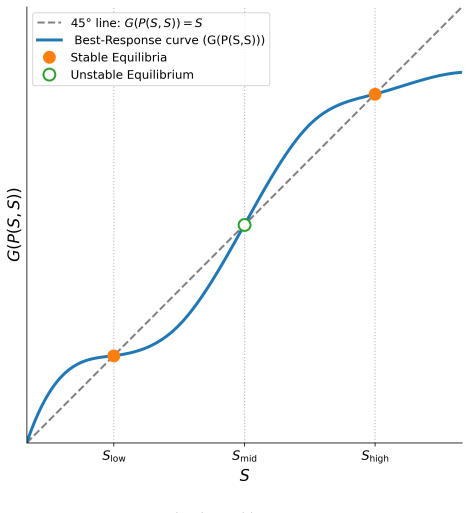
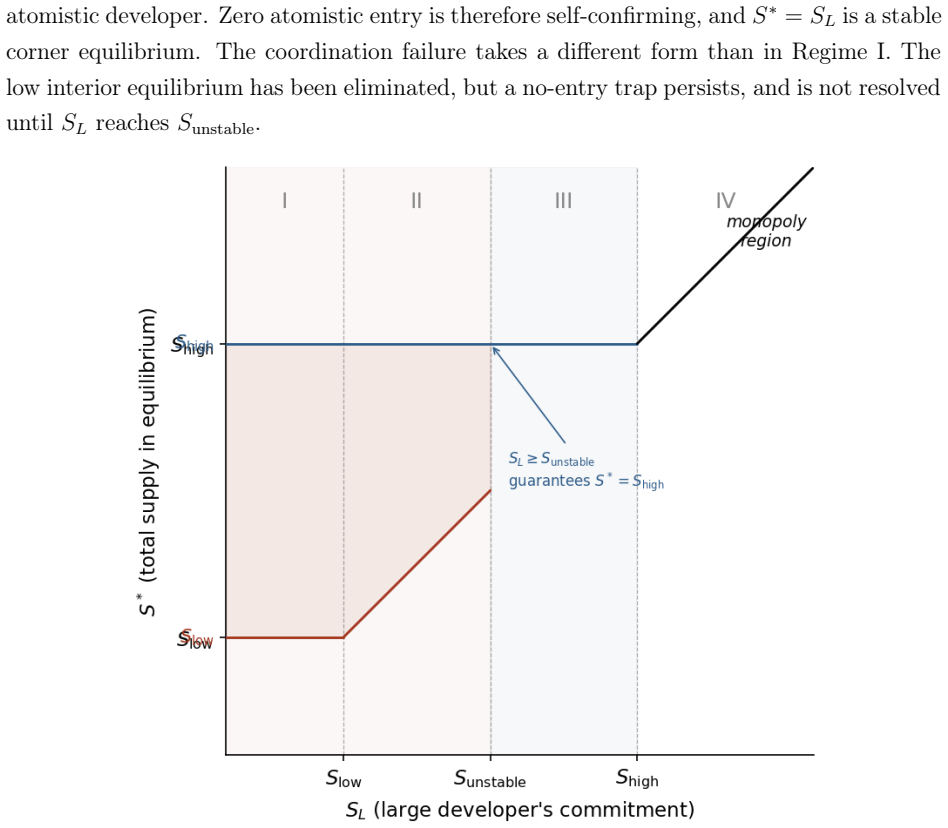
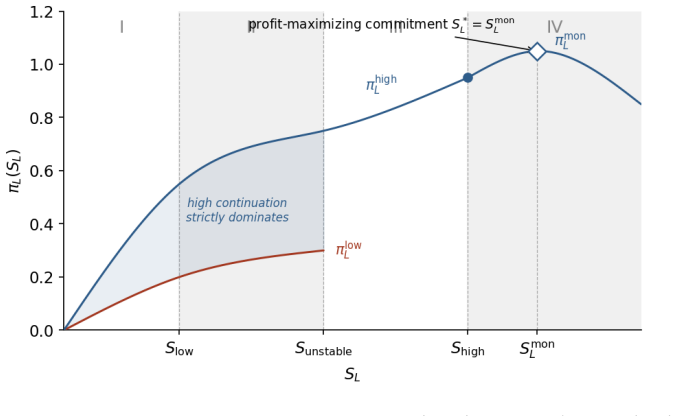
The large developer always commits at least to the high-supply equilibrium, eliminating the coordination failure by pushing past the unstable threshold that separates the low and high outcomes. The result is unconditional; it holds for general demand functions and cost distributions, and does not depend on which stable continuation equilibrium materializes. The leader's commitment inverts standard monopoly intuition: first-mover commitment can improve welfare by resolving a coordination problem that atomistic markets cannot solve on their own.
What carries the argument
Stackelberg commitment by the large developer to a supply level before atomistic developers choose entry, selecting a quantity that exceeds the unstable threshold between the low- and high-supply equilibria.
If this is right
- The market underprovides housing relative to the social optimum even after the leader moves.
- The leader sometimes builds beyond the high equilibrium into a monopoly region.
- First-mover commitment raises total welfare by resolving coordination rather than by restricting output as in standard monopoly models.
Where Pith is reading between the lines
- The same first-mover logic may apply to other network-good markets such as broadband or charging infrastructure where scale creates value.
- Empirical comparisons of supply outcomes in concentrated versus fragmented local housing markets could test the mechanism.
- Zoning or permitting policies that favor large-scale commitments might replicate the coordination benefit without requiring a single private leader.
Load-bearing premise
Network effects are strong and convex enough to produce multiple equilibria with an unstable threshold, and the large developer can credibly commit to its supply before the smaller developers move.
What would settle it
Observe a housing market with convex network effects in which a dominant developer commits to a total supply strictly below the high equilibrium threshold.
Figures



read the original abstract
I study coordination failures in housing development markets with network effects, where the value of building depends on aggregate supply. When network effects are sufficiently strong and convex, multiple equilibria arise: a low-supply coordination failure and a high-supply outcome. Without a coordination mechanism, equilibrium is indeterminate. I introduce a large developer who moves first in a Stackelberg game, committing to housing supply before atomistic developers make entry decisions. The main result is that the large developer always commits at least to the high-supply equilibrium, eliminating the coordination failure by pushing past the unstable threshold that separates the low and high outcomes. The result is unconditional; it holds for general demand functions and cost distributions, and does not depend on which stable continuation equilibrium materializes. The leader's commitment inverts standard monopoly intuition: first-mover commitment can improve welfare by resolving a coordination problem that atomistic markets cannot solve on their own. I also characterize when the developer builds beyond the high equilibrium into a monopoly region, and show that the market underprovides housing relative to the social optimum.
Editorial analysis
A structured set of objections, weighed in public.
Referee Report
Summary. The paper studies coordination failures in housing development with network effects, where strong convex network effects lead to multiple equilibria: a low-supply coordination failure and a high-supply outcome. A large developer acts as a Stackelberg leader by committing to a supply level before atomistic developers decide. The central claim is that the leader's profit-maximizing commitment is always at or above the high-supply equilibrium threshold, selecting the high equilibrium and resolving the coordination problem. This holds for arbitrary demand functions and cost distributions, and the leader may sometimes build beyond the high equilibrium into a monopoly region. The market is shown to underprovide housing relative to the social optimum.
Significance. If the result holds, it offers a novel mechanism for resolving coordination failures through Stackelberg leadership in network-effect markets, inverting the usual first-mover disadvantage intuition. The generality to arbitrary demand and costs is a strength, as it avoids reliance on specific functional forms. This has potential implications for understanding large-scale housing development and policy interventions to encourage coordination. The paper provides falsifiable predictions about when large developers will lead supply.
major comments (2)
- The main result (abstract and §3) asserts that the leader always commits at or above the unstable threshold for general demand and costs. The argument compares leader payoffs under low vs. high continuation equilibria, but the manuscript does not explicitly derive or state the condition ensuring the threshold is strictly unstable under the maintained convexity assumption; without this, the selection of the high equilibrium is not guaranteed for all admissible functions.
- §4 (welfare section): the claim that the market underprovides relative to the social optimum relies on the high equilibrium being the relevant benchmark, but the comparison does not address cases where the leader's optimum lies strictly inside the monopoly region; this could reverse the underprovision conclusion depending on the curvature of the social welfare function.
minor comments (2)
- Notation for the network-effect function and the unstable threshold should be defined in the model section before the main theorem to improve flow.
- The abstract's phrasing that the result is 'unconditional' should include a brief qualifier noting dependence on the convexity condition that generates multiple equilibria.
Simulated Author's Rebuttal
We thank the referee for the constructive and insightful comments. We address each major comment below, indicating the revisions we will incorporate to strengthen the rigor and clarity of the manuscript.
read point-by-point responses
-
Referee: The main result (abstract and §3) asserts that the leader always commits at or above the unstable threshold for general demand and costs. The argument compares leader payoffs under low vs. high continuation equilibria, but the manuscript does not explicitly derive or state the condition ensuring the threshold is strictly unstable under the maintained convexity assumption; without this, the selection of the high equilibrium is not guaranteed for all admissible functions.
Authors: We appreciate the referee highlighting the need for greater explicitness here. While the maintained assumptions of sufficiently strong and convex network effects are intended to ensure an unstable threshold separating the low- and high-supply equilibria, we agree that deriving the instability condition formally would make the selection argument fully rigorous. In the revised version, we will insert a new lemma in §2 that derives the strict instability of the threshold directly from the positive second derivative of the network benefit function (under the convexity maintained throughout). This lemma will confirm that the leader's payoff comparison always selects the high equilibrium for the entire class of admissible demand and cost functions, without changing the statement or proof strategy of the main result. revision: yes
-
Referee: §4 (welfare section): the claim that the market underprovides relative to the social optimum relies on the high equilibrium being the relevant benchmark, but the comparison does not address cases where the leader's optimum lies strictly inside the monopoly region; this could reverse the underprovision conclusion depending on the curvature of the social welfare function.
Authors: The referee correctly identifies a case that requires additional attention. When the leader's optimum lies in the monopoly region, the welfare comparison must be handled separately. We will revise §4 to add an explicit proposition addressing this case. The proposition will show that underprovision relative to the social optimum continues to hold, because the social planner internalizes the full marginal network externality while the leader captures only the private marginal benefit; this comparison is robust to standard concavity of the social welfare function and does not reverse the underprovision conclusion. We will also clarify that the high equilibrium serves as the lower bound for the relevant benchmark in all cases. revision: yes
Circularity Check
No significant circularity
full rationale
The paper's central result—that the Stackelberg leader commits at or above the unstable threshold for general demand functions and cost distributions—follows directly from the sequential-move game structure and the maintained assumption of sufficiently strong convex network effects. No step reduces a prediction to a fitted parameter, renames a known result, or relies on a load-bearing self-citation whose content is itself unverified within the paper. The derivation is self-contained against the stated assumptions and does not invoke prior author work to force the outcome.
Axiom & Free-Parameter Ledger
axioms (2)
- domain assumption Network effects are sufficiently strong and convex to generate multiple equilibria separated by an unstable threshold
- domain assumption The large developer can credibly commit to supply before atomistic developers move in the continuation game
Reference graph
Works this paper leans on
-
[1]
Journal of the European Economic Association , volume =
Rochet, Jean-Charles and Tirole, Jean , title =. Journal of the European Economic Association , volume =
-
[2]
The RAND Journal of Economics , volume =
Armstrong, Mark , title =. The RAND Journal of Economics , volume =
-
[3]
The RAND Journal of Economics , volume =
Rochet, Jean-Charles and Tirole, Jean , title =. The RAND Journal of Economics , volume =
- [4]
- [5]
-
[6]
European Journal of Political Economy , volume =
Economides, Nicholas , title =. European Journal of Political Economy , volume =
-
[7]
The Quarterly Journal of Economics , volume =
Card, David and Mas, Alexandre and Rothstein, Jesse , title =. The Quarterly Journal of Economics , volume =
-
[8]
The Quarterly Journal of Economics , volume =
Cooper, Russell and John, Andrew , title =. The Quarterly Journal of Economics , volume =
-
[9]
and Shleifer, Andrei and Vishny, Robert W
Murphy, Kevin M. and Shleifer, Andrei and Vishny, Robert W. , title =. Journal of Political Economy , volume =
-
[10]
Katz, Michael L. and Shapiro, Carl , title =. The American Economic Review , volume =
-
[11]
Katz, Michael L. and Shapiro, Carl , title =. Journal of Political Economy , volume =
-
[12]
The RAND Journal of Economics , volume =
Caillaud, Bernard and Jullien, Bruno , title =. The RAND Journal of Economics , volume =
-
[13]
Journal of Political Economy , volume =
Rossi-Hansberg, Esteban and Sarte, Pierre-Daniel and Owens, Raymond , title =. Journal of Political Economy , volume =
-
[14]
Owens, Raymond and Rossi-Hansberg, Esteban and Sarte, Pierre-Daniel , title =. 2017 , url =
work page 2017
-
[15]
and Kolko, Jed and Saiz, Albert , title =
Glaeser, Edward L. and Kolko, Jed and Saiz, Albert , title =. Journal of Economic Geography , volume =
-
[16]
Journal of Urban Economics , volume =
Couture, Victor and Handbury, Jessie , title =. Journal of Urban Economics , volume =
- [17]
-
[18]
Bulow, Jeremy I. and Geanakoplos, John D. and Klemperer, Paul D. , title =. Journal of Political Economy , volume =
-
[19]
Lipsey, R. G. and Lancaster, Kelvin , title =. The Review of Economic Studies , volume =
-
[20]
Helsley, Robert W. and Strange, William C. , title =. Regional Science and Urban Economics , volume =
-
[21]
Journal of Public Economics , volume =
Guerrieri, Veronica and Hartley, Daniel and Hurst, Erik , title =. Journal of Public Economics , volume =
-
[22]
Urban Affairs Review , volume =
Freemark, Yonah , title =. Urban Affairs Review , volume =
-
[23]
Greenaway-McGrevy, Ryan and Phillips, Peter C. B. , title =. Journal of Urban Economics , volume =
discussion (0)
Sign in with ORCID, Apple, or X to comment. Anyone can read and Pith papers without signing in.