Recognition: 2 theorem links
· Lean TheoremPhase-resolved field-space distance bounds in ekpyrotic, bouncing and cyclic cosmologies
Pith reviewed 2026-05-15 05:06 UTC · model grok-4.3
The pith
Ekpyrotic and bouncing cosmologies obey a total field-space distance budget that decomposes by phase and yields a lower bound on ε_ek.
A machine-rendered reading of the paper's core claim, the machinery that carries it, and where it could break.
Core claim
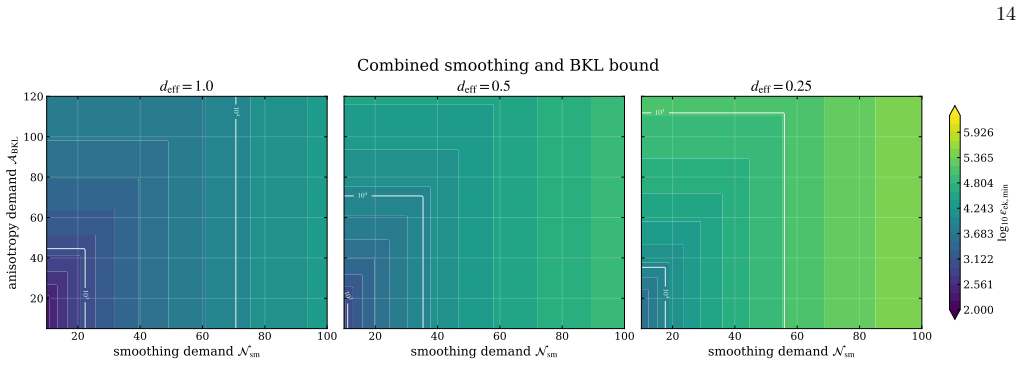
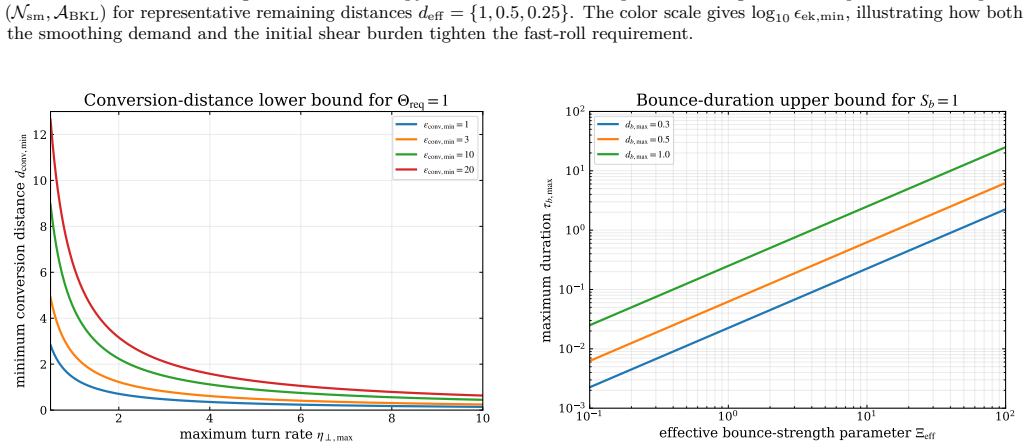
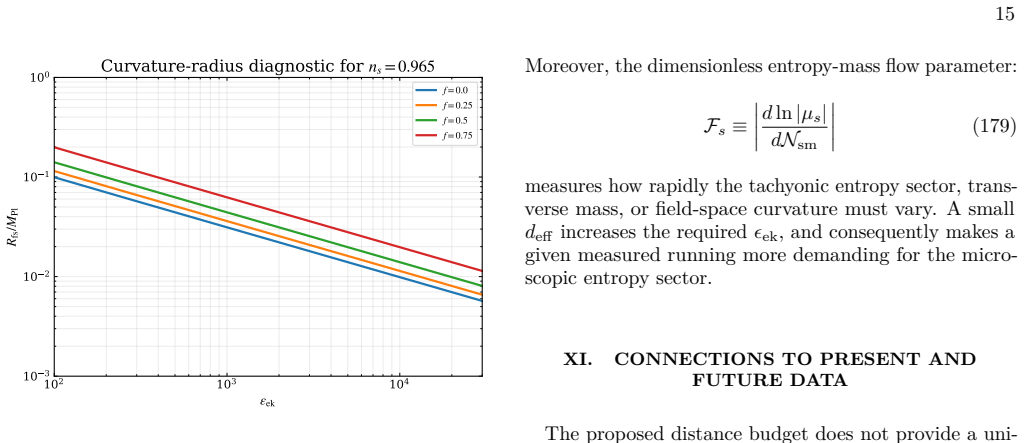
The background kinematics of ekpyrotic contraction fulfills a useful field-space distance budget. Resolving the invariant distance into ekpyrotic, conversion, bounce and post-bounce contributions and adding BKL suppression produces a master inequality that lower-bounds ε_ek by the leftover distance after conversion and bounce. The same framework yields a curvature constraint for scale-invariant entropy perturbations showing that small total distance together with the observed red tilt favors ultra-fast-roll ekpyrosis, sharp turns, short or strongly modified bounces, and significant negative sectional curvature of the scalar manifold.
What carries the argument
The phase-resolved field-space distance budget, which decomposes the invariant scalar distance into ekpyrotic smoothing, entropy conversion, bounce and post-bounce segments and supplies a master condition that lower-bounds ε_ek.
If this is right
- ε_ek must exceed a value fixed by the distance remaining after conversion and the bounce contribution.
- BKL anisotropy suppression requires a minimum contraction strength or duration in the ekpyrotic phase.
- Scale-invariant entropy perturbations in curved field space together with small total distance and red tilt imply ultra-fast-roll behavior or modified bounces.
- Phenomenological cutoff corrections and observational conversion windows further restrict allowed distance allocations across phases.
- The total budget satisfies a generalized inequality that reduces to the known small-field scaling in the canonical limit.
Where Pith is reading between the lines
- The bound could be tested directly with future limits on the tensor-to-scalar ratio once the conversion window is fixed by isocurvature data.
- Cyclic models with repeated bounces would accumulate extra distance and therefore face stricter lower limits on ε_ek.
- Allowing negative sectional curvature in the scalar manifold relaxes the bound and may permit slower-roll solutions consistent with observations.
- If the distance budget is saturated, specific bounce constructions in string theory could be ruled out by precision CMB measurements of the tilt and non-Gaussianity.
Load-bearing premise
The concrete mechanism that violates or evades the null energy condition and the details of entropy-to-curvature conversion are taken as given and compatible with the assumed phase kinematics.
What would settle it
A measured tensor-to-scalar ratio and isocurvature amplitude that imply a total field excursion falling below the master-bound minimum for the observed spectral index would falsify the distance criterion.
Figures






read the original abstract
The inflationary Lyth bound relates the primordial tensor amplitude to the inflaton field excursion. There is no analogous universal relationship in the case of ekpyrotic, bouncing, and cyclic models because scalar and tensor perturbations depend on entropy conversion, matching through the bounce and the specific mechanism that violates or evades the null energy condition. Nevertheless, the background kinematics fulfills a useful non-inflationary analogue: a field-space distance budget. In this study, we propose a phase-resolved distance criterion for a non-inflationary smoothing process and decompose the invariant scalar distance into ekpyrotic smoothing, entropy-to-curvature conversion, bounce, and post-bounce contributions. Then, we impose BKL anisotropy suppression as an additional constraint on the ekpyrotic phase. In the canonical phase of the ekpyrotic contraction, we recover the known small-field scaling and generalize it to total budget inequality. We impose three requirements: a BKL (Belinski-Khalatnikov-Lifshitz) anisotropy suppression that is parameterized separately, a phenomenological cutoff-corrected distance budget inspired by tower of states logic, and observational conversion windows from residual isocurvature and non-Gaussianity. Furthermore, we propose a new master condition that provides a lower bound on the value of the parameter $\epsilon_{\rm ek}$ that depends on the remaining distance available after conversion and the cosmological bounce. We also derive a curvature constraint for scale-invariant entropy perturbations in curved field space which shows that the small total distance and the observed red tilt seem to indicate ultra-fast-roll ekpyrosis, sharp turns, short or strongly modified bounces, and/or significant negative sectional curvature of the scalar manifold. Finally, we demonstrate methods for testing the distance budget against observational data.
Editorial analysis
A structured set of objections, weighed in public.
Referee Report
Summary. The paper proposes a phase-resolved field-space distance criterion for non-inflationary smoothing in ekpyrotic, bouncing, and cyclic cosmologies. It decomposes the invariant scalar distance into four sequential phases (ekpyrotic smoothing, entropy-to-curvature conversion, bounce, post-bounce), imposes BKL anisotropy suppression on the ekpyrotic segment, and incorporates a tower-inspired cutoff. From this budget the authors recover the known small-field scaling for canonical ekpyrosis and derive a new master condition that supplies a lower bound on ε_ek in terms of the residual distance after conversion and bounce. They also obtain a curvature constraint for scale-invariant entropy modes and outline tests against observational windows on isocurvature and non-Gaussianity.
Significance. If the distance additivity and phase kinematics hold, the master bound supplies a useful non-inflationary analogue to the Lyth relation, constraining the ekpyrotic parameter space and linking field-space geometry to observable spectral tilt and residual isocurvature. The explicit decomposition and BKL requirement are concrete strengths that could guide model-building once the bounce and conversion mechanisms are specified.
major comments (2)
- [master-condition derivation] The master condition (derived after the four-phase decomposition) treats the lengths of the entropy-to-curvature conversion and bounce intervals as fixed kinematic quantities independent of the concrete NEC-violating operator. If the bounce is realized by higher-derivative terms that deform the field-space metric or induce non-geodesic motion, the assumed additivity of the distance budget fails and the residual-distance term no longer supplies a model-independent lower bound on ε_ek.
- [BKL suppression and cutoff implementation] The phenomenological cutoff-corrected term in the distance budget is introduced via tower-of-states logic and observational conversion windows; because the cutoff scale is listed among the free parameters, the resulting lower bound on ε_ek risks circularity unless the cutoff is shown to be fixed by independent data rather than tuned to the target result.
minor comments (1)
- [phase decomposition] The notation for the invariant distance ds and the separate BKL suppression parameter should be introduced with an explicit equation before the decomposition is used.
Simulated Author's Rebuttal
We thank the referee for the careful reading and constructive comments on our manuscript. We address each major comment below, indicating where revisions have been made to clarify assumptions and strengthen the presentation.
read point-by-point responses
-
Referee: The master condition (derived after the four-phase decomposition) treats the lengths of the entropy-to-curvature conversion and bounce intervals as fixed kinematic quantities independent of the concrete NEC-violating operator. If the bounce is realized by higher-derivative terms that deform the field-space metric or induce non-geodesic motion, the assumed additivity of the distance budget fails and the residual-distance term no longer supplies a model-independent lower bound on ε_ek.
Authors: We agree that the additivity of the invariant scalar distance presupposes a fixed field-space metric and geodesic motion throughout the phases. Our derivation explicitly assumes standard kinetic terms and a non-deformed metric during the bounce, consistent with the canonical ekpyrotic and many bouncing constructions in the literature. For realizations involving higher-derivative operators that induce metric deformations or non-geodesic trajectories, the master condition would require model-specific corrections, as the referee notes. We have added a dedicated paragraph in the revised manuscript (Section 3.2) clarifying these assumptions, delineating the regime of validity, and noting that the bound remains useful as a conservative lower limit under the stated kinematic conditions. This does not claim universality beyond those assumptions. revision: partial
-
Referee: The phenomenological cutoff-corrected term in the distance budget is introduced via tower-of-states logic and observational conversion windows; because the cutoff scale is listed among the free parameters, the resulting lower bound on ε_ek risks circularity unless the cutoff is shown to be fixed by independent data rather than tuned to the target result.
Authors: The cutoff is introduced from the tower-of-states conjecture and is further anchored by independent observational constraints on residual isocurvature and non-Gaussianity (detailed in Section 4). To address potential circularity, we have revised the manuscript to fix the cutoff scale explicitly via the BKL anisotropy suppression requirement and the string scale, without reference to the final ε_ek bound. An explicit example is now provided showing how the cutoff is determined from the requirement that the ekpyrotic phase lasts long enough to suppress anisotropies, yielding a numerical value consistent with but independent of the master condition. This removes any tuning to the target result. revision: yes
Circularity Check
No significant circularity detected in derivation chain
full rationale
The paper decomposes the invariant field-space distance into four sequential phases (ekpyrotic smoothing, entropy-to-curvature conversion, bounce, post-bounce) and imposes external constraints (BKL anisotropy suppression, tower-inspired phenomenological cutoff, observational conversion windows) to obtain the master lower bound on ε_ek. These inputs are introduced as independent requirements rather than being fitted to or defined in terms of the target bound itself. The resulting inequality is a direct consequence of the additive distance budget under the stated assumptions; no step reduces the claimed result to its own outputs by construction, no self-citation chain is load-bearing for the central claim, and no ansatz is smuggled via prior work. The derivation remains self-contained against the paper's own kinematic premises.
Axiom & Free-Parameter Ledger
free parameters (2)
- ε_ek
- cutoff scale
axioms (2)
- domain assumption BKL anisotropy suppression must be achieved during the ekpyrotic phase
- domain assumption Observational windows on residual isocurvature and non-Gaussianity constrain the conversion phase
Lean theorems connected to this paper
-
IndisputableMonolith/Cost/FunctionalEquation.leanwashburn_uniqueness_aczel unclear?
unclearRelation between the paper passage and the cited Recognition theorem.
dtot = dek + dconv + db + dpost … master condition … lower bound on ε_ek that depends on the remaining distance available after conversion and the cosmological bounce
-
IndisputableMonolith/Foundation/DimensionForcing.leanreality_from_one_distinction unclear?
unclearRelation between the paper passage and the cited Recognition theorem.
BKL anisotropy suppression … tower-inspired cutoff … observational conversion windows
What do these tags mean?
- matches
- The paper's claim is directly supported by a theorem in the formal canon.
- supports
- The theorem supports part of the paper's argument, but the paper may add assumptions or extra steps.
- extends
- The paper goes beyond the formal theorem; the theorem is a base layer rather than the whole result.
- uses
- The paper appears to rely on the theorem as machinery.
- contradicts
- The paper's claim conflicts with a theorem or certificate in the canon.
- unclear
- Pith found a possible connection, but the passage is too broad, indirect, or ambiguous to say the theorem truly supports the claim.
Reference graph
Works this paper leans on
-
[1]
Mechanism-dependent interpretation of the bounce contributiond(B) b
Ghost condensate and Galileon For a ghost condensate or Galileon bounces, the scalar field itself is responsible for the NEC-violating phase 8 TABLE I. Mechanism-dependent interpretation of the bounce contributiond(B) b . In scalar-mediated bounces it is a genuine field-space distance. In quantum-gravity-driven or thin-matching descriptions it is more acc...
-
[2]
derivative scalar-tensor operators
DHOST and Horndeski For DHOST1 or Horndeski-type bounces, the relation between ˙H and the scalar velocity is modified by higher- 1 Degenerate Higher-Order Scalar-Tensor. derivative scalar-tensor operators. A useful schematic decomposition is: d(DHOST) b =d σ,b+d hd,(113) wheredσ,bis the direct scalar distance anddhd represents the cost of keeping the high...
-
[3]
LQC For a loop quantum cosmology-type effective bounce, the modified Friedmann equation is often written as [38, 9 39]: H2 = ρ 3M2 Pl ( 1−ρ ρc ) ,(114) with the effective Raychaudhuri equation of the form: ˙H=−(ρ+p) 2M2 Pl ( 1−2ρ ρc ) .(115) In the case of: ρ+p= ˙σ2,(116) comparison with(98) suggests the effective identification: ΞLQC(t) = 2ρ(t) ρc −1.(11...
-
[4]
5.f(R)theories Forf(R)or related modified gravity bounces, the dis- tance may reside in the gravitational sector rather than in a matter scalar [35, 36]
Matter bounce and quintom Matter bounce or quintom-type realizations are closer to scalar-mediated bounces [33, 34], but the relevant dis- tance must be computed in the full target space of the fields responsible for the NEC-violating stage, namely: d(q) b = 1 MPl ∫ b √ GIJ ˙ϕI ˙ϕJdt.(119) This class is especially sensitive to ghost [54–56] or gradi- ent ...
-
[5]
Galilean Genesis and conformal Galileon Galilean Genesis or conformal Galileon transitions [32, 37] should also be distinguished from a canonical scalar bounce scenarios. They are naturally represented by: d(Gen) b =d (Gen) scalar +d (Gen) EFT .(123) The second term summarizes the requirements for strong coupling, cutoff, and higher-derivative stability. ...
-
[6]
CCC Conformal cyclic cosmology2 (CCC) [44–51] is a spe- cific type of cyclic cosmological model, but it does not involve a bounce in the usual metric sense. Rather than a local transition characterized by the bounce condition, the future conformal infinity of one aeon is identified with the conformally rescaled Big Bang of the next aeon. Con- sequently, t...
-
[7]
Addressing observational tensions in cosmol- ogy with systematics and fundamental physics (Cosmo- Verse)
S-brane and thin-matching In an S-brane or thin-matching description [9, 40–43], the scalar field-space distance consumed during the tran- sition may be negligible: d(S) b ≃0.(127) However, the cost of the bounce is shifted to the require- ment that the matching conditions generate stable and observationally viable scalar and tensor transfer functions. Th...
- [8]
-
[9]
A Field Range Bound for General Single-Field Inflation
D. Baumann and D. Green, JCAP05, 017, arXiv:1111.3040 [hep-th]
work page internal anchor Pith review Pith/arXiv arXiv
-
[10]
The Ekpyrotic Universe: Colliding Branes and the Origin of the Hot Big Bang
J. Khoury, B. A. Ovrut, P. J. Steinhardt, and N. Turok, Phys. Rev. D64, 123522 (2001), arXiv:hep-th/0103239
work page internal anchor Pith review Pith/arXiv arXiv 2001
-
[11]
P. J. Steinhardt and N. Turok, Phys. Rev. D65, 126003 (2002), arXiv:hep-th/0111098
work page internal anchor Pith review Pith/arXiv arXiv 2002
-
[12]
Ekpyrotic and Cyclic Cosmology
J.-L. Lehners, Phys. Rept.465, 223 (2008), arXiv:0806.1245 [astro-ph]
work page internal anchor Pith review Pith/arXiv arXiv 2008
-
[13]
A Critical Review of Classical Bouncing Cosmologies
D. Battefeld and P. Peter, Phys. Rept.571, 1 (2015), arXiv:1406.2790 [astro-ph.CO]
work page internal anchor Pith review Pith/arXiv arXiv 2015
-
[14]
M. Postolak, Did the Big Bang and cosmic inflation re- ally happen? (A tale of alternative cosmological models) (2024), arXiv:2404.18503 [physics.pop-ph]
-
[15]
L. A. Boyle, P. J. Steinhardt, and N. Turok, Phys. Rev. D69, 127302 (2004), arXiv:hep-th/0307170
work page internal anchor Pith review Pith/arXiv arXiv 2004
-
[16]
R. Brandenberger and Z. Wang, Phys. Rev. D101, 063522 (2020), arXiv:2001.00638 [hep-th]
- [17]
- [18]
-
[19]
Small-Field and Scale-Free: Inflation and Ekpyrosis at their Extremes
J.-L. Lehners, JCAP11, 001, arXiv:1807.05240 [hep-th]
work page internal anchor Pith review Pith/arXiv arXiv
-
[20]
Adiabatic and entropy perturbations from inflation
C. Gordon, D. Wands, B. A. Bassett, and R. Maartens, Phys. Rev. D63, 023506 (2000), arXiv:astro-ph/0009131
work page internal anchor Pith review Pith/arXiv arXiv 2000
-
[21]
A covariant approach to general field space metric in multi-field inflation
J.-O. Gong and T. Tanaka, JCAP03, 015, [Erratum: JCAP 02, E01 (2012)], arXiv:1101.4809 [astro-ph.CO]
work page internal anchor Pith review Pith/arXiv arXiv 2012
-
[22]
Geometrical Destabilization of Inflation
S. Renaux-Petel and K. Turzyński, Phys. Rev. Lett.117, 141301 (2016), arXiv:1510.01281 [astro-ph.CO]
work page internal anchor Pith review Pith/arXiv arXiv 2016
-
[23]
V. A. Belinsky, I. M. Khalatnikov, and E. M. Lifshitz, Adv. Phys.19, 525 (1970)
1970
- [24]
-
[25]
On the Geometry of the String Landscape and the Swampland
H. Ooguri and C. Vafa, Nucl. Phys. B766, 21 (2007), arXiv:hep-th/0605264
work page internal anchor Pith review Pith/arXiv arXiv 2007
-
[26]
Distance and de Sitter Conjectures on the Swampland
H. Ooguri, E. Palti, G. Shiu, and C. Vafa, Phys. Lett. B 788, 180 (2019), arXiv:1810.05506 [hep-th]
work page internal anchor Pith review Pith/arXiv arXiv 2019
-
[27]
The Swampland: Introduction and Review
E. Palti, Fortsch. Phys.67, 1900037 (2019), arXiv:1903.06239 [hep-th]
work page internal anchor Pith review Pith/arXiv arXiv 2019
-
[28]
Isocurvature perturbations in the Ekpyrotic universe
A. Notari and A. Riotto, Nucl. Phys. B644, 371 (2002), arXiv:hep-th/0205019
work page internal anchor Pith review Pith/arXiv arXiv 2002
-
[29]
J.-L. Lehners, P. McFadden, N. Turok, and P. J. Stein- hardt, Phys. Rev. D76, 103501 (2007), arXiv:hep- th/0702153
-
[30]
E. I. Buchbinder, J. Khoury, and B. A. Ovrut, Phys. Rev. D76, 123503 (2007), arXiv:hep-th/0702154. 22
work page internal anchor Pith review Pith/arXiv arXiv 2007
-
[31]
K. A. Malik and D. Wands, Phys. Rept.475, 1 (2009), arXiv:0809.4944 [astro-ph]
work page internal anchor Pith review Pith/arXiv arXiv 2009
-
[32]
Planck 2018 results. X. Constraints on inflation
Y. Akramiet al.(Planck), Astron. Astrophys.641, A10 (2020), arXiv:1807.06211 [astro-ph.CO]
work page internal anchor Pith review Pith/arXiv arXiv 2020
-
[33]
Ekpyrotic Non-Gaussianity -- A Review
J.-L. Lehners, Adv. Astron.2010, 903907 (2010), arXiv:1001.3125 [hep-th]
work page internal anchor Pith review Pith/arXiv arXiv 2010
-
[34]
Planck 2018 results. IX. Constraints on primordial non-Gaussianity
Y. Akramiet al.(Planck), Astron. Astrophys.641, A9 (2020), arXiv:1905.05697 [astro-ph.CO]
work page internal anchor Pith review Pith/arXiv arXiv 2020
-
[35]
Bouncing Cosmologies: Progress and Problems
R. Brandenberger and P. Peter, Found. Phys.47, 797 (2017), arXiv:1603.05834 [hep-th]
work page internal anchor Pith review Pith/arXiv arXiv 2017
-
[36]
Ghost Condensation and a Consistent Infrared Modification of Gravity
N. Arkani-Hamed, H.-C. Cheng, M. A. Luty, and S. Muko- hyama, JHEP05, 074, arXiv:hep-th/0312099
work page internal anchor Pith review Pith/arXiv arXiv
-
[37]
Y.-F. Cai, D. A. Easson, and R. Brandenberger, JCAP 08, 020, arXiv:1206.2382 [hep-th]
work page internal anchor Pith review Pith/arXiv arXiv
-
[38]
Cosmological Perturbations Through a Non-Singular Ghost-Condensate/Galileon Bounce
L. Battarra, M. Koehn, J.-L. Lehners, and B. A. Ovrut, JCAP07, 007, arXiv:1404.5067 [hep-th]
work page internal anchor Pith review Pith/arXiv arXiv
-
[39]
A. Ijjas and P. J. Steinhardt, Phys. Rev. Lett.117, 121304 (2016), arXiv:1606.08880 [gr-qc]
-
[40]
M. Novello and S. E. P. Bergliaffa, Phys. Rept.463, 127 (2008), arXiv:0802.1634 [astro-ph]
work page internal anchor Pith review Pith/arXiv arXiv 2008
-
[41]
R. H. Brandenberger, The Matter Bounce Alternative to Inflationary Cosmology (2012), arXiv:1206.4196 [astro- ph.CO]
work page internal anchor Pith review Pith/arXiv arXiv 2012
-
[42]
T. P. Sotiriou, Class. Quant. Grav.23, 5117 (2006), arXiv:gr-qc/0604028
work page internal anchor Pith review Pith/arXiv arXiv 2006
-
[43]
T. P. Sotiriou and V. Faraoni, Rev. Mod. Phys.82, 451 (2010), arXiv:0805.1726 [gr-qc]
work page internal anchor Pith review Pith/arXiv arXiv 2010
-
[44]
T. Qiu, J. Evslin, Y.-F. Cai, M. Li, and X. Zhang, JCAP 10, 036, arXiv:1108.0593 [hep-th]
work page internal anchor Pith review Pith/arXiv arXiv
-
[45]
Loop Quantum Cosmology: A Status Report
A. Ashtekar and P. Singh, Class. Quant. Grav.28, 213001 (2011), arXiv:1108.0893 [gr-qc]
work page internal anchor Pith review Pith/arXiv arXiv 2011
-
[46]
Non-singular bounce scenarios in loop quantum cosmology and the effective field description
Y.-F. Cai and E. Wilson-Ewing, JCAP03, 026, arXiv:1402.3009 [gr-qc]
work page internal anchor Pith review Pith/arXiv arXiv
- [47]
-
[48]
S-brane to thermal non-singular string cosmology
C. Kounnas, H. Partouche, and N. Toumbas, Class. Quant. Grav.29, 095014 (2012), arXiv:1111.5816 [hep-th]
work page internal anchor Pith review Pith/arXiv arXiv 2012
-
[49]
R. H. Brandenberger, C. Kounnas, H. Partouche, S. P. Patil, and N. Toumbas, JCAP03, 015, arXiv:1312.2524 [hep-th]
work page internal anchor Pith review Pith/arXiv arXiv
-
[50]
R. Brandenberger and Z. Wang, Phys. Rev. D102, 023516 (2020), arXiv:2004.06437 [hep-th]
-
[51]
Penrose, SINGULARITIES AND TIME ASYMME- TRY, inGeneral Relativity: An Einstein Centenary Sur- vey(1980) pp
R. Penrose, SINGULARITIES AND TIME ASYMME- TRY, inGeneral Relativity: An Einstein Centenary Sur- vey(1980) pp. 581–638
1980
-
[52]
Penrose, Conf
R. Penrose, Conf. Proc. C060626, 2759 (2006)
2006
-
[53]
Penrose,Cycles of Time: An Extraordinary New View of the Universe(The Bodley Head, London, 2010)
R. Penrose,Cycles of Time: An Extraordinary New View of the Universe(The Bodley Head, London, 2010)
2010
-
[54]
Penrose, AIP Conf
R. Penrose, AIP Conf. Proc.1446, 233 (2012)
2012
-
[55]
P. Tod, Gen. Rel. Grav.47, 17 (2015), arXiv:1309.7248 [gr-qc]
work page internal anchor Pith review Pith/arXiv arXiv 2015
-
[56]
K. A. Meissner and P. Nurowski, Phys. Rev. D95, 084016 (2017), arXiv:1506.03280 [gr-qc]
work page internal anchor Pith review Pith/arXiv arXiv 2017
-
[57]
O. Markwell and C. Stevens, Gen. Rel. Grav.55, 93 (2023), arXiv:2212.06914 [gr-qc]
- [58]
-
[59]
Generic instabilities of non-singular cosmologies in Horndeski theory: a no-go theorem
T. Kobayashi, Phys. Rev. D94, 043511 (2016), arXiv:1606.05831 [hep-th]
work page internal anchor Pith review Pith/arXiv arXiv 2016
-
[60]
Y. Cai, Y. Wan, H.-G. Li, T. Qiu, and Y.-S. Piao, JHEP 01, 090, arXiv:1610.03400 [gr-qc]
work page internal anchor Pith review Pith/arXiv arXiv
-
[61]
S. M. Carroll, M. Hoffman, and M. Trodden, Phys. Rev. D68, 023509 (2003), arXiv:astro-ph/0301273
work page internal anchor Pith review Pith/arXiv arXiv 2003
-
[62]
J. M. Cline, S. Jeon, and G. D. Moore, Phys. Rev. D70, 043543 (2004), arXiv:hep-ph/0311312
work page internal anchor Pith review Pith/arXiv arXiv 2004
-
[63]
Y.-F. Cai, E. N. Saridakis, M. R. Setare, and J.-Q. Xia, Phys. Rept.493, 1 (2010), arXiv:0909.2776 [hep-th]
work page internal anchor Pith review Pith/arXiv arXiv 2010
-
[64]
Generalized Galileons: instabilities of bouncing and Genesis cosmologies and modified Genesis
M. Libanov, S. Mironov, and V. Rubakov, JCAP08, 037, arXiv:1605.05992 [hep-th]
work page internal anchor Pith review Pith/arXiv arXiv
-
[65]
Y.-F. Cai, R. Brandenberger, and P. Peter, Class. Quant. Grav.30, 075019 (2013), arXiv:1301.4703 [gr-qc]
work page internal anchor Pith review Pith/arXiv arXiv 2013
-
[66]
T. Qiu, X. Gao, and E. N. Saridakis, Phys. Rev. D88, 043525 (2013), arXiv:1303.2372 [astro-ph.CO]
work page internal anchor Pith review Pith/arXiv arXiv 2013
-
[67]
Penrose, Gen
R. Penrose, Gen. Rel. Grav.28, 581 (1996)
1996
-
[68]
Penrose, Found
R. Penrose, Found. Phys.44, 557 (2014)
2014
-
[69]
Penrose, Found
R. Penrose, Found. Phys.44, 873 (2014)
2014
-
[70]
Penrose,Fashion, Faith, and Fantasy in the New Physics of the Universe(Princeton University Press, Princeton, New Jersey, 2024)
R. Penrose,Fashion, Faith, and Fantasy in the New Physics of the Universe(Princeton University Press, Princeton, New Jersey, 2024)
2024
-
[71]
E. J. Copeland, A. R. Liddle, and D. Wands, Phys. Rev. D57, 4686 (1998), arXiv:gr-qc/9711068
work page internal anchor Pith review Pith/arXiv arXiv 1998
-
[72]
P. J. Steinhardt, N. Turok, and N. Turok, Science296, 1436 (2002), arXiv:hep-th/0111030
work page internal anchor Pith review Pith/arXiv arXiv 2002
-
[73]
M. Postolak, Non-minimally coupled scalar field dark sector of the universe: in-depth (Einstein frame) case study (2025), arXiv:2505.07456 [gr-qc]
-
[74]
V. F. Mukhanov, H. A. Feldman, and R. H. Branden- berger, Phys. Rept.215, 203 (1992)
1992
-
[75]
R. H. Brandenberger, Lect. Notes Phys.646, 127 (2004), arXiv:hep-th/0306071
work page internal anchor Pith review Pith/arXiv arXiv 2004
-
[76]
Planck 2018 results. VI. Cosmological parameters
N. Aghanimet al.(Planck), Astron. Astrophys.641, A6 (2020), [Erratum: Astron.Astrophys. 652, C4 (2021)], arXiv:1807.06209 [astro-ph.CO]
work page internal anchor Pith review Pith/arXiv arXiv 2020
-
[77]
J.-L. Lehners and P. J. Steinhardt, Phys. Rev. D77, 063533 (2008), [Erratum: Phys.Rev.D 79, 129903 (2009)], arXiv:0712.3779 [hep-th]
work page internal anchor Pith review Pith/arXiv arXiv 2008
-
[78]
O. Iarygina, M. C. D. Marsh, and G. Salinas, JCAP03, 014, arXiv:2303.14156 [astro-ph.CO]
-
[79]
An Observational Test of Two-field Inflation
D. Wands, N. Bartolo, S. Matarrese, and A. Riotto, Phys. Rev. D66, 043520 (2002), arXiv:astro-ph/0205253
work page internal anchor Pith review Pith/arXiv arXiv 2002
- [80]
discussion (0)
Sign in with ORCID, Apple, or X to comment. Anyone can read and Pith papers without signing in.