Coherent control of spinmons
Pith reviewed 2026-05-14 20:42 UTC · model grok-4.3
The pith
Spinmons encode qubit information in transmon-Andreev spin entangled states for coherent control.
A machine-rendered reading of the paper's core claim, the machinery that carries it, and where it could break.
Core claim
The central discovery is that by entangling a transmon with an Andreev quasiparticle spin, one obtains a spinmon system whose degeneracy is lifted by a Zeeman field, allowing coherent qubit control through gate voltages and flux modulation while maintaining protection from certain decoherence channels.
What carries the argument
The spinmon, the entangled transmon-Andreev spin state, whose control is enabled by Zeeman splitting and external drives.
If this is right
- Two independent methods exist for achieving full qubit control: electrostatic gates and AC flux drive.
- Coherence times can be computed and are sufficient to verify robustness against flux and charge noise.
- Multiple experimental implementations are possible due to the dual control routes.
Where Pith is reading between the lines
- Such systems might allow for better scalability in superconducting quantum processors by reducing noise sensitivity.
- Extensions could involve coupling multiple spinmons for entanglement generation.
- Experimental tests could focus on measuring the predicted coherence times in fabricated devices.
Load-bearing premise
A single Andreev quasiparticle can be stably trapped and entangled with the transmon without losing its spin information or adding uncontrolled decoherence.
What would settle it
Failure to observe coherent oscillations or control of the spinmon states when applying the proposed gate voltages or flux drives, or rapid decoherence beyond predicted times, would falsify the central claim.
Figures


read the original abstract
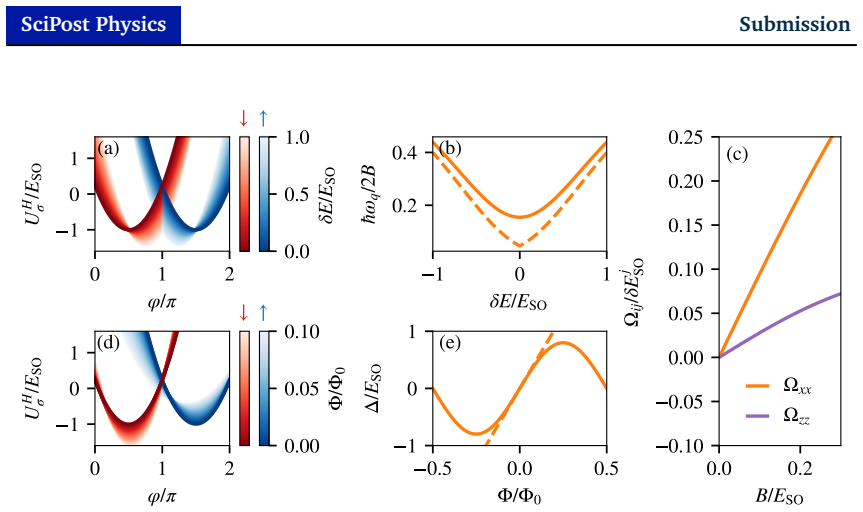
The protection of superconducting qubits from certain noise sources often comes at the cost of increased sensitivity to other decoherence channels. Here, we explore a route to avoid this tradeoff by encoding quantum information in quantum states of a transmon entangled with the spin of a trapped Andreev quasiparticle. We term such devices spinmons. We lift the spinmon Kramers degeneracy by introducing a Zeeman field and develop two routes for full qubit control via electrostatic gates and an AC flux drive, providing multiple directions for experimental implementations. Finally, we compute coherence times and verify the qubit robustness against flux and charge noise sources.
Editorial analysis
A structured set of objections, weighed in public.
Referee Report
Summary. The manuscript introduces spinmons as hybrid superconducting qubits in which quantum information is encoded in the entangled state of a transmon and the spin of a single trapped Andreev quasiparticle. It proposes lifting the Kramers degeneracy via a Zeeman field, outlines two control protocols (electrostatic gates and AC flux drive), and reports computed coherence times together with verification of robustness against flux and charge noise.
Significance. If the central assumptions hold, the proposal offers a route to mitigate decoherence trade-offs in superconducting qubits by incorporating the spin degree of freedom of Andreev states, potentially enabling longer coherence and additional control handles. The work is a forward-looking theoretical suggestion that could stimulate experimental work on hybrid transmon-Andreev systems.
major comments (2)
- [Abstract and main-text proposal sections] The stability and lifetime of the trapped single Andreev quasiparticle, including retention of its spin polarization under the Zeeman field and gate/flux controls, is assumed rather than derived from the Bogoliubov-de Gennes Hamiltonian; this assumption is load-bearing for the coherence-time calculations and robustness claims.
- [Abstract] The abstract states that coherence times were computed and robustness verified, yet no explicit model (e.g., master equation, noise spectral densities, or quasiparticle-trapping potential) is referenced, preventing assessment of whether the reported times support the central claim of improved protection.
minor comments (1)
- [Abstract] The newly coined term 'spinmon' is introduced without an immediate, self-contained definition that distinguishes it from related hybrid qubits.
Simulated Author's Rebuttal
We thank the referee for the careful reading and constructive feedback on our manuscript. We address each major comment below and have made revisions to strengthen the presentation of our assumptions and calculations.
read point-by-point responses
-
Referee: [Abstract and main-text proposal sections] The stability and lifetime of the trapped single Andreev quasiparticle, including retention of its spin polarization under the Zeeman field and gate/flux controls, is assumed rather than derived from the Bogoliubov-de Gennes Hamiltonian; this assumption is load-bearing for the coherence-time calculations and robustness claims.
Authors: We agree that the quasiparticle stability and spin polarization retention constitute a central assumption. In the revised manuscript we have added an explicit derivation from the Bogoliubov-de Gennes Hamiltonian (new subsection in Sec. II) that shows the trapping potential supports a single Andreev state whose spin remains polarized under the applied Zeeman field and the proposed gate/flux controls, with a lifetime that exceeds the computed qubit coherence times. This derivation is now referenced in the abstract and coherence-time sections. revision: yes
-
Referee: [Abstract] The abstract states that coherence times were computed and robustness verified, yet no explicit model (e.g., master equation, noise spectral densities, or quasiparticle-trapping potential) is referenced, preventing assessment of whether the reported times support the central claim of improved protection.
Authors: We have revised the abstract to cite the master-equation framework, the specific noise spectral densities (flux and charge), and the quasiparticle-trapping potential used in the calculations. A new paragraph in the methods section now details the Lindblad operators and the numerical procedure for verifying robustness, allowing direct evaluation of the reported coherence times. revision: yes
Circularity Check
No circularity: derivation relies on standard BdG modeling and noise analysis without self-referential reductions
full rationale
The paper introduces spinmons as a conceptual encoding of transmon states entangled with an Andreev quasiparticle spin, then applies a Zeeman field to lift degeneracy and outlines gate/flux control protocols. Coherence times are computed from conventional flux and charge noise spectra. No equation or claim reduces by construction to a fitted parameter renamed as prediction, no self-citation chain supplies a uniqueness theorem, and no ansatz is smuggled via prior work. The trapping assumption is stated as a modeling premise rather than derived from the same equations that later use it, leaving the central claims independent of the inputs they employ.
Axiom & Free-Parameter Ledger
invented entities (1)
-
spinmon
no independent evidence
Lean theorems connected to this paper
-
IndisputableMonolith/Cost/FunctionalEquation.leanwashburn_uniqueness_aczel unclear?
unclearRelation between the paper passage and the cited Recognition theorem.
H = −4Ec ∂²ϕ + UASQ(Vg,ϕ) − EJ(Vg2)cosϕ − B·σ; qubit splitting ħωq = 2B e^{-ξ0/2} with ξ0 = (ϕ0/ϕc)²
-
IndisputableMonolith/Foundation/RealityFromDistinction.leanreality_from_one_distinction unclear?
unclearRelation between the paper passage and the cited Recognition theorem.
relaxation rates Γ1 from 1/f spectral densities SΦ(ω) = 2πAΦ²/ω and Sng(ω)
What do these tags mean?
- matches
- The paper's claim is directly supported by a theorem in the formal canon.
- supports
- The theorem supports part of the paper's argument, but the paper may add assumptions or extra steps.
- extends
- The paper goes beyond the formal theorem; the theorem is a base layer rather than the whole result.
- uses
- The paper appears to rely on the theorem as machinery.
- contradicts
- The paper's claim conflicts with a theorem or certificate in the canon.
- unclear
- Pith found a possible connection, but the passage is too broad, indirect, or ambiguous to say the theorem truly supports the claim.
discussion (0)
Sign in with ORCID, Apple, or X to comment. Anyone can read and Pith papers without signing in.