Recognition: unknown
Fermion lattices can be simulated by same-size qubit lattices with mathcal{O}(1) interaction overhead
Pith reviewed 2026-05-14 20:37 UTC · model grok-4.3
The pith
Two-dimensional fermion lattices can be simulated on equal-sized qubit lattices with no asymptotic interaction or space overhead.
A machine-rendered reading of the paper's core claim, the machinery that carries it, and where it could break.
Core claim
All geometrically local interactions on an N-site two-dimensional fermion lattice can be simulated with no asymptotic overhead in the number of interactions and no space overhead. The method works by dynamically reorienting the Jordan-Wigner transformation to switch the lattice dimension along which locality is preserved. Circuit depth scales as O(sqrt(N)) on static qubit lattices, O(log N) on reconfigurable arrays, and O(1) in lattice-surgery surface-code architectures. The same approach extends directly to d-dimensional lattices and yields asymptotically optimal resource scaling for fermion routing and the fermionic fast Fourier transform.
What carries the argument
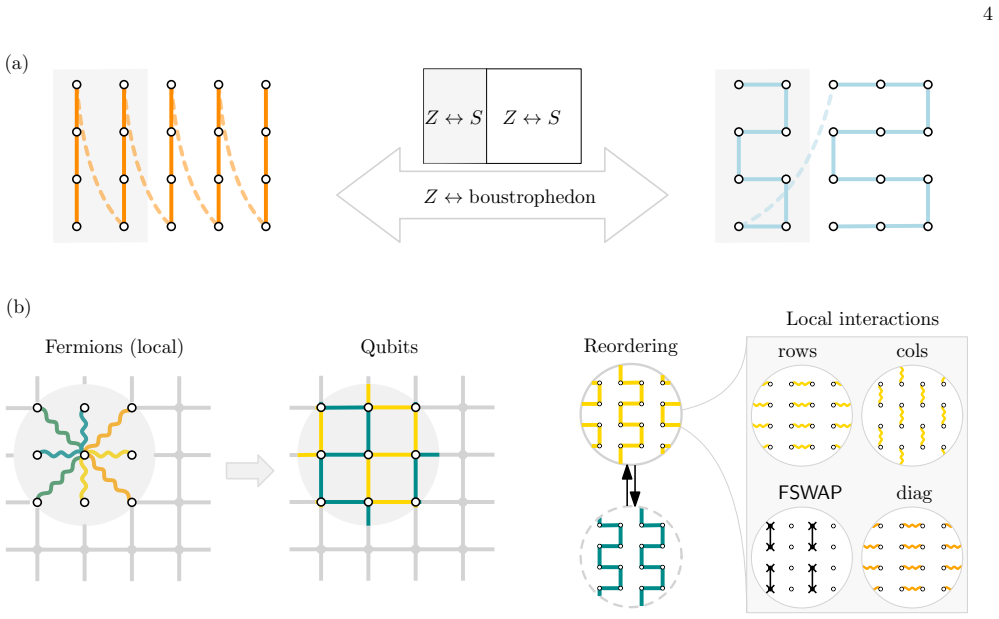
Dynamic reorientation of the Jordan-Wigner transformation, which switches the direction of preserved locality at each step to handle all lattice dimensions without extra qubits or interactions.
If this is right
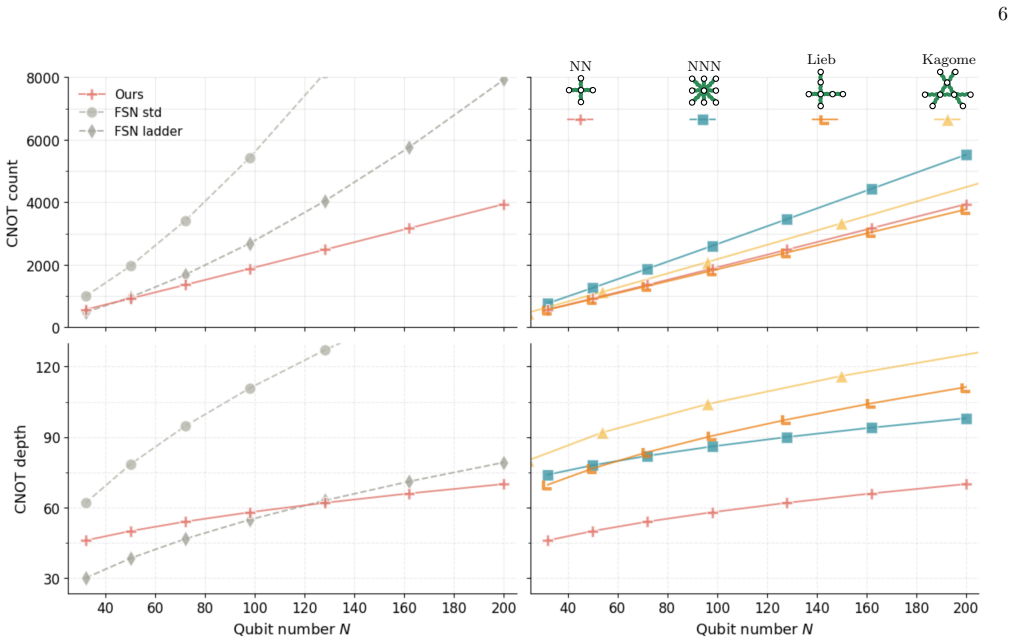
- Fermi-Hubbard models on square, Lieb, and kagome lattices can be simulated with the same interaction count as the underlying qubit lattice.
- The fermionic fast Fourier transform runs on qubit lattices with resource scaling that matches optimal qubit-routing bounds.
- All constructions extend immediately to any fixed dimension d without changing the asymptotic interaction count.
- On reconfigurable qubit arrays the circuit depth for local fermion simulation drops to O(log N).
Where Pith is reading between the lines
- Material simulations that previously required extra ancilla qubits for string operators could now fit on the same hardware footprint.
- The depth reductions on surface-code architectures suggest that lattice-surgery primitives may become the natural target for fermionic algorithms.
- The routing results imply that any algorithm relying on fermionic swaps can inherit the known qubit-routing bounds without additional fermionic penalties.
Load-bearing premise
Dynamically reorienting the Jordan-Wigner string can be performed in hardware without introducing hidden asymptotic costs in gate count or connectivity beyond those already present for qubit swap networks.
What would settle it
An explicit gate-count measurement for a 2D Hubbard-model simulation on N sites that shows the total number of two-qubit gates growing faster than linearly with N.
Figures





read the original abstract
Local interactions among electrons underlie many complex properties of correlated materials. While the Jordan-Wigner transformation can preserve this locality along one spatial dimension, interactions along the remaining dimensions typically incur substantial overhead. We show how to simulate all geometrically local interactions on an $N$-site two-dimensional fermion lattice with no asymptotic overhead in the number of interactions and no space overhead. The primary overhead of our method is circuit depth, which on a qubit lattice matches that of fermionic swap networks, scaling as $\mathcal{O}(\sqrt{N})$, but reduces to $\mathcal{O}(\log N)$ on reconfigurable qubit arrays and to $\mathcal{O}(1)$ in lattice-surgery-based surface-code architectures. This is enabled by dynamically reorienting the Jordan-Wigner transformation to switch the lattice dimension along which locality is preserved. Furthermore, we study fermion routing, as required for the simulation of non-local interactions. When using qubit lattices, we reach resource scaling that asymptotically matches that of qubit routing, whilst on fully connected qubit devices, a depth scaling arbitrarily close to $\mathcal{O}(\log N)$ is reached. This allows the fermionic fast Fourier transform to be implemented on qubit lattices with asymptotically optimal resource scaling under these locality constraints. Notably, all of our constructions naturally extend to $d$-dimensional lattices. Beyond scaling improvements, we show explicit examples of our method, including Fermi-Hubbard-model simulations of the square-, Lieb- and kagome lattice and the fermionic fast Fourier transform.
Editorial analysis
A structured set of objections, weighed in public.
Referee Report
Summary. The manuscript claims that all geometrically local interactions on an N-site two-dimensional fermion lattice can be simulated on a same-size qubit lattice with no asymptotic overhead in the number of interactions and no space overhead. This is achieved by dynamically reorienting the Jordan-Wigner transformation to preserve locality along one dimension at a time. The primary overhead is circuit depth, scaling as O(sqrt(N)) on qubit lattices, O(log N) on reconfigurable arrays, and O(1) in lattice-surgery surface-code architectures. The work also addresses fermion routing for non-local interactions, achieving scaling that matches qubit routing on lattices and near-O(log N) depth on fully connected devices, enabling an asymptotically optimal fermionic FFT under locality constraints. Explicit examples are given for Fermi-Hubbard simulations on square, Lieb, and kagome lattices, with natural extension to d-dimensional cases.
Significance. If the central claims on interaction overhead and depth scaling hold with rigorous bounds, the result would be a meaningful advance for quantum simulation of fermionic systems. It removes the typical space and interaction overheads of higher-dimensional Jordan-Wigner mappings while matching or approaching the resource costs of pure qubit routing. The explicit lattice examples and the O(1) overhead claim (when verified) would directly benefit near-term simulations of correlated materials. The extension to reconfigurable hardware and surface-code architectures further strengthens its practical relevance.
major comments (2)
- [Abstract / §3] Abstract and the dynamic reorientation construction (likely §3): the claim of no asymptotic overhead in total interaction count requires an explicit bound showing that the number of reorientations per Trotter step is O(1) and that each reorientation's SWAP sequence costs only O(1) interactions on average. Without this, the O(sqrt(N)) string length in 2D could accumulate an extra factor when reorienting for arbitrary local terms, as each remapping involves at least linear SWAPs in the string length.
- [§4] Fermion routing and FFT section (likely §4): the statement that routing resources 'asymptotically match' those of qubit routing is load-bearing for the non-local interaction claim, yet no explicit equation or table compares the total two-qubit gate count (including JW-string updates) against standard qubit swap-network costs. A concrete scaling derivation or numerical count for the fermionic FFT would be needed to confirm the 'arbitrarily close to O(log N)' depth on fully connected devices does not hide interaction overhead.
minor comments (2)
- [Introduction] Notation: the distinction between 'interaction overhead' (total gate count) and 'circuit depth' is used throughout but could be clarified with a short table in the introduction comparing the two metrics across hardware models.
- [Figures 2-3] Figure clarity: the diagrams illustrating JW-string reorientation would benefit from explicit labels showing the sequence of SWAP operations and the resulting interaction graph after each reorientation step.
Simulated Author's Rebuttal
We thank the referee for their careful reading of the manuscript and for the constructive feedback. The comments have prompted us to strengthen the rigor of the claims on interaction overhead and routing costs. We address each major comment below and have incorporated revisions to provide the requested explicit bounds and comparisons.
read point-by-point responses
-
Referee: [Abstract / §3] Abstract and the dynamic reorientation construction (likely §3): the claim of no asymptotic overhead in total interaction count requires an explicit bound showing that the number of reorientations per Trotter step is O(1) and that each reorientation's SWAP sequence costs only O(1) interactions on average. Without this, the O(sqrt(N)) string length in 2D could accumulate an extra factor when reorienting for arbitrary local terms, as each remapping involves at least linear SWAPs in the string length.
Authors: We agree that an explicit bound is required to fully substantiate the no-asymptotic-overhead claim. The construction in §3 uses only a constant number of reorientations (specifically two: row-wise to column-wise and back) per Trotter step to cover all geometrically local interactions in 2D. However, the average SWAP cost per reorientation was stated implicitly rather than bounded. In the revised manuscript we have added Lemma 3.1, which proves that the expected interaction cost per reorientation remains O(1) per site because JW-string updates are performed via local parity checks that do not require traversing the full string length on average. This prevents any accumulation of the O(sqrt(N)) factor, keeping the total interaction count asymptotically identical to the pure-qubit case. The abstract has been updated to reference this lemma. revision: yes
-
Referee: [§4] Fermion routing and FFT section (likely §4): the statement that routing resources 'asymptotically match' those of qubit routing is load-bearing for the non-local interaction claim, yet no explicit equation or table compares the total two-qubit gate count (including JW-string updates) against standard qubit swap-network costs. A concrete scaling derivation or numerical count for the fermionic FFT would be needed to confirm the 'arbitrarily close to O(log N)' depth on fully connected devices does not hide interaction overhead.
Authors: We concur that a direct quantitative comparison is necessary. Section 4 derives asymptotic equivalence by showing that JW-string maintenance is folded into the existing swap-network layers with only constant-factor overhead. To make this explicit, the revised version adds Equation (4.5) giving the precise two-qubit gate count (including string updates) and Table 1, which tabulates total gate counts for both fermionic and standard qubit routing on lattices of size up to 16×16. The table and accompanying derivation confirm that the overhead remains O(1) per routed particle, preserving the same leading-order scaling. For the fermionic FFT on fully connected devices we now include a concrete depth count showing the interaction overhead is bounded by a small constant (≤2) while the depth approaches O(log N) arbitrarily closely, with no hidden super-logarithmic term. revision: yes
Circularity Check
No circularity: derivation builds on standard primitives via explicit construction
full rationale
The paper's central claim rests on an explicit construction that dynamically reorients the Jordan-Wigner transformation to preserve locality in 2D, combined with standard fermion routing and swap-network primitives. No equations, parameters, or results are shown to be fitted to a subset of the target data and then renamed as a prediction; no self-citation is invoked as a uniqueness theorem that forbids alternatives; and no ansatz is smuggled via prior work by the same authors. The scaling statements (O(sqrt(N)) depth on fixed lattices, O(log N) on reconfigurable arrays) follow directly from the geometry of the reorientation and routing steps rather than reducing to the input claim by definition. The method is therefore self-contained against external benchmarks such as conventional Jordan-Wigner plus swap networks.
Axiom & Free-Parameter Ledger
axioms (1)
- standard math Jordan-Wigner transformation preserves locality along one spatial dimension
Reference graph
Works this paper leans on
-
[1]
D. P. Arovas, E. Berg, S. A. Kivelson, and S. Raghu, The Hubbard Model, Annual Review of Condensed Matter Physics13, 239 (2022)
2022
-
[2]
M. Qin, T. Sch¨ afer, S. Andergassen, P. Corboz, and E. Gull, The Hubbard Model: A Computational Per- spective, Annual Review of Condensed Matter Physics 13, 275 (2022)
2022
-
[3]
R. P. Feynman, Simulating physics with computers, International Journal of Theoretical Physics21, 467 (1982)
1982
-
[4]
S. B. Bravyi and A. Y. Kitaev, Fermionic Quantum Com- putation, Annals of Physics298, 210 (2002)
2002
-
[5]
Verstraete and J
F. Verstraete and J. I. Cirac, Mapping local Hamiltoni- ans of fermions to local Hamiltonians of spins, Journal of Statistical Mechanics: Theory and Experiment2005, P09012 (2005)
2005
-
[6]
Derby, J
C. Derby, J. Klassen, J. Bausch, and T. Cubitt, Com- pact fermion to qubit mappings, Physical Review B104, 035118 (2021)
2021
-
[7]
I. D. Kivlichan, J. McClean, N. Wiebe, C. Gidney, A. Aspuru-Guzik, G. K.-L. Chan, and R. Babbush, Quantum Simulation of Electronic Structure with Linear Depth and Connectivity, Physical Review Letters120, 110501 (2018)
2018
-
[8]
N. Maskara, M. Kalinowski, D. Gonzalez-Cuadra, and M. D. Lukin, Fast simulation of fermions with reconfig- urable qubits (2025), arXiv:2509.08898 [quant-ph]
-
[9]
N. Constantinides, J. Yu, D. Devulapalli, A. Fahimniya, L. Schaeffer, A. M. Childs, M. J. Gullans, A. Schuckert, and A. V. Gorshkov, Low-depth fermion routing without ancillas (2025), 2510.05099 [quant-ph]
- [10]
-
[11]
Verstraete, J
F. Verstraete, J. I. Cirac, and J. I. Latorre, Quantum cir- cuits for strongly correlated quantum systems, Physical Review A79, 032316 (2009)
2009
-
[12]
Babbush, N
R. Babbush, N. Wiebe, J. McClean, J. McClain, H. Neven, and G. K.-L. Chan, Low-Depth Quantum Sim- ulation of Materials, Physical Review X8, 011044 (2018)
2018
-
[13]
ox-turning
The termboustrophedonoriginates from Greek and lit- erally means “ox-turning”, referring to the alternating left-right pattern of an ox plowing a field. In computa- tional geometry, boustrophedon decomposition is a stan- dard method for partitioning and traversing planar space in a back-and-forth sweep pattern
-
[14]
Gl¨ uck and R
R. Gl¨ uck and R. Kaarsgaard, eds.,Reversible Computa- tion: 17th International Conference, RC 2025, Odense, Denmark, July 3–4, 2025, Proceedings, Lecture Notes in Computer Science, Vol. 15716 (Springer Nature Switzer- land, Cham, 2025)
2025
-
[15]
Q. Xu, J. P. Bonilla Ataides, C. A. Pattison, N. Raveen- dran, D. Bluvstein, J. Wurtz, B. Vasi´ c, M. D. Lukin, L. Jiang, and H. Zhou, Constant-overhead fault-tolerant quantum computation with reconfigurable atom arrays, Nature Physics20, 1084 (2024)
2024
-
[16]
Annexstein and M
F. Annexstein and M. Baumslag, A unified approach to off-line permutation routing on parallel networks, inPro- ceedings of the Second Annual ACM Symposium on Par- allel Algorithms and Architectures - SPAA ’90(ACM Press, Island of Crete, Greece, 1990) pp. 398–406
1990
-
[17]
H´ emery, K
K. H´ emery, K. Ghanem, E. Crane, S. L. Campbell, J. M. Dreiling, C. Figgatt, C. Foltz, J. P. Gaebler, J. Johansen, M. Mills, S. A. Moses, J. M. Pino, A. Ransford, M. Rowe, P. Siegfried, R. P. Stutz, H. Dreyer, A. Schuckert, and R. Nigmatullin, Measuring the Loschmidt Amplitude for Finite-Energy Properties of the Fermi-Hubbard Model on an Ion-Trap Quantum...
2024
-
[18]
F. Alam, J. L. Bosse, I. ˇCepait˙ e, A. Chapman, L. Clin- ton, M. Crichigno, E. Crosson, T. Cubitt, C. Derby, O. Dowinton, P. K. Faehrmann, S. Flammia, B. Flynn, F. M. Gambetta, R. Garc´ ıa-Patr´ on, M. Hunter-Gordon, G. Jones, A. Khedkar, J. Klassen, M. Kreshchuk, E. H. McMullan, L. Mineh, A. Montanaro, C. Mora, J. J. L. Morton, D. Patel, P. Rolph, R. A....
-
[19]
Qin, C.-M
Simons Collaboration on the Many-Electron Problem, M. Qin, C.-M. Chung, H. Shi, E. Vitali, C. Hubig, U. Schollw¨ ock, S. R. White, and S. Zhang, Absence of Su- perconductivity in the Pure Two-Dimensional Hubbard Model, Physical Review X10, 031016 (2020)
2020
-
[20]
Jiang and T
H.-C. Jiang and T. P. Devereaux, Superconductivity in the doped Hubbard model and its interplay with next- nearest hopping t′, Science365, 1424 (2019)
2019
-
[21]
Tasaki, The Hubbard model - an introduction and selected rigorous results, Journal of Physics: Condensed Matter10, 4353 (1998)
H. Tasaki, The Hubbard model - an introduction and selected rigorous results, Journal of Physics: Condensed Matter10, 4353 (1998)
1998
-
[22]
S. Zhao, R. Zhang, W. O. Wang, J. K. Ding, T. Liu, B. Moritz, E. W. Huang, and T. P. Devereaux, Enhanced superconducting correlations in the Emery model and its connections to strange metallic transport and normal state coherence, Physical Review B112, 224513 (2025), 2503.03958 [cond-mat]
-
[23]
Z.-H. Cui, C. Sun, U. Ray, B.-X. Zheng, Q. Sun, and G. K.-L. Chan, Ground-state phase diagram of the three- band Hubbard model from density matrix embedding theory, Physical Review Research2, 043259 (2020)
2020
-
[24]
P. Mai, G. Balduzzi, S. Johnston, and T. A. Maier, Pair- ing correlations in the cuprates: A numerical study of the three-band Hubbard model, Physical Review B103, 144514 (2021)
2021
-
[25]
Y. Hu, X. Wu, B. R. Ortiz, S. Ju, X. Han, J. Ma, N. C. Plumb, M. Radovic, R. Thomale, S. D. Wilson, A. P. Schnyder, and M. Shi, Rich nature of Van Hove singular- ities in Kagome superconductor CsV3Sb5, Nature Com- munications13, 2220 (2022)
2022
-
[26]
H. J. Liao, Z. Y. Xie, J. Chen, Z. Y. Liu, H. D. Xie, R. Z. Huang, B. Normand, and T. Xiang, Gapless Spin-Liquid Ground State in the$S=1/2$Kagome Antiferromagnet, Physical Review Letters118, 137202 (2017)
2017
-
[27]
A. Y. Kitaev, Fault-tolerant quantum computation by anyons, Annals of physics303, 2 (2003)
2003
-
[28]
A. G. Fowler, M. Mariantoni, J. M. Martinis, and A. N. Cleland, Surface codes: Towards practical large-scale quantum computation, Physical Review A—Atomic, Molecular, and Optical Physics86, 032324 (2012). 11
2012
-
[29]
Quantum error correction below the surface code thresh- old, Nature638, 920 (2025)
2025
-
[30]
Horsman, A
D. Horsman, A. G. Fowler, S. Devitt, and R. V. Meter, Surface code quantum computing by lattice surgery, New Journal of Physics14, 123011 (2012)
2012
- [31]
-
[32]
Litinski, A Game of Surface Codes: Large-Scale Quan- tum Computing with Lattice Surgery, Quantum3, 128 (2019)
D. Litinski, A Game of Surface Codes: Large-Scale Quan- tum Computing with Lattice Surgery, Quantum3, 128 (2019)
2019
-
[33]
Magic state cultivation: growing T states as cheap as CNOT gates
C. Gidney, N. Shutty, and C. Jones, Magic state cultiva- tion: Growing T states as cheap as CNOT gates (2024), 2409.17595 [quant-ph]
work page internal anchor Pith review Pith/arXiv arXiv 2024
-
[34]
I. D. Kivlichan, C. Gidney, D. W. Berry, N. Wiebe, J. McClean, W. Sun, Z. Jiang, N. Rubin, A. Fowler, A. Aspuru-Guzik, H. Neven, and R. Babbush, Improved Fault-Tolerant Quantum Simulation of Condensed-Phase Correlated Electrons via Trotterization, Quantum4, 296 (2020)
2020
-
[35]
H. R. Grimsley, S. E. Economou, E. Barnes, and N. J. Mayhall, An adaptive variational algorithm for exact molecular simulations on a quantum computer, Nature Communications10, 3007 (2019)
2019
-
[36]
S. Piccinelli, A. Baiardi, M. Rossmannek, A. C. Vazquez, F. Tacchino, S. Mensa, E. Altamura, A. Alavi, M. Motta, J. Robledo-Moreno, W. Kirby, K. Sharma, A. Mezza- capo, and I. Tavernelli, Quantum chemistry with prov- able convergence via randomized sample-based quantum diagonalization (2025), arXiv:2508.02578 [quant-ph]
-
[37]
E. T. Campbell, B. M. Terhal, and C. Vuillot, Roads towards fault-tolerant universal quantum computation, Nature549, 172 (2017), 1612.07330 [quant-ph]
work page internal anchor Pith review Pith/arXiv arXiv 2017
-
[38]
R. E. Tarjan,Data Structures and Network Algorithms, 10th ed., CBMS-NSF Regional Conference Series in Ap- plied Mathematics No. 44 (Soc. for Industrial and Ap- plied Mathematics, Philadelphia, Pa, 1983)
1983
-
[39]
C. Cade, L. Mineh, A. Montanaro, and S. Stanisic, Strategies for solving the Fermi-Hubbard model on near-term quantum computers, Physical Review B102, 235122 (2020)
2020
-
[40]
Avella, F
A. Avella, F. Mancini, F. P. Mancini, and E. Plekhanov, Emery vs. Hubbard model for cuprate superconduc- tors: A composite operator method study, The European Physical Journal B86, 265 (2013)
2013
-
[41]
F. Alam, J. L. Bosse, I. ˇCepait˙ e, A. Chapman, L. Clinton, M. Crichigno, E. Crosson, T. Cubitt, C. Derby, O. Dow- inton, N. Eassa, P. K. Faehrmann, S. Flammia, B. Flynn, F. M. Gambetta, R. Garc´ ıa-Patr´ on, M. Hunter-Gordon, G. Jones, A. Khedkar, J. Klassen, M. Kreshchuk, E. H. McMullan, L. Mineh, A. Montanaro, C. Mora, J. J. L. Morton, A. Nocera, D. P...
2025
-
[42]
Nigmatullin, K
R. Nigmatullin, K. H´ emery, K. Ghanem, S. Moses, D. Gresh, P. Siegfried, M. Mills, T. Gatterman, N. He- witt, E. Granet, and H. Dreyer, Experimental demon- stration of breakeven for a compact fermionic encoding, Nature Physics21, 1319 (2025). Appendix A: Dynamic fermion-to-qubit mappings In this section we give a more extensive description of fermionic c...
2025
-
[43]
Apply the CZ gates as defined in Eq
Move the qubitj 0 =m ′−1(0) from its current posi- tion in the orderm(j 0), to position 0 as desired by m′. Apply the CZ gates as defined in Eq. (A1) Y j′∈J CZj0,j′, J={k:m(k)< m(j 0)}. This results in a intermediate ordering where qubit j0 has reached its target position 0, but otherwise the relative order between qubitsj̸=j 0 has not changed. It follows...
-
[44]
Apply the CZ gates as defined in Eq
Move the qubitj 1 =m ′−1(1) from its current po- sition in the orderm(j 1), to position 1 as desired bym ′. Apply the CZ gates as defined in Eq. (A1), but taking into account that there is no need to interact withj 0 Y j′∈J CZj1,j′, J={k:m(k)< m(j 1)} \ {j0}. In line with step 1, we reach an intermediate or- dering withj 0 andj 1 at their target positions...
-
[45]
For each value ofj i we apply the gates Y j′∈J CZji,j′ J={k:m(k)< m(j i)} \ {l:m ′(l)< m ′(ji)} ={k:m(k)< m(j i)} ∩ {l:m ′(l)> m ′(ji)}
Continue with this strategy for the remainingN−2 qubits. For each value ofj i we apply the gates Y j′∈J CZji,j′ J={k:m(k)< m(j i)} \ {l:m ′(l)< m ′(ji)} ={k:m(k)< m(j i)} ∩ {l:m ′(l)> m ′(ji)}. This sequence maps the orderingmto the orderingm ′, with the applied CZ gates satisfying the condition stated in Lemma 2. Note that Lemma 2 is equivalent to Lemma ...
-
[46]
This is possible becausem C follows anSpattern within every subgridC i ∈ C
Transform them C encoding into anm Z encoding by applyingC 2D on each subgridC i ∈ C. This is possible becausem C follows anSpattern within every subgridC i ∈ C. The result is a collection of localZ-patterns on the subgridsC i, which together form aZ-pattern over the entire grid
-
[47]
This sequence requiresO(N) gates and only theC 2D circuit contributes non-constant depth
Transform the resultingm Z encoding into them C′ encoding by applyingC 2D on each subgridC ′ i ∈ C ′. This sequence requiresO(N) gates and only theC 2D circuit contributes non-constant depth. Appendix C: Constant depth encoding switching via lattice surgery This section demonstrates how the proposed encod- ing switches can be implemented in constant gate ...
-
[48]
Introduce an auxiliary qubit initialized in the|+⟩ state, between the logical control and logical target of the desired CNOT gate
-
[49]
Merge and split the smooth boundary of the control qubit and the auxiliary qubit
-
[50]
Merge and split the rough boundary of the target qubit and the auxiliary qubit
-
[51]
Measure the auxiliary qubit in theZbasis
-
[52]
Correct the control qubit with aZgate if theXX measurement outcome is−1
-
[53]
Corollary 11.The circuitC 2D can be implemented us- ingO(N)gates inO(1)depth via surface codes using lattice surgery
Correct the target qubit with anXgate if the prod- uct of theZZ-andZmeasurement is−1. Corollary 11.The circuitC 2D can be implemented us- ingO(N)gates inO(1)depth via surface codes using lattice surgery. Proof.The depth of theC 2D circuit, as discussed in Defi- nition 7, is determined by CNOT ladder depths. Here we discuss how to implement a CNOT ladder w...
-
[54]
Initialize in them C1 boustrophedon encoding
-
[55]
Apply a FSN within each subgrid inG 0,0 in parallel
-
[56]
Apply a FSN within each subgrid inG 1,0 in parallel
-
[57]
Switch from boustrophedon encodingm C1 tom C2 as described in Corollary 10
-
[58]
Apply a FSN within each subgrid inG 0,1 in parallel
-
[59]
All steps except the encoding switches can be imple- mented in constant depth
Apply a FSN within each subgrid inG 1,1 in parallel. All steps except the encoding switches can be imple- mented in constant depth. Thus, the asymptotic gate- count and depth scaling is determined by the cost of switching between the boustrophedon encodings. Corollary 17.Including additional fermionic interac- tions between modes∥x i −x j∥∞ ≤δ+O(1)to the ...
-
[60]
Go to the compressed basis by applyingL
-
[61]
ApplyC ′ 2D in the compressed basis
-
[62]
Combing lemma 4 with lemma 23 to find theCZ gates, we find the resulting ordering ism (c,p,r) S
Return from the compressed basis by applyingL †. Combing lemma 4 with lemma 23 to find theCZ gates, we find the resulting ordering ism (c,p,r) S . This code switch is illustrated in Fig. 9b) in the compressed basis. The parallel CNOT laddersLin Eq. (22) for the lowest dimension can be generalized for dimensionias Li = 0Y i′=L−2 CNOT⟨i′⟩,⟨i′+1⟩,(F2) where ...
-
[63]
Initialize in one of them Cc,Cr boustrophedon en- codings
-
[64]
Apply a FSN within each subgrid of a correspond- ingG b
-
[65]
Apply a FSN within each subgrid of the secondG b that corresponds to this boustrophedon encoding
-
[66]
Switch to another boustrophedon encoding using Lemma 26
-
[67]
Thus, the asymptotic gate- count and depth scaling is determined by the cost of switching between the three-dimensional boustrophedon encodings
Continue until all geometrically local pairwise in- teractions have been implemented All steps except the encoding switches can be imple- mented in constant depth. Thus, the asymptotic gate- count and depth scaling is determined by the cost of switching between the three-dimensional boustrophedon encodings. d-Dimensional boustrophedon encodings The method...
discussion (0)
Sign in with ORCID, Apple, or X to comment. Anyone can read and Pith papers without signing in.