Recognition: unknown
Bridging perturbation and variational approaches in brittle fracture
Pith reviewed 2026-05-14 20:37 UTC · model grok-4.3
The pith
A variational model merges energy minimization with crack-front perturbation theory to simulate three-dimensional brittle fracture in disordered solids.
A machine-rendered reading of the paper's core claim, the machinery that carries it, and where it could break.
Core claim
The central claim is that equilibrium crack-front shapes in heterogeneous brittle solids under mixed-mode I+II+III loading can be found by minimizing a total energy functional whose elastic part is obtained from first-order perturbation theory around a reference front and whose fracture part is given by the local fracture energy; this minimization, performed with a matrix-free Newton conjugate-gradient solver and fast Fourier transform evaluation, reproduces the transition from smooth to intermittent growth and uncovers a finite-size crossover from disorder-induced weakening to toughening governed by depinning instabilities.
What carries the argument
The central object is the variational reduced-order model that computes the elastic energy asymptotically from small front deformations via the Fast Fourier Transform and solves the resulting nonconvex minimization problem while enforcing crack irreversibility.
If this is right
- Crack fronts adopt quasi-elliptic shapes under mixed-mode II+III loading.
- The onset of intermittent growth depends only weakly on the degree of mode mixity.
- A size-dependent crossover occurs from disorder-induced weakening to toughening once depinning instabilities appear.
- The transition from smooth to jumpy growth can be reproduced across a wide range of disorder intensities and system sizes.
Where Pith is reading between the lines
- The same energy-minimization framework could be adapted to study statistical distributions of jump sizes and waiting times in larger systems.
- Relaxing the coplanar constraint might reveal how out-of-plane deflections interact with the in-plane depinning mechanism.
- The observed crossover suggests that similar size-dependent toughening could appear in other depinning problems such as magnetic domain walls or fluid invasion fronts.
Load-bearing premise
The model requires that crack fronts stay strictly coplanar and that the elastic energy remains well captured by first-order perturbation expansions around a reference shape even when the surrounding medium contains strong heterogeneities.
What would settle it
Experimental measurements or higher-fidelity simulations that show substantial out-of-plane front motion or that the elastic energy deviates markedly from the first-order prediction in strongly disordered samples would contradict the model's core predictions.
Figures



read the original abstract
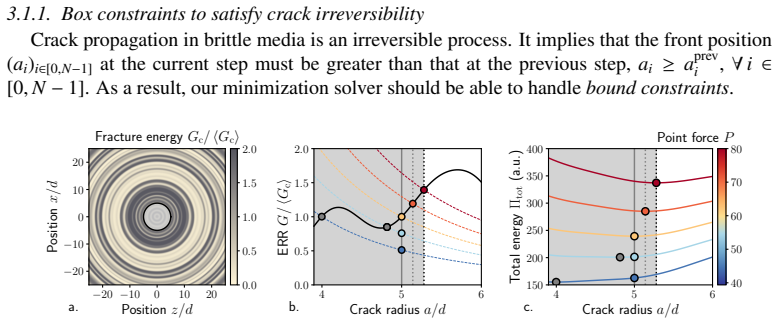
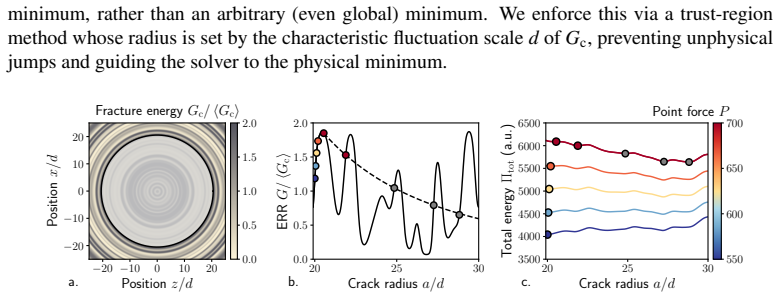
We present a variational reduced-order model for three-dimensional coplanar propagation of sharp cracks in heterogeneous perfectly brittle solids under mixed-mode I+II+III loading. The approach connects the variational fracture formulation of Francfort and Marigo (1998) and the perturbation theory of Rice (1985) by computing equilibrium crack-front configurations through minimization of the total energy defined as the sum of (i) the elastic potential energy, evaluated asymptotically from front deformations, and (ii) the dissipated energy, set by the fracture energy field. The potential energy and its derivatives are evaluated efficiently using the Fast Fourier Transform. The resulting nonconvex box-constrained minimization problem is solved with a matrix-free Newton conjugate gradient algorithm with a trust region and physics-based preconditioning, enforcing irreversibility while resolving energy barriers and long-range elastic interactions. We validate our implementation against newly derived analytical solutions. We then perform 116,000 large-scale simulations of tensile and shear crack propagation in disordered media to quantify the impact of finite-size effects, disorder intensity, and mode mixity. The simulations reproduce the transition from smooth to intermittent crack growth, and show that mode mixity has limited influence on the onset of intermittency but induces quasi-elliptic fronts in mixed II+III loading. They reveal a size-dependent crossover from disorder-induced weakening to toughening controlled by the emergence of depinning instabilities.
Editorial analysis
A structured set of objections, weighed in public.
Referee Report
Summary. The paper presents a variational reduced-order model that bridges the Francfort-Marigo variational fracture formulation with Rice's first-order perturbation theory to simulate three-dimensional coplanar crack propagation in heterogeneous perfectly brittle solids under mixed-mode I+II+III loading. Elastic potential energy is evaluated asymptotically from front deformations using the Fast Fourier Transform, and the resulting nonconvex minimization problem (subject to irreversibility) is solved via a matrix-free Newton conjugate gradient algorithm with trust-region and physics-based preconditioning. After validation against newly derived analytical solutions, the authors perform 116,000 large-scale simulations to quantify finite-size effects, disorder intensity, and mode mixity, reporting a transition from smooth to intermittent crack growth, limited influence of mode mixity on intermittency onset, quasi-elliptic fronts in mixed II+III loading, and a size-dependent crossover from disorder-induced weakening to toughening controlled by depinning instabilities.
Significance. If the numerical results hold, the work provides an efficient computational bridge between established perturbation and variational approaches, enabling systematic exploration of crack-front dynamics in disordered media at scales inaccessible to full-field methods. Strengths include the FFT-based evaluation of long-range elastic interactions, the matrix-free solver with physics-informed preconditioning, explicit validation against analytical solutions, and the large simulation campaign that isolates specific phenomena such as quasi-elliptic fronts and depinning-controlled toughening. These elements could inform predictive models of intermittency and toughness in heterogeneous brittle solids.
major comments (2)
- [Abstract] The central claim of a size-dependent crossover from weakening to toughening (controlled by depinning instabilities) rests on the first-order perturbation expansion for elastic energy remaining accurate at the disorder intensities that trigger those instabilities; the manuscript provides no quantitative error assessment or higher-order correction test in this regime beyond the analytical validation cases.
- [Abstract] The abstract states that 116,000 simulations were performed and that they reveal specific transitions and crossovers, yet reports no error bars, convergence studies with respect to discretization or ensemble size, or details on the post-processing used to classify smooth versus intermittent growth and to locate the weakening-toughening crossover; these omissions make the quantitative claims difficult to assess.
minor comments (1)
- [Abstract] The abstract would be clearer if it specified the ranges of disorder intensity, system size, and mode-mixity ratios explored in the 116,000 simulations.
Simulated Author's Rebuttal
We thank the referee for the thorough review and constructive feedback on our manuscript. We are pleased that the significance of the work is recognized. Below, we provide point-by-point responses to the major comments and outline the revisions we will make to address them.
read point-by-point responses
-
Referee: [Abstract] The central claim of a size-dependent crossover from weakening to toughening (controlled by depinning instabilities) rests on the first-order perturbation expansion for elastic energy remaining accurate at the disorder intensities that trigger those instabilities; the manuscript provides no quantitative error assessment or higher-order correction test in this regime beyond the analytical validation cases.
Authors: We agree that providing a quantitative assessment of the perturbation approximation's accuracy at the relevant disorder levels would enhance the robustness of our claims. The analytical solutions used for validation are derived within the same first-order framework, and our choice of disorder intensities is guided by the regime where higher-order terms are expected to be small, as per established perturbation theory in fracture mechanics. In the revised manuscript, we will include an additional analysis comparing the first-order elastic energy to estimates from a second-order perturbation expansion for selected high-disorder cases, along with a discussion of the error bounds and their impact on the observed crossover. revision: yes
-
Referee: [Abstract] The abstract states that 116,000 simulations were performed and that they reveal specific transitions and crossovers, yet reports no error bars, convergence studies with respect to discretization or ensemble size, or details on the post-processing used to classify smooth versus intermittent growth and to locate the weakening-toughening crossover; these omissions make the quantitative claims difficult to assess.
Authors: We acknowledge the need for greater transparency regarding the statistical reliability and methodological details of our large-scale simulation campaign. The full manuscript includes some convergence checks, but we agree they should be more prominently featured. In the revision, we will add error bars to key figures and results (computed over ensembles of disorder realizations), report on discretization convergence studies (e.g., varying the FFT grid size), specify the ensemble sizes used, and detail the post-processing procedures, including the criteria for distinguishing smooth vs. intermittent growth (based on front velocity fluctuations) and the method for locating the weakening-toughening crossover (via fitting to scaling laws), in a new subsection of the methods section. revision: yes
Circularity Check
No significant circularity; derivation rests on external theories and numerical minimization
full rationale
The paper adopts the variational fracture framework directly from Francfort and Marigo (1998) and the first-order elastic perturbation expansion from Rice (1985), both external citations with no author overlap. Equilibrium configurations are obtained by numerical minimization of the sum of these energies subject to coplanarity and irreversibility constraints, using FFT evaluation and a matrix-free Newton-CG solver. The 116,000 simulations generate the reported transitions and crossovers as outputs rather than fitting parameters or redefining quantities by construction. No self-citation chain or self-definitional reduction appears in the load-bearing steps.
Axiom & Free-Parameter Ledger
free parameters (2)
- disorder intensity
- mode-mixity ratios
axioms (3)
- domain assumption Crack fronts remain strictly coplanar during propagation
- domain assumption Material is perfectly brittle with a prescribed fracture energy field
- domain assumption Elastic potential energy can be evaluated asymptotically from front deformations via Rice perturbation theory
Reference graph
Works this paper leans on
-
[1]
Shapiro, Serge A. , year =. Fluid-. doi:10.1017/CBO9781139051132 , file =
-
[2]
Journal of Geophysical Research: Solid Earth , author =
A constitutive law for rate of earthquake production and its application to earthquake clustering , volume =. Journal of Geophysical Research: Solid Earth , author =. 1994 , note =. doi:10.1029/93JB02581 , abstract =
-
[3]
International Journal of Fracture , author =
Somewhat circular tensile cracks , volume =. International Journal of Fracture , author =. 1987 , pages =. doi:10.1007/BF00013168 , abstract =
-
[4]
International Journal of Solids and Structures , author =
Coplanar propagation paths of. International Journal of Solids and Structures , author =. 2006 , pages =. doi:10.1016/j.ijsolstr.2005.06.041 , abstract =
-
[5]
Journal of the Mechanics and Physics of Solids , author =
Perturbation approaches of a planar crack in linear elastic fracture mechanics:. Journal of the Mechanics and Physics of Solids , author =. 2011 , pages =. doi:10.1016/j.jmps.2010.12.006 , abstract =
-
[6]
Journal of the Mechanics and Physics of Solids , author =
Numerical simulations of fast crack growth in brittle solids , volume =. Journal of the Mechanics and Physics of Solids , author =. 1994 , pages =. doi:10.1016/0022-5096(94)90003-5 , abstract =
-
[7]
International Journal of Solids and Structures , author =
Computational modelling of impact damage in brittle materials , volume =. International Journal of Solids and Structures , author =. 1996 , pages =. doi:10.1016/0020-7683(95)00255-3 , abstract =
-
[8]
Annual Review of Condensed Matter Physics , author =
Brittle. Annual Review of Condensed Matter Physics , author =. 2019 , pages =. doi:10.1146/annurev-conmatphys-031218-013327 , abstract =
-
[9]
Classical shear cracks drive the onset of dry frictional motion , volume =. Nature , author =. 2014 , pages =. doi:10.1038/nature13202 , language =
-
[10]
Physical Review Letters , author =
Dynamics of. Physical Review Letters , author =. 2007 , pages =. doi:10.1103/PhysRevLett.98.226103 , language =
-
[11]
International Journal of Solids and Structures , author =
Meso-scale size effects of material heterogeneities on crack propagation in brittle solids:. International Journal of Solids and Structures , author =. 2024 , pages =. doi:10.1016/j.ijsolstr.2024.112795 , abstract =
-
[12]
Physical Review Letters , author =
Quantitative prediction of effective toughness at random heterogeneous interfaces , volume =. Physical Review Letters , author =. 2013 , keywords =. doi:10.1103/PhysRevLett.110.165507 , abstract =
-
[13]
Physical Review Letters , author =
Fluctuations of global energy release and crackling in nominally brittle heterogeneous fracture , volume =. Physical Review Letters , author =. 2014 , keywords =
2014
-
[14]
Journal of Elasticity , author =
The. Journal of Elasticity , author =. 2008 , pages =. doi:10.1007/s10659-007-9107-3 , language =
-
[15]
Failure of heterogeneous materials:. Physics Reports , author =. 2011 , pages =. doi:10.1016/j.physrep.2010.07.006 , abstract =
-
[16]
International Journal for Numerical Methods in Engineering , author =
A finite element method for crack growth without remeshing , volume =. International Journal for Numerical Methods in Engineering , author =. 1999 , note =. doi:10.1002/(SICI)1097-0207(19990910)46:1<131::AID-NME726>3.0.CO;2-J , abstract =
-
[17]
Journal of Applied Mechanics , author =
First-. Journal of Applied Mechanics , author =. 1985 , keywords =. doi:10.1115/1.3169103 , abstract =
-
[18]
Journal of Applied Mechanics , author =
Shear. Journal of Applied Mechanics , author =. 1986 , keywords =. doi:10.1115/1.3171857 , abstract =
-
[19]
European Journal of Mechanics - A/Solids , author =
Effective toughness of heterogeneous brittle materials , volume =. European Journal of Mechanics - A/Solids , author =. 2003 , keywords =. doi:10.1016/S0997-7538(03)00078-0 , abstract =
-
[20]
Journal of the Mechanics and Physics of Solids , author =
Finite size effects on crack front pinning at heterogeneous planar interfaces:. Journal of the Mechanics and Physics of Solids , author =. 2013 , keywords =. doi:10.1016/j.jmps.2012.10.012 , abstract =
-
[21]
EPL (Europhysics Letters) , author =
From microstructural features to effective toughness in disordered brittle solids , volume =. EPL (Europhysics Letters) , author =. 2014 , keywords =. doi:10.1209/0295-5075/105/34003 , abstract =
-
[22]
Engineering Fracture Mechanics , author =
Second-order coplanar perturbation of a semi-infinite crack in an infinite body , volume =. Engineering Fracture Mechanics , author =. 2012 , keywords =. doi:10.1016/j.engfracmech.2012.03.002 , abstract =
-
[23]
Journal of the Mechanics and Physics of Solids , author =
Revisiting brittle fracture as an energy minimization problem , volume =. Journal of the Mechanics and Physics of Solids , author =. 1998 , keywords =. doi:10.1016/S0022-5096(98)00034-9 , abstract =
-
[24]
Journal of the Mechanics and Physics of Solids , author =
Disordering of a dynamic planar crack front in a model elastic medium of randomly variable toughness , volume =. Journal of the Mechanics and Physics of Solids , author =. 1994 , keywords =. doi:10.1016/0022-5096(94)90083-3 , abstract =
-
[25]
Fracture Mechanics: Perspectives and Directions (Twentieth Symposium) , author =
Weight. Fracture Mechanics: Perspectives and Directions (Twentieth Symposium) , author =. 1989 , keywords =. doi:10.1520/STP18819S , language =
-
[26]
Journal of the Mechanics and Physics of Solids , author =
Three-dimensional fluid-driven stable frictional ruptures , volume =. Journal of the Mechanics and Physics of Solids , author =. 2022 , keywords =. doi:10.1016/j.jmps.2021.104754 , abstract =
-
[27]
Journal of the Mechanics and Physics of Solids , author =
Crack-front model for adhesion of soft elastic spheres with chemical heterogeneity , volume =. Journal of the Mechanics and Physics of Solids , author =. 2022 , keywords =. doi:10.1016/j.jmps.2022.104781 , abstract =
-
[28]
International Journal of Solids and Structures , author =
Nearly circular shear mode cracks , volume =. International Journal of Solids and Structures , author =. 1988 , pages =. doi:10.1016/0020-7683(88)90028-5 , abstract =
-
[29]
International Journal of Solids and Structures , author =
Size effects in the toughening of brittle materials by heterogeneities:. International Journal of Solids and Structures , author =. 2023 , keywords =. doi:10.1016/j.ijsolstr.2023.112392 , abstract =
-
[30]
Journal de Mécanique , author =
Méthodes energetiques en mécanique de la rupture , volume =. Journal de Mécanique , author =. 1980 , file =
1980
-
[31]
Journal of Applied Mechanics , author =
A First-Order Perturbation Analysis of Crack Trapping by Arrays of Obstacles , volume =. Journal of Applied Mechanics , author =. 1989 , pages =. doi:10.1115/1.3176178 , abstract =
-
[32]
and Rice, J.R
Gao, H. and Rice, J.R. , Doi =. A First-Order Perturbation Analysis of Crack Trapping by Arrays of Obstacles , Url =. Journal of Applied Mechanics , Number =
-
[33]
James Bradbury and Roy Frostig and Peter Hawkins and Matthew James Johnson and Chris Leary and Dougal Maclaurin and George Necula and Adam Paszke and Jake Vander
-
[34]
Advances in Water Resources , volume =
Parallel distributed computing using Python , author =. Advances in Water Resources , volume =. doi:10.1016/j.advwatres.2011.04.013 , year =
-
[35]
Tada, Hiroshi and Paris, Paul. C. and Irwin, George R. , publisher =. The Stress Analysis of Cracks Handbook , year =
-
[36]
Tada, Hiroshi and Paris, Paul C. and Irwin, George R. , month = jan, year =. The. doi:10.1115/1.801535 , abstract =
-
[37]
doi:10.5281/zenodo.7427712 , keywords =
Cadiou, Corentin , year =. doi:10.5281/zenodo.7427712 , keywords =
-
[38]
Navier Laboratory
Navier Laboratory. Navier Laboratory. 2025 , url =
2025
-
[39]
Geophysical Research Letters , author =
Hierarchical. Geophysical Research Letters , author =. 2017 , note =. doi:10.1002/2017GL075251 , abstract =
-
[40]
Journal of Geophysical Research: Solid Earth , author =
Migration of. Journal of Geophysical Research: Solid Earth , author =. 2021 , note =. doi:10.1029/2021JB022767 , abstract =
-
[41]
Le Budget Vert
Ministère de l'Économie, des Finances et de la Souveraineté industrielle et numérique. Le Budget Vert. 2025 , url =
2025
-
[42]
La Centrale Géothermique de Soultz-sous-Forêts (Bas-Rhin) , year =
-
[43]
Trajets d'équilibre des systèmes mécaniques dissipatifs à comportement indépendant du temps physique , copyright =
Fedelich, Bernard , collaborator =. Trajets d'équilibre des systèmes mécaniques dissipatifs à comportement indépendant du temps physique , copyright =. 1990 , keywords =
1990
-
[44]
Caffarelli, Luis and Silvestre, Luis , month = aug, year =. An. Communications in Partial Differential Equations , publisher =. doi:10.1080/03605300600987306 , abstract =
-
[45]
Comptes Rendus Mécanique , volume=
Crack front stability for a tunnel-crack propagating along its plane in mode 2+3 , author=. Comptes Rendus Mécanique , volume=. 2002 , doi=
2002
-
[46]
Why soft contacts are stickier when breaking than when making them , volume =. Science Advances , author =. 2024 , note =. doi:10.1126/sciadv.adl1277 , abstract =
-
[47]
The European Physical Journal B - Condensed Matter , author =
From weak to strong pinning. The European Physical Journal B - Condensed Matter , author =. 2004 , pages =. doi:10.1140/epjb/e2004-00101-6 , abstract =
-
[48]
Hills, D. A. and Kelly, P. A. and Dai, D. N. and Korsunsky, A. M. , title =
-
[49]
Journal of the Mechanics and Physics of Solids , author =
Effective toughness of heterogeneous media , volume =. Journal of the Mechanics and Physics of Solids , author =. 2014 , pages =. doi:10.1016/j.jmps.2014.06.002 , abstract =
-
[50]
International Journal of Fracture , author =
A geometrically nonlinear phase field theory of brittle fracture , volume =. International Journal of Fracture , author =. 2014 , pages =. doi:10.1007/s10704-014-9965-1 , language =
-
[51]
International Journal for Numerical Methods in Engineering , author =
A. International Journal for Numerical Methods in Engineering , author =. 2025 , note =. doi:10.1002/nme.7664 , abstract =
-
[52]
Extreme Mechanics Letters , author =
Large-scale simulations of quasi-brittle microcracking in realistic highly heterogeneous microstructures obtained from micro. Extreme Mechanics Letters , author =. 2017 , keywords =. doi:10.1016/j.eml.2017.09.013 , abstract =
-
[53]
Fatigue & Fracture of Engineering Materials & Structures , author =. 2025 , note =. doi:10.1111/ffe.14553 , abstract =
-
[54]
Pinning of crack fronts by hard and soft inclusions:. Physical Review E , author =. 2024 , pages =. doi:10.1103/PhysRevE.109.025002 , language =
-
[55]
Journal of the Mechanics and Physics of Solids , author =
Crack nucleation in variational phase-field models of brittle fracture , volume =. Journal of the Mechanics and Physics of Solids , author =. 2018 , keywords =. doi:10.1016/j.jmps.2017.09.006 , abstract =
-
[56]
Journal of the Mechanics and Physics of Solids , author =
Effective toughness of disordered brittle solids:. Journal of the Mechanics and Physics of Solids , author =. 2021 , keywords =. doi:10.1016/j.jmps.2021.104463 , abstract =
-
[57]
Asymptotic approaches for dealing with distorted crack geometries , url =
Lazarus, Véronique , month = apr, year =. Asymptotic approaches for dealing with distorted crack geometries , url =
-
[58]
Journal of Applied Mechanics , author =
Analysis of. Journal of Applied Mechanics , author =. 1957 , pages =. doi:10.1115/1.4011547 , number =
-
[59]
Lazarus, V. , Doi =. Brittle fracture and fatigue propagation paths of 3D plane cracks under uniform remote tensile loading , Url =. International Journal of Fracture , Number =
-
[60]
and Lazarus, V
Vasoya, M. and Lazarus, V. and Ponson, L. , Doi =. Bridging micro to macroscale fracture properties in highly heterogeneous brittle solids: weak pinning versus fingering , Url =. Journal of the Mechanics and Physics of Solids , Pages =
-
[61]
International Journal of Fracture , author =
Towards brittle materials with tailored fracture properties: the decisive influence of the material disorder and its microstructure , volume =. International Journal of Fracture , author =. 2021 , keywords =. doi:10.1007/s10704-021-00538-7 , abstract =
-
[62]
Favier, E. and Lazarus, V. and Leblond, J.B. , year =. Statistics of the deformation of the front of a tunnel-crack propagating in some inhomogeneous medium , volume =. Journal of the Mechanics and Physics of Solids , shortjournal =. doi:10.1016/j.jmps.2006.01.004 , pages =
-
[63]
Crack propagation through disordered materials as a depinning transition:. Physical Review E , author =. 2017 , pages =. doi:10.1103/PhysRevE.95.053004 , number =
-
[64]
Stability and
Nguyen, Quoc Son , year =. Stability and
-
[65]
, publisher =
Nocedal, Jorge and Wright, Stephen J. , publisher =. Numerical Optimization , year =
-
[66]
Nocedal, Jorge and Wright, Stephen J. , series =. Numerical. 2006 , keywords =. doi:10.1007/978-0-387-40065-5 , language =
-
[67]
International Journal of Fracture , author =
Minimum theorems in. International Journal of Fracture , author =. 2013 , pages =. doi:10.1007/s10704-013-9818-3 , number =
-
[68]
Salvadori, A. and Fantoni, F. , month = oct, year =. Fracture propagation in brittle materials as a standard dissipative process:. doi:10.1016/j.jmps.2016.04.034 , journal =
-
[69]
Physical Review Letters , author =
Crackling. Physical Review Letters , author =. 2008 , pages =. doi:10.1103/PhysRevLett.101.045501 , number =
-
[70]
Avalanches and clusters in planar crack front propagation , volume =. Physical Review E , author =. 2010 , pages =. doi:10.1103/PhysRevE.81.046116 , number =
-
[71]
Barés, Jonathan and Bonamy, Daniel and Rosso, Alberto , year =. Seismiclike organization of avalanches in a driven long-range elastic string as a paradigm of brittle cracks , volume =. Physical Review E , publisher =. doi:10.1103/PhysRevE.100.023001 , number =
-
[72]
Måløy, Knut Jørgen and Schmittbuhl, Jean , year =. Dynamical. Physical Review Letters , publisher =. doi:10.1103/PhysRevLett.87.105502 , number =
-
[73]
Local dynamics of a randomly pinned crack front during creep and forced propagation:
Tallakstad, Ken Tore and Toussaint, Renaud and Santucci, Stephane and Schmittbuhl, Jean and Måløy, Knut Jørgen , year =. Local dynamics of a randomly pinned crack front during creep and forced propagation:. Physical Review E , publisher =. doi:10.1103/PhysRevE.83.046108 , number =
-
[74]
Lengliné, O. and Elkhoury, J. E. and Daniel, G. and Schmittbuhl, J. and Toussaint, R. and Ampuero, J. -P. and Bouchon, M. , year =. Interplay of seismic and aseismic deformations during earthquake swarms:. doi:10.1016/j.epsl.2012.03.022 , journal =
-
[75]
Chopin, J. and Boudaoud, A. and Adda-Bedia, M. , year =. Morphology and dynamics of a crack front propagating in a model disordered material , volume =. doi:10.1016/j.jmps.2014.10.001 , journal =
-
[76]
Journal of the Mechanics and Physics of Solids , author =
Numerical bifurcation and stability analysis of variational gradient-damage models for phase-field fracture , volume =. Journal of the Mechanics and Physics of Solids , author =. 2021 , pages =. doi:10.1016/j.jmps.2021.104424 , urldate =
-
[77]
Journal of Geophysical Research: Solid Earth , author =
Penetration of a quasi-statically slipping crack into a seismogenic zone of heterogeneous fracture resistance , volume =. Journal of Geophysical Research: Solid Earth , author =. 1991 , pages =. doi:10.1029/91JB02261 , number =
-
[78]
Journal of the Mechanics and Physics of Solids , author =
A three-dimensional analysis of crack trapping and bridging by tough particles , volume =. Journal of the Mechanics and Physics of Solids , author =. 1991 , pages =. doi:10.1016/0022-5096(91)90026-K , number =
-
[79]
Mechanics of Materials , author =
Experimental investigations of crack trapping in brittle heterogeneous solids , volume =. Mechanics of Materials , author =. 1995 , pages =. doi:10.1016/0167-6636(94)00042-F , number =
-
[80]
International Journal of Fracture , author =
Toughening effects of out-of-crack-path architected zones , volume =. International Journal of Fracture , author =. 2024 , pages =. doi:10.1007/s10704-024-00811-5 , number =
discussion (0)
Sign in with ORCID, Apple, or X to comment. Anyone can read and Pith papers without signing in.