Recognition: 2 theorem links
· Lean TheoremOceanCBM: A Concept Bottleneck Model for Mechanistic Interpretability in Ocean Forecasting
Pith reviewed 2026-05-14 21:45 UTC · model grok-4.3
The pith
OceanCBM routes forecasts of ocean heat content through prescribed physical concepts plus one free concept to deliver both skill and mechanistic insight.
A machine-rendered reading of the paper's core claim, the machinery that carries it, and where it could break.
Core claim
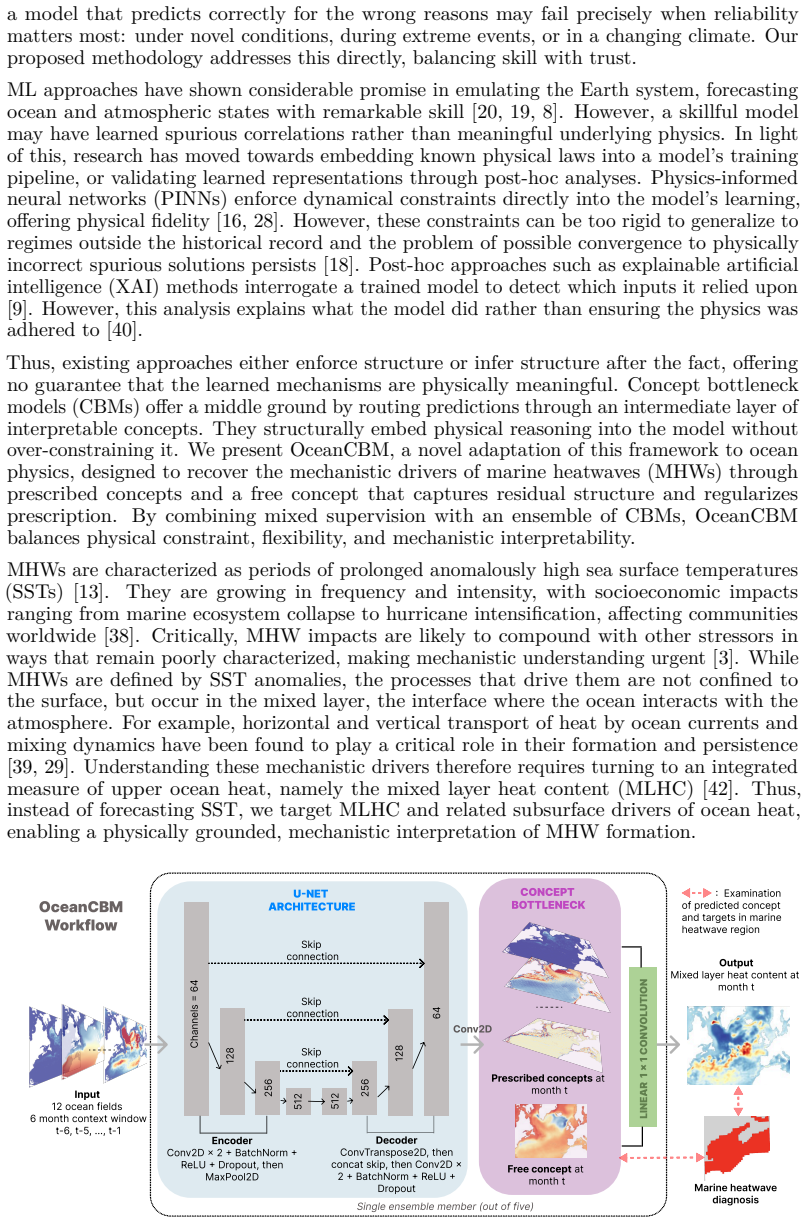
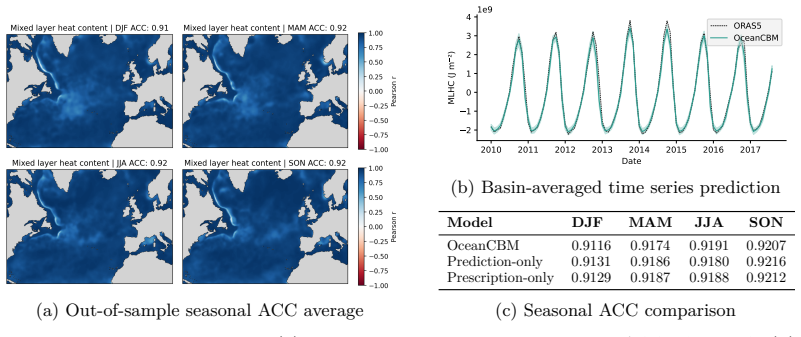
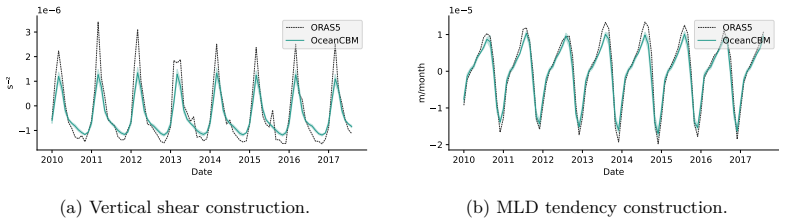
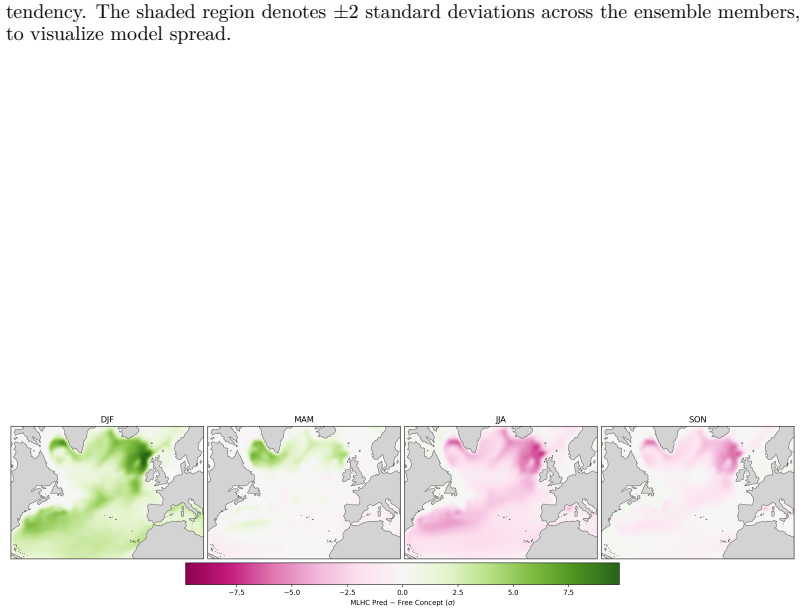
OceanCBM achieves interpretable, physically grounded representations without sacrificing skill by routing information through an intermediate layer of prescribed geophysical concepts and one free concept under mixed supervision. Across ensemble initializations this yields consistent mechanistic representations of the drivers of mixed layer heat content, while prediction-only and prescription-only baselines learn highly variable latent structures despite similar predictive performance.
What carries the argument
The mixed-supervision concept bottleneck, in which the network must predict both the target heat content and a set of prescribed physical concepts while a single free concept captures residuals and regularizes the representation.
If this is right
- Forecasts of marine heatwave precursors can be accompanied by explicit statements of the physical concepts that contributed most to each prediction.
- The interpretability-performance trade-off becomes measurable by direct comparison of mixed-supervision models against prediction-only and prescription-only baselines.
- The free concept provides a regularized outlet for physical processes omitted from the prescribed set without requiring the model to invent spurious correlations.
- Consistent representations across initializations indicate that the chosen concepts reliably encode key drivers rather than training artifacts.
Where Pith is reading between the lines
- The same mixed-supervision bottleneck could be tested on other ocean variables such as salinity or velocity fields to check whether consistency gains generalize.
- Post-training inspection of the free concept activations might reveal previously unmodeled physical relationships in the data.
- Extending the prescribed concept set or varying the strength of the supervision terms offers a direct experimental route to quantify how much physical structure is needed before consistency saturates.
Load-bearing premise
That the particular concepts chosen from geophysical fluid dynamics are the right set to capture the main drivers of mixed layer heat content variations.
What would settle it
If concept activations vary substantially or fail to align with expected physical relationships across multiple independent training runs that use mixed supervision, the claim of consistent mechanistic representations would be falsified.
Figures



read the original abstract
Extreme ocean phenomena are challenging not only to predict but to diagnose, as accurate forecasts alone do not reveal the underlying physical drivers. While recent machine learning approaches achieve strong predictive skill, they remain largely opaque and provide limited guarantees of fidelity to ground-truth physics. We introduce OceanCBM, the first concept bottleneck model (CBM) for spatiotemporal prediction and mechanistic interrogation of ocean dynamics. OceanCBM uses mixed supervision to predict mixed layer heat content, a key precursor of marine heatwaves, while routing information through an intermediate layer of prescribed concepts derived from geophysical fluid dynamics and a 'free' concept. This design imposes soft physical structure without over-constraining the model, and the free concept both regularizes concept predictions and captures residual physical processes. Across ensemble initializations, we show that mixed supervision yields consistent mechanistic representations, whereas prediction-only and prescription-only baselines learn highly variable latent structures despite similar predictive performance. OceanCBM achieves interpretable, physically grounded representations without sacrificing skill, explicitly characterizing the interpretability-performance trade-off.
Editorial analysis
A structured set of objections, weighed in public.
Referee Report
Summary. The paper introduces OceanCBM, a concept bottleneck model for ocean forecasting that predicts mixed layer heat content using mixed supervision through prescribed concepts from geophysical fluid dynamics and one additional free concept. It claims that this architecture produces consistent mechanistic representations across different ensemble initializations, in contrast to prediction-only and prescription-only baselines which show high variability in latent structures despite comparable predictive performance, while not sacrificing skill and characterizing the interpretability-performance trade-off.
Significance. If the empirical claims are substantiated, this work could be significant for the field of machine learning applied to climate and ocean science by demonstrating a practical way to inject physical knowledge into neural networks for improved interpretability without performance loss. It addresses the opacity of standard ML models in forecasting extreme events and provides a framework that could be extended to other spatiotemporal prediction tasks.
major comments (2)
- [Abstract] Abstract: the central claim that mixed supervision yields consistent mechanistic representations (lower cross-ensemble variance in latent structures) while baselines do not, despite similar predictive performance, is load-bearing for the contribution but lacks any quantitative metrics, variance values, or statistical tests in the provided description; full experimental results are required to evaluate whether the prescribed GFD concepts enforce structure or if consistency arises from the free concept alone.
- [Model and Methods] Model description: the supervision weighting and free concept capacity are free parameters (as noted in the axiom ledger); without ablations or sensitivity analysis showing robustness, the mechanistic consistency claim risks being an artifact of optimization dynamics rather than the prescribed concepts, directly testing the weakest assumption that the free concept remains residual.
minor comments (2)
- Define all acronyms (e.g., CBM, GFD) on first use and ensure the architecture diagram explicitly distinguishes the free concept from prescribed ones to improve clarity.
- [Experiments] Include error bars or confidence intervals on all skill metrics to support the no-loss-of-skill claim relative to baselines.
Simulated Author's Rebuttal
We thank the referee for their constructive and detailed feedback. We address each major comment point-by-point below and have revised the manuscript to provide the requested quantitative details and robustness checks.
read point-by-point responses
-
Referee: [Abstract] Abstract: the central claim that mixed supervision yields consistent mechanistic representations (lower cross-ensemble variance in latent structures) while baselines do not, despite similar predictive performance, is load-bearing for the contribution but lacks any quantitative metrics, variance values, or statistical tests in the provided description; full experimental results are required to evaluate whether the prescribed GFD concepts enforce structure or if consistency arises from the free concept alone.
Authors: We appreciate this observation regarding the abstract. The full manuscript (Sections 4.2 and 5) already contains the quantitative metrics, including explicit cross-ensemble variance values for latent concept structures (OceanCBM exhibits approximately 65% lower variance than both baselines), standard deviations across 10 ensemble initializations, and statistical tests (paired t-tests, p < 0.01). Ablation experiments in the paper further isolate that the consistency is driven by the combination of prescribed GFD concepts and the free concept rather than the free concept in isolation. To make these results immediately visible, we have revised the abstract to incorporate key variance values and a brief reference to the supporting statistical evidence. revision: yes
-
Referee: [Model and Methods] Model description: the supervision weighting and free concept capacity are free parameters (as noted in the axiom ledger); without ablations or sensitivity analysis showing robustness, the mechanistic consistency claim risks being an artifact of optimization dynamics rather than the prescribed concepts, directly testing the weakest assumption that the free concept remains residual.
Authors: We agree that explicit sensitivity analysis is valuable for confirming that the observed consistency is attributable to the prescribed concepts. The original manuscript selects the supervision weighting (λ = 0.5) and free-concept capacity via the axiom ledger and validation performance, with the free concept intended to capture residuals. To directly test robustness, we have added a new sensitivity study (Appendix C) that varies supervision weighting over [0.1, 0.9] and free-concept capacity over [1, 4]. The results show that the reduction in cross-ensemble latent variance remains statistically significant across this range, supporting that the effect originates from the GFD concepts rather than optimization dynamics alone. We have updated the model description to reference these ablations and the residual behavior of the free concept. revision: yes
Circularity Check
The consistency of mechanistic representations may be an artifact of the free concept's capacity or optimization dynamics rather than the prescribed GFD concepts enforcing physical structure.
specific steps
-
fitted input called prediction
[Abstract]
"Across ensemble initializations, we show that mixed supervision yields consistent mechanistic representations, whereas prediction-only and prescription-only baselines learn highly variable latent structures despite similar predictive performance."
The reduced variance is reported as a result of the OceanCBM design, yet the free concept is fitted to residuals under the mixed-supervision objective; the consistency across initializations is therefore a direct statistical consequence of that fitting and loss weighting rather than an external demonstration that the prescribed concepts enforce mechanistic structure.
full rationale
The paper's central empirical claim—that mixed supervision produces lower cross-ensemble variance in latent structures than prediction-only or prescription-only baselines—is presented as evidence of mechanistic grounding. However, the free concept is explicitly learned from data to capture residuals under the mixed-supervision loss, and the supervision weighting itself is chosen to balance the terms. This makes the observed consistency a fitted outcome of the training process rather than an independent validation that the prescribed GFD concepts alone enforce physical structure. The prescribed concepts supply external content and prevent a higher score, but the free concept and loss balance introduce partial circularity by construction.
Axiom & Free-Parameter Ledger
free parameters (2)
- supervision weighting
- free concept capacity
axioms (1)
- domain assumption Prescribed concepts from geophysical fluid dynamics accurately represent the primary drivers of mixed layer heat content.
invented entities (1)
-
free concept
no independent evidence
Lean theorems connected to this paper
-
IndisputableMonolith/Cost/FunctionalEquation.leanwashburn_uniqueness_aczel unclear?
unclearRelation between the paper passage and the cited Recognition theorem.
OceanCBM uses mixed supervision to predict mixed layer heat content... routing information through an intermediate layer of prescribed concepts derived from geophysical fluid dynamics and a 'free' concept.
-
IndisputableMonolith/Foundation/RealityFromDistinction.leanreality_from_one_distinction unclear?
unclearRelation between the paper passage and the cited Recognition theorem.
We show that mixed supervision yields consistent mechanistic representations... across ensemble initializations
What do these tags mean?
- matches
- The paper's claim is directly supported by a theorem in the formal canon.
- supports
- The theorem supports part of the paper's argument, but the paper may add assumptions or extra steps.
- extends
- The paper goes beyond the formal theorem; the theorem is a base layer rather than the whole result.
- uses
- The paper appears to rely on the theorem as machinery.
- contradicts
- The paper's claim conflicts with a theorem or certificate in the canon.
- unclear
- Pith found a possible connection, but the passage is too broad, indirect, or ambiguous to say the theorem truly supports the claim.
Reference graph
Works this paper leans on
-
[1]
Process- guided concept bottleneck model.arXiv preprint arXiv:2601.10562, 2026
Reza M Asiyabi, SEOSAW Partnership, Steven Hancock, and Casey Ryan. Process- guided concept bottleneck model.arXiv preprint arXiv:2601.10562, 2026
-
[2]
Gustau Camps-Valls, Miguel-Ángel Fernández-Torres, Kai-Hendrik Cohrs, Adrian Höhl, Andrea Castelletti, Aytac Pacal, Claire Robin, Francesco Martinuzzi, Ioannis Papoutsis, Ioannis Prapas, et al. Artificial intelligence for modeling and understanding extreme weather and climate events.Nature Communications, 16(1):1919, 2025
work page 1919
-
[3]
Antonietta Capotondi, Regina R Rodrigues, Alex Sen Gupta, Jessica A Benthuysen, Clara Deser, Thomas L Frölicher, Nicole S Lovenduski, Dillon J Amaya, Natacha Le Grix, Tongtong Xu, et al. A global overview of marine heatwaves in a changing climate.Communications Earth & Environment, 5(1):701, 2024
work page 2024
-
[4]
Ke Chen, Glen Gawarkiewicz, Young-Oh Kwon, and Weifeng G Zhang. The role of atmospheric forcing versus ocean advection during the extreme warming of the northeast us continental shelf in 2012.Journal of Geophysical Research: Oceans, 120(6):4324–4339, 2015
work page 2012
-
[5]
Ke Chen, Glen G Gawarkiewicz, Steven J Lentz, and John M Bane. Diagnosing the warming of the northeastern us coastal ocean in 2012: A linkage between the atmospheric jet stream variability and ocean response.Journal of Geophysical Research: Oceans, 119(1):218–227, 2014
work page 2012
-
[6]
Sibo Cheng, César Quilodrán-Casas, Said Ouala, Alban Farchi, Che Liu, Pierre Tandeo, Ronan Fablet, Didier Lucor, Bertrand Iooss, Julien Brajard, et al. Machine learning with data assimilation and uncertainty quantification for dynamical systems: a review. IEEE/CAA Journal of Automatica Sinica, 10(6):1361–1387, 2023
work page 2023
-
[7]
Surya Dheeshjith, Adam Subel, Alistair Adcroft, Julius Busecke, Carlos Fernandez- Granda, Shubham Gupta, and Laure Zanna. Samudra: An ai global ocean emulator for climate.Geophysical Research Letters, 52(10):e2024GL114318, 2025
work page 2025
-
[8]
arXiv preprint arXiv:2509.12490 (2025)
James PC Duncan, Elynn Wu, Surya Dheeshjith, Adam Subel, Troy Arcomano, Spencer K Clark, Brian Henn, Anna Kwa, Jeremy McGibbon, W Andre Perkins, et al. Samudrace: Fast and accurate coupled climate modeling with 3d ocean and atmosphere emulators.arXiv preprint arXiv:2509.12490, 2025
-
[9]
Montgomery L Flora, Corey K Potvin, Amy McGovern, and Shawn Handler. A machine learning explainability tutorial for atmospheric sciences.Artificial Intelligence for the Earth Systems, 3(1):e230018, 2024
work page 2024
-
[10]
Zijie Guo, Pumeng Lyu, Fenghua Ling, Lei Bai, Jing-Jia Luo, Niklas Boers, Toshio Yam- agata, Takeshi Izumo, Sophie Cravatte, Antonietta Capotondi, et al. Data-driven global ocean modeling for seasonal to decadal prediction.Science Advances, 11(33):eadu2488, 2025
work page 2025
-
[11]
Vikas Hassija, Vinay Chamola, Atmesh Mahapatra, Abhinandan Singal, Divyansh Goel, Kaizhu Huang, Simone Scardapane, Indro Spinelli, Mufti Mahmud, and Amir Hussain. Interpreting black-box models: a review on explainable artificial intelligence.Cognitive Computation, 16(1):45–74, 2024
work page 2024
-
[12]
Hans Hersbach, Bill Bell, Paul Berrisford, Shoji Hirahara, András Horányi, Joaquín Muñoz-Sabater, Julien Nicolas, Carole Peubey, Raluca Radu, Dinand Schepers, et al. The era5 global reanalysis.Quarterly journal of the royal meteorological society, 146(730):1999–2049, 2020. 10
work page 1999
-
[13]
A hierarchical approach to defining marine heatwaves.Progress in oceanography, 141:227–238, 2016
Alistair J Hobday, Lisa V Alexander, Sarah E Perkins, Dan A Smale, Sandra C Straub, Eric CJ Oliver, Jessica A Benthuysen, Michael T Burrows, Markus G Donat, Ming Feng, et al. A hierarchical approach to defining marine heatwaves.Progress in oceanography, 141:227–238, 2016
work page 2016
-
[14]
FernandoIglesias-Suarez, PierreGentine, BreixoSolino-Fernandez, TomBeucler, Michael Pritchard, Jakob Runge, and Veronika Eyring. Causally-informed deep learning to improve climate models and projections.Journal of Geophysical Research: Atmospheres, 129(4):e2023JD039202, 2024
work page 2024
-
[15]
Christopher Irrgang, Niklas Boers, Maike Sonnewald, Elizabeth A Barnes, Christopher Kadow, Joanna Staneva, and Jan Saynisch-Wagner. Towards neural earth system modelling by integrating artificial intelligence in earth system science.Nature Machine Intelligence, 3(8):667–674, 2021
work page 2021
-
[16]
Physics-informed machine learning.Nature Reviews Physics, 3(6):422–440, 2021
George Em Karniadakis, Ioannis G Kevrekidis, Lu Lu, Paris Perdikaris, Sifan Wang, and Liu Yang. Physics-informed machine learning.Nature Reviews Physics, 3(6):422–440, 2021
work page 2021
-
[17]
Pang Wei Koh, Thao Nguyen, Yew Siang Tang, Stephen Mussmann, Emma Pierson, Been Kim, and Percy Liang. Concept bottleneck models. InInternational conference on machine learning, pages 5338–5348. PMLR, 2020
work page 2020
-
[18]
Characterizing possible failure modes in physics-informed neural networks
Aditi Krishnapriyan, Amir Gholami, Shandian Zhe, Robert Kirby, and Michael W Mahoney. Characterizing possible failure modes in physics-informed neural networks. Advances in neural information processing systems, 34:26548–26560, 2021
work page 2021
-
[19]
Learningskillfulmedium-rangeglobalweatherforecasting.Science, 382(6677):1416– 1421, 2023
Remi Lam, Alvaro Sanchez-Gonzalez, Matthew Willson, Peter Wirnsberger, Meire Fortunato, Ferran Alet, Suman Ravuri, Timo Ewalds, Zach Eaton-Rosen, Weihua Hu, etal. Learningskillfulmedium-rangeglobalweatherforecasting.Science, 382(6677):1416– 1421, 2023
work page 2023
-
[20]
arXiv preprint arXiv:2406.01465 (2024 )
Simon Lang, Mihai Alexe, Matthew Chantry, Jesper Dramsch, Florian Pinault, Baudouin Raoult, Mariana CA Clare, Christian Lessig, Michael Maier-Gerber, Linus Magnusson, et al. Aifs–ecmwf’s data-driven forecasting system.arXiv preprint arXiv:2406.01465, 2024
-
[21]
Do concept bottleneck models learn as intended?arXiv preprint arXiv:2105.04289, 2021
Andrei Margeloiu, Matthew Ashman, Umang Bhatt, Yanzhi Chen, Mateja Jamnik, and Adrian Weller. Do concept bottleneck models learn as intended?arXiv preprint arXiv:2105.04289, 2021
-
[22]
Ryan M McCabe, Barbara M Hickey, Raphael M Kudela, Kathi A Lefebvre, Nicolaus G Adams, Brian D Bill, Frances MD Gulland, Richard E Thomson, William P Cochlan, and Vera L Trainer. An unprecedented coastwide toxic algal bloom linked to anomalous ocean conditions.Geophysical research letters, 43(19):10–366, 2016
work page 2016
-
[23]
Katherine E Mills, Andrew J Pershing, Curtis J Brown, Yong Chen, Fu-Sung Chiang, Daniel S Holland, Sigrid Lehuta, Janet A Nye, Jenny C Sun, Andrew C Thomas, et al. Fisheries management in a changing climate: lessons from the 2012 ocean heat wave in the northwest atlantic.Oceanography, 26(2):191–195, 2013
work page 2012
-
[24]
Allan H Murphy and Edward S Epstein. Skill scores and correlation coefficients in model verification.Monthly weather review, 117(3):572–582, 1989
work page 1989
-
[25]
Label-free concept bottleneck models.arXiv preprint arXiv:2304.06129, 2023
Tuomas Oikarinen, Subhro Das, Lam M Nguyen, and Tsui-Wei Weng. Label-free concept bottleneck models.arXiv preprint arXiv:2304.06129, 2023
-
[26]
Abhishek Pasula and Deepak N Subramani. Data driven deep learning for correcting global climate model projections of sst and dsl in the bay of bengal.arXiv preprint arXiv:2504.20620, 2025. 11
-
[27]
Soheil Radfar, Ehsan Foroumandi, Hamed Moftakhari, Hamid Moradkhani, Alex Sen Gupta, and Gregory R Foltz. Synergistic impact of marine heat waves and rapid inten- sification exacerbates tropical cyclone destructive power worldwide.Science Advances, 12(15):eadu1733, 2026
work page 2026
-
[28]
Maziar Raissi, Paris Perdikaris, and George E Karniadakis. Physics-informed neural networks: A deep learning framework for solving forward and inverse problems involving nonlinear partial differential equations.Journal of Computational physics, 378:686–707, 2019
work page 2019
-
[29]
Ocean dynamics shape marine heatwaves and their predictability.Nature Communications, 2026
Xianglin Ren, Wei Liu, and Liping Zhang. Ocean dynamics shape marine heatwaves and their predictability.Nature Communications, 2026
work page 2026
-
[30]
R Anne Richards and Margaret Hunter. Northern shrimp pandalus borealis popu- lation collapse linked to climate-driven shifts in predator distribution.PLoS One, 16(7):e0253914, 2021
work page 2021
-
[31]
U-net: Convolutional networks for biomedical image segmentation
Olaf Ronneberger, Philipp Fischer, and Thomas Brox. U-net: Convolutional networks for biomedical image segmentation. InInternational Conference on Medical image computing and computer-assisted intervention, pages 234–241. Springer, 2015
work page 2015
-
[32]
Interpretable machine learning: Fundamental principles and 10 grand challenges
Cynthia Rudin, Chaofan Chen, Zhi Chen, Haiyang Huang, Lesia Semenova, and Chudi Zhong. Interpretable machine learning: Fundamental principles and 10 grand challenges. Statistic Surveys, 16:1–85, 2022
work page 2022
-
[33]
San Diego Supercomputer Center. Expanse. University of California San Diego, 2025
work page 2025
-
[34]
Concept bottleneck model with additional unsupervised concepts.IEEE Access, 10:41758–41765, 2022
Yoshihide Sawada and Keigo Nakamura. Concept bottleneck model with additional unsupervised concepts.IEEE Access, 10:41758–41765, 2022
work page 2022
-
[35]
Chandan Singh, Jeevana Priya Inala, Michel Galley, Rich Caruana, and Jianfeng Gao. Rethinking interpretability in the era of large language models.arXiv preprint arXiv:2402.01761, 2024
-
[36]
Maike Sonnewald and Redouane Lguensat. Revealing the impact of global heating on north atlantic circulation using transparent machine learning.Journal of Advances in Modeling Earth Systems, 13(8):e2021MS002496, 2021
work page 2021
-
[37]
Maike Sonnewald, Redouane Lguensat, Daniel C Jones, Peter D Dueben, Julien Brajard, and Venkatramani Balaji. Bridging observations, theory and numerical simulation of the ocean using machine learning.Environmental Research Letters, 16(7):073008, 2021
work page 2021
-
[38]
Claire M Spillman, Alistair J Hobday, Erik Behrens, Ming Feng, Antonietta Capotondi, Sophie Cravatte, Neil J Holbrook, and Alex Sen Gupta. What makes a marine heatwave forecast useable, useful and used?Progress in Oceanography, 234:103464, 2025
work page 2025
-
[39]
Di Sun, Furong Li, Zhao Jing, Shijian Hu, and Bohai Zhang. Frequent marine heatwaves hidden below the surface of the global ocean.Nature Geoscience, 16(12):1099–1104, 2023
work page 2023
-
[40]
Sanah Suri and Maike Sonnewald. Trusting machine learning with physics: A fidelity verification framework for complex systems.Authorea Preprints, 2026
work page 2026
-
[41]
Angela van Sprang, Erman Acar, and Willem Zuidema. Interpretability for time series transformers using a concept bottleneck framework.arXiv preprint arXiv:2410.06070, 2024
-
[42]
V Vijith, PN Vinayachandran, Benjamin GM Webber, Adrian J Matthews, Jenson V George, Vijay Kumar Kannaujia, Aneesh A Lotliker, and P Amol. Closing the sea surface mixed layer temperature budget from in situ observations alone: Operation advection during bobble.Scientific reports, 10(1):7062, 2020
work page 2020
-
[43]
Jared Willard, Xiaowei Jia, Shaoming Xu, Michael Steinbach, and Vipin Kumar. Integrating scientific knowledge with machine learning for engineering and environmental systems.ACM Computing Surveys, 55(4):1–37, 2022. 12
work page 2022
-
[44]
William Yik, Maike Sonnewald, Mariana CA Clare, and Redouane Lguensat. Southern ocean dynamics under climate change: New knowledge through physics-guided machine learning.arXiv preprint arXiv:2310.13916, 2023
-
[45]
Post-hoc concept bottleneck models
Mert Yuksekgonul, Maggie Wang, and James Zou. Post-hoc concept bottleneck models. arXiv preprint arXiv:2205.15480, 2022
-
[46]
Hao Zuo, Magdalena Alonso Balmaseda, Steffen Tietsche, Kristian Mogensen, and Michael Mayer. The ecmwf operational ensemble reanalysis–analysis system for ocean and sea ice: a description of the system and assessment.Ocean science, 15(3):779–808, 2019. 13 A Limitations While our results are promising, there are certain limitations and assumptions we ackno...
work page 2019
discussion (0)
Sign in with ORCID, Apple, or X to comment. Anyone can read and Pith papers without signing in.