Recognition: unknown
Low Rank Structure of the Reduced Transition Matrix
Pith reviewed 2026-05-14 20:13 UTC · model grok-4.3
The pith
The reduced transition matrix for local observables in chaotic dual-unitary circuits admits a low-rank approximation because its entropy grows at most logarithmically in time.
A machine-rendered reading of the paper's core claim, the machinery that carries it, and where it could break.
Core claim
The reduced transition matrix can be efficiently approximated because its singular-value spectrum controls the truncation error, and for chaotic dual-unitary circuits the associated entropy grows at most logarithmically in time. This follows from exact results for random dual-unitary circuits and is supported by numerical results for fixed instances.
What carries the argument
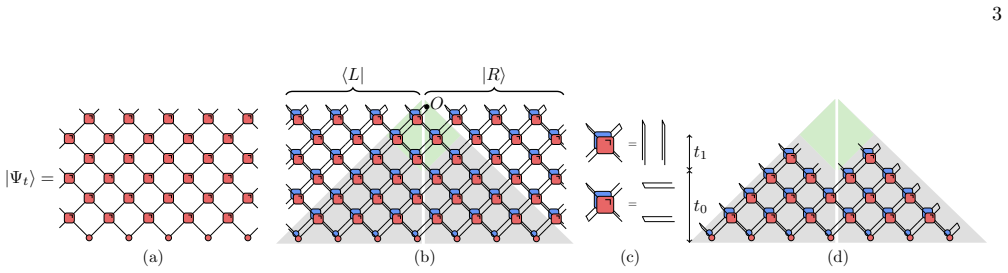
The reduced transition matrix, a combination of influence matrices that directly determines local expectation values, with truncation error controlled by its singular-value spectrum.
If this is right
- Local expectation values can be computed to controlled accuracy using low-rank truncations of the reduced transition matrix.
- Simulation cost for local observables remains manageable at long times in chaotic dual-unitary systems.
- The logarithmic entropy bound holds for both random dual-unitary circuits (exactly) and fixed instances (numerically).
- Singular-value truncation provides a systematic approximation scheme without needing the full wavefunction.
Where Pith is reading between the lines
- Similar low-rank structure might appear in other classes of circuits if comparable entropy bounds can be established.
- The method could be combined with existing tensor-network techniques to simulate larger open systems or measurement dynamics.
- Checking whether the logarithmic bound survives in non-dual-unitary chaotic circuits would test the generality of the result.
Load-bearing premise
The truncation error is controlled by the singular-value spectrum of the reduced transition matrix in chaotic dual-unitary circuits.
What would settle it
A numerical or analytical observation that the entropy of the reduced transition matrix grows faster than logarithmically with time in a chaotic dual-unitary circuit.
Figures



read the original abstract
The influence-matrix formalism provides an alternative route to the classical simulation of quantum dynamics. Because influence matrices retain information only about the effective bath seen by local observables, they are expected to be easier to simulate than the full wavefunction. Recent work, however, has shown that they carry strong temporal correlations even in maximally chaotic systems, making them difficult to represent efficiently. Here we show that the reduced transition matrix, a suitable combination of influence matrices that directly determines local expectation values, can nevertheless be efficiently approximated. We first show that the truncation error is controlled by its singular-value spectrum, which naturally motivates a low-rank approximation. We then prove that, for chaotic dual-unitary circuits, the associated entropy grows at most logarithmically in time. Our conclusions follow from exact results for random dual-unitary circuits and are further supported by numerical results for fixed instances of both dual-unitary and random circuits.
Editorial analysis
A structured set of objections, weighed in public.
Referee Report
Summary. The manuscript claims that the reduced transition matrix, a combination of influence matrices determining local expectation values, admits an efficient low-rank approximation because its truncation error is controlled by the tail of the singular-value spectrum. For chaotic dual-unitary circuits the associated von Neumann entropy grows at most logarithmically in time; this follows from exact results on random dual-unitary circuits together with numerical support on fixed instances of both dual-unitary and random circuits.
Significance. If the central claims hold, the work is significant for the influence-matrix approach to classical simulation of quantum dynamics. Demonstrating that the reduced transition matrix remains low-rank despite strong temporal correlations in the underlying influence matrices, and that its entropy grows only logarithmically, directly addresses a known obstacle to efficient simulation of chaotic systems. The exact analytic results for random dual-unitary circuits constitute a clear strength, supplying rigorous, parameter-free support that is then corroborated numerically.
minor comments (3)
- [Abstract] Abstract: the statement that truncation error is controlled by the singular-value spectrum would benefit from an explicit reference to the relevant Eckart-Young-type bound or theorem number in the main text.
- The numerical section should report the precise circuit sizes, time ranges, and singular-value cutoffs used, together with error bars or convergence checks, to allow readers to assess the strength of the supporting evidence.
- Notation: ensure that the precise definition of the reduced transition matrix (as a combination of influence matrices) is stated once, early, and used consistently in all subsequent equations and figures.
Simulated Author's Rebuttal
We thank the referee for their positive summary, recognition of the significance of our results, and recommendation for minor revision. We are pleased that the exact analytic results for random dual-unitary circuits and the logarithmic entropy growth were viewed as strengths.
Circularity Check
No significant circularity; derivation is self-contained
full rationale
The paper's central claims rest on two independent steps: (1) the truncation error of the reduced transition matrix is bounded by the tail of its singular-value spectrum, which follows directly from the Eckart-Young theorem in linear algebra and does not presuppose the low-rank form; (2) the von Neumann entropy of the reduced transition matrix grows at most logarithmically for chaotic dual-unitary circuits, which is obtained from exact averaging over random dual-unitary circuits plus separate numerical checks on fixed instances. Neither step reduces to a self-definition, a fitted parameter renamed as prediction, or a load-bearing self-citation whose validity depends on the present work. The conclusions are therefore externally falsifiable and do not collapse to the inputs by construction.
Axiom & Free-Parameter Ledger
axioms (1)
- standard math Truncation error of low-rank approximation is controlled by the singular-value spectrum
Reference graph
Works this paper leans on
-
[1]
Vidal, Efficient classical simulation of slightly entan- gled quantum computations, Phys
G. Vidal, Efficient classical simulation of slightly entan- gled quantum computations, Phys. Rev. Lett.91, 147902 (2003)
2003
-
[2]
Phys.326, 96 (2011)
U.Schollwöck,Thedensity-matrixrenormalizationgroup in the age of matrix product states, Ann. Phys.326, 96 (2011)
2011
-
[3]
J. I. Cirac, D. Pérez-García, N. Schuch, and F. Ver- straete, Matrix product states and projected entangled pair states: Concepts, symmetries, theorems, Rev. Mod. Phys.93, 045003 (2021)
2021
-
[4]
Vidal, Efficient simulation of one-dimensional quan- tum many-body systems, Phys
G. Vidal, Efficient simulation of one-dimensional quan- tum many-body systems, Phys. Rev. Lett.93, 040502 (2004)
2004
-
[5]
A. J. Daley, C. Kollath, U. Schollwöck, and G. Vidal, Time-dependent density-matrix renormalization-group using adaptive effective hilbert spaces, Journal of Statis- tical Mechanics: Theory and Experiment2004, P04005 (2004)
2004
-
[6]
S. R. White and A. E. Feiguin, Real-time evolution us- ing the density matrix renormalization group, Phys. Rev. Lett.93, 076401 (2004)
2004
-
[7]
A. C. Potter and R. Vasseur, Entanglement dynamics 6 in hybrid quantum circuits, inEntanglement in Spin Chains: From Theory to Quantum Technology Applica- tions, edited by A. Bayat, S. Bose, and H. Johannes- son (Springer International Publishing, Cham, 2022) pp. 211–249
2022
-
[8]
M. P. A. Fisher, V. Khemani, A. Nahum, and S. Vijay, Random quantum circuits, Annu. Rev. Condens. Matter Phys.14, 335 (2023)
2023
-
[9]
Bertini, P
B. Bertini, P. W. Claeys, and T. Prosen, Exactly solvable quantum many-body dynamics from space-time duality, Rev. Mod. Phys.98, 025001 (2026)
2026
-
[10]
M. C. Bañuls, M. B. Hastings, F. Verstraete, and J. I. Cirac, Matrix Product States for dynamical simulation of infinite chains, Physical Review Letters102, 240603 (2009), arXiv:0904.1926 [cond-mat, physics:quant-ph]
work page internal anchor Pith review Pith/arXiv arXiv 2009
-
[11]
Müller-Hermes, J
A. Müller-Hermes, J. I. Cirac, and M. C. Bañuls, Tensor network techniques for the computation of dynamical ob- servables in one-dimensional quantum spin systems, New J. Phys.14, 075003 (2012)
2012
-
[12]
M. B. Hastings and R. Mahajan, Connecting entangle- ment in time and space: Improving the folding algorithm, Phys. Rev. A91, 032306 (2015)
2015
-
[13]
A.Lerose, M.Sonner,andD.A.Abanin,Influencematrix approach to many-body Floquet dynamics, Phys. Rev. X 11, 021040 (2021)
2021
-
[14]
Lerose, M
A. Lerose, M. Sonner, and D. A. Abanin, Overcoming the entanglement barrier in quantum many-body dynam- ics via space-time duality, Phys. Rev. B107, L060305 (2023)
2023
-
[15]
R.FeynmanandF.Vernon,Thetheoryofageneralquan- tum system interacting with a linear dissipative system, Annals of Physics24, 118 (1963)
1963
-
[16]
A. J. Leggett, S. Chakravarty, A. T. Dorsey, M. P. A. Fisher, A. Garg, and W. Zwerger, Dynamics of the dissi- pative two-state system, Rev. Mod. Phys.59, 1 (1987)
1987
-
[17]
Foligno, T
A. Foligno, T. Zhou, and B. Bertini, Temporal entan- glement in chaotic quantum circuits, Phys. Rev. X13, 041008 (2023)
2023
-
[18]
Lerose, M
A. Lerose, M. Sonner, and D. A. Abanin, Scaling of tem- poral entanglement in proximity to integrability, Phys. Rev. B104, 035137 (2021)
2021
-
[19]
K.Klobas, B.Bertini,andL.Piroli,Exactthermalization dynamics in the “Rule 54” quantum cellular automaton, Phys. Rev. Lett.126, 160602 (2021)
2021
-
[20]
Klobas and B
K. Klobas and B. Bertini, Exact relaxation to Gibbs and non-equilibrium steady states in the quantum cellular au- tomaton Rule 54, SciPost Phys.11, 106 (2021)
2021
-
[21]
Giudice, G
G. Giudice, G. Giudici, M. Sonner, J. Thoenniss, A. Lerose, D. A. Abanin, and L. Piroli, Temporal en- tanglement, quasiparticles, and the role of interactions, Phys. Rev. Lett.128, 220401 (2022)
2022
-
[22]
Bertini, P
B. Bertini, P. Kos, and T. Prosen, Entanglement spread- ing in a minimal model of maximal many-body quantum chaos, Phys. Rev. X9, 021033 (2019)
2019
-
[23]
Piroli, B
L. Piroli, B. Bertini, J. I. Cirac, and T. Prosen, Exact dynamics in dual-unitary quantum circuits, Phys. Rev. B101, 094304 (2020)
2020
-
[24]
Foligno, P
A. Foligno, P. Calabrese, and B. Bertini, Nonequilibrium dynamics of charged dual-unitary circuits, PRX Quan- tum6, 010324 (2025)
2025
-
[25]
Segal, A
D. Segal, A. J. Millis, and D. R. Reichman, Numerically exact path-integral simulation of nonequilibrium quan- tum transport and dissipation, Phys. Rev. B82, 205323 (2010)
2010
-
[26]
Segal, A
D. Segal, A. J. Millis, and D. R. Reichman, Nonequilib- rium transport in quantum impurity models: exact path integral simulations, Phys. Chem. Chem. Phys.13, 14378 (2011)
2011
-
[27]
Magazzù and M
L. Magazzù and M. Grifoni, Feynman-vernon influence functional approach to quantum transport in interacting nanojunctions: An analytical hierarchical study, Phys. Rev. B105, 125417 (2022)
2022
-
[28]
Thoenniss, A
J. Thoenniss, A. Lerose, and D. A. Abanin, Nonequi- librium quantum impurity problems via matrix-product states in the temporal domain, Phys. Rev. B107, 195101 (2023)
2023
-
[29]
Thoenniss, M
J. Thoenniss, M. Sonner, A. Lerose, and D. A. Abanin, Efficient method for quantum impurity problems out of equilibrium, Phys. Rev. B107, L201115 (2023)
2023
-
[30]
N.Ng, G.Park, A.J.Millis, G.K.-L.Chan,andD.R.Re- ichman, Real-time evolution of anderson impurity mod- els via tensor network influence functionals, Phys. Rev. B107, 125103 (2023)
2023
-
[31]
R. Chen, X. Xu, and C. Guo, Grassmann time-evolving matrix product operators for quantum impurity models, Phys. Rev. B109, 045140 (2024)
2024
-
[32]
R. Chen, X. Xu, and C. Guo, Real-time impurity solver usinggrassmanntime-evolvingmatrixproductoperators, Phys. Rev. B109, 165113 (2024)
2024
-
[33]
G. Park, N. Ng, D. R. Reichman, and G. K.-L. Chan, Tensor network influence functionals in the continuous- time limit: Connections to quantum embedding, bath discretization, and higher-order time propagation, Phys. Rev. B110, 045104 (2024)
2024
-
[34]
Nayak, J
M. Nayak, J. Thoenniss, M. Sonner, D. A. Abanin, and P. Werner, Steady-state dynamical mean field the- ory based on influence functional matrix product states, Phys. Rev. B112, 035103 (2025)
2025
-
[35]
Sonner, V
M. Sonner, V. Link, and D. A. Abanin, Semigroup in- fluence matrices for nonequilibrium quantum impurity models, Phys. Rev. Lett.135, 170402 (2025)
2025
-
[36]
I. Vilkoviskiy, M. Sonner, Q. C. Huang, W. W. Ho, A. Lerose, and D. A. Abanin, Temporal entanglement transition in chaotic quantum many-body dynamics (2025), arXiv:2511.03846 [quant-ph]
-
[37]
O’Donovan, N
P. O’Donovan, N. Dowling, K. Modi, and M. T. Mitchi- son, Diagnosing chaos with projected ensembles of pro- cess tensors, PRX Quantum7, 020322 (2026)
2026
-
[38]
Schuch, M
N. Schuch, M. M. Wolf, F. Verstraete, and J. I. Cirac, En- tropy scaling and simulability by matrix product states, Phys. Rev. Lett.100, 030504 (2008)
2008
-
[39]
Carignano, C
S. Carignano, C. Ramos Marimón, and L. Tagliacozzo, Temporal entropy and the complexity of computing the expectation value of local operators after a quench, Phys. Rev. Res.6, 033021 (2024)
2024
-
[40]
Carignano, The ITransverse.jl library for transverse tensor network contractions, SciPost Phys
S. Carignano, The ITransverse.jl library for transverse tensor network contractions, SciPost Phys. Codebases 63, 63 (2026), arXiv:2509.03699 [quant-ph]
-
[41]
S. Carignano, G. Lami, J. D. Nardis, and L. Tagliacozzo, Overcoming the entanglement barrier with sampled ten- sor networks (2025), arXiv:2505.09714 [quant-ph]
- [42]
-
[43]
Mirsky, Symmetric gauge functions and unitarily in- variant norms, The quarterly journal of mathematics11, 50 (1960)
L. Mirsky, Symmetric gauge functions and unitarily in- variant norms, The quarterly journal of mathematics11, 50 (1960). 7
1960
-
[44]
Nielsen and I
M. Nielsen and I. Chuang,Quantum Computation and Quantum Information: 10th Anniversary Edition(Cam- bridge University Press, 2010)
2010
-
[45]
Bertini, P
B. Bertini, P. Kos, and T. Prosen, Exact correlation func- tions for dual-unitary lattice models in1 + 1dimensions, Phys. Rev. Lett.123, 210601 (2019)
2019
-
[46]
See Supplemental Material at [URL will be inserted by publisher] for the derivation of the entropy bounds for dual-unitary circuits, the proof of the conjectured form ofp k for random dual-unitary circuits, the membrane calculation away from the critical point, additional nu- merical data for the decay ofpk and the singular values of the reduced transitio...
-
[47]
Jonay and T
C. Jonay and T. Zhou, Physical theory of two-stage ther- malization, Phys. Rev. B110, L020306 (2024)
2024
-
[48]
Jonay, C
C. Jonay, C. Li, and T. Zhou, Two-stage relaxation of operators through domain wall and magnon dynamics, Phys. Rev. B111, 224304 (2025)
2025
-
[49]
Bertini and L
B. Bertini and L. Piroli, Scrambling in random unitary circuits: Exact results, Phys. Rev. B102, 064305 (2020)
2020
-
[50]
Foligno and B
A. Foligno and B. Bertini, Growth of entanglement of generic states under dual-unitary dynamics, Phys. Rev. B107, 174311 (2023)
2023
-
[51]
The entangling powerpmeasures the ability of the lo- cal gate to entangle two qubits in a random product state [55]
-
[52]
Coarse-grained dynamics of operator and state entanglement
C. Jonay, D. A. Huse, and A. Nahum, Coarse- grained dynamics of operator and state entanglement, arXiv:1803.00089 (2018)
work page internal anchor Pith review Pith/arXiv arXiv 2018
-
[53]
Zhou and A
T. Zhou and A. Nahum, Entanglement membrane in chaotic many-body systems, Phys. Rev. X10, 031066 (2020)
2020
-
[54]
S. Carignano and L. Tagliacozzo, Loschmidt echo, emerg- ing dual unitarity and scaling of generalized temporal entropies after quenches to the critical point (2025), arXiv:2405.14706 [cond-mat]
-
[55]
Zanardi, C
P. Zanardi, C. Zalka, and L. Faoro, Entangling power of quantum evolutions, Phys. Rev. A62, 030301 (2000)
2000
-
[56]
R. Suzuki, H. Katsura, Y. Mitsuhashi, T. Soejima, J. Eis- ert, and N. Yoshioka, More global randomness from less random local gates (2025), arXiv:2410.24127 [quant-ph]. Supplemental Material: Low Rank Structure of the Reduced Transition Matrix Here we report some useful information complementing the main text. In particular - In Sec. I we explicitly compu...
discussion (0)
Sign in with ORCID, Apple, or X to comment. Anyone can read and Pith papers without signing in.