Recognition: unknown
Time-Resolved Pore-Scale Imaging of Multiphase Dissolution during CO2-Saturated Brine Injection into a Carbonate: Competition between Hydrocarbon Mobilisation and Swelling
Pith reviewed 2026-05-14 19:56 UTC · model grok-4.3
The pith
Effective dissolution rates in residual-oil carbonate rock are controlled by the competition between hydrocarbon swelling and ganglion mobilisation.
A machine-rendered reading of the paper's core claim, the machinery that carries it, and where it could break.
Core claim
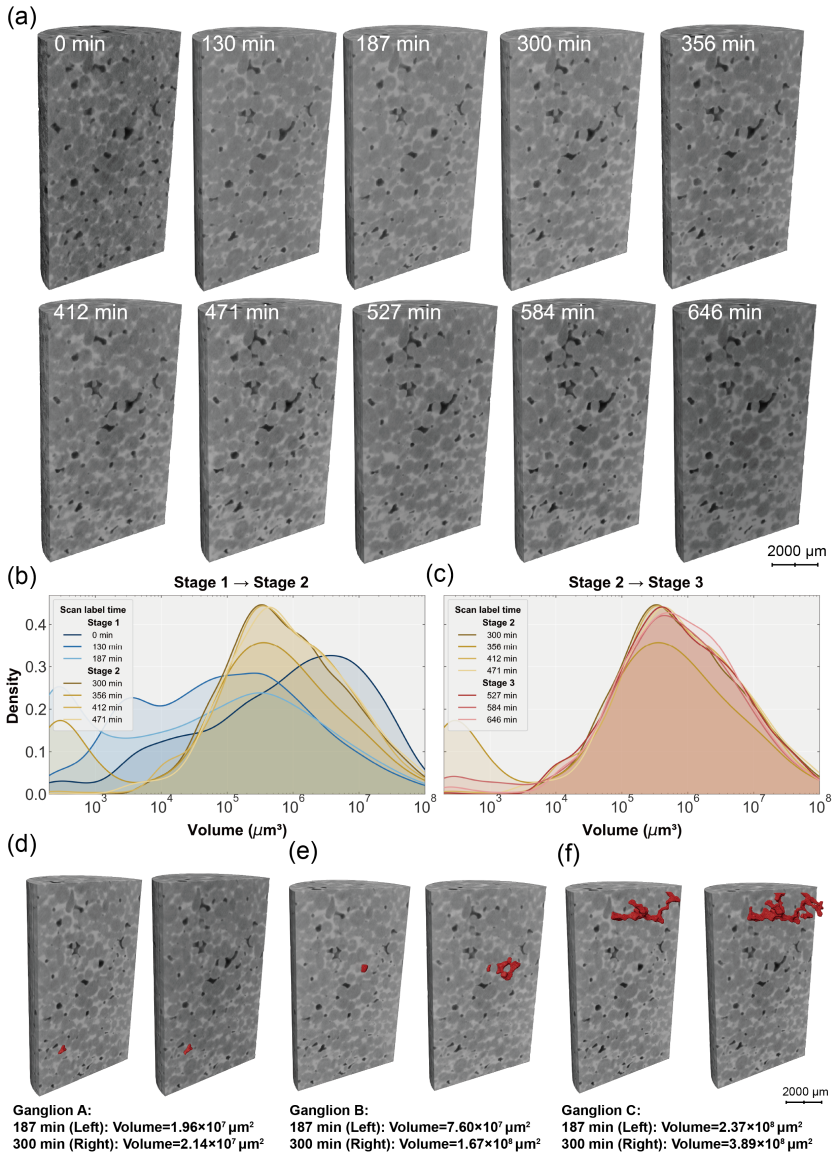
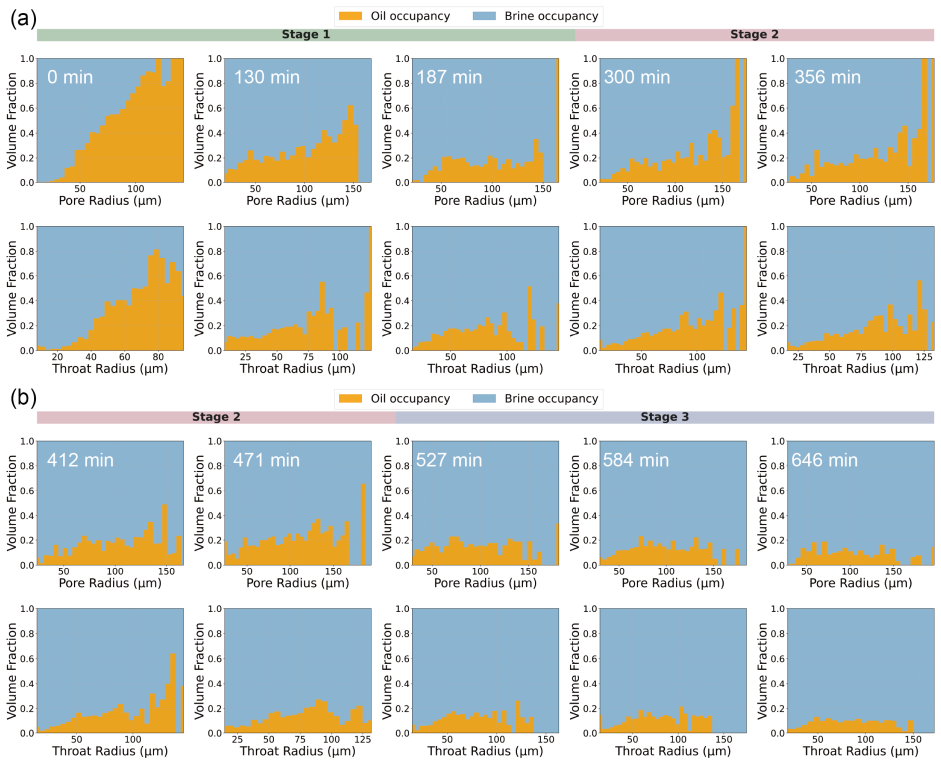
Time-resolved pore-scale experiments show that the dissolution rate of Ketton limestone by CO2-saturated brine in the presence of residual hydrocarbon is non-monotonic and proceeds through three regimes. In the first advection-dominated regime, pore-throat widening mobilises hydrocarbon ganglia and delivers acidic brine efficiently to reactive surfaces. The second dissolution-inhibited regime features up to two orders of magnitude reduction in effective reaction rate because swollen hydrocarbon ganglia persistently occupy the largest throats, reorganising the flow field into preferential paths and stagnant zones; the suppression is interpreted as arising mainly from path-dependent loss ofadv
What carries the argument
The competition between hydrocarbon swelling and ganglion mobilisation that governs advective access to reactive mineral surfaces.
If this is right
- Pore-throat widening in the first regime produces efficient ganglion mobilisation and high initial dissolution rates.
- Persistent occupation of the largest throats by swollen ganglia in the second regime reorganises flow and suppresses the effective reaction rate by up to two orders of magnitude.
- Displacement of hydrocarbon from the largest throats in the third regime restores advective access and accelerates dissolution.
- The overall effective dissolution rate therefore depends dynamically on the shifting balance between swelling and mobilisation.
Where Pith is reading between the lines
- Field-scale models of CO2 injection into carbonate reservoirs may require time-dependent reaction rates that account for local residual-oil saturation and its effect on flow topology.
- The same swelling-mobilisation competition could appear in other multiphase reactive transport problems, such as acid stimulation or contaminant dissolution, whenever a non-aqueous phase occupies pore throats.
- Pre-flushing to reduce residual hydrocarbon saturation before CO2 injection could avoid the inhibited regime and maintain higher average dissolution rates.
- Repeating the experiment on rocks with different pore-size distributions would test whether the three-regime pattern depends on the presence of a broad throat-size spectrum.
Load-bearing premise
The rate suppression is caused primarily by loss of advective access to surfaces as swollen ganglia block the largest throats, rather than by H+ depletion or mass-transfer limits, and that the three observed regimes generalise to other carbonates and conditions.
What would settle it
An otherwise identical experiment that prevents hydrocarbon swelling (for example by using a non-swelling fluid or by pre-flushing to remove residual oil) would produce a monotonic dissolution rate without the middle inhibited regime.
Figures






read the original abstract
We present time-resolved pore-scale experiments in which CO2-saturated brine was injected into a water-wet Ketton limestone sample containing residual hydrocarbon under reservoir conditions (8 MPa, 50 {\deg}C) and monitored by 4D X-ray microtomography. Equivalent pore-network models were extracted at each scan time to track pore geometry, topology, and fluid occupancy, while fluid-fluid and fluid-rock interfacial areas and the effective reaction rate were determined from segmented images. The dissolution rate is non-monotonic in time and proceeds through three regimes, consistent with a shifting balance between hydrocarbon swelling and ganglion mobilisation, which control advective access to reactive surfaces. In the initial advection-dominated regime, pore-throat widening leads to ganglia mobilisation and efficient acidic brine delivery to reactive surfaces. The second, dissolution-inhibited regime is marked by up to two orders of magnitude reduction in effective reaction rate. Pore-network analysis shows that swollen hydrocarbon ganglia persistently occupy the largest throats throughout this regime. This occupancy is associated with a reorganisation of the advective flow field into preferential flow paths and stagnant zones. We interpret the rate suppression as primarily reflecting a path-dependent loss of advective access to reactive surfaces, with subordinate contributions from localised H+ depletion near ganglia and reduced near-wall mass transfer in widened flow paths. The inhibited state persists until hydrocarbon is displaced from the largest throats, after which, in the third stage, advective access improves and rock dissolution accelerates. These results show that the effective dissolution rate in residual-hydrocarbon-bearing carbonate depends dynamically on the competition between hydrocarbon swelling and ganglion mobilisation, governing advective access to surfaces.
Editorial analysis
A structured set of objections, weighed in public.
Referee Report
Summary. The paper reports time-resolved 4D X-ray microtomography experiments injecting CO2-saturated brine into a water-wet Ketton limestone sample containing residual hydrocarbon at reservoir conditions (8 MPa, 50°C). Equivalent pore networks are extracted at successive scan times to track geometry, topology, and fluid occupancy; interfacial areas and effective reaction rates are computed from segmented images. The dissolution rate is shown to be non-monotonic, progressing through three regimes governed by the competition between hydrocarbon swelling and ganglion mobilisation that controls advective access to reactive surfaces.
Significance. If the interpretation holds, the results establish that residual hydrocarbons can suppress effective dissolution rates by up to two orders of magnitude through dynamic flow-field reorganization, with direct implications for reactive transport modeling in CO2 storage and EOR. The time-resolved imaging plus network extraction approach supplies observational evidence of regime transitions that is stronger than steady-state bulk measurements.
major comments (1)
- [Results (pore-network analysis and rate interpretation)] The central claim that rate suppression in the inhibited regime is primarily caused by path-dependent loss of advective access (via swollen ganglia occupying largest throats) rests on qualitative correlation between throat occupancy and observed rate drop. No single-phase flow simulations (Stokes or Darcy) on the extracted pore networks are reported to compute local velocity fields, flux-weighted reactive-surface fractions, or stagnant-zone volumes, leaving the causal link unquantified and difficult to separate from subordinate mechanisms such as local H+ depletion or reduced near-wall mass transfer.
minor comments (1)
- [Abstract] The abstract states that the inhibited state persists 'until hydrocarbon is displaced from the largest throats,' but the corresponding time series or occupancy statistics are not referenced to a specific figure or table.
Simulated Author's Rebuttal
We thank the referee for their constructive and detailed review. The major comment highlights an important opportunity to strengthen the quantitative support for our interpretation of advective-access control. We address the point directly below and will revise the manuscript accordingly.
read point-by-point responses
-
Referee: [Results (pore-network analysis and rate interpretation)] The central claim that rate suppression in the inhibited regime is primarily caused by path-dependent loss of advective access (via swollen ganglia occupying largest throats) rests on qualitative correlation between throat occupancy and observed rate drop. No single-phase flow simulations (Stokes or Darcy) on the extracted pore networks are reported to compute local velocity fields, flux-weighted reactive-surface fractions, or stagnant-zone volumes, leaving the causal link unquantified and difficult to separate from subordinate mechanisms such as local H+ depletion or reduced near-wall mass transfer.
Authors: We agree that the original manuscript presents the link between swollen-ganglia occupancy of the largest throats and the observed rate drop as a correlation derived from the time-resolved pore-network extractions. While the network data directly document the topological changes and persistent occupancy that accompany the transition into the inhibited regime, we did not perform single-phase flow simulations. In the revised manuscript we will add Stokes-flow simulations on the extracted networks at representative time points within each regime. These simulations will compute local velocity fields, identify stagnant-zone volumes, and estimate flux-weighted fractions of reactive surface area, thereby providing a quantitative measure of advective-access loss and allowing clearer separation from the subordinate mechanisms (local H+ depletion and reduced near-wall mass transfer) that we already acknowledge in the text. revision: yes
Circularity Check
No significant circularity: purely observational experimental study with direct image-based measurements
full rationale
The manuscript reports time-resolved 4D X-ray microtomography experiments on Ketton limestone under reservoir conditions. Pore-network models are extracted at each time step, and interfacial areas plus effective reaction rates are computed directly from segmented images. The three regimes and rate suppression are identified from observed non-monotonic dissolution behavior and fluid occupancy changes. No equations, fitted parameters, or predictions are presented that reduce to inputs by construction. No self-citations are invoked as load-bearing uniqueness theorems or ansatzes. The central interpretation (advective-access loss due to swollen ganglia) is qualitative inference from imaging data rather than a mathematical reduction. The study is self-contained as direct experimental observation against external benchmarks.
Axiom & Free-Parameter Ledger
axioms (1)
- domain assumption Segmented X-ray images and derived pore-network models accurately capture fluid occupancies, pore geometry, and interfacial areas at each time step
Reference graph
Works this paper leans on
- [1]
-
[2]
M. L. Szulczewski, C. W. MacMinn, H. J. Herzog, R. Juanes, Lifetime of carbon capture and storage as a climate-change mitigation technology, Proceedings of the National Academy of Sciences 109 (14) (2012) 5185– 5189
work page 2012
-
[3]
R. Chai, S. Foroughi, S. Goodarzi, A. Patmonoaji, F. Y . Yow, B. Bijeljic, M. J. Blunt, Pore-scale imaging to quantify the evolution and reduction in trapped CO 2 due to Ostwald ripening, Environmental Science & Technology 59 (49) (2025) 26419–26427. doi:10.1021/acs.est.5c06424
-
[4]
R. Chai, Q. Ma, S. Goodarzi, F. Y . Yow, B. Bijeljic, M. J. Blunt, Multiphase reactive flow during co2 storage in sandstone, Engineering 48 (2025) 81–91
work page 2025
-
[5]
X. Zhou, Y .-S. Wu, H. Chen, M. Elsayed, W. Yu, X. Zhao, M. Murtaza, M. S. Kamal, S. Z. Khan, R. Al- Abdrabalnabi, et al., Review of carbon dioxide utilization and sequestration in depleted oil reservoirs, Renewable and Sustainable Energy Reviews 202 (2024) 114646
work page 2024
-
[6]
W. Li, J. T. Germaine, H. H. Einstein, A three-dimensional study of wormhole formation in a porous medium: Wormhole length scaling and a rankine ovoid model, Water Resources Research 58 (6) (2022) e2021WR030627
work page 2022
-
[7]
C.-X. Zhou, R. Hu, H.-W. Li, Z. Yang, Y .-F. Chen, Pore-scale visualization and quantification of dissolution in microfluidic rough channels, Water Resources Research 58 (11) (2022) e2022WR032255
work page 2022
-
[8]
Q. Xie, S. An, H. Xie, W. Wang, V . Niasar, Pore-scale transition behavior of digital carbonate rock dissolution during co2 geo-sequestration, Water Resources Research 62 (2) (2026) e2025WR041604
work page 2026
-
[9]
C. Noiriel, P. Gouze, D. Bernard, Investigation of porosity and permeability effects from microstructure changes during limestone dissolution, Geophysical Research Letters 31 (24) (2004). doi:10.1029/2004GL021572
-
[10]
C. Noiriel, D. Bernard, P. Gouze, X. Thibault, Hydraulic properties and microgeometry evolution accom- panying limestone dissolution by acidic water, Oil & Gas Science and Technology 60 (1) (2005) 177–192. doi:10.2516/ogst:2005011
-
[11]
L. Luquot, P. Gouze, Experimental determination of porosity and permeability changes induced by injection of co2 into carbonate rocks, Chemical Geology 265 (1) (2009) 148–159. doi:10.1016/j.chemgeo.2009.03.028
-
[12]
M. M. Smith, Y . Sholokhova, Y . Hao, S. A. Carroll, Evaporite caprock integrity: An experimental study of reac- tive mineralogy and pore-scale heterogeneity during brine-co2 exposure, Environmental science & technology 47 (1) (2013) 262–268
work page 2013
-
[13]
H. Ott, S. Oedai, Wormhole formation and compact dissolution in single- and two-phase co 2-brine injections, Geophysical Research Letters 42 (7) (2015) 2270–2276. doi:10.1002/2015GL063582
-
[14]
A. J. Luhmann, X.-Z. Kong, B. M. Tutolo, N. Garapati, B. C. Bagley, M. O. Saar, W. E. Seyfried Jr, Experimental dissolution of dolomite by co2-charged brine at 100 c and 150 bar: Evolution of porosity, permeability, and reactive surface area, Chemical Geology 380 (2014) 145–160
work page 2014
-
[15]
H. P. Menke, B. Bijeljic, M. G. Andrew, M. J. Blunt, Dynamic three-dimensional pore-scale imaging of re- action in a carbonate at reservoir conditions, Environmental Science & Technology 49 (7) (2015) 4407–4414. doi:10.1021/es505789f
-
[16]
H. P. Menke, M. G. Andrew, M. J. Blunt, B. Bijeljic, Reservoir condition imaging of reactive transport in het- erogeneous carbonates using fast synchrotron tomography — effect of initial pore structure and flow conditions, Chemical Geology 428 (2016) 15–26. doi:10.1016/j.chemgeo.2016.02.030. 24
-
[17]
Y . Al-Khulaifi, Q. Lin, M. J. Blunt, B. Bijeljic, Pore-scale dissolution by co 2 saturated brine in a multimineral carbonate at reservoir conditions: Impact of physical and chemical heterogeneity, Water Resources Research 55 (4) (2019) 3171–3193. doi:10.1029/2018WR024137
-
[18]
M. S. Sabo, L. E. Beckingham, Porosity-permeability evolution during simultaneous mineral dissolution and precipitation, Water Resources Research 57 (6) (2021) e2020WR029072
work page 2021
-
[19]
Y . Yang, J. Wang, J. Wang, Y . Li, H. Sun, L. Zhang, J. Zhong, K. Zhang, J. Yao, Pore-scale modeling of coupled co2 flow and dissolution in 3d porous media for geological carbon storage, Water Resources Research 59 (10) (2023) e2023WR035402
work page 2023
- [20]
-
[21]
Q. Ma, R. Chai, S. Foroughi, Y . Wang, M. J. Blunt, B. Bijeljic, Pore-scale dynamics of multiphase reactive transport in water-wet carbonates under co2-acidified brine injection: Dissolution patterns and reaction rates, Advances in Water Resources (2026) 105202
work page 2026
-
[22]
D. Akindipe, S. Saraji, M. Piri, Pore matrix dissolution in carbonates: An in-situ experimental investigation of carbonated water injection, Applied Geochemistry 147 (2022) 105483. doi:10.1016/j.apgeochem.2022.105483
-
[23]
Y . Al-Khulaifi, Q. Lin, M. J. Blunt, B. Bijeljic, Reaction rates in chemically heterogeneous rock: Coupled impact of structure and flow properties studied by x-ray microtomography, Environmental Science & Technology 51 (7) (2017) 4108–4116. doi:10.1021/acs.est.6b06224
-
[24]
B. Bijeljic, A. H. Muggeridge, M. J. Blunt, Multicomponent mass transfer across water films during hydrocarbon gas injection, Chemical Engineering Science 58 (11) (2003) 2377–2388
work page 2003
-
[25]
J. Foroozesh, M. Jamiolahmady, M. Sohrabi, Mathematical modeling of carbonated water injection for eor and co2 storage with a focus on mass transfer kinetics, Fuel 174 (2016) 325–332
work page 2016
-
[26]
J. Foroozesh, M. Jamiolahmady, The physics of co2 transfer during carbonated water injection into oil reser- voirs: from non-equilibrium core-scale physics to field-scale implication, Journal of Petroleum Science and Engineering 166 (2018) 798–805
work page 2018
-
[27]
P. Mahzari, A. P. Jones, E. H. Oelkers, An integrated evaluation of enhanced oil recovery and geochemical processes for carbonated water injection in carbonate rocks, Journal of Petroleum Science and Engineering 181 (2019) 106188
work page 2019
-
[28]
A. Sharbatian, A. Abedini, Z. Qi, D. Sinton, Full characterization of co2–oil properties on-chip: solubility, diffusivity, extraction pressure, miscibility, and contact angle, Analytical chemistry 90 (4) (2018) 2461–2467
work page 2018
-
[29]
J. Jiménez-Martínez, J. D. Hyman, Y . Chen, J. W. Carey, M. L. Porter, Q. Kang, G. Guthrie Jr, H. S. Viswanathan, Homogenization of dissolution and enhanced precipitation induced by bubbles in multiphase flow systems, Geo- physical Research Letters 47 (7) (2020) e2020GL087163
work page 2020
-
[30]
P. Li, H. Deng, S. Molins, The effect of pore-scale two-phase flow on mineral reaction rates, Frontiers in Water 3 (2022) 734518
work page 2022
-
[31]
A. Patmonoaji, R. Chai, A. S. Gundogar, M. Regaieg, M. J. Blunt, B. Bijeljic, Differential imaging-based porous plate measurements of fluid distribution and capillary pressure during drainage in a multiscale oolitic limestone, Transport in Porous Media 152 (5) (2025) 1–18
work page 2025
- [32]
-
[33]
Q. Lin, B. Bijeljic, A. Q. Raeini, H. Rieke, M. J. Blunt, Drainage capillary pressure distribution and fluid displacement in a heterogeneous laminated sandstone, Geophysical Research Letters 48 (14) (2021) e2021GL093604
work page 2021
-
[34]
Y . Gao, Q. Lin, B. Bijeljic, M. J. Blunt, X-ray microtomography of intermittency in multiphase flow at steady state using a differential imaging method, Water Resour. Res. 53 (2017) 10274–10292
work page 2017
-
[35]
R. Chai, Y . Liu, L. Xue, Z. Rui, R. Zhao, J. Wang, Formation damage of sandstone geothermal reservoirs: During decreased salinity water injection, Applied Energy 322 (2022) 119465
work page 2022
-
[36]
Q. Lin, Y . Al-Khulaifi, M. J. Blunt, B. Bijeljic, Quantification of sub-resolution porosity in carbonate rocks by applying high-salinity contrast brine using x-ray microtomography differential imaging, Advances in Water Resources 96 (2016) 306–322
work page 2016
-
[37]
A. Hatamizadeh, V . Nath, Y . Tang, D. Yang, H. R. Roth, D. Xu, Swin unetr: Swin transformers for semantic segmentation of brain tumors in mri images, in: International MICCAI brainlesion workshop, Springer, 2021, pp. 272–284
work page 2021
-
[38]
B. Bijeljic, P. Mostaghimi, M. J. Blunt, Insights into non-fickian solute transport in carbonates, Water Resources Research 49 (5) (2013) 2714–2728. doi:10.1002/wrcr.20238
-
[39]
A. Q. Raeini, M. J. Blunt, B. Bijeljic, Modelling two-phase flow in porous media at the pore scale using the volume-of-fluid method, Journal of Computational Physics 231 (17) (2012) 5653–5668. doi:https://doi.org/10.1016/j.jcp.2012.04.011
-
[40]
H. Dong, M. J. Blunt, Pore-network extraction from micro-computerized-tomography images, Phys. Rev. E 80 (2009) 036307. doi:10.1103/PhysRevE.80.036307
-
[41]
Péclet, Traité de l’éclairage, A la Librairie scientifique et industrielle de Malher et cie, 1827
E. Péclet, Traité de l’éclairage, A la Librairie scientifique et industrielle de Malher et cie, 1827
-
[42]
P. Mostaghimi, B. Bijeljic, M. J. Blunt, Simulation of flow and dispersion on pore-space images, SPE Journal 17 (04) (2012) 1131–1141
work page 2012
-
[43]
A. C. Lasaga, Chemical kinetics of water-rock interactions, Journal of geophysical research: solid earth 89 (B6) (1984) 4009–4025
work page 1984
-
[44]
Y . Al-Khulaifi, Q. Lin, M. J. Blunt, B. Bijeljic, Reservoir-condition pore-scale imaging of dolomite reaction with supercritical co 2 acidified brine: Effect of pore-structure on reaction rate using velocity distribution analysis, International Journal of Greenhouse Gas Control 68 (2018) 99–111. doi:10.1016/j.ijggc.2017.11.011
-
[45]
F. Golfier, C. Zarcone, B. Bazin, R. Lenormand, D. Lasseux, M. Quintard, On the ability of a darcy-scale model to capture wormhole formation during the dissolution of a porous medium, Journal of fluid Mechanics 457 (2002) 213–254
work page 2002
-
[46]
E. W. Lemmon, I. H. Bell, M. Huber, M. McLinden, Nist standard reference database 23: reference fluid thermo- dynamic and transport properties-refprop, version 10.0, national institute of standards and technology, Standard Reference Data Program, Gaithersburg (2018) 45–46
work page 2018
-
[47]
R. Span, W. Wagner, A new equation of state for carbon dioxide covering the fluid region from the triple-point temperature to 1100 k at pressures up to 800 mpa, Journal of physical and chemical reference data 25 (6) (1996) 1509–1596
work page 1996
-
[48]
E. W. Lemmon, R. Span, Short fundamental equations of state for 20 industrial fluids, Journal of Chemical & Engineering Data 51 (3) (2006) 785–850
work page 2006
-
[49]
O. Kunz, W. Wagner, The gerg-2008 wide-range equation of state for natural gases and other mixtures: An expansion of gerg-2004, Journal of chemical & engineering data 57 (11) (2012) 3032–3091. 26
work page 2008
-
[50]
Z. Duan, N. Møller, J. H. Weare, An equation of state for the ch4-co2-h2o system: I. pure systems from 0 to 1000 c and 0 to 8000 bar, Geochimica et Cosmochimica Acta 56 (7) (1992) 2605–2617
work page 1992
-
[51]
Z. Duan, R. Sun, An improved model calculating co2 solubility in pure water and aqueous nacl solutions from 273 to 533 k and from 0 to 2000 bar, Chemical geology 193 (3-4) (2003) 257–271
work page 2000
-
[52]
S. Weisenberger, d. A. Schumpe, Estimation of gas solubilities in salt solutions at temperatures from 273 k to 363 k, AIChE Journal 42 (1) (1996) 298–300
work page 1996
- [53]
-
[54]
G. Hirasakl, Wettability: fundamentals and surface forces, SPE formation evaluation 6 (02) (1991) 217–226
work page 1991
-
[55]
P. C. Myint, A. Firoozabadi, Thin liquid films in improved oil recovery from low-salinity brine, Current Opinion in Colloid & Interface Science 20 (2) (2015) 105–114
work page 2015
-
[56]
N. Nishiyama, T. Yokoyama, Water film thickness in unsaturated porous media: Effect of pore size, pore solution chemistry, and mineral type, Water Resources Research 57 (6) (2021) e2020WR029257
work page 2021
-
[57]
L. N. Plummer, T. M. Wigley, D. L. Parkhurst, The kinetics of calcite dissolution in co 2–water systems at 5° to 60°c and 0.0 to 1.0 atm co2, American journal of science 278 (2) (1978) 179–216
work page 1978
-
[58]
C. Peng, J. P. Crawshaw, G. C. Maitland, J. M. Trusler, Kinetics of calcite dissolution in co2-saturated water at temperatures between (323 and 373) k and pressures up to 13.8 mpa, Chemical Geology 403 (2015) 74–85
work page 2015
-
[59]
J. Maes, H. P. Menke, Geochemfoam: Direct modelling of multiphase reactive transport in real pore geometries with equilibrium reactions, Transport in porous media 139 (2) (2021) 271–299
work page 2021
-
[60]
C. Soulaine, S. Roman, A. Kovscek, H. A. Tchelepi, Pore-scale modelling of multiphase reactive flow: applica- tion to mineral dissolution with production of, Journal of Fluid Mechanics 855 (2018) 616–645. 27
work page 2018
discussion (0)
Sign in with ORCID, Apple, or X to comment. Anyone can read and Pith papers without signing in.