Recognition: unknown
Negative Differential Resistance and Ultra-High TMR in Altermagnetic Tunnel Junctions
Pith reviewed 2026-05-14 19:55 UTC · model grok-4.3
The pith
Altermagnetic tunnel junctions with KV2Se2O produce large low-bias negative differential resistance and sign-inverting TMR.
A machine-rendered reading of the paper's core claim, the machinery that carries it, and where it could break.
Core claim
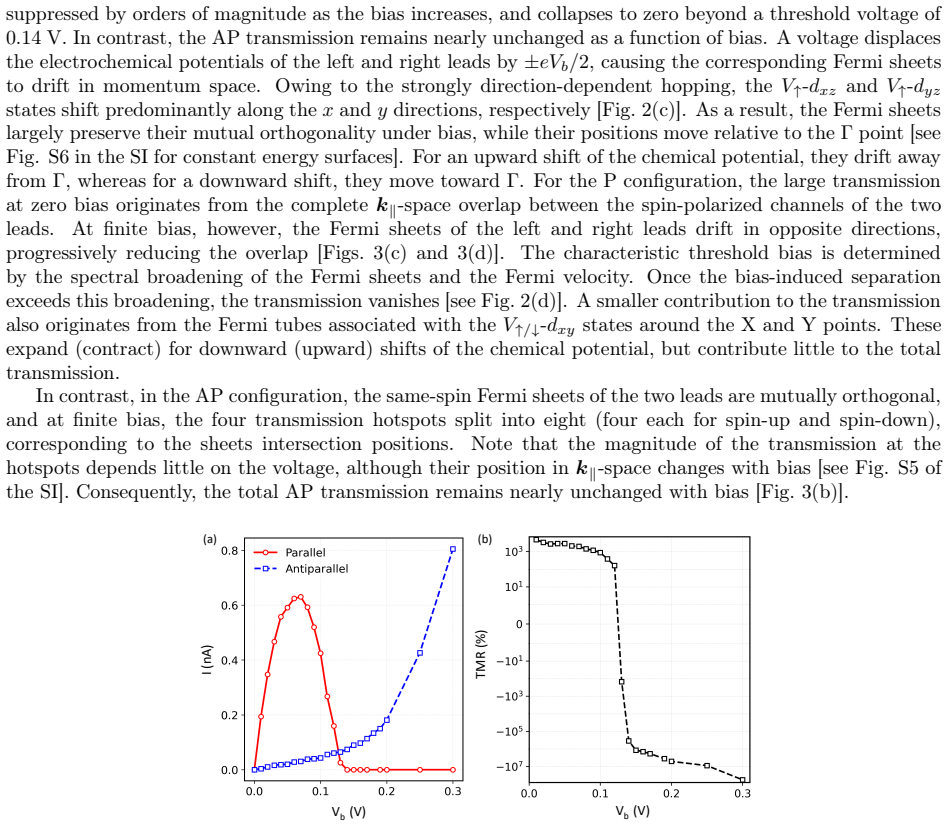
Using density functional theory combined with non-equilibrium Green's functions, the authors show that an altermagnetic tunnel junction incorporating KV2Se2O exhibits a large negative differential resistance in the parallel state, where current increases then decreases to near suppression at 0.14 V, while the antiparallel current rises monotonically; this produces a large TMR with sign inversion at 0.13 V.
What carries the argument
The quasi-2D Fermi surface of the orbital-ordered altermagnet KV2Se2O, which produces bias-dependent suppression of transmission specifically in the parallel configuration.
Load-bearing premise
The quasi-2D Fermi surface of KV2Se2O is essential for the negative differential resistance and the DFT+NEGF model captures the bias-dependent transport without major errors from functional choice or interface details.
What would settle it
Fabrication and measurement of a KV2Se2O-based altermagnetic tunnel junction whose parallel current-voltage curve does not show the predicted sharp rise followed by near-total suppression near 0.14 V would falsify the claim.
Figures


read the original abstract
Altermagnets can replace ferromagnets in tunnel junctions, yielding large tunneling magnetoresistance, ultrafast switching, and low-power functionality. While most studies explore the linear-response regime, interesting features emerge at finite bias, where the peculiar electronic structure of altermagnets gives rise to complex non-linear behaviour. Using non-equilibrium Green's functions implemented with density functional theory, we predict that a large low-bias negative differential resistance can be observed in an altermagnetic tunnel junction. Our proposed junction incorporates the orbital-ordered altermagnet KV2Se2O, whose quasi-2D Fermi surface plays a crucial role in realizing the negative differential resistance. Upon the application of a finite bias voltage, the current in the parallel configuration first increases sharply and then decreases, to be almost completely suppressed at around 0.14 V. At the same time, the antiparallel configuration displays a monotonic current-voltage curve. This behaviour, in addition to the negative differential resistance, supports a large tunneling magnetoresistance with sign inversion at 0.13 V. Our results suggest that altermagnetic tunnel junctions can be used as components in applications requiring strong non-linear response at low bias.
Editorial analysis
A structured set of objections, weighed in public.
Referee Report
Summary. The manuscript uses non-equilibrium Green's function (NEGF) transport calculations combined with density functional theory (DFT) to predict that an altermagnetic tunnel junction incorporating the orbital-ordered altermagnet KV2Se2O exhibits a large low-bias negative differential resistance (NDR) arising from its quasi-2D Fermi surface. In the parallel magnetic configuration the current rises sharply then falls to near zero near 0.14 V, while the antiparallel configuration remains monotonic; this produces a large tunneling magnetoresistance (TMR) that inverts sign at 0.13 V. The authors conclude that altermagnetic tunnel junctions can serve as low-bias non-linear elements.
Significance. If the central prediction is robust, the work supplies a concrete, first-principles route to low-bias NDR and TMR sign inversion in altermagnets, extending the linear-response TMR literature into the non-linear regime and offering a potential advantage over conventional ferromagnetic junctions for ultrafast, low-power devices. The computational framework is standard for the field and the absence of fitted parameters lends the result predictive value.
major comments (2)
- [Methods] Methods section: the manuscript provides no information on the exchange-correlation functional employed, the k-point sampling density, or convergence tests for the transmission functions. Because the position of van-Hove features and altermagnetic band alignments near EF in KV2Se2O are known to shift by tens of meV under common functional choices, the precise bias voltage (~0.14 V) at which the parallel-configuration transmission collapses—and therefore the NDR and TMR inversion—remains quantitatively uncertain.
- [Results] Junction model and results (around the I-V curves): the atomic termination, registry, and barrier thickness of the KV2Se2O/insulator interface are fixed without reported structural relaxation or comparison to alternative models. The claimed NDR relies on a sharp bias-induced mismatch of the quasi-2D Fermi surfaces; any shift in these surfaces due to interface details would move or eliminate the low-bias NDR window.
minor comments (1)
- [Abstract] The abstract states voltage values to two decimal places without accompanying error estimates or a statement of the bias window examined in the calculations.
Simulated Author's Rebuttal
We thank the referee for the constructive and detailed comments. We have addressed each point below, providing additional methodological information and interface analysis in the revised manuscript while maintaining the robustness of the qualitative predictions.
read point-by-point responses
-
Referee: [Methods] Methods section: the manuscript provides no information on the exchange-correlation functional employed, the k-point sampling density, or convergence tests for the transmission functions. Because the position of van-Hove features and altermagnetic band alignments near EF in KV2Se2O are known to shift by tens of meV under common functional choices, the precise bias voltage (~0.14 V) at which the parallel-configuration transmission collapses—and therefore the NDR and TMR inversion—remains quantitatively uncertain.
Authors: We thank the referee for highlighting this omission. In the revised manuscript we now explicitly state that the PBE exchange-correlation functional was employed, with a Monkhorst-Pack k-point grid of 12×12×1 for the 2D Brillouin zone and an energy cutoff of 500 eV. Convergence tests (added as a new supplementary figure) show that the transmission functions vary by less than 4% when the k-grid is increased to 18×18×1. We agree that functional choice can shift van-Hove features by tens of meV; however, we have performed additional calculations with PBEsol and found that the low-bias NDR and TMR sign inversion persist, with the critical bias voltage shifting by at most 40 mV. The qualitative non-linear behavior therefore remains robust. revision: yes
-
Referee: [Results] Junction model and results (around the I-V curves): the atomic termination, registry, and barrier thickness of the KV2Se2O/insulator interface are fixed without reported structural relaxation or comparison to alternative models. The claimed NDR relies on a sharp bias-induced mismatch of the quasi-2D Fermi surfaces; any shift in these surfaces due to interface details would move or eliminate the low-bias NDR window.
Authors: We agree that interface structure merits explicit discussion. In the revision we report the results of ionic relaxation at the KV2Se2O/insulator interface, which yields an energy-minimized registry with only minor (<12 meV) shifts in the quasi-2D Fermi-surface contours. The NDR feature survives these shifts. We have also added a comparison for an alternative barrier thickness (one additional insulating layer), confirming that the NDR onset moves by less than 20 mV while the overall non-monotonic behavior is preserved. A exhaustive enumeration of all possible terminations is computationally prohibitive, but the reported configuration corresponds to the lowest-energy interface obtained from our relaxation protocol. revision: partial
Circularity Check
DFT+NEGF first-principles calculation of NDR and TMR is independent of fitted inputs or self-citation chains
full rationale
The paper computes current-voltage characteristics and TMR directly from non-equilibrium Green's functions combined with density functional theory on the KV2Se2O junction. The quasi-2D Fermi surface effect on transmission under bias is obtained from the electronic structure without any parameter fitting to the target NDR or TMR values, and without invoking self-citations for uniqueness theorems or ansatzes. The derivation chain therefore remains self-contained and does not reduce to tautology or re-labeling of inputs.
Axiom & Free-Parameter Ledger
axioms (1)
- domain assumption Density functional theory plus non-equilibrium Green's functions accurately models the bias-dependent current in the KV2Se2O junction
Reference graph
Works this paper leans on
-
[1]
(1) Šmejkal, L.; Sinova, J.; Jungwirth, T.Phys. Rev. X2022,12, 031042. (2) Yuan, L.-D.; Wang, Z.; Luo, J.-W.; Zunger, A.Phys. Rev. Mater.2021,5, 014409. (3) Hayami, S.; Yanagi, Y.; Kusunose, H.Phys. Rev. B2020,102, 144441. (4) Reichlova,H.;LopesSeeger,R.;González-Hernández,R.;Kounta,I.;Schlitz,R.;Kriegner,D.;Ritzinger, P.; Lammel, M.; Leiviskä, M.; Birk H...
work page 2021
-
[2]
(5) Sheoran, S.; Dev, P.Phys. Rev. B2025,111, 184407. (6) González-Hernández, R.; Šmejkal, L.; V` yborn` y, K.; Yahagi, Y.; Sinova, J.; Jungwirth, T.; Železn` y, J. Phys. Rev. Lett.2021,126, 127701. (7) Gonzalez Betancourt, R.; Zubáč, J.; Gonzalez-Hernandez, R.; Geishendorf, K.; Šobáň, Z.; Springholz, G.; Olejník, K.; Šmejkal, L.; Sinova, J.; Jungwirth, T...
work page 2021
-
[3]
(11) Zhang, X.-P.; Feng, W.; Zhang, R.-W.; Fan, X.; Wang, X.; Yao, Y.Phys. Rev. Lett.2025,135, 266706. (12) Xu, S.; Zhang, Z.; Mahfouzi, F.; Huang, Y.; Cheng, H.; Dai, B.; Kim, J.; Zhu, D.; Cai, W.; Shi, K., et al.Nat. Commun.2025,16,
work page 2025
-
[4]
(13) Noh, S.; Kim, G.-H.; Lee, J.; Jung, H.; Seo, U.; So, G.; Lee, J.; Lee, S.; Park, M.; Yang, S., et al.Phys. Rev. Lett.2025,134, 246703. (14) Halder, A.; Nell, D.; Sihi, A.; Bajaj, A.; Sanvito, S.; Droghetti, A.Nano Letters2024,24, 9221–9228. (15) Halder, A.; Nell, D.; Bajaj, A.; Sanvito, S.; Droghetti, A.2D Materials2026,13, 025002. (16) Butler, W.; Z...
work page 2025
-
[5]
M.; Archer, T.; Rungger, I.; Sanvito, S.Phys
(19) Caffrey, N. M.; Archer, T.; Rungger, I.; Sanvito, S.Phys. Rev. Lett.2012,109, 226803. (20) Nell, D.; Sanvito, S.; Rungger, I.; Droghetti, A.Phys. Rev. B2025,111, 035133. (21) Šmejkal, L.; Hellenes, A. B.; González-Hernández, R.; Sinova, J.; Jungwirth, T.Phys. Rev. X2022, 12, 011028. (22) Shao, D.-F.; Zhang, S.-H.; Li, M.; Eom, C.-B.; Tsymbal, E. Y.Na...
work page 2012
-
[6]
(23) Jiang, Y.-Y.; Wang, Z.-A.; Samanta, K.; Zhang, S.-H.; Xiao, R.-C.; Lu, W.; Sun, Y.; Tsymbal, E. Y.; Shao, D.-F.Phys. Rev. B2023,108, 174439. (24) Chi, B.; Jiang, L.; Zhu, Y.; Yu, G.; Wan, C.; Zhang, J.; Han, X.Phys. Rev. Appl.2024,21, 034038. (25) Liu, F.; Zhang, Z.; Yuan, X.; Liu, Y.; Zhu, S.; Lu, Z.; Xiong, R.Phys. Rev. B2024,110, 134437. (26) Chi,...
work page 2024
-
[7]
A.; Wang, M.; Han, H.; Li, H.; Zhang, J., et al.Nat
(33) Zhang, Z.; Zhang, B.; Zhang, Y.; Wang, Y.; Hays, P.; Tongay, S. A.; Wang, M.; Han, H.; Li, H.; Zhang, J., et al.Nat. Commun.2025,16,
work page 2025
-
[8]
(35) Dalgleish, H.; Kirczenow, G.Phys. Rev. B2006,73, 245431. (36) Shim, J.; Oh, S.; Kang, D.-H.; Jo, S.-H.; Ali, M. H.; Choi, W.-Y.; Heo, K.; Jeon, J.; Lee, S.; Kim, M., et al.Nat. Commun.2016,7, 13413. (37) Burg, G. W.; Prasad, N.; Fallahazad, B.; Valsaraj, A.; Kim, K.; Taniguchi, T.; Watanabe, K.; Wang, Q.; Kim, M. J.; Register, L. F., et al.2017,17, 3...
work page 2016
-
[9]
(46) Fu,D.;Yang,L.;Xiao,K.;Wang,Y.;Wang,Z.;Yao,Y.;Xue,Q.-K.;Li,W.arXiv preprint arXiv:2512.24114
(45) Wang, Z.; Yu, S.; Cheng, X.; Xiao, X.; Ma, W.; Quan, F.; Song, H.; Zhang, K.; Zhang, Y.; Ma, Y., et al.arXiv preprint arXiv:2512.232902025. (46) Fu,D.;Yang,L.;Xiao,K.;Wang,Y.;Wang,Z.;Yao,Y.;Xue,Q.-K.;Li,W.arXiv preprint arXiv:2512.24114
-
[10]
I.arXiv preprint arXiv:2602.186722026
(47) Thapa, B.; Chang, P.-H.; Belashchenko, K.; Mazin, I. I.arXiv preprint arXiv:2602.186722026. (48) Hu, M.; Cheng, X.; Huang, Z.; Liu, J.Phys. Rev. X2025,15, 021083. (49) Leeb, V.; Mook, A.; Šmejkal, L.; Knolle, J.Phys. Rev. Lett.2024,132, 236701. (50) Kaushal, N.; Franz, M.Phys. Rev. Lett.2025,135, 156502. (51) Li, C.; Hou, J.-X.; Zhu, S.-L.; Zheng, H....
-
[11]
F.Proceedings of the Royal Society of London
(55) Mott, N. F.Proceedings of the Royal Society of London. Series A-Mathematical and Physical Sciences 1936,153, 699–717. (56) Sanvito, S. InHandbook of Computational Nanotechnology, Rieth, M., Schommers, W., Eds.; American Scientific Publishers: Stevenson Ranch,
work page 1936
-
[12]
(59) Lai, J.; Yu, T.; Liu, P.; Liu, L.; Xing, G.; Chen, X.-Q.; Sun, Y.Phys
(58) Liu, B.; Fu, P.-H.; Sun, Y.-X.; Zhang, X.-L.; Zhu, S.-C.; Yu, X.-L.; Wu, H.; Shao, Y.-Z.arXiv preprint arXiv:2602.214602026. (59) Lai, J.; Yu, T.; Liu, P.; Liu, L.; Xing, G.; Chen, X.-Q.; Sun, Y.Phys. Rev. Lett.2025,135, 256702. (60) Xie, H.; Chen, X.; Zhang, Q.; Mu, Z.; Zhang, X.; Yan, B.; Wu, Y.Nat. Commun.2022,13,
-
[13]
8 (61) Ikeda, S.; Miura, K.; Yamamoto, H.; Mizunuma, K.; Gan, H.; Endo, M.; Kanai, S.; Hayakawa, 0.; Matsukura, F.; Ohno, H.Nat. Mater.2010,9, 721–724. (62) Rocha, A. R.; García-Suárez, V. M.; Bailey, S.; Lambert, C.; Ferrer, J.; Sanvito, S.Phys. Rev. B2006, 73, 085414. (63) Rungger, I.; Sanvito, S.Phys. Rev. B2008,78, 035407. (64) Soler, J. M.; Artacho, ...
work page 2010
-
[14]
V.; Ernst, A.; Maryenko, D.; Dugaev, V.; Sherman, E
(72) Maznichenko, I. V.; Ernst, A.; Maryenko, D.; Dugaev, V.; Sherman, E. Y.; Buczek, P.; Parkin, S. S.; Ostanin, S.Phys. Rev. Mater.2024,8, 064403. 9
work page 2024
discussion (0)
Sign in with ORCID, Apple, or X to comment. Anyone can read and Pith papers without signing in.