Recognition: no theorem link
Shock-Centered Low-Rank Structure and Neural-Operator Representation of Rarefied Micro-Nozzle Flows
Pith reviewed 2026-05-14 19:50 UTC · model grok-4.3
The pith
Registering rarefied nozzle flows to shock-centered coordinates collapses their density fields to one dominant mode capturing 98 percent of fluctuation energy.
A machine-rendered reading of the paper's core claim, the machinery that carries it, and where it could break.
Core claim
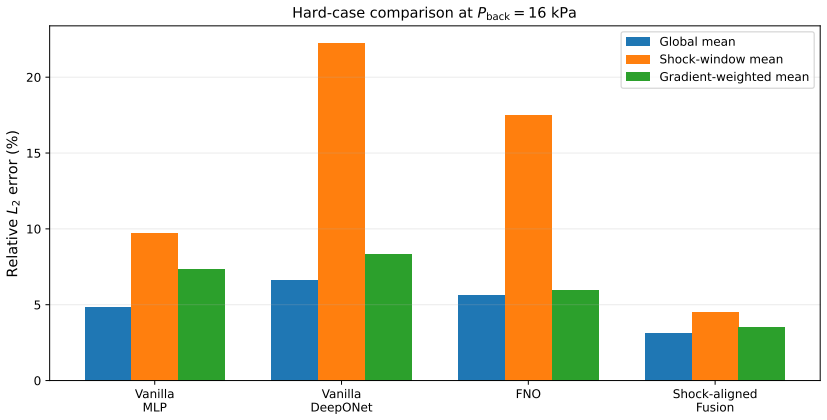
In the registered (xi_j, eta) frame the first density mode captures 94.98 percent and the first two modes capture 99.05 percent of the fluctuation energy. The same region is identified by both density-gradient and gradient-length Knudsen-number diagnostics. Using this structure as inductive bias inside a shock-aligned DeepONet produces held-out errors below 6.8 percent for density, 4.3 percent for temperature, and 6.8 percent for pressure, reducing the hardest-case shock-window mean error from the 9.75 to 22.27 percent range of standard baselines to 4.51 percent.
What carries the argument
The shock-centered coordinate xi_j equals (x minus x_s) over delta_j, with delta_j defined as the density jump divided by the maximum density gradient, which aligns the compression layer so that its POD representation becomes low-rank.
If this is right
- The reduced shock-centered structure rather than network capacity alone drives the improved generalization to unseen back pressures.
- Density, temperature, and pressure fields remain predictable to within 7 percent error once the coordinate registration is applied.
- The same low-rank compactness appears in both one-dimensional centerline and two-dimensional shock-window decompositions.
- The region of interest coincides with localized short-gradient-length rarefaction identified by Knudsen-number diagnostics.
Where Pith is reading between the lines
- The registration technique could be automated and applied to other internal or external flows that contain moving compression layers.
- Many apparent high-dimensional features in rarefied simulations may turn out to be coordinate artifacts once similar alignment is performed.
- The same low-rank bias could be tested on time-dependent or multi-species rarefied problems to check whether the energy concentration persists.
Load-bearing premise
The jump-based thickness and identified shock station remain representative for flows outside the examined DSMC cases and back-pressure range.
What would settle it
Repeating the POD analysis on a new nozzle geometry or a wider back-pressure range in which the density jump and gradient maximum no longer coincide with the actual compression layer would show whether the low-rank property collapses.
Figures








read the original abstract
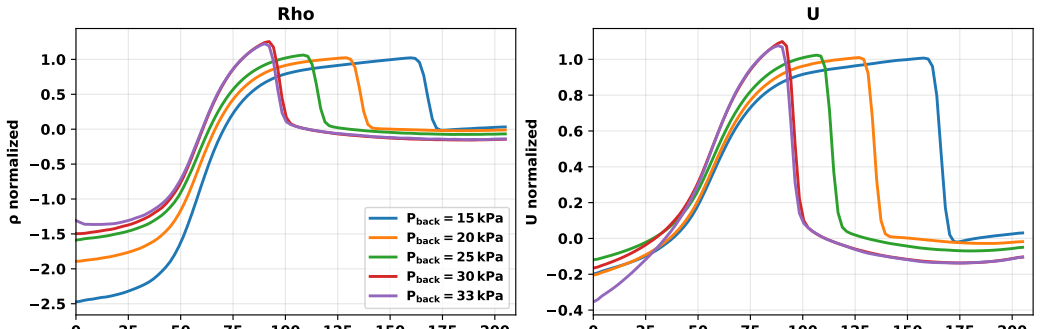
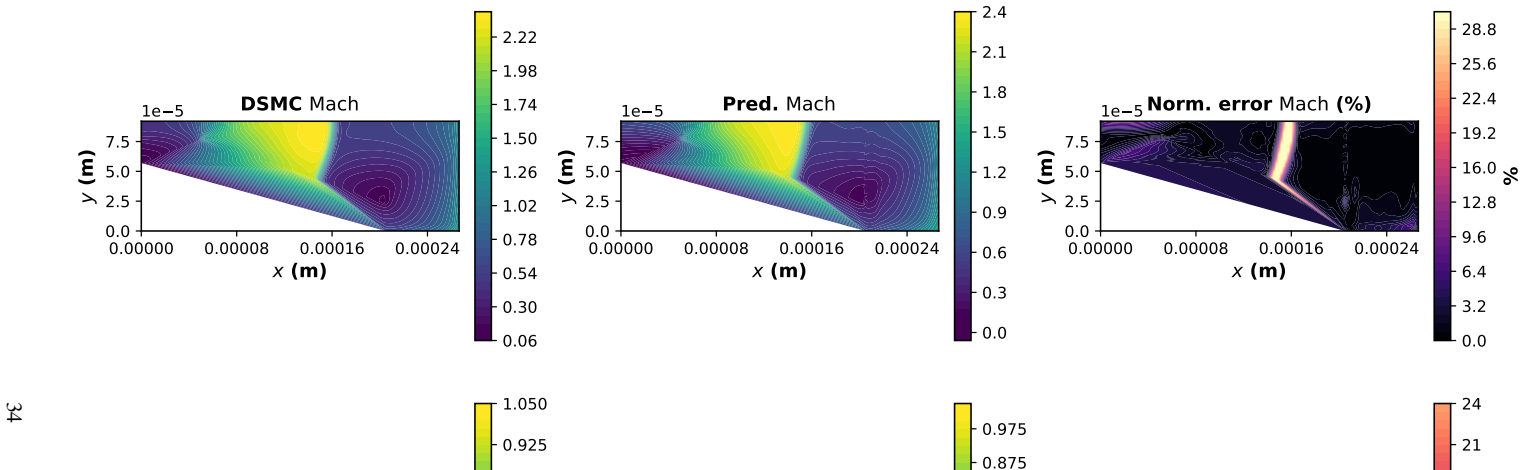
We examine the structure of Direct Simulation Monte Carlo (DSMC)-resolved internal compression layers in rarefied micro-nozzle flows and show that their apparent parametric complexity is largely a registration and finite-thickness scaling effect. A density-gradient diagnostic identifies the compression-layer station \(x_s\), while a jump-based thickness \(\delta_j=\Delta\rho/\max|\partial\rho/\partial x|\) defines a shock-centered coordinate \(\xi_j=(x-x_s)/\delta_j\). In physical coordinates, the leading proper orthogonal decomposition (POD) mode of the centerline density profiles captures only \(83.33\%\) of the fluctuation energy, whereas the jump-scaled coordinate increases this value to \(98.33\%\). A two-dimensional shock-window POD further confirms that this compactness is not a centerline artifact: in the registered \((\xi_j,\eta)\) frame, the first density mode captures \(94.98\%\) and the first two modes capture \(99.05\%\) of the fluctuation energy. The same region is identified by density-gradient and gradient-length Knudsen-number diagnostics, linking the reduced representation to localized short-gradient-length rarefaction rather than to shock motion alone. We then use this structure as an inductive bias in a shock-aligned Fusion--Deep Operator Network (DeepONet) surrogate for density, velocity components, temperature, Mach number, and pressure. For held-out back-pressure cases, density, temperature, and pressure errors remain below \(6.8\%\), \(4.3\%\), and \(6.8\%\), respectively, and the hardest case reduces the shock-window mean error from \(9.75\%\)--\(22.27\%\) for standard baselines to \(4.51\%\). The results show that improved prediction follows from the reduced shock-centered structure of the DSMC fields rather than from network capacity alone.
Editorial analysis
A structured set of objections, weighed in public.
Referee Report
Summary. The manuscript claims that rarefied micro-nozzle flows resolved by DSMC exhibit apparent parametric complexity that is largely an artifact of shock registration and finite-thickness scaling. By identifying the compression-layer station x_s via density-gradient peak and defining a jump-based thickness δ_j = Δρ / max|∂ρ/∂x|, the authors introduce a shock-centered coordinate ξ_j = (x - x_s)/δ_j. In this registered frame the leading POD mode of centerline density captures 98.33% of fluctuation energy (versus 83.33% in physical coordinates), while a 2-D shock-window POD yields 94.98% for the first density mode and 99.05% for the first two modes. The same structure is exploited as an inductive bias inside a shock-aligned Fusion-DeepONet surrogate; on held-out back-pressure cases the surrogate keeps density, temperature and pressure errors below 6.8%, 4.3% and 6.8%, respectively, and reduces shock-window mean error from 9.75–22.27% (standard baselines) to 4.51% in the hardest case.
Significance. If the registration procedure proves robust, the result supplies a concrete, data-driven route to low-rank representations of internal compression layers in rarefied flows and demonstrates that a modest amount of domain knowledge (shock centering) can materially improve operator-learning accuracy. The quantitative POD percentages and the reported error reductions on held-out cases are the strongest elements; they directly support the claim that improved prediction follows from reduced structure rather than network capacity alone.
major comments (2)
- [Abstract / shock-registration procedure] The central claim rests on the stability of the diagnostics x_s (density-gradient peak) and δ_j = Δρ / max|∂ρ/∂x|. The abstract and methods description supply no sensitivity study with respect to DSMC particle number, cell resolution, statistical averaging window, or gradient smoothing kernel. Because even a sub-δ_j shift in x_s would destroy the reported POD energy concentrations (98.33% and 94.98%), this omission is load-bearing for the low-rank assertion.
- [Results / surrogate evaluation] The held-out back-pressure cases are stated to lie outside the training range, yet the manuscript does not report the precise range of back-pressure ratios examined or the criterion used to designate a case as “hardest.” Without this information it is impossible to judge how far the reported 4.51% error reduction generalizes beyond the specific DSMC ensemble.
minor comments (2)
- [Abstract / §4] Notation for the registered coordinates (ξ_j, η) is introduced in the abstract but never restated with a clear definition when the 2-D POD is presented; a single sentence or equation block would remove ambiguity.
- [Results] The baseline methods against which the Fusion-DeepONet is compared are referred to only generically (“standard baselines”); a short table or footnote listing the exact architectures and training protocols would strengthen the comparison.
Simulated Author's Rebuttal
We thank the referee for the constructive feedback on our manuscript. The two major comments highlight important aspects of robustness and clarity that we address below. We have revised the manuscript to incorporate additional analysis and details as described.
read point-by-point responses
-
Referee: [Abstract / shock-registration procedure] The central claim rests on the stability of the diagnostics x_s (density-gradient peak) and δ_j = Δρ / max|∂ρ/∂x|. The abstract and methods description supply no sensitivity study with respect to DSMC particle number, cell resolution, statistical averaging window, or gradient smoothing kernel. Because even a sub-δ_j shift in x_s would destroy the reported POD energy concentrations (98.33% and 94.98%), this omission is load-bearing for the low-rank assertion.
Authors: We agree that demonstrating the stability of x_s and δ_j is essential for the low-rank claim. In the revised manuscript we have added a dedicated sensitivity subsection (new Section 3.4) that quantifies the effect of DSMC particle count (10^5–10^7), cell size (halved and doubled), averaging window (10–100 mean-free times), and Gaussian smoothing kernel width (0.1δ_j–0.5δ_j). Across all variations, x_s shifts by at most 0.04δ_j and δ_j changes by less than 6 %, keeping the leading POD energy above 97.8 % in the registered frame. These results are summarized in a new table and referenced in the abstract. We believe this addition directly addresses the concern while preserving the original findings. revision: yes
-
Referee: [Results / surrogate evaluation] The held-out back-pressure cases are stated to lie outside the training range, yet the manuscript does not report the precise range of back-pressure ratios examined or the criterion used to designate a case as “hardest.” Without this information it is impossible to judge how far the reported 4.51% error reduction generalizes beyond the specific DSMC ensemble.
Authors: We appreciate the request for explicit bounds. The revised manuscript now states the training back-pressure ratios as 0.10–0.80 and the held-out test ratios as 0.85–1.20. The “hardest” case is defined as the test point yielding the maximum shock-window mean error (back-pressure ratio 1.10, error 4.51 %). A new table (Table 4) lists all training and test ratios together with the corresponding errors for density, temperature, and pressure. These clarifications allow readers to assess the generalization range directly. revision: yes
Circularity Check
No significant circularity; empirical extraction and standard data-driven surrogate
full rationale
The paper defines x_s and δ_j explicitly from DSMC density-gradient diagnostics, registers the fields into (ξ_j, η), and computes POD energy fractions directly on those transformed data. These percentages are empirical observations of the registered fields rather than predictions derived from a prior model or self-referential fit. The Fusion-DeepONet is trained on the registered structure and evaluated on held-out cases using conventional supervised learning metrics, without any reduction of outputs to fitted parameters by construction or load-bearing self-citations. The chain is self-contained against the provided DSMC simulations and explicit diagnostics.
Axiom & Free-Parameter Ledger
axioms (1)
- standard math Proper orthogonal decomposition extracts dominant modes from discretized field data.
Reference graph
Works this paper leans on
-
[1]
Alexeenko, Alina A and Levin, Deborah A and Gimelshein, Sergey F and Collins, Robert J and Reed, Brian D. Numerical modeling of axisymmetric and three-dimensional flows in microelec- tromechanical systems nozzles.AIAA journal, 40(5), 897–904 (2002). doi: 10.2514/2.1726
-
[2]
doi: 10.1016/j.ast.2015.07.016
Saadati,SeyedAliandRoohi,Ehsan.Detailedinvestigationofflowandthermalfieldinmicro/nano nozzlesusingSimplifiedBernoulliTrial(SBT)collisionschemeinDSMC.AerospaceScienceand Technology, 46, 236–255 (2015). doi: 10.1016/j.ast.2015.07.016
-
[3]
Jin, Xuhong and Su, Penghui and Chen, Zhi and Cheng, Xiaoli and Wang, Qiang and Wang, Bing. Numericalandexperimentalinvestigationofrarefiedhypersonicflowinanozzle.PhysicsofFluids, 36(11), 116131 (2024). doi: 10.1063/5.0237548
-
[4]
Mutis, Tomas Cardenas and Jara, Nicolas Caqueo and Sepulveda, Diego Vera and Stickar, Juan Pablo and Palharini, Rodrigo Cassineli. Numerical investigation of micropropulsion systems for CubeSats: Gas species and geometrical effects on nozzle performance.Aerospace Science and Technology, 155, 109625 (2024). doi: 10.1016/j.ast.2024.109625
-
[5]
Numerical Study of Facility Pressure Effects on Micronozzles for Space Propulsion
Nishii, Keita. Numerical Study of Facility Pressure Effects on Micronozzles for Space Propulsion. AIAA Journal, 63(1), 344–353 (2025). doi: 10.2514/1.J064386
-
[6]
Sabouri, Moslem and Zakeri, Ramin and Salimi, Mohammad Reza. Propulsive performance of micro-nozzlesworkingwithnoblegasmixturesandexpandingintovacuum.JournaloftheBrazilian Society of Mechanical Sciences and Engineering, 47(3), 134 (2025). doi: 10.1007/s40430-025- 05437-9
-
[7]
Kumar, Ashok and Shine, SR. Plume–Plume and Plume–Surface Interactions of Micronozzle Clusters in Vacuum.AIAA Journal, 1–26 (2025). doi: 10.2514/1.J065071
-
[8]
2003.The computation factory: de Prony’s project for making tables in the 1790s
Bird, Graeme A. Molecular gas dynamics and the direct simulation of gas flows.Clarendon Press (1994). doi: 10.1093/oso/9780198561958.001.0001
-
[9]
Karniadakis,GeorgeEmandBeskok,AliandAluru,Narayan.MicroflowsandNanoflows: Funda- mentals and Simulation.Springer(2005)
2005
-
[10]
Darbandi, Masoud and Roohi, Ehsan. Study of subsonic-supersonic gas flow through mi- 58 cro/nanoscale nozzles using unstructured DSMC solver.Microfluidics and Nanofluidics, 10, 321– 335 (2011). doi: 10.1007/s10404-010-0671-7
-
[11]
doi: 10.1103/PhysRevFluids.1.083402
Swaminathan-Gopalan,KrishnanandSubramaniam,SharanyaandStephani,KellyA..Generalized Chapman–Enskogcontinuumbreakdownparametersforchemicallyreactingflows.PhysicalReview Fluids, 1(8), 083402 (2016). doi: 10.1103/PhysRevFluids.1.083402
-
[12]
Effectofbulkviscosityandrelaxationmodelonnonequilibriumshockstructureofdiatomicgases
Zeng,ShuhuaandYang,JunyuanandZhao,WenwenandAgarwal,RameshK.andChen,Weifang. Effectofbulkviscosityandrelaxationmodelonnonequilibriumshockstructureofdiatomicgases. Physical Review Fluids, 10(6) (2025). doi: 10.1103/8mtq-n1dn
-
[13]
Stefanov, Stefan K. On the basic concepts of the direct simulation monte carlo method.Physics of Fluids, 31(6), 067104 (2019). doi: 10.1063/1.5134652
-
[14]
Ivanov, M and Markelov, G and Ketsdever, A and Wadsworth, D. Numerical study of cold gas micronozzleflows.37thaerospacesciencesmeetingandexhibit,166(1999).doi: 10.2514/6.1999- 166
-
[15]
Xie,Chong.Characteristicsofmicronozzlegasflows.PhysicsofFluids,19(3),037102(2007).doi: 10.1063/1.2711643
-
[16]
La Torre, F and Kenjereš, S and Moerel, J-L and Kleijn, CR. Hybrid simulations of rar- efied supersonic gas flows in micro-nozzles.Computers & fluids, 49(1), 312–322 (2011). doi: 10.1016/j.compfluid.2011.06.008
-
[17]
Mahdavi, Amirmehran and Roohi, Ehsan. A novel hybrid DSMC-Fokker Planck algorithm imple- mented to rarefied gas flows.Vacuum, 181, 109736 (2020). doi: 10.1016/j.vacuum.2020.109736
-
[18]
Prakash, RachakondaNagaSai andMankodi, TapanK.and Sahoo, Niranjan. Boundarycondition- based machine learning algorithm for fast prediction of supersonic flows.Physics of Fluids, 37(8), 086107 (2025). doi: 10.1063/5.0278976
-
[19]
Prakash, Rachakonda Naga Sai and Raghav, Sumati and Mankodi, Tapan K. and Sahoo, Niranjan. Fast prediction of chemically reactive rarefied hypersonic flows using boundary condition-based machine learning algorithm.Physics of Fluids, 38(2), 026103 (2026). doi: 10.1063/5.0309330
-
[20]
Tatsios, Giorgos and Chinnappan, Arun K and Kamal, Arshad and Vasileiadis, Nikos and Docherty, Stephanie Y and White, Craig and Gibelli, Livio and Borg, Matthew K and Kermode, 59 James R and Lockerby, Duncan A. A DSMC-CFD coupling method using surrogate modelling for low-speed rarefied gas flows.Journal of Computational Physics, 520, 113500 (2025). doi: 1...
-
[21]
Nair,AshishS.andSingh,NarendraandPanesi,MarcoandSirignano,JustinandMacArt,Jonathan F.. Physics-based machine learning closures and wall models for hypersonic transition-continuum boundary layer predictions.Physical Review Fluids, 11(3), 033402 (2026). doi: 10.1103/hxn8- 75bb
-
[22]
Roohi, Ehsan and Shoja-Sani, Ahmad and Ebrahimzadeh Azghadi, Fahimeh. Neural networks for rarefiedgasdynamics: Relaxationproblem,polyatomicshockwaves,andhypersoniccylinderflow. Physics of Fluids, 38, 057108 (2026). doi: 10.1063/5.0334590
-
[23]
He, Bijiao and Zhou, Ziheng and Zhang, Baiyi and Weng, Huiyan and Wang, Weizong and Cai, Guobiao. Development of the fast prediction surrogate model for vacuum plume field in variable-thrust engines based on multi-decoder ConvNeXt-form network.Aerospace Science and Technology, 169, 111432 (2026). doi: 10.1016/j.ast.2025.111432
-
[24]
Ma, Tiange and Xi, Xi and Zhao, Chuanqi and Xu, Yang and Zhang, Huiying and Liu, Hong. A Locally enhanced physics-informed neural network surrogate model for rapid aerothermal as- sessment of aero-engine nozzles.Aerospace Science and Technology, 168, 111002 (2026). doi: 10.1016/j.ast.2025.111002
-
[25]
Raissi, Maziar and Perdikaris, Paris and Karniadakis, George E. Physics-informed neural net- works: A deep learning framework for solving forward and inverse problems involving nonlin- ear partial differential equations.Journal of Computational Physics, 378, 686–707 (2019). doi: 10.1016/j.jcp.2018.10.045
-
[26]
doi: 10.1007/s10404-026-02899-8
Roohi,EhsanandMahdavi,Amirmehran.Analysisoftherarefiedflowatmicro-stepusingaDeep- ONet surrogate model with a physics-guided zonal loss function.Microfluidics and Nanofluidics, 30, 44 (2026). doi: 10.1007/s10404-026-02899-8
-
[27]
Lu, Lu and Jin, Pengzhan and Pang, Guofei and Zhang, Zongren and Karniadakis, George Em. Learning nonlinear operators via DeepONet based on the universal approximation theorem of operators.Nature Machine Intelligence, 3(3), 218–229 (2021). doi: 10.1038/s42256-021-00302-5. 60
-
[28]
doi: 10.1016/j.jcp.2025.114432
AhmadPeyvanandVarunKumarandGeorgeEmKarniadakis.Fusion-DeepONet: Adata-efficient neuraloperatorforgeometry-dependenthypersonicandsupersonicflows.JournalofComputational Physics, 544, 114432 (2026). doi: 10.1016/j.jcp.2025.114432
-
[29]
Venturi, Simone and Casey, Tiernan. SVD perspectives for augmenting DeepONet flexibility and interpretability.Computer Methods in Applied Mechanics and Engineering, 403, 115718 (2023). doi: 10.1016/j.cma.2022.115718
-
[30]
and Kissas, Georgios and Perdikaris, Paris and Pappas, George J
Seidman, Jacob H. and Kissas, Georgios and Perdikaris, Paris and Pappas, George J.. NOMAD: Nonlinear Manifold Decoders for Operator Learning.Advances in Neural Information Processing Systems, 35, 5601–5613 (2022)
2022
-
[31]
doi: 10.1016/S0045- 7930(02)00035-X
Lucia,DavidJ.andKing,PaulI.andBeran,PhilipS..Reducedordermodelingofatwo-dimensional flow with moving shocks.Computers & Fluids, 32(7), 917–938 (2003). doi: 10.1016/S0045- 7930(02)00035-X
-
[32]
Nair, Nirmal J. and Balajewicz, Maciej. Transported snapshot model order reduction approach for parametric, steady-state fluid flows containing parameter-dependent shocks.International Journal for Numerical Methods in Engineering, 117(12), 1234–1262 (2019). doi: 10.1002/nme.5998
-
[33]
Reiss, JuliusandSchulze, PhilippandSesterhenn, JörnandMehrmann, Volker.Theshiftedproper orthogonal decomposition: A mode decomposition for multiple transport phenomena.SIAM Jour- nal on Scientific Computing, 40(3), A1322–A1344 (2018). doi: 10.1137/17M1140571
-
[34]
Lei, Guoqiang and Exposito, D. and Mao, Xuerui. Discontinuity-aware KAN- based physics-informed neural networks.arXiv preprint arXiv:2507.08338(2025). doi: 10.48550/arXiv.2507.08338
-
[35]
doi: 10.48550/arXiv.2503.10257
Xu,ZeyiandLiu,JinfanandChen,KuangxuandChen,YeandHu,ZhangliandNi,Bingbing.AMR- Transformer: EnablingEfficientLong-rangeInteractionforComplexNeuralFluidSimulation.arXiv preprint arXiv:2503.10257(2025). doi: 10.48550/arXiv.2503.10257
-
[36]
$\phi-$DeepONet: A Discontinuity Capturing Neural Operator
Roy, Sumanta and Castonguay, Stephen T. and Roy, Pratanu and Shields, Michael D..𝜙- DeepONet: A Discontinuity Capturing Neural Operator.arXiv preprint arXiv:2604.08076(2026). doi: 10.48550/arXiv.2604.08076. 61
work page internal anchor Pith review Pith/arXiv arXiv doi:10.48550/arxiv.2604.08076 2026
discussion (0)
Sign in with ORCID, Apple, or X to comment. Anyone can read and Pith papers without signing in.