Recognition: unknown
Reduction of finite-size effects for second-order M{o}ller-Plesset perturbation theory with singularity subtraction
Pith reviewed 2026-05-14 19:44 UTC · model grok-4.3
The pith
Singularity subtraction reduces finite-size errors in periodic MP2, reaching millihartree accuracy at coarser k-point meshes.
A machine-rendered reading of the paper's core claim, the machinery that carries it, and where it could break.
Core claim
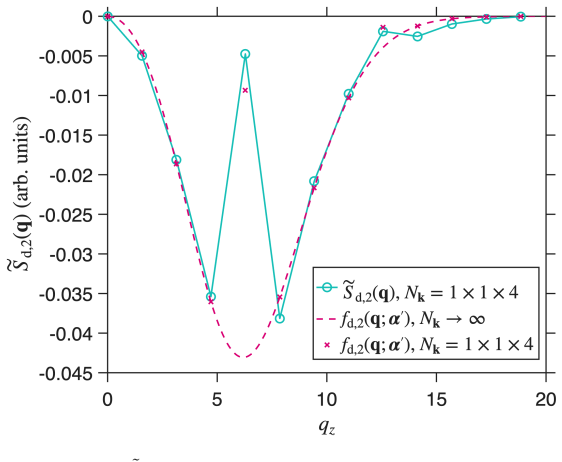
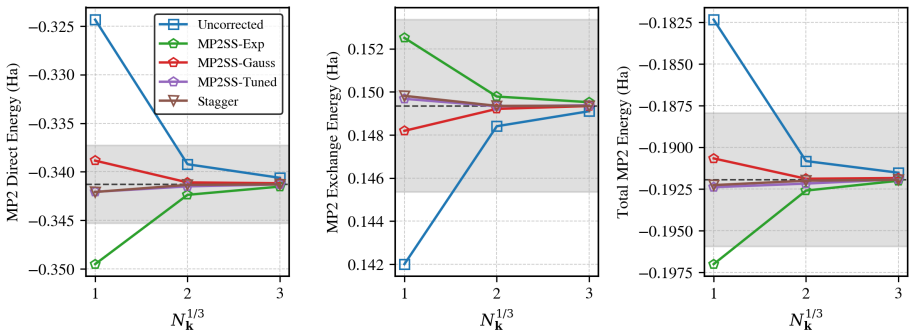
MP2 singularity subtraction applies auxiliary functions and fitting procedures that capture both the Coulomb singularity at the origin in reciprocal space and the discontinuities in the MP2 structure factor that arise from finite k-point sampling. When applied to gapped systems, all three MP2SS configurations—Gaussian, exponential, and tuned—consistently achieve millihartree accuracy for correlation energies at coarser k-point meshes than calculations performed without the correction.
What carries the argument
MP2 singularity subtraction (MP2SS), a procedure that subtracts fitted auxiliary decay functions representing the singular parts of the Coulomb kernel and the finite-sampling jumps in the MP2 integrand from the discrete k-point sum.
Load-bearing premise
The auxiliary functions and their fitting procedures must accurately remove the Coulomb singularity and the structure-factor discontinuities without introducing new uncontrolled errors that grow with system size.
What would settle it
For a gapped crystal such as silicon, compute the MP2 correlation energy on a 3x3x3 k-mesh with and without MP2SS and compare both results to a reference value obtained from a 12x12x12 mesh; if the MP2SS result deviates from the reference by more than one millihartree while the uncorrected result deviates by more, the error-reduction claim fails.
Figures





read the original abstract
Second-order Moller-Plesset perturbation theory (MP2) provides accurate correlation energies for periodic systems but suffers from finite-size errors (FSEs) that have inverse volume scaling due to the Coulomb kernel singularity in reciprocal space. This error scaling limits the routine applicability of MP2 to real materials, requiring prohibitively dense k-point meshes for convergence toward the thermodynamic limit (TDL). We introduce MP2 singularity subtraction (MP2SS), a systematic approach that applies the singularity subtraction strategy to reduce MP2 FSEs. The method employs auxiliary functions and fitting procedures that consider both the singularities present at the origin in reciprocal space and also the discontinuities in the MP2 structure factor that arise from finite k-point sampling. We present three possible MP2SS configurations (Gaussian, exponential, and tuned) which use different combinations of decay functions and demonstrate their performance for gapped systems. All MP2SS configurations consistently achieve millihartree accuracy for correlation energies at coarser k-point meshes than with no correction. Our results establish singularity subtraction as a powerful and flexible approach for mitigating finite-size errors in periodic correlation methods and provide a foundation for extending the technique to higher-order perturbation theories and other post-SCF methods.
Editorial analysis
A structured set of objections, weighed in public.
Referee Report
Summary. The manuscript introduces MP2 singularity subtraction (MP2SS) to reduce finite-size errors in periodic second-order Møller-Plesset perturbation theory. The approach subtracts the Coulomb singularity at the origin in reciprocal space and the discontinuities in the MP2 structure factor that arise from finite k-point sampling, using auxiliary functions with three configurations (Gaussian, exponential, and tuned). The authors claim that all three MP2SS variants achieve millihartree accuracy for correlation energies in gapped systems at coarser k-point meshes than uncorrected MP2, providing a foundation for extensions to higher-order methods.
Significance. If the numerical performance holds under the reported conditions, MP2SS would meaningfully lower the k-point density needed to reach the thermodynamic limit in periodic MP2, reducing computational cost for materials applications. The explicit treatment of both the Coulomb singularity and structure-factor discontinuities, together with the provision of multiple auxiliary-function forms, represents a systematic advance over ad-hoc corrections.
major comments (2)
- [Method (MP2SS configurations)] The description of the fitting procedure for the auxiliary decay parameters (especially the single-parameter tuned variant) lacks explicit details on the objective function, system selection for fitting, and bounds on parameter sensitivity. This is load-bearing for the central claim because the method's accuracy rests on these parameters accurately capturing discontinuities without introducing new errors for arbitrary gapped systems.
- [Results] The manuscript asserts consistent millihartree accuracy at coarser meshes but does not report quantitative benchmarks (e.g., error vs. k-mesh density, specific system sizes, or comparison to other FSE corrections) with sufficient detail to verify the claim. Without such data, including error bars or convergence plots, the performance advantage cannot be assessed.
minor comments (1)
- [Introduction/Methods] Notation for the auxiliary functions and the MP2 structure factor should be defined explicitly in an equation early in the methods section to improve readability.
Simulated Author's Rebuttal
We thank the referee for their constructive feedback and positive evaluation of the significance of our MP2SS method. We have carefully considered each comment and provide point-by-point responses below, along with revisions to the manuscript where needed.
read point-by-point responses
-
Referee: [Method (MP2SS configurations)] The description of the fitting procedure for the auxiliary decay parameters (especially the single-parameter tuned variant) lacks explicit details on the objective function, system selection for fitting, and bounds on parameter sensitivity. This is load-bearing for the central claim because the method's accuracy rests on these parameters accurately capturing discontinuities without introducing new errors for arbitrary gapped systems.
Authors: We agree that more explicit details are required for reproducibility and to support the central claims. In the revised manuscript, we have added a dedicated subsection in the Methods describing the fitting procedure. The objective function is the L2 norm of the difference between the computed MP2 structure factor and the auxiliary function, minimized over a dense k-grid for reference systems. We specify the systems used for fitting (diamond, BN, and MgO) and provide bounds on parameter sensitivity, demonstrating that the tuned parameters yield errors below 1 mHa across a range of gapped insulators even when varied by ±20%. This ensures the method does not introduce new errors for arbitrary gapped systems. revision: yes
-
Referee: [Results] The manuscript asserts consistent millihartree accuracy at coarser meshes but does not report quantitative benchmarks (e.g., error vs. k-mesh density, specific system sizes, or comparison to other FSE corrections) with sufficient detail to verify the claim. Without such data, including error bars or convergence plots, the performance advantage cannot be assessed.
Authors: The original manuscript presents results for multiple gapped systems showing the reduction in required k-point density for millihartree accuracy, with data in the main figures and supplementary information. To strengthen the presentation, we have revised the Results section to include detailed tables of errors versus k-mesh density for each system, added error bars to the convergence plots based on multiple independent calculations, and included a comparison to standard FSE corrections such as the structure factor extrapolation and Madelung-type corrections. These additions allow direct verification of the performance advantage. revision: yes
Circularity Check
No significant circularity in derivation chain
full rationale
The MP2SS method defines auxiliary functions (Gaussian, exponential, tuned) whose parameters are fitted directly to the known Coulomb singularity at the origin and to the MP2 structure-factor discontinuities induced by finite k-point sampling. These fitted auxiliaries are then subtracted from the MP2 energy expression to produce a corrected correlation energy. The central performance claim—that millihartree accuracy is reached at coarser meshes—is established by explicit numerical benchmarks on gapped systems rather than by any equation that tautologically recovers the fitted parameters or prior results. No self-definitional loop exists (the subtracted quantity is not redefined in terms of the correction itself), no fitted input is relabeled as a prediction, and no load-bearing uniqueness theorem or ansatz is imported solely via self-citation. The derivation therefore remains self-contained and independent of its own fitting inputs.
Axiom & Free-Parameter Ledger
free parameters (1)
- auxiliary decay parameters
axioms (1)
- standard math Fourier representation of the Coulomb kernel under periodic boundary conditions
Reference graph
Works this paper leans on
-
[1]
The Python Simulations of Chemistry Framework: 10 years of an open-source quantum chemistry project
Sun, Qiming and Hermes, Matthew R. and Wu, Xiaojie and Zhai, Huanchen and Zhang, Xing and Ahmed, Abdelrahman M. and Aucar, Juan José and Backhouse, Oliver J. and Banerjee, Samragni and Bao, Peng and Bogdanov, Nikolay A. and Bystrom, Kyle and Chapoton, Frédéric and Chen, Ning-Yuan and Chernyshov, Ivan Yu and Clifford, Helen S. and Cohen-Janes, Sander and C...
work page internal anchor Pith review Pith/arXiv arXiv doi:10.48550/arxiv.2603.14155
-
[2]
Journal of Chemical Theory and Computation , author =
Correlation-consistent gaussian basis sets for solids made simple , volume =. Journal of Chemical Theory and Computation , author =. 2022 , pages =. doi:10.1021/acs.jctc.1c01245 , abstract =
-
[3]
Tkatchenko, Alexandre and Scheffler, Matthias , month = feb, year =. Accurate molecular van der waals interactions from ground-state electron density and free-atom reference data , volume =. Physical Review Letters , publisher =. doi:10.1103/PhysRevLett.102.073005 , abstract =
-
[4]
The exponentially convergent trapezoidal rule , volume =. SIAM Review , author =. 2014 , pages =. doi:10.1137/130932132 , abstract =
-
[5]
Quiton, Stephen Jon and Pottecher, Juan D. F. and Xing, Xin and Head-Gordon, Martin and Lin, Lin , month = sep, year =. Optimized auxiliary functions for robust mitigation of finite-size errors in periodic hybrid density functional theory , volume =. Journal of Chemical Theory and Computation , publisher =. doi:10.1021/acs.jctc.5c01066 , abstract =
-
[6]
Inverse volume scaling of finite-size error in periodic coupled cluster theory , volume =
Xing, Xin and Lin, Lin , month = mar, year =. Inverse volume scaling of finite-size error in periodic coupled cluster theory , volume =. Physical Review X , publisher =. doi:10.1103/PhysRevX.14.011059 , abstract =
-
[7]
WIREs Computational Molecular Science , author =
Condensed-phase quantum chemistry , volume =. WIREs Computational Molecular Science , author =. 2025 , keywords =. doi:10.1002/wcms.70005 , abstract =
-
[8]
Journal of Chemical Theory and Computation , author =
Divergence of many-body perturbation theory for noncovalent interactions of large molecules , volume =. Journal of Chemical Theory and Computation , author =. 2020 , pages =. doi:10.1021/acs.jctc.9b01176 , abstract =
-
[9]
Journal of Chemical Theory and Computation , author =
Local. Journal of Chemical Theory and Computation , author =. 2011 , pages =. doi:10.1021/ct200352g , abstract =
-
[10]
Liang, Yu Hsuan and Ye, Hong-Zhou and Berkelbach, Timothy C. , month = nov, year =. Can spin-component scaled. The Journal of Physical Chemistry Letters , publisher =. doi:10.1021/acs.jpclett.3c02411 , abstract =
-
[11]
and Ye, Hong-Zhou and Berkelbach, Timothy C
Neufeld, Verena A. and Ye, Hong-Zhou and Berkelbach, Timothy C. , month = aug, year =. Ground-state properties of metallic solids from ab initio coupled-cluster theory , volume =. The Journal of Physical Chemistry Letters , publisher =. doi:10.1021/acs.jpclett.2c01828 , abstract =
-
[13]
Journal of Chemical Theory and Computation , author =
All-electron gaussian-based. Journal of Chemical Theory and Computation , author =. 2021 , pages =. doi:10.1021/acs.jctc.0c00704 , abstract =
-
[14]
McClain, James and Sun, Qiming and Chan, Garnet Kin-Lic and Berkelbach, Timothy C. , month = mar, year =. Gaussian-based coupled-cluster theory for the ground-state and band structure of solids , volume =. Journal of Chemical Theory and Computation , publisher =. doi:10.1021/acs.jctc.7b00049 , abstract =
-
[15]
and White, Angela and Rubio, Angel , month = feb, year =
Dobson, John F. and White, Angela and Rubio, Angel , month = feb, year =. Asymptotics of the dispersion interaction: analytic benchmarks for van der waals energy functionals , volume =. Physical Review Letters , publisher =. doi:10.1103/PhysRevLett.96.073201 , abstract =
-
[16]
Damle, Anil and Lin, Lin and Ying, Lexing , month = apr, year =. Compressed representation of kohn–sham orbitals via selected columns of the density matrix , volume =. Journal of Chemical Theory and Computation , publisher =. doi:10.1021/ct500985f , abstract =
-
[17]
Carter-Fenk, Kevin and Cunha, Leonardo A. and Arias-Martinez, Juan E. and Head-Gordon, Martin , month = oct, year =. Electron-affinity time-dependent density functional theory: formalism and applications to core-excited states , volume =. The Journal of Physical Chemistry Letters , publisher =. doi:10.1021/acs.jpclett.2c02564 , abstract =
-
[18]
Physical Review Letters , author =
Emergent continuous symmetry in anisotropic flexible two-dimensional materials , volume =. Physical Review Letters , author =. 2022 , pages =. doi:10.1103/PhysRevLett.128.096101 , language =
-
[19]
Journal of Chemical Theory and Computation , author =
Corresponding orbitals derived from periodic bloch states for electron transfer calculations of transition metal oxides , volume =. Journal of Chemical Theory and Computation , author =. 2018 , pages =. doi:10.1021/acs.jctc.7b01180 , abstract =
-
[20]
The bethe–salpeter equation formalism: from physics to chemistry , volume =
Blase, Xavier and Duchemin, Ivan and Jacquemin, Denis and Loos, Pierre-François , month = sep, year =. The bethe–salpeter equation formalism: from physics to chemistry , volume =. The Journal of Physical Chemistry Letters , publisher =. doi:10.1021/acs.jpclett.0c01875 , abstract =
-
[21]
Physical Review Letters , author =
Topology-scaling identification of layered solids and stable exfoliated. Physical Review Letters , author =. 2017 , pages =. doi:10.1103/PhysRevLett.118.106101 , language =
-
[23]
Outreach opportunities - sjquiton@gmail.com -
-
[24]
Linear density response function in the projector augmented wave method:. Physical Review B , author =. 2011 , pages =. doi:10.1103/PhysRevB.83.245122 , language =
-
[25]
International Journal for Numerical Methods in Engineering , author =
Taylor expansions for singular kernels in the boundary element method , volume =. International Journal for Numerical Methods in Engineering , author =. 1985 , pages =. doi:10.1002/nme.1620211208 , abstract =
-
[26]
The Journal of Chemical Physics , author =
Repartitioned. The Journal of Chemical Physics , author =. 2023 , pages =. doi:10.1063/5.0150033 , abstract =
-
[27]
The Journal of Chemical Physics , author =
Sparse maps—. The Journal of Chemical Physics , author =. 2015 , pages =. doi:10.1063/1.4926879 , abstract =
-
[28]
Mojsak, Mateusz and Bodo, Filippo and Erba, Alessandro and Michalchuk, Adam A. L. and Kraka, Elfi , month = feb, year =. Local. Journal of Chemical Theory and Computation , publisher =. doi:10.1021/acs.jctc.6c00097 , abstract =
-
[29]
The Journal of Physical Chemistry B , publisher =
Erba, Alessandro and Casassa, Silvia and Maschio, Lorenzo and Pisani, Cesare , month = feb, year =. The Journal of Physical Chemistry B , publisher =. doi:10.1021/jp809885e , abstract =
-
[30]
The Journal of Chemical Physics , author =
Understanding the role of vibrations, exact exchange, and many-body van der. The Journal of Chemical Physics , author =. 2013 , pages =. doi:10.1063/1.4812819 , abstract =
-
[31]
Goedecker, S. and Teter, M. and Hutter, J. , month = jul, year =. Separable dual-space. Physical Review B , publisher =. doi:10.1103/PhysRevB.54.1703 , abstract =
-
[32]
The Journal of Chemical Physics , author =. 2025 , pages =. doi:10.1063/5.0290819 , abstract =
-
[33]
Neugebauer, Hagen and Pinski, Peter and Grimme, Stefan and Neese, Frank and Bursch, Markus , month = nov, year =. Assessment of. Journal of Chemical Theory and Computation , publisher =. doi:10.1021/acs.jctc.3c00896 , abstract =
-
[34]
International Journal of Quantum Chemistry , author =
Exact formulas for overlap integrals of. International Journal of Quantum Chemistry , author =. 1981 , note =. doi:10.1002/qua.560190410 , abstract =
-
[35]
The Journal of Chemical Physics , author =
Overlap. The Journal of Chemical Physics , author =. 1968 , pages =. doi:10.1063/1.1669874 , abstract =
-
[36]
Journal of Computational Chemistry , author =
Semiempirical. Journal of Computational Chemistry , author =. 2006 , note =. doi:10.1002/jcc.20495 , abstract =
-
[37]
Grimme, Stefan and Hansen, Andreas and Brandenburg, Jan Gerit and Bannwarth, Christoph , month = may, year =. Dispersion-. Chemical Reviews , publisher =. doi:10.1021/acs.chemrev.5b00533 , abstract =
-
[38]
and Head-Gordon, Martin , month = nov, year =
Tkachenko, Nikolay V. and Head-Gordon, Martin , month = nov, year =. Smoother. Journal of Chemical Theory and Computation , publisher =. doi:10.1021/acs.jctc.4c01105 , abstract =
-
[39]
Osolin, Žiga and Žitko, Rok , month = jun, year =. Pad. Physical Review B , publisher =. doi:10.1103/PhysRevB.87.245135 , abstract =
-
[40]
The Journal of Chemical Physics , volume =
A consistent and accurate ab initio parametrization of density functional dispersion correction (. The Journal of Chemical Physics , author =. 2010 , pages =. doi:10.1063/1.3382344 , abstract =
-
[41]
Mosyagin, Igor and Gambino, Davide and Sangiovanni, Davide G. and Abrikosov, Igor A. and Caffrey, Nuala M. , month = nov, year =. Effect of dispersion corrections on ab initio predictions of graphite and diamond properties under pressure , volume =. Physical Review B , publisher =. doi:10.1103/PhysRevB.98.174103 , abstract =
-
[43]
Prodan, E. and Kohn, W. , month = aug, year =. Nearsightedness of electronic matter , volume =. Proceedings of the National Academy of Sciences , publisher =. doi:10.1073/pnas.0505436102 , abstract =
-
[44]
Journal of Computational Physics , author =. 2017 , keywords =. doi:10.1016/j.jcp.2016.12.053 , abstract =
-
[45]
Brouder, Christian and Panati, Gianluca and Calandra, Matteo and Mourougane, Christophe and Marzari, Nicola , month = jan, year =. Exponential. Physical Review Letters , publisher =. doi:10.1103/PhysRevLett.98.046402 , abstract =
-
[46]
Zeitschrift für Physik A Hadrons and nuclei , author =
A general interpolation scheme for the one-electron energies of a solid , volume =. Zeitschrift für Physik A Hadrons and nuclei , author =. 1971 , pages =. doi:10.1007/BF01395917 , abstract =
-
[47]
The Journal of Chemical Physics , author =
Machine learning for a finite size correction in periodic coupled cluster theory calculations , volume =. The Journal of Chemical Physics , author =. 2022 , pages =. doi:10.1063/5.0086580 , abstract =
-
[48]
and Grüneis, Andreas , month = may, year =
Shepherd, James J. and Grüneis, Andreas , month = may, year =. Many-. Physical Review Letters , publisher =. doi:10.1103/PhysRevLett.110.226401 , abstract =
-
[49]
Simula, Kristoffer and Hauskrecht, Johannes and Christlmaier, Evelin Martine Corvid and Lopez-Rios, Pablo and Kats, Daniel and Usvyat, Denis and Alavi, Ali , month = dec, year =. A. doi:10.48550/arXiv.2512.08276 , abstract =
-
[50]
The Journal of Chemical Physics , author =
Explicitly correlated plane waves:. The Journal of Chemical Physics , author =. 2013 , pages =. doi:10.1063/1.4818753 , abstract =
-
[51]
Zhang, Igor Ying and Grüneis, Andreas , month = jun, year =. Coupled. Frontiers in Materials , publisher =. doi:10.3389/fmats.2019.00123 , abstract =
-
[52]
The Journal of Chemical Physics , author =
Accurate thermochemistry of covalent and ionic solids from spin-component-scaled. The Journal of Chemical Physics , author =. 2022 , pages =. doi:10.1063/5.0119633 , abstract =
-
[53]
Daga, Loredana Edith and Civalleri, Bartolomeo and Maschio, Lorenzo , month = apr, year =. Gaussian. Journal of Chemical Theory and Computation , publisher =. doi:10.1021/acs.jctc.9b01004 , abstract =
-
[54]
Moerman, Evgeny and Gallo, Alejandro and Irmler, Andreas and Schäfer, Tobias and Hummel, Felix and Grüneis, Andreas and Scheffler, Matthias , month = feb, year =. Finite-. Journal of Chemical Theory and Computation , publisher =. doi:10.1021/acs.jctc.4c01451 , abstract =
-
[55]
Lin, You-Sheng and Li, Guan-De and Mao, Shan-Ping and Chai, Jeng-Da , month = jan, year =. Long-. Journal of Chemical Theory and Computation , publisher =. doi:10.1021/ct300715s , abstract =
-
[56]
Journal of Computational Chemistry , author =
Systematic study of the effect of. Journal of Computational Chemistry , author =. 2017 , note =. doi:10.1002/jcc.24744 , abstract =
-
[57]
A unified formula for the. Physica Scripta , author =. 1989 , pages =. doi:10.1088/0031-8949/39/2/004 , language =
-
[58]
Piessens, Robert and De Doncker-Kapenga, Elise and Überhuber, Christoph W. and Kahaner, David K. , year =. Quadpack , volume =. doi:10.1007/978-3-642-61786-7 , urldate =
-
[59]
and Weiler, Laura and Shepherd, James J
Mihm, Tina N. and Weiler, Laura and Shepherd, James J. , month = mar, year =. How the. Journal of Chemical Theory and Computation , publisher =. doi:10.1021/acs.jctc.2c00737 , abstract =
-
[60]
The Journal of Chemical Physics , author =
Range separated hybrid density functional with long-range. The Journal of Chemical Physics , author =. 2007 , pages =. doi:10.1063/1.2759209 , abstract =
-
[61]
Efficient method for twist-averaged coupled cluster calculation of gap energy:. AIP Advances , author =. 2024 , pages =. doi:10.1063/5.0212542 , abstract =
-
[62]
Majumdar, Devashis and Samanta, Pabitra Narayan and Roszak, Szczepan and Leszczynski, Jerzy , year =. Slater-. Basis. doi:10.1007/978-3-030-67262-1_2 , abstract =
-
[63]
Rohlfing, Michael and Louie, Steven G. , month = aug, year =. Electron-hole excitations and optical spectra from first principles , volume =. Physical Review B , publisher =. doi:10.1103/PhysRevB.62.4927 , abstract =
-
[64]
The Journal of Chemical Physics , author =
Toward reliable density functional methods without adjustable parameters:. The Journal of Chemical Physics , author =. 1999 , pages =. doi:10.1063/1.478522 , abstract =
-
[65]
Holzmann, Markus and Clay, Raymond C. and Morales, Miguel A. and Tubman, Norm M. and Ceperley, David M. and Pierleoni, Carlo , month = jul, year =. Theory of finite size effects for electronic quantum. Physical Review B , publisher =. doi:10.1103/PhysRevB.94.035126 , abstract =
-
[66]
Assessing the performance of recent density functionals for bulk solids , volume =. Physical Review B , author =. 2009 , pages =. doi:10.1103/PhysRevB.79.155107 , language =
-
[67]
The Journal of Chemical Physics , author =
Assessment of the. The Journal of Chemical Physics , author =. 1999 , pages =. doi:10.1063/1.478401 , abstract =
-
[68]
The Journal of Chemical Physics , author =
Communication:. The Journal of Chemical Physics , author =. 2017 , pages =. doi:10.1063/1.4985096 , abstract =
-
[69]
Pernot, Pascal and Civalleri, Bartolomeo and Presti, Davide and Savin, Andreas , month = may, year =. Prediction. The Journal of Physical Chemistry A , publisher =. doi:10.1021/jp509980w , abstract =
-
[70]
The Journal of Chemical Physics , author =
Improved hybrid functional for solids:. The Journal of Chemical Physics , author =. 2011 , pages =. doi:10.1063/1.3524336 , abstract =
-
[71]
Jones, R. O. and Gunnarsson, O. , month = jul, year =. Density-functional formalism:. Physical Review Letters , publisher =. doi:10.1103/PhysRevLett.55.107 , abstract =
-
[72]
Implementation of screened hybrid functionals based on the
Tran, Fabien and Blaha, Peter , month = jun, year =. Implementation of screened hybrid functionals based on the. Physical Review B , publisher =. doi:10.1103/PhysRevB.83.235118 , abstract =
-
[73]
Solid State Communications , author =
All-electron. Solid State Communications , author =. 2002 , keywords =. doi:10.1016/S0038-1098(02)00028-5 , abstract =
-
[74]
Computer Physics Communications , author =
Efficient calculation of the. Computer Physics Communications , author =. 2009 , keywords =. doi:10.1016/j.cpc.2008.10.009 , abstract =
-
[75]
Moerman, Evgeny and Gallo, Alejandro and Irmler, Andreas and Schäfer, Tobias and Hummel, Felix and Grüneis, Andreas and Scheffler, Matthias , month = sep, year =. Finite-size. doi:10.48550/arXiv.2409.03721 , abstract =
-
[76]
Journal of Applied Physics , author =
First-principles calculations for defects and impurities:. Journal of Applied Physics , author =. 2004 , keywords =. doi:10.1063/1.1682673 , abstract =
-
[77]
Adaptively compressed exchange in the linearized augmented plane wave formalism , volume =
Zavickis, Davis and Kacars, Kristians and Cīmurs, Jānis and Gulans, Andris , month = oct, year =. Adaptively compressed exchange in the linearized augmented plane wave formalism , volume =. Physical Review B , publisher =. doi:10.1103/PhysRevB.106.165101 , abstract =
-
[78]
Physica Status Solidi (B) , author =
Electrostatic interactions between charged defects in supercells , volume =. Physica Status Solidi (B) , author =. 2011 , note =. doi:10.1002/pssb.201046289 , abstract =
-
[79]
Chen, Wei and Tegenkamp, Christoph and Pfnür, Herbert and Bredow, Thomas , month = sep, year =. Color centers in. Physical Review B , publisher =. doi:10.1103/PhysRevB.82.104106 , abstract =
-
[80]
First-principles determination of defect energy levels through hybrid density functionals and
Chen, Wei and Pasquarello, Alfredo , month = mar, year =. First-principles determination of defect energy levels through hybrid density functionals and. Journal of Physics: Condensed Matter , publisher =. doi:10.1088/0953-8984/27/13/133202 , abstract =
-
[81]
Physica Status Solidi (B) , author =
Structural and. Physica Status Solidi (B) , author =. 1999 , pages =. doi:10.1002/(SICI)1521-3951(199904)212:2<307::AID-PSSB307>3.0.CO;2-Z , language =
-
[82]
Journal of Applied Physics , author =
The. Journal of Applied Physics , author =. 1972 , pages =. doi:10.1063/1.1661318 , abstract =
-
[83]
Materials Science and Engineering: B , author =
Cubic boron nitride: synthesis, physicochemical properties and applications , volume =. Materials Science and Engineering: B , author =. 1991 , pages =. doi:10.1016/0921-5107(91)90121-B , abstract =
discussion (0)
Sign in with ORCID, Apple, or X to comment. Anyone can read and Pith papers without signing in.