Recognition: unknown
Purification of a monitored qubit: exact path-integral solution
Pith reviewed 2026-05-14 19:56 UTC · model grok-4.3
The pith
Purification of a monitored qubit reduces to an exactly solvable multiplicative Langevin equation for its purity.
A machine-rendered reading of the paper's core claim, the machinery that carries it, and where it could break.
Core claim
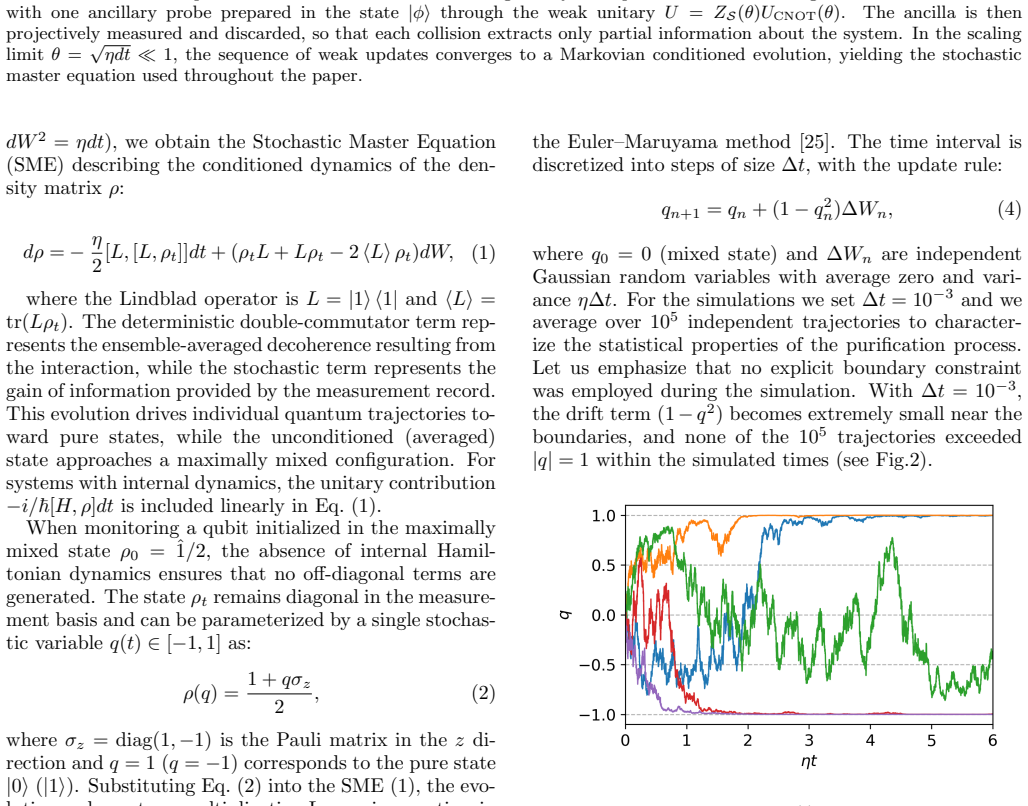
For initial mixed states, the dynamics reduce to a multiplicative Langevin equation for a single scalar parameter representing the state's purity. This stochastic process is solved exactly using the Onsager-Machlup path integral formalism, allowing us to derive the full probability distribution for the qubit's trajectories. Our analytical results reveal that purification is characterized by a dynamical crossover from a diffusion dominated regime to a measurement dominated regime, visible in the emergence of a bimodal state distribution. The analytical solutions are in strong agreement with numerical simulations.
What carries the argument
The multiplicative Langevin equation for the purity scalar, solved exactly by the Onsager-Machlup path-integral formalism.
Load-bearing premise
The collisional model of sequential interactions with ancillary qubits faithfully represents continuous monitoring and the conditioned density-matrix evolution reduces to a single purity scalar without loss of essential information.
What would settle it
Direct numerical integration of the stochastic master equation for the full qubit density matrix would produce statistics of purity trajectories that deviate from the analytically derived probability distribution.
Figures



read the original abstract
We investigate the purification dynamics of a single qubit under continuous in time monitoring. By employing a collisional model framework where the system interacts sequentially with ancillary qubits, we describe the conditioned evolution of the density matrix through a stochastic master equation. We show that for initial mixed states, the dynamics reduce to a multiplicative Langevin equation for a single scalar parameter representing the state's purity. This stochastic process is solved exactly using the Onsager-Machlup path integral formalism, allowing us to derive the full probability distribution for the qubit's trajectories. Our analytical results reveal that purification is characterized by a dynamical crossover from a diffusion dominated regime to a measurement dominated regime, visible in the emergence of a bimodal state distribution. The analytical solutions are in strong agreement with numerical simulations, providing a robust theoretical benchmark for the study of information extraction in monitored quantum systems.
Editorial analysis
A structured set of objections, weighed in public.
Referee Report
Summary. The paper investigates the purification of a monitored qubit using a collisional model that leads to a stochastic master equation. It claims that for initial mixed states, the dynamics reduce exactly to a multiplicative Langevin equation for the purity parameter, which is then solved exactly using the Onsager-Machlup path-integral formalism to obtain the full probability distribution of the qubit's trajectories. The results show a dynamical crossover from diffusion-dominated to measurement-dominated regimes, with the analytical solutions agreeing strongly with numerical simulations.
Significance. If the central reduction holds, this provides an exact analytical tool for computing trajectory distributions in continuously monitored quantum systems, which is a significant contribution to the field of quantum trajectories and open quantum systems. The path-integral approach allows for closed-form expressions that can serve as benchmarks for numerical methods and could inspire similar treatments in higher-dimensional systems.
major comments (2)
- [§3] §3 (Reduction to Langevin equation): The claim that the stochastic master equation reduces to a closed multiplicative Langevin equation solely in the purity p is problematic. For standard continuous monitoring of σ_z, the Itô SDE for p = Tr(ρ²) includes a drift term -2γ(r_x² + r_y²)dt that depends on the separate value of r_z (specifically -2γ(p - r_z² - 1/2)dt), preventing closure on p alone without additional assumptions such as initial r_x = r_y = 0. This issue must be resolved for the subsequent path-integral solution to be valid.
- [§4] §4 (Path-integral solution): The application of the Onsager-Machlup formalism assumes the SDE is one-dimensional and closed. If the reduction in §3 does not hold for general initial mixed states, the derived probability distribution does not correspond to the actual qubit dynamics and the agreement with numerics may be limited to special cases.
minor comments (3)
- [Abstract] Abstract: Specify the quantitative metric used to claim 'strong agreement' with numerical simulations, such as the L1 distance between distributions or mean-squared error.
- [Introduction] Introduction: Provide more context on how the collisional model approximates continuous monitoring, including the limit taken for the interaction strength and frequency.
- [Figure 1] Figure 1: Ensure the caption clearly explains the parameters used in the plotted distributions and the initial conditions for the mixed states.
Simulated Author's Rebuttal
We thank the referee for their careful reading of the manuscript and for highlighting important points regarding the validity of the reduction to a closed equation for the purity. We address each major comment below and propose revisions to clarify the scope of our results.
read point-by-point responses
-
Referee: [§3] §3 (Reduction to Langevin equation): The claim that the stochastic master equation reduces to a closed multiplicative Langevin equation solely in the purity p is problematic. For standard continuous monitoring of σ_z, the Itô SDE for p = Tr(ρ²) includes a drift term -2γ(r_x² + r_y²)dt that depends on the separate value of r_z (specifically -2γ(p - r_z² - 1/2)dt), preventing closure on p alone without additional assumptions such as initial r_x = r_y = 0. This issue must be resolved for the subsequent path-integral solution to be valid.
Authors: We agree that in general the equation for the purity does not close without additional assumptions. In our work, we restrict to initial mixed states that are diagonal in the measurement basis, i.e., with vanishing transverse Bloch components r_x = r_y = 0. In this case, r_z² = 2p - 1, and the drift term becomes a function of p only, yielding the multiplicative Langevin equation. We will revise §3 and the abstract to explicitly state this initial condition assumption. revision: yes
-
Referee: [§4] §4 (Path-integral solution): The application of the Onsager-Machlup formalism assumes the SDE is one-dimensional and closed. If the reduction in §3 does not hold for general initial mixed states, the derived probability distribution does not correspond to the actual qubit dynamics and the agreement with numerics may be limited to special cases.
Authors: With the clarification that our results apply to initial states with r_x = r_y = 0, the SDE is indeed closed and one-dimensional. The numerical simulations presented in the manuscript use the same class of initial states, and the excellent agreement supports the analytical solution. We will update the manuscript to emphasize that the results are for this specific class of initial mixed states, rather than arbitrary mixed states. revision: yes
Circularity Check
Derivation chain from collisional model to Onsager-Machlup path integral is self-contained; only minor non-load-bearing self-citation possible
full rationale
The paper starts from the standard stochastic master equation obtained via the collisional model, performs an exact reduction of the qubit density-matrix dynamics to a multiplicative Langevin equation in the purity scalar for the stated initial conditions, and then applies the established Onsager-Machlup formalism to obtain the probability distribution. No parameter is fitted to data and then re-labeled as a prediction, no uniqueness theorem is imported from the authors' prior work, and no ansatz is smuggled via self-citation. The central steps are therefore independent of the target result. A score of 2 accounts for the possibility of routine self-citation of the collisional-model framework without that citation carrying the load of the derivation.
Axiom & Free-Parameter Ledger
axioms (1)
- domain assumption The stochastic master equation for continuous monitoring in the collisional model framework accurately describes the conditioned evolution of the qubit density matrix.
Reference graph
Works this paper leans on
-
[1]
Y. Li, X. Chen, and M. P. A. Fisher,Quantum Zeno effect and the many-body entanglement transition, Phys. Rev. B98, 205136 (2018)
work page 2018
-
[2]
B. Skinner, J. Ruhman, and A. Nahum,Measurement- Induced Phase Transitions in the Dynamics of Entangle- ment, Phys. Rev. X9, 031009 (2019)
work page 2019
-
[3]
Y. Li, X. Chen, and M. P. A. Fisher,Measurement- driven entanglement transition in hybrid quantum cir- cuits, Phys. Rev. B100, 134306 (2019)
work page 2019
-
[4]
M. J. Gullans and D. A. Huse,Dynamical purifica- tion phase transition induced by quantum measurements, Phys. Rev. X10, 041020 (2020)
work page 2020
-
[5]
C.-M. Jian, Y.-Z. You, R. Vasseur, and A. W. W. Lud- wig,Measurement-induced criticality in random quantum circuits, Phys. Rev. B101, 104302 (2020)
work page 2020
-
[6]
Schomerus,Noisy monitored quantum dynamics of er- godic multi-qubit systems, J
H. Schomerus,Noisy monitored quantum dynamics of er- godic multi-qubit systems, J. Phys. A: Math. Theor.55, 214001 (2022)
work page 2022
-
[7]
J. M. Deutsch,Quantum statistical mechanics in a closed system, Phys. Rev. A43, 2046–2049 (1991)
work page 2046
-
[8]
Srednicki,Chaos and quantum thermalization, Phys
M. Srednicki,Chaos and quantum thermalization, Phys. Rev. E50, 888–901 (1994)
work page 1994
- [9]
-
[10]
R. Nandkishore and D. A. Huse,Many-Body Localization and Thermalization in Quantum Statistical Mechanics, Annu. Rev. Condens. Matter Phys.6, 15–38 (2015)
work page 2015
-
[11]
G. Grimmett,Percolation, 2nd ed. (Springer-Verlag, Berlin, 1999)
work page 1999
-
[12]
R. Vasseur, A. C. Potter, Y.-Z. You, and A. W. W. Lud- wig,Entanglement transitions from holographic random tensor networks, Phys. Rev. B100, 134203 (2019)
work page 2019
-
[13]
A. C. Potter and R. Vasseur, inEntanglement in Spin Chains(Springer International Publishing, 2022), pp. 211–249
work page 2022
-
[14]
K. Jacobs and D. A. Steck,A straightforward intro- duction to continuous quantum measurement, Contemp. Phys.47, 279–303 (2006)
work page 2006
-
[15]
H. M. Wiseman and G. J. Milburn,Quantum Measure- ment and Control(Cambridge University Press, 2010)
work page 2010
-
[16]
Jacobs,How to project qubits faster using quantum feedback, Phys
K. Jacobs,How to project qubits faster using quantum feedback, Phys. Rev. A67, 030301 (2003)
work page 2003
-
[17]
A. N. Korotkov,Selective quantum evolution of a qubit state due to continuous measurement, Phys. Rev. B63, 115403 (2001)
work page 2001
-
[18]
T. A. Brun,A simple model of quantum trajectories, Am. J. Phys.70, 719–737 (2002)
work page 2002
-
[19]
H. M. Wiseman,Quantum trajectories and quantum mea- surement theory, Quantum Semiclass. Opt.8, 205–222 (1996)
work page 1996
-
[20]
F. Ciccarello, S. Lorenzo, V. Giovannetti, and G. M. Palma,Quantum collision models: Open system dynam- ics from repeated interactions, Phys. Rep.954, 1–70 (2022)
work page 2022
-
[21]
L. Onsager and S. Machlup,Fluctuations and Irreversible Processes, Phys. Rev.91, 1505–1512 (1953)
work page 1953
-
[22]
S. Machlup and L. Onsager,Fluctuations and Irreversible Process. II. Systems with Kinetic Energy, Phys. Rev.91, 1512–1515 (1953)
work page 1953
-
[23]
L. F. Cugliandolo and V. Lecomte,Rules of calculus in the path integral representation of white noise Langevin equations: the Onsager–Machlup approach, J. Phys. A: Math. Theor.50, 345001 (2017)
work page 2017
-
[24]
T. de Pirey, L. F. Cugliandolo, V. Lecomte, and F. van Wijland,Path integrals and stochastic calculus, Adv. Phys.71, 1–85 (2022)
work page 2022
-
[25]
Maruyama,Continuous Markov processes and stochastic equations, Rend
G. Maruyama,Continuous Markov processes and stochastic equations, Rend. Circ. Mat. Palermo4, 48–90 (1955)
work page 1955
-
[26]
V. E. Beneˇ s,Exact finite-dimensional filters for certain diffusions with nonlinear drift, Stochastics5(1–2), 65–92 (1981)
work page 1981
-
[27]
S. S¨ arkk¨ a and A. Solin,Applied stochastic differential equations, Cambridge University Press (2019)
work page 2019
-
[28]
I. V. Girsanov,On transforming a certain class of stochastic processes by absolutely continuous substitution of measures, Theory Probab. Appl.5, 285–301 (1960)
work page 1960
-
[29]
Risken,The Fokker–Planck Equation: Methods of So- lution and Applications, 2nd ed
H. Risken,The Fokker–Planck Equation: Methods of So- lution and Applications, 2nd ed. (Springer, Berlin, 1989)
work page 1989
-
[30]
C. W. Gardiner,Handbook of Stochastic Methods (Springer-Verlag, Berlin, 1985)
work page 1985
-
[31]
N. G. Van Kampen,Stochastic Processes in Physics and Chemistry(Elsevier Science, Amsterdam, 2011)
work page 2011
-
[32]
A. Patel and P. Kumar,Weak measurements, quantum state collapse, and the Born rule, Phys. Rev. A92, 022115 (2015)
work page 2015
discussion (0)
Sign in with ORCID, Apple, or X to comment. Anyone can read and Pith papers without signing in.