Recognition: 1 theorem link
· Lean TheoremUltrafast electron dynamics of electron-irradiated graphene
Pith reviewed 2026-05-14 20:41 UTC · model grok-4.3
The pith
Quantum mechanical effects cause significant differences in backscattered electron yields from graphene at around 400 eV incident energy.
A machine-rendered reading of the paper's core claim, the machinery that carries it, and where it could break.
Core claim
The simulations show that around 400 eV incident energy there are significant differences in backscattered electron yields between classical point-charge and quantum wave-packet descriptions of the incident electron, while the quantum-mechanical effects diminish at incident energies above 600 eV. These differences highlight the critical importance of quantum effects in electron irradiation phenomena in that specific energy range. The results provide guidance for selecting appropriate incident electron descriptions based on kinetic-energy regimes.
What carries the argument
First-principles simulations that model the incident electron as either a classical point-charge or a quantum wave-packet and track resulting differences in kinetic energy loss, secondary electron emission, and backscattered yields.
Load-bearing premise
The first-principles simulations fully capture the physical distinction between classical and quantum incident-electron dynamics without omitting important interaction channels that could erase the reported differences in yields.
What would settle it
An experiment measuring backscattered electron yields from graphene at 400 eV incident energy that finds yields matching the classical prediction exactly, with no measurable difference from the quantum prediction, would falsify the claim of significant quantum effects in that range.
Figures



read the original abstract
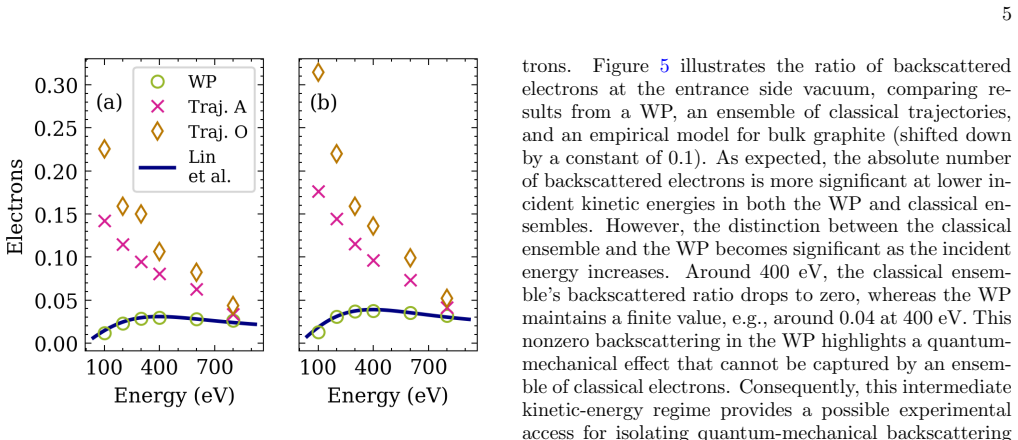
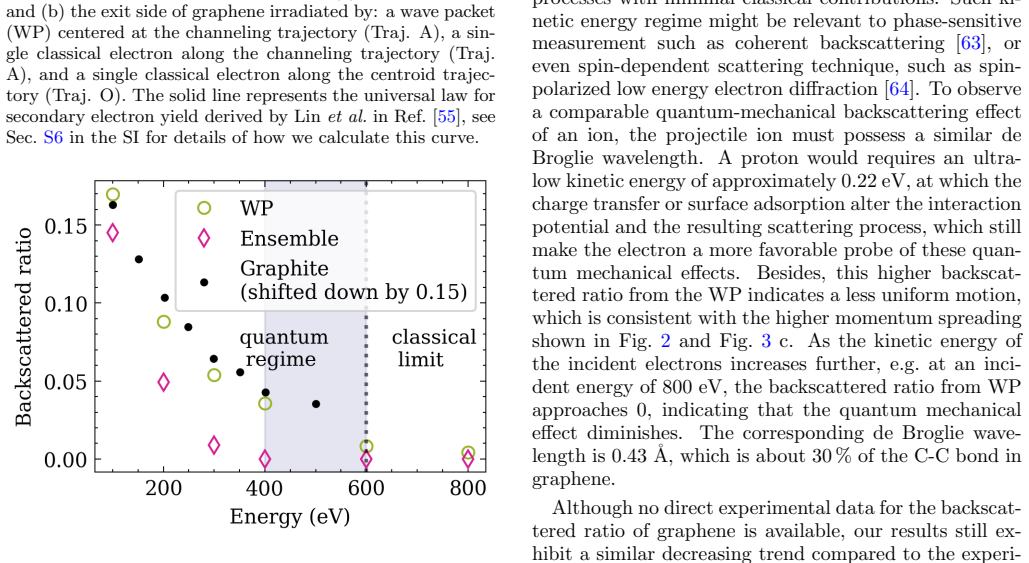
Electron irradiation is essential for materials characterization and modification, though the fundamental interactions between incident electrons and host materials remain under investigation. Here, we employ first-principles simulations to study electron dynamics under external electron irradiation. We quantify differences in key observables, including kinetic energy loss, secondary electron emission, and backscattered electrons, between classical and quantum mechanical descriptions of the incident electron. Around 400 eV incident energy, we identify significant differences in backscattered electron yields between classical point-charge and quantum wave-packet descriptions, whereas the quantum-mechanical effects diminish at incident energies above 600 eV. These differences highlight the critical importance of quantum effects in electron irradiation phenomena that occur in a specific energy range of the incident electron. Our results provide clear guidance for selecting appropriate incident, electron descriptions based on kinetic-energy regimes, identify a targeted experimental window for isolating quantum-only backscattering, and enable the rational design of 2D materials for nanofabrication and high-resolution electron-beam technologies.
Editorial analysis
A structured set of objections, weighed in public.
Referee Report
Summary. The manuscript employs first-principles simulations to compare classical point-charge and quantum wave-packet treatments of incident electrons interacting with graphene. It reports significant differences in backscattered electron yields around 400 eV incident energy that diminish above 600 eV, alongside comparisons of kinetic energy loss and secondary electron emission between the two descriptions.
Significance. If the central comparison holds after verification, the work identifies a targeted energy regime in which quantum effects are non-negligible for electron-irradiation modeling of 2D materials. This supplies practical guidance for choosing simulation descriptions in electron-beam nanofabrication and high-resolution imaging applications.
major comments (3)
- [Abstract and §2] Abstract and §2 (Methods): the headline claim of yield differences at 400 eV requires explicit documentation of wave-packet initialization (width, momentum spread, centering), propagation scheme, and basis-set/supercell convergence; none of these parameters or tests appear, leaving open the possibility that the reported gap is a numerical artifact rather than a physical distinction.
- [§3] §3 (Results): no quantitative error bars, ensemble statistics, or extraction protocols are supplied for the backscattered yield, secondary-electron count, or energy-loss spectra; without these, the magnitude and statistical significance of the classical–quantum difference cannot be assessed.
- [§4] §4 (Discussion): the assertion that quantum effects vanish above 600 eV assumes completeness of elastic and inelastic channels (plasmon, core-loss, etc.); the manuscript provides no test that omitted channels would not reintroduce differences at higher energies.
minor comments (2)
- [Figures] Figure 2 and 3 captions omit the precise simulation parameters (k-point sampling, time step, packet width) used for each data set, hindering reproducibility.
- [Abstract] A typographical error appears in the abstract: 'incident, electron' contains an extraneous comma.
Simulated Author's Rebuttal
We thank the referee for their constructive and detailed comments, which have identified important areas for improving the clarity, reproducibility, and rigor of our manuscript. We address each major comment below and will revise the manuscript accordingly.
read point-by-point responses
-
Referee: [Abstract and §2] Abstract and §2 (Methods): the headline claim of yield differences at 400 eV requires explicit documentation of wave-packet initialization (width, momentum spread, centering), propagation scheme, and basis-set/supercell convergence; none of these parameters or tests appear, leaving open the possibility that the reported gap is a numerical artifact rather than a physical distinction.
Authors: We agree that these details are required for full reproducibility and to rule out numerical artifacts. In the revised manuscript we will expand §2 with a dedicated subsection that specifies the wave-packet width, momentum spread, and centering procedure, describes the time-propagation scheme, and reports explicit basis-set and supercell convergence tests performed at the relevant energies. These additions will confirm that the reported classical–quantum differences at ~400 eV are physical. revision: yes
-
Referee: [§3] §3 (Results): no quantitative error bars, ensemble statistics, or extraction protocols are supplied for the backscattered yield, secondary-electron count, or energy-loss spectra; without these, the magnitude and statistical significance of the classical–quantum difference cannot be assessed.
Authors: We acknowledge the absence of statistical measures in the current version. The revised manuscript will include ensemble averages and standard deviations (error bars) obtained from multiple independent wave-packet realizations with randomized initial phases or positions. We will also add a clear description of the post-processing protocols used to extract backscattered yields, secondary-electron counts, and energy-loss spectra, enabling quantitative assessment of the differences. revision: yes
-
Referee: [§4] §4 (Discussion): the assertion that quantum effects vanish above 600 eV assumes completeness of elastic and inelastic channels (plasmon, core-loss, etc.); the manuscript provides no test that omitted channels would not reintroduce differences at higher energies.
Authors: This is a fair concern about model completeness. In the revision we will add a paragraph to §4 that discusses the expected magnitude of omitted channels (plasmon excitations, core-loss) at energies above 600 eV, supported by order-of-magnitude estimates from our first-principles framework. We will argue that these channels do not restore significant classical–quantum distinctions in the backscattering yield within the energy range examined; if additional resources permit, limited test calculations will be included to support this statement. revision: partial
Circularity Check
No significant circularity in simulation-based quantum-classical comparison
full rationale
The paper's central results derive from direct first-principles simulations that compare classical point-charge and quantum wave-packet treatments of the incident electron, producing observables such as backscattered yields as simulation outputs. No equations or claims reduce a prediction to a fitted input by construction, no self-citation is invoked as a uniqueness theorem or load-bearing premise, and no ansatz is smuggled via prior work. The derivation chain is self-contained against the computational setup and external benchmarks.
Axiom & Free-Parameter Ledger
axioms (1)
- domain assumption First-principles simulations accurately capture the quantum versus classical distinction for electron-irradiation observables in graphene.
Lean theorems connected to this paper
-
IndisputableMonolith/Cost/FunctionalEquation.leanwashburn_uniqueness_aczel unclear?
unclearRelation between the paper passage and the cited Recognition theorem.
We employ real-time time-dependent density functional theory (rt-TDDFT) ... Gaussian wave packet (WP) ... classical electron projectile is represented by a pseudopotential
What do these tags mean?
- matches
- The paper's claim is directly supported by a theorem in the formal canon.
- supports
- The theorem supports part of the paper's argument, but the paper may add assumptions or extra steps.
- extends
- The paper goes beyond the formal theorem; the theorem is a base layer rather than the whole result.
- uses
- The paper appears to rely on the theorem as machinery.
- contradicts
- The paper's claim conflicts with a theorem or certificate in the canon.
- unclear
- Pith found a possible connection, but the passage is too broad, indirect, or ambiguous to say the theorem truly supports the claim.
Reference graph
Works this paper leans on
-
[1]
Ciston, H
J. Ciston, H. G. Brown, A. J. D’Alfonso, P. Koirala, C. Ophus, Y. Lin, Y. Suzuki, H. Inada, Y. Zhu, L. J. Allen, and L. D. Marks, Surface determination through atomically resolved secondary-electron imaging, Nature Communications6, 7358 (2015)
2015
-
[2]
J. C. Meyer, C. O. Girit, M. F. Crommie, and A. Zettl, Imaging and dynamics of light atoms and molecules on graphene, Nature454, 319 (2008)
2008
-
[3]
P. Y. Huang, C. S. Ruiz-Vargas, A. M. Van Der Zande, W. S. Whitney, M. P. Levendorf, J. W. Kevek, S. Garg, J. S. Alden, C. J. Hustedt, Y. Zhu, J. Park, P. L. McEuen, and D. A. Muller, Grains and grain boundaries in single- layer graphene atomic patchwork quilts, Nature469, 389 (2011)
2011
-
[4]
P. Y. Huang, S. Kurasch, J. S. Alden, A. Shekhawat, A. A. Alemi, P. L. McEuen, J. P. Sethna, U. Kaiser, and D. A. Muller, Imaging Atomic Rearrangements in Two-Dimensional Silica Glass: Watching Silica’s Dance, Science342, 224 (2013)
2013
-
[5]
J. Wu, W. Gao, H. Yang, and J.-M. Zuo, Dissolution Kinetics of Oxidative Etching of Cubic and Icosahe- dral Platinum Nanoparticles Revealed byin SituLiquid Transmission Electron Microscopy, ACS Nano11, 1696 (2017)
2017
-
[6]
P. Lu, R. L. Yuan, J. F. Ihlefeld, E. D. Spoerke, W. Pan, and J. M. Zuo, Fast Atomic-Scale Chemical Imaging of Crystalline Materials and Dynamic Phase Transforma- tions, Nano Letters16, 2728 (2016)
2016
-
[7]
K. X. Nguyen, Y. Jiang, C.-H. Lee, P. Kharel, Y. Zhang, A. M. Van Der Zande, and P. Y. Huang, Achieving sub- 0.5-angstrom–resolution ptychography in an uncorrected electron microscope, Science383, 865 (2024)
2024
-
[8]
J. I. Goldstein, D. E. Newbury, P. Echlin, D. C. Joy, C. E. Lyman, E. Lifshin, L. Sawyer, and J. R. Michael, Scanning Electron Microscopy and X-ray Microanalysis: Third Edition(Springer US, Boston, MA, 2003)
2003
-
[9]
Jesse, A
S. Jesse, A. Y. Borisevich, J. D. Fowlkes, A. R. Lupini, P. D. Rack, R. R. Unocic, B. G. Sumpter, S. V. Kalinin, A. Belianinov, and O. S. Ovchinnikova, Directing Matter: Toward Atomic-Scale 3D Nanofabrication, ACS Nano10, 5600 (2016)
2016
-
[10]
O. Dyck, M. Ziatdinov, D. B. Lingerfelt, R. R. Unocic, B. M. Hudak, A. R. Lupini, S. Jesse, and S. V. Kalinin, Atom-by-atom fabrication with electron beams, Nature Reviews Materials4, 497 (2019)
2019
-
[11]
I. Utke, P. Hoffmann, and J. Melngailis, Gas-assisted fo- cused electron beam and ion beam processing and fab- rication, Journal of Vacuum Science & Technology B: Microelectronics and Nanometer Structures Processing, Measurement, and Phenomena26, 1197 (2008)
2008
-
[12]
W. F. Van Dorp and C. W. Hagen, A critical literature re- view of focused electron beam induced deposition, Jour- nal of Applied Physics104, 081301 (2008)
2008
-
[13]
R. K. Retsuo Kawakami, J. K. Jun Kawata, and K. O. Kaoru Ohya, Simultaneous Calculation of Reflection, Physical Sputtering and Secondary Electron Emission from a Metal Surface due to Impact of Low-Energy Ions, Japanese Journal of Applied Physics38, 6058 (1999)
1999
-
[14]
S. A. Schwarz, Application of a semi-empirical sputtering model to secondary electron emission, Journal of Applied Physics68, 2382 (1990)
1990
-
[15]
Schlueter, K
K. Schlueter, K. Nordlund, G. Hobler, M. Balden, F. Granberg, O. Flinck, T. F. Da Silva, and R. Neu, Ab- sence of a Crystal Direction Regime in which Sputtering Corresponds to Amorphous Material, Physical Review Letters125, 225502 (2020)
2020
-
[16]
Z. Wang, Y. Zhou, J. Bang, M. Prange, S. Zhang, and F. Gao, Modification of Defect Structures in Graphene by Electron Irradiation: Ab Initio Molecular Dynamics Simulations, The Journal of Physical Chemistry C116, 16070 (2012)
2012
-
[17]
T. M. Rodgers, J. D. Madison, V. Tikare, and M. C. Maguire, Predicting Mesoscale Microstructural Evolu- tion in Electron Beam Welding, JOM68, 1419 (2016)
2016
-
[18]
Zakirov, S
A. Zakirov, S. Belousov, M. Bogdanova, B. Korneev, A. Stepanov, A. Perepelkina, V. Levchenko, A. Meshkov, and B. Potapkin, Predictive modeling of laser and elec- tron beam powder bed fusion additive manufacturing of metals at the mesoscale, Additive Manufacturing35, 101236 (2020)
2020
-
[19]
Yasuda, Y
M. Yasuda, Y. Kimoto, K. Tada, H. Mori, S. Akita, Y. Nakayama, and Y. Hirai, Molecular dynamics study of electron-irradiation effects in single-walled carbon nan- otubes, Physical Review B75, 205406 (2007)
2007
-
[20]
Lacombe, Y
L. Lacombe, Y. Suzuki, K. Watanabe, and N. T. Maitra, Electron scattering in time-dependent density functional theory, The European Physical Journal B91, 96 (2018)
2018
-
[21]
Suzuki, L
Y. Suzuki, L. Lacombe, K. Watanabe, and N. T. Maitra, Exact Time-Dependent Exchange-Correlation Potential in Electron Scattering Processes, Physical Review Letters 119, 263401 (2017)
2017
-
[22]
Suzuki, R
Y. Suzuki, R. Nagai, and J. Haruyama, Machine learn- ing exchange-correlation potential in time-dependent density-functional theory, Physical Review A101, 050501 (2020)
2020
-
[23]
Van Faassen, A
M. Van Faassen, A. Wasserman, E. Engel, F. Zhang, and K. Burke, Time-Dependent Density Functional Calcu- lation of e - H Scattering, Physical Review Letters99, 043005 (2007)
2007
-
[24]
J.-A. Yan, J. A. Driscoll, B. K. Wyatt, K. Varga, and S. T. Pantelides, Time-domain simulation of electron diffraction in crystals, Physical Review B84, 224117 (2011)
2011
-
[25]
Tsubonoya, C
K. Tsubonoya, C. Hu, and K. Watanabe, Time- dependent density-functional theory simulation of elec- tron wave-packet scattering with nanoflakes, Physical Re- view B90, 035416 (2014)
2014
-
[26]
Y. Ueda, Y. Suzuki, and K. Watanabe, Quantum dynam- 8 ics of secondary electron emission from nanographene, Physical Review B94, 035403 (2016)
2016
-
[27]
Y. Ueda, Y. Suzuki, and K. Watanabe, Time-dependent first-principles study of angle-resolved secondary elec- tron emission from atomic sheets, Physical Review B97, 075406 (2018)
2018
-
[28]
Miyauchi, Y
H. Miyauchi, Y. Ueda, Y. Suzuki, and K. Watanabe, Electron transmission through bilayer graphene: A time- dependent first-principles study, Physical Review B95, 125425 (2017)
2017
-
[29]
X. Yao, Y. Lee, D. Ceresoli, and K. Cho, First-Principles Study on Electron-Induced Excitations of Atomic Layer Deposition Precursors: Inelastic Electron Wave Packet Scattering with Cobalt Tricarbonyl Nitrosyl Co(CO) 3 NO Using Time-Dependent Density Functional Theory, The Journal of Physical Chemistry A125, 4524 (2021)
2021
-
[30]
M. Gao, X. Lang, Z. Zheng, C. Yu, Z. Xu, and X. Yao, Real-Time Time-Dependent Density Functional Theory Study of Inelastic Electron Scattering: Energy Transfer in Tetracarbonyl Nickel Molecule Reactions, The Journal of Physical Chemistry Letters16, 1461 (2025)
2025
-
[31]
Tonzani and C
S. Tonzani and C. H. Greene, Low-energy electron scat- tering from DNA and RNA bases: Shape resonances and radiation damage, The Journal of Chemical Physics124, 054312 (2006)
2006
-
[32]
Schleife, Y
A. Schleife, Y. Kanai, and A. A. Correa, Accurate atom- istic first-principles calculations of electronic stopping, Physical Review B91, 014306 (2015)
2015
-
[33]
A. A. Correa, Calculating electronic stopping power in materials from first principles, Computational Materials Science150, 291 (2018)
2018
-
[34]
A. A. Correa, J. Kohanoff, E. Artacho, D. S´ anchez- Portal, and A. Caro, Nonadiabatic Forces in Ion-Solid Interactions: The Initial Stages of Radiation Damage, Physical Review Letters108, 213201 (2012)
2012
-
[35]
Nordlund, Molecular dynamics simulation of ion ranges in the 1–100 keV energy range, Computational Materials Science3, 448 (1995)
K. Nordlund, Molecular dynamics simulation of ion ranges in the 1–100 keV energy range, Computational Materials Science3, 448 (1995)
1995
-
[36]
Ullah, E
R. Ullah, E. Artacho, and A. A. Correa, Core Electrons in the Electronic Stopping of Heavy Ions, Physical Review Letters121, 116401 (2018)
2018
-
[37]
A. E. Sand, R. Ullah, and A. A. Correa, Heavy ion ranges from first-principles electron dynamics, npj Computa- tional Materials5, 43 (2019)
2019
-
[38]
Y. Yao, A. Kononov, A. Metzlaff, A. Wucher, L. Kalkhoff, L. Breuer, M. Schleberger, and A. Schleife, Nonequilibrium Dynamics of Electron Emission from Cold and Hot Graphene under Proton Irradiation, Nano Letters , acs.nanolett.4c00356 (2024)
2024
-
[39]
Kononov and A
A. Kononov and A. Schleife, Anomalous Stopping and Charge Transfer in Proton-Irradiated Graphene, Nano Letters21, 4816 (2021)
2021
-
[40]
V´ azquez, A
H. V´ azquez, A. Kononov, A. Kyritsakis, N. Medvedev, A. Schleife, and F. Djurabekova, Electron cascades and secondary electron emission in graphene under energetic ion irradiation, Physical Review B103, 224306 (2021)
2021
-
[41]
Kononov, A
A. Kononov, A. Olmstead, A. D. Baczewski, and A. Schleife, First-principles simulation of light-ion mi- croscopy of graphene, 2D Materials9, 045023 (2022)
2022
-
[42]
W. He, C. Chen, and Z. Xu, Electronic excitation in graphene under single-particle irradiation, Nanotechnol- ogy32, 165702 (2021)
2021
-
[43]
Zhang, Y
H. Zhang, Y. Miyamoto, and A. Rubio,Ab InitioSimula- tion of Helium-Ion Microscopy Images: The Case of Sus- pended Graphene, Physical Review Letters109, 265505 (2012)
2012
-
[44]
Guichard, A
P. Guichard, A. Dochain, R. Marion, P. D. C. De Pic- quendaele, N. Lejeune, B. Hackens, P.-A. Hervieux, and X. Urbain, Fast Hydrogen Atom Diffraction through Monocrystalline Graphene, Physical Review Letters135, 263403 (2025)
2025
-
[45]
D. C. Yost, Y. Yao, and Y. Kanai, Examining real- time time-dependent density functional theory nonequi- librium simulations for the calculation of electronic stop- ping power, Physical Review B96, 115134 (2017)
2017
-
[46]
Lee and A
C.-W. Lee and A. Schleife, Hot-Electron-Mediated Ion Diffusion in Semiconductors for Ion-Beam Nanostructur- ing, Nano Letters19, 3939 (2019)
2019
-
[47]
C.-W. Lee, J. A. Stewart, R. Dingreville, S. M. Foiles, and A. Schleife, Multiscale simulations of electron and ion dynamics in self-irradiated silicon, Physical Review B102, 024107 (2020)
2020
-
[48]
Kononov and A
A. Kononov and A. Schleife, Pre-equilibrium stop- ping and charge capture in proton-irradiated aluminum sheets, Physical Review B102, 165401 (2020)
2020
-
[49]
Andrade, C
X. Andrade, C. D. Pemmaraju, A. Kartsev, J. Xiao, A. Lindenberg, S. Rajpurohit, L. Z. Tan, T. Ogitsu, and A. A. Correa,Inq, a Modern GPU-Accelerated Compu- tational Framework for (Time-Dependent) Density Func- tional Theory, Journal of Chemical Theory and Compu- tation17, 7447 (2021)
2021
-
[50]
Zangwill and P
A. Zangwill and P. Soven, Resonant Photoemission in Barium and Cerium, Physical Review Letters45, 204 (1980)
1980
-
[51]
Zangwill and P
A. Zangwill and P. Soven, Resonant two-electron excita- tion in copper, Physical Review B24, 4121 (1981)
1981
-
[52]
D. R. Hamann, Optimized norm-conserving Vanderbilt pseudopotentials, Physical Review B88, 085117 (2013)
2013
-
[53]
Ojanper¨ a, A
A. Ojanper¨ a, A. V. Krasheninnikov, and M. Puska, Elec- tronic stopping power from first-principles calculations with account for core electron excitations and projectile ionization, Physical Review B89, 035120 (2014)
2014
-
[54]
D. C. Yost and Y. Kanai, Electronic stopping for protons andαparticles from first-principles electron dynamics: The case of silicon carbide, Physical Review B94, 115107 (2016)
2016
-
[55]
Lin and D
Y. Lin and D. C. Joy, A new examination of secondary electron yield data, Surface and Interface Analysis37, 895 (2005)
2005
-
[56]
Seiler, Secondary electron emission in the scanning electron microscope, Journal of Applied Physics54, R1 (1983)
H. Seiler, Secondary electron emission in the scanning electron microscope, Journal of Applied Physics54, R1 (1983)
1983
-
[57]
Bundaleska, A
N. Bundaleska, A. Dias, N. Bundaleski, E. Felizardo, J. Henriques, D. Tsyganov, M. Abrashev, E. Valcheva, J. Kissovski, A. M. Ferraria, A. M. B. Do Rego, A. Almeida, J. Zavaˇ snik, U. Cvelbar, O. M. N. D. Teodoro, Th. Strunskus, and E. Tatarova, Prospects for microwave plasma synthesized N-graphene in secondary electron emission mitigation applications, S...
2020
-
[58]
J. Wang, Y. Wang, Y. Xu, Y. Zhang, B. Zhang, and W. Wei, Secondary electron emission characteristics of graphene films with copper substrate, Chinese Physics C 40, 117003 (2016)
2016
-
[59]
G.-B. Feng, Y. Li, X.-J. Li, G.-B. Xie, and L. Liu, Char- acteristics of secondary electron emission from few layer graphene on silicon (111) surface, Chinese Physics B31, 107901 (2022). S1
2022
-
[60]
Walker, M
C. Walker, M. El-Gomati, A. Assa’d, and M. Zadraˇ zil, The secondary electron emission yield for 24 solid ele- ments excited by primary electrons in the range 250–5000 ev: A theory/experiment comparison, Scanning30, 365 (2008)
2008
-
[61]
Da, and Z
Mehnaz, B. Da, and Z. J. Ding, Exploring the absolute yield curve of secondary electrons using machine learn- ing methods, Physical Chemistry Chemical Physics25, 17238 (2023)
2023
-
[62]
Farhang, E
H. Farhang, E. Napchan, and B. H. Blott, Electron backscattering and secondary electron emission from car- bon targets: Comparison of experimental results with Monte Carlo simulations, Journal of Physics D: Applied Physics26, 2266 (1993)
1993
-
[63]
M. J. Berry, J. H. Baskey, R. M. Westervelt, and A. C. Gossard, Coherent electronic backscattering in ballistic microstructures, Physical Review B50, 8857 (1994)
1994
-
[64]
R Feder, Spin-polarised low-energy electron diffraction, Journal of Physics C: Solid State Physics14, 2049 (1981)
2049
-
[65]
Bouchard and J
C. Bouchard and J. Carette, The surface potential bar- rier in secondary emission from semiconductors, Surface Science100, 251 (1980)
1980
-
[66]
L. Ward, B. Blaiszik, C.-W. Lee, T. Martin, I. Fos- ter, and A. Schleife, Accelerating multiscale electronic stopping power predictions with time-dependent density functional theory and machine learning, npj Computa- tional Materials10, 214 (2024)
2024
-
[67]
Kononov, C.-W
A. Kononov, C.-W. Lee, T. P. Dos Santos, B. Robin- son, Y. Yao, Y. Yao, X. Andrade, A. D. Baczewski, E. Constantinescu, A. A. Correa, Y. Kanai, N. Modine, and A. Schleife, Electron dynamics in extended systems within real-time time-dependent density-functional the- ory, MRS Communications12, 1002 (2022)
2022
-
[68]
De Giovannini, A
U. De Giovannini, A. H. Larsen, and A. Rubio, Mod- eling electron dynamics coupled to continuum states in finite volumes with absorbing boundaries, The European Physical Journal B88, 56 (2015). S2 Figure S1. The deflection angle of classical electrons impacting an isolated H 0.9+, to mimic the hydrogen nucleus. The solid lines denote the analytical soluti...
2015
discussion (0)
Sign in with ORCID, Apple, or X to comment. Anyone can read and Pith papers without signing in.