Recognition: unknown
Ultraviolet plastic scintillators based on naphthalene-doped polystyrene and polyvinyltoluene
Pith reviewed 2026-05-14 18:54 UTC · model grok-4.3
The pith
Naphthalene doping in polyvinyltoluene scintillators retains more light yield after proton irradiation than polystyrene versions.
A machine-rendered reading of the paper's core claim, the machinery that carries it, and where it could break.
Core claim
Naphthalene acts as an effective ultraviolet emission enhancer when incorporated into polystyrene and polyvinyltoluene, raising photoluminescence intensity and scintillation light yield while producing a dominant slow decay component around 87 ns; after proton exposure, naphthalene-doped polyvinyltoluene retains a larger share of its initial light yield than the corresponding polystyrene scintillators.
What carries the argument
Naphthalene doping within polystyrene and polyvinyltoluene polymer chains that shifts emission spectra, lengthens decay times, and improves post-irradiation light-yield retention in the polyvinyltoluene host.
If this is right
- Doped polyvinyltoluene can serve as the active medium in compact ultraviolet-sensitive detectors placed near particle sources.
- The bimodal emission profile offers wavelength-specific signal channels that undoped polymers lack.
- Radiation tolerance improvement in doped polyvinyltoluene directly supports longer operational lifetimes in accelerator or space environments.
- Undoped matrices deliver only moderate performance, so doping becomes a necessary step to reach usable light output levels.
Where Pith is reading between the lines
- The same doping strategy might be tested with other primary particles or gamma rays to check whether the retention advantage generalizes beyond protons.
- The 87 ns slow component could limit timing precision in applications that require fast coincidence detection.
- Combining naphthalene with secondary wavelength shifters might further tune the output spectrum for specific photomultiplier sensitivities.
Load-bearing premise
The measured gains in light yield and radiation tolerance stem primarily from the naphthalene dopant itself rather than uncontrolled differences in sample preparation or test conditions.
What would settle it
Repeating the proton irradiation on newly fabricated samples with identical naphthalene concentrations but altered solvent or curing protocols that erase the retention advantage in polyvinyltoluene would falsify the doping-attribution claim.
Figures



read the original abstract
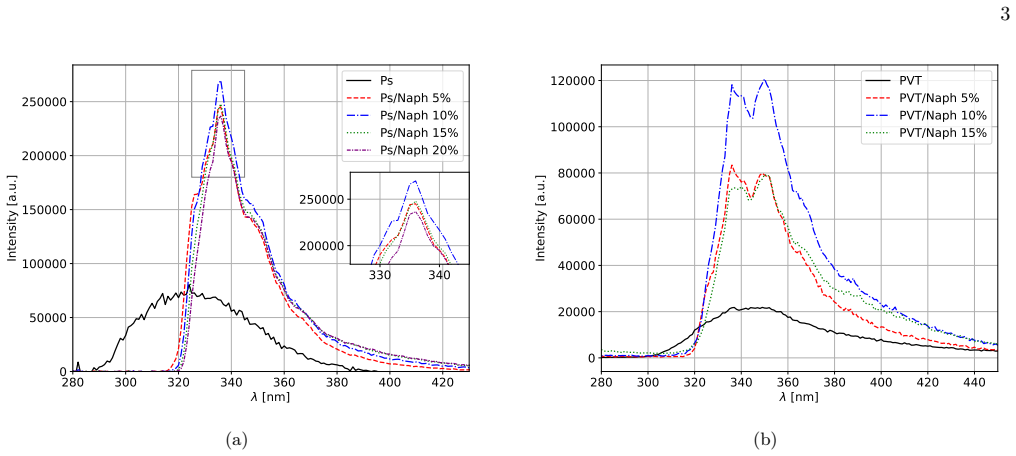
This work reports the fabrication and optical characterization of ultraviolet-emitting plastic scintillators based on polystyrene [-(CH2-CH(C6H5))n-] and polyvinyltoluene [-(CH2-CH(C6H4CH3))n-] doped with different concentrations of naphthalene (Naph). Photoluminescence (PL) measurements show that Naph incorporation enhances the emission intensity, inducing a red shift in the emission wavelength of the polystyrene (PS), while Naph-doped polyvinyltoluene (PVT) exhibits a bimodal emission with peaks around 335 and 350 nm. Time-resolved photoluminescence (TRPL) reveals fast decay components for the undoped matrices and a dominant slow component of approximately 87 ns in the doped samples. Scintillation light yield measurements indicate moderate performance for the undoped polymers and a significant enhancement upon Naph doping. Proton irradiation experiments reveal a reduction in light yield for all samples, with Naph-doped PVT retaining a larger fraction of its initial light yield compared to PS-based scintillators, indicating improved radiation tolerance. Overall, these results demonstrate the effectiveness of Naph as a UV emission enhancer and highlight Naph-doped PVT as a promising candidate for compact and radiation-resistant scintillation detectors.
Editorial analysis
A structured set of objections, weighed in public.
Referee Report
Summary. The manuscript reports fabrication and optical characterization of UV-emitting plastic scintillators using polystyrene and polyvinyltoluene matrices doped with varying concentrations of naphthalene. Key claims include enhanced photoluminescence intensity and red-shifted emission in Naph-doped PS, bimodal emission in Naph-doped PVT, fast decay in undoped matrices versus a dominant ~87 ns slow component in doped samples, improved scintillation light yield upon doping, and superior post-proton-irradiation light-yield retention for Naph-doped PVT relative to PS-based samples, indicating better radiation tolerance.
Significance. If the central claims are substantiated with adequate controls, the work would provide useful experimental data on naphthalene as a UV emission enhancer and on matrix-dependent radiation tolerance in plastic scintillators, potentially aiding development of compact detectors for high-radiation environments. The multi-technique approach (PL, TRPL, light-yield, and irradiation testing) is appropriate for the field, though the current lack of quantitative controls and statistics limits the strength of attribution to naphthalene doping itself.
major comments (3)
- [Proton irradiation experiments] Proton irradiation experiments: no quantitative fluence, absorbed-dose normalization procedure, or confirmation that all samples shared identical thickness and optical coupling is provided. These details are required to support the claim that Naph-doped PVT retains a larger fraction of initial light yield, as differences could arise from matrix-dependent fabrication artifacts or setup variations rather than doping.
- [Scintillation light yield measurements and irradiation results] Light-yield and irradiation results: absence of reported sample sizes, error bars, or statistical measures of variability makes it impossible to determine whether the observed retention difference exceeds sample-to-sample fabrication or measurement scatter, weakening the radiation-tolerance comparison.
- [Experimental methods / sample preparation] Sample fabrication and doping: exact naphthalene concentrations, polymer molecular weights, and any controls for thickness uniformity or optical quality across PS and PVT batches are not specified. Without these, attribution of PL intensity enhancement and radiation tolerance improvements primarily to naphthalene (rather than processing differences) cannot be rigorously assessed.
minor comments (3)
- [Abstract] The abstract should explicitly state the doping concentrations tested and the proton fluence used to allow readers to assess the scope of the reported trends.
- [Time-resolved photoluminescence] TRPL data interpretation would benefit from a brief comparison of the observed 87 ns component to literature values for naphthalene or matrix excitons.
- [Figures] Figure captions should indicate whether error bars are shown and, if so, how they were determined (e.g., standard deviation across replicates).
Simulated Author's Rebuttal
We thank the referee for the constructive and detailed comments, which have helped us identify areas where the manuscript can be strengthened. We agree that additional quantitative details on experimental parameters are necessary to support the claims regarding naphthalene doping effects and radiation tolerance. We will revise the manuscript to address each point as outlined below.
read point-by-point responses
-
Referee: Proton irradiation experiments: no quantitative fluence, absorbed-dose normalization procedure, or confirmation that all samples shared identical thickness and optical coupling is provided. These details are required to support the claim that Naph-doped PVT retains a larger fraction of initial light yield, as differences could arise from matrix-dependent fabrication artifacts or setup variations rather than doping.
Authors: We agree that these parameters must be explicitly reported. In the revised manuscript, we will add the proton fluence values, the absorbed-dose normalization procedure (based on sample thickness and stopping-power calculations), and confirmation that all samples were prepared with identical thickness and optically coupled in the same manner. This will allow readers to evaluate whether the observed retention differences are attributable to doping rather than experimental variations. revision: yes
-
Referee: Light-yield and irradiation results: absence of reported sample sizes, error bars, or statistical measures of variability makes it impossible to determine whether the observed retention difference exceeds sample-to-sample fabrication or measurement scatter, weakening the radiation-tolerance comparison.
Authors: We acknowledge that statistical reporting is essential for assessing the robustness of the results. The revised manuscript will include the number of samples measured per composition, error bars (representing standard deviation) on the relevant light-yield and retention figures, and a short discussion of sample-to-sample variability to demonstrate that the retention advantage for Naph-doped PVT exceeds typical scatter. revision: yes
-
Referee: Sample fabrication and doping: exact naphthalene concentrations, polymer molecular weights, and any controls for thickness uniformity or optical quality across PS and PVT batches are not specified. Without these, attribution of PL intensity enhancement and radiation tolerance improvements primarily to naphthalene (rather than processing differences) cannot be rigorously assessed.
Authors: We will expand the experimental section to specify the exact naphthalene concentrations used, the molecular weights of the polystyrene and polyvinyltoluene polymers, and the controls applied for thickness uniformity (e.g., micrometer measurements) and optical quality (e.g., transmission checks). These additions will enable clearer attribution of the observed PL and radiation-tolerance effects to naphthalene doping. revision: yes
Circularity Check
No circularity: purely experimental characterization with no derivations or models
full rationale
The paper reports fabrication of Naph-doped PS and PVT scintillators followed by direct measurements of photoluminescence spectra, time-resolved decay, scintillation light yield, and post-proton-irradiation retention. No equations, fitted parameters, predictive models, or derivation chains appear in the abstract or described full text. Claims rest on raw experimental comparisons rather than any reduction of outputs to inputs by construction, self-citation of uniqueness results, or renaming of known patterns. The work is therefore self-contained against external benchmarks with no load-bearing circular steps.
Axiom & Free-Parameter Ledger
Reference graph
Works this paper leans on
-
[1]
was calibrated in single photoelectron (SPE) mode to determine the mean charge per detected photon. This calibration was performed at 460 nm and subse- quently corrected for each scintillator’s specific emission spectrum and the PMT’s quantum efficiency. For abso- lute light yield determination, samples were irradiated with a mixedα-source (239Pu, 241Am, ...
-
[2]
using a10MeV proton beam. The proton fluence applied to the samples was monitored in situ using a Faraday cup, allowing precise control of the accumulated charge during irradiation. The target fluence was set to 4.8×1011 cm−2, corresponding to a total absorbed dose of approximately 3 Mrad for each scintillator sample. This irradiation protocol was designe...
work page 2000
-
[3]
A. Oblakowska-Mucha (RD50), Radiation Damage in Sil- icon Particle Detectors in High Luminosity Experiments, Acta Phys. Polon. B48, 1707 (2017)
work page 2017
-
[4]
B. J. Baliga, Gallium nitride devices for power electronic applications, Semiconductor Science and Technology28, 074011 (2013)
work page 2013
-
[5]
S. Strite and H. Morkoç, Gan, aln, and inn: A review, Journal of Vacuum Science & Tech- nology B: Microelectronics and Nanometer Struc- tures Processing, Measurement, and Phenomena 10, 1237 (1992), https://pubs.aip.org/avs/jvb/article- pdf/10/4/1237/11845940/1237_1_online.pdf
work page 1992
-
[6]
M. Meneghini, C. De Santi, I. Abid, M. Buffolo, M. Cioni, R. A. Khadar, L. Nela, N. Zagni, A. Chini, F. Medjdoub, G. Meneghesso, G. Verzellesi, E. Zanoni, and E. Matioli, Gan-based power devices: Physics, reliability, and perspectives, Journal of Applied Physics 130, 181101 (2021), https://pubs.aip.org/aip/jap/article- pdf/doi/10.1063/5.0061354/19876866/1...
work page doi:10.1063/5.0061354/19876866/181101_1_5.0061354.pdf 2021
-
[7]
S. J. Pearton, F. Ren, E. Patrick, M. E. Law, and A. Y. Polyakov, Review—ionizing radiation damage effects on gan devices, ECS Journal of Solid State Science and Tech- nology5, Q35 (2015)
work page 2015
-
[8]
M. C. Sequeira, J.-G. Mattei, H. Vazquez, F. Djurabekova, K. Nordlund, I. Monnet, P. Mota-Santiago, P. Kluth, C. Grygiel, S. Zhang, E. Alves, and K. Lorenz, Unravelling the secrets of the resistance of GaN to strongly ionising radiation, Communications Physics4, 51 (2021)
work page 2021
-
[9]
I. Abid, J. Mehta, Y. Cordier, J. Derluyn, S. Degroote, H. Miyake, and F. Medjdoub, Algan channel high elec- tron mobility transistors with regrown ohmic contacts, Electronics10, 10.3390/electronics10060635 (2021)
-
[10]
M. Sharma, C.-L. Tsai, S. Manjunatha, Y.-L. Hsieh, A. Das, K.-Y. Lee, S.-C. Ko, S.-F. Huang, L.-B. Chang, and M.-C. Wu, Unveiling the abnormal response behavior of algan-based high electron mobility transistors (hemts) under ultraviolet light illumination, Materials Science in Semiconductor Processing187, 109134 (2025)
work page 2025
-
[11]
E. V. Péan, S. Dimitrov, C. S. De Castro, and M. L. Davies, Interpreting time-resolved photoluminescence of perovskite materials, Phys. Chem. Chem. Phys.22, 28345 (2020)
work page 2020
-
[12]
Serie compacta de 13 mm, tipo side-on, que incluye los modelos R6350 a R6358
Hamamatsu Photonics K.K.,NEW COMPACT TYPE PMT SERIES R6350 to R6358, Hamamatsu Photonics K.K., accedido el 22 de abril de 2026. Serie compacta de 13 mm, tipo side-on, que incluye los modelos R6350 a R6358
work page 2026
-
[13]
Comisión Nacional de Energía Atómica (CNEA), Acel- erador tandem argentino (tandar), Sitio web de Ar- gentina.gob.ar, accedido el 22 de abril de 2026
work page 2026
-
[14]
J. Brown, T. Laplace, B. Goldblum, J. Manfredi, T. John- son, F. Moretti, and A. Venkatraman, Absolute light yield of the ej-204 plastic scintillator, Nuclear Instruments and Methods in Physics Research Section A: Accelera- tors, Spectrometers, Detectors and Associated Equipment 1054, 168397 (2023)
work page 2023
discussion (0)
Sign in with ORCID, Apple, or X to comment. Anyone can read and Pith papers without signing in.