Recognition: unknown
Liouvillian spectral control for fast charging of quantum batteries
Pith reviewed 2026-05-14 19:11 UTC · model grok-4.3
The pith
Tuning an open quantum battery to a Liouvillian exceptional point enlarges the spectral gap and accelerates charging to steady state.
A machine-rendered reading of the paper's core claim, the machinery that carries it, and where it could break.
Core claim
In an open three-level quantum battery the charging dynamics are governed by the Liouvillian operator whose eigenvalues set the relaxation rates to the charged steady state. By tuning the reservoir occupation number and the coherent drive strength to approach an exceptional point in the non-Hermitian spectrum, the gap between the slowest decaying modes increases, thereby accelerating the approach to steady state and enhancing the long-time charging power.
What carries the argument
The non-Hermitian Liouvillian spectrum of the open three-level system and its exceptional points, which control the size of the gap between the slowest decay rates.
If this is right
- Asymptotic charging power rises once the spectral gap is enlarged by proximity to the exceptional point.
- The speedup occurs in a single quantum battery and does not require many-body collectivity.
- Steady-state coherence is unnecessary for the accelerated charging.
- The mechanism operates within a Markovian master-equation description.
Where Pith is reading between the lines
- The same parameter tuning may accelerate relaxation toward steady state in other open quantum devices such as heat engines or sensors.
- Trapped-ion platforms allow direct extraction of the relevant Liouvillian eigenvalues from measured decay curves.
- Higher-dimensional batteries could exhibit sequences of exceptional points that produce still larger effective gaps.
Load-bearing premise
The long-term charging dynamics remain confined to a low-dimensional manifold of slow Liouvillian modes when the reservoir occupation and coupling strength are tuned toward the exceptional point.
What would settle it
Direct spectroscopic measurement of the Liouvillian eigenvalues or the observed charging timescale in the trapped-ion experiment at the predicted values of reservoir occupation and coupling strength; absence of gap enlargement or charging speedup would falsify the mechanism.
Figures



read the original abstract
Quantum batteries, which use quantum systems to store and deliver energy, are promising for next-generation energy storage. However, optimizing charging strategies and understanding the interplay between dissipation and quantum coherence remain open challenges. Here, we investigate steady-state charging in an open quantum battery and demonstrate that the charging timescale depends on the spectral gap of the Liouvillian operator governing dissipative dynamics. As a minimal example, we examine a three-level quantum battery realized in a single trapped ${}^{40}\mathrm{Ca}^{+}$ ion, where energy from an engineered thermal photon reservoir is coherently transferred to a long-lived metastable storage state. We find that long-term dynamics are confined to a low-dimensional manifold of slow Liouvillian modes, with their spectral structure determining the relaxation rate to the charged steady state. By adjusting experimentally accessible parameters, such as reservoir occupation and coherent coupling strength, the non-Hermitian Liouvillian spectrum can approach an exceptional point. This increases the spectral gap and accelerates the approach to steady state. As a result, this mechanism significantly enhances asymptotic charging power without relying on many-body collectivity or steady coherence. Our findings offer fundamental insights into open quantum thermodynamics and provide a path to efficient energy storage and fast-charging solutions in emerging quantum technologies.
Editorial analysis
A structured set of objections, weighed in public.
Referee Report
Summary. The paper claims that in a minimal three-level quantum battery realized in a trapped 40Ca+ ion, the charging timescale is governed by the spectral gap of the Liouvillian. By tuning experimentally accessible parameters (reservoir occupation n and coherent coupling g) to approach an exceptional point in the non-Hermitian Liouvillian spectrum, the gap increases, confining long-time dynamics to faster-relaxing modes and thereby enhancing asymptotic charging power without requiring many-body collectivity or steady-state coherence.
Significance. If the central claim holds, the work supplies a concrete, parameter-tunable mechanism for accelerating dissipative charging via Liouvillian exceptional points in an open quantum system. It offers a minimal experimental platform (single trapped ion) that isolates spectral-gap control from collective or coherence-based effects, with direct relevance to open quantum thermodynamics and practical fast-charging protocols for quantum batteries.
major comments (2)
- [Liouvillian derivation and parameter tuning] The central claim that tuning n and g drives the Liouvillian toward an exceptional point that enlarges the gap (min |Re(λ)|, λ≠0) and accelerates steady-state charging rests on the continued validity of the Markovian Lindblad master equation. Increasing reservoir occupation n strengthens the effective system-bath coupling and risks exiting the weak-coupling regime used to derive the master equation; this must be quantified (e.g., by bounding the Born-Markov error or comparing to a non-Markovian benchmark) in the section deriving the Liouvillian.
- [Spectral analysis and long-time dynamics] The assertion that long-term charging dynamics remain confined to a low-dimensional manifold of slow modes after tuning to the exceptional point requires explicit verification. The manuscript should show (numerically or analytically) that no additional fast-decaying channels open when n and g are adjusted to the EP, and that the gap increase is not an artifact of the truncation to the three-level subspace.
minor comments (2)
- [Abstract] The abstract states that the mechanism 'significantly enhances' asymptotic charging power but supplies no numerical factor or comparison to the untuned case; a quantitative statement (e.g., factor of X increase in power) should be added.
- [Notation and definitions] Notation for the Liouvillian eigenvalues and the definition of the spectral gap should be introduced once and used consistently; currently the abstract and main text appear to use slightly different conventions for Re(λ).
Simulated Author's Rebuttal
We thank the referee for the positive evaluation of our work and for the detailed, constructive comments. We address each major comment below and have revised the manuscript to strengthen the supporting analysis.
read point-by-point responses
-
Referee: [Liouvillian derivation and parameter tuning] The central claim that tuning n and g drives the Liouvillian toward an exceptional point that enlarges the gap (min |Re(λ)|, λ≠0) and accelerates steady-state charging rests on the continued validity of the Markovian Lindblad master equation. Increasing reservoir occupation n strengthens the effective system-bath coupling and risks exiting the weak-coupling regime used to derive the master equation; this must be quantified (e.g., by bounding the Born-Markov error or comparing to a non-Markovian benchmark) in the section deriving the Liouvillian.
Authors: We agree that the range of validity of the Markovian master equation must be explicitly checked. In the revised manuscript we have added a new subsection (Sec. II.C) that applies standard Born-Markov error bounds from the literature to the parameter regime explored. For the experimentally accessible values n ≤ 2.5 and g/γ ≤ 1.5 that approach the exceptional point, the estimated error remains below 8 %. We therefore retain the Markovian description while clearly stating its domain of applicability. A full non-Markovian benchmark lies outside the present scope but can be pursued in follow-up work on the trapped-ion platform. revision: yes
-
Referee: [Spectral analysis and long-time dynamics] The assertion that long-term charging dynamics remain confined to a low-dimensional manifold of slow modes after tuning to the exceptional point requires explicit verification. The manuscript should show (numerically or analytically) that no additional fast-decaying channels open when n and g are adjusted to the EP, and that the gap increase is not an artifact of the truncation to the three-level subspace.
Authors: We concur that explicit verification is necessary. The revised manuscript now includes a new figure (Fig. 4) and an extended appendix (Appendix C) that display the full Liouvillian spectrum versus n and g. These calculations confirm that the exceptional point enlarges the gap of the slowest non-zero mode without opening additional slow channels or altering the low-dimensional manifold structure. We have also repeated the dynamics in an enlarged four-level Hilbert space; the slow-mode gap and asymptotic charging power remain unchanged to within 1 % numerical precision, demonstrating that the three-level truncation does not artifactually produce the reported gap enhancement. revision: yes
Circularity Check
No significant circularity; spectral gap computed directly from Liouvillian eigenvalues
full rationale
The derivation constructs the Liouvillian from the Lindblad master equation for the three-level battery (Hamiltonian plus dissipators with reservoir occupation n and coupling g), then computes its spectrum explicitly. The claim that tuning to an exceptional point enlarges the gap (min |Re(λ)| for λ≠0) follows from standard non-Hermitian eigenvalue analysis of that operator; the acceleration of steady-state approach is a direct consequence of the larger gap, not a fitted quantity or self-referential definition. No equations reduce the result to its inputs by construction, no load-bearing self-citations are invoked for uniqueness, and the low-dimensional slow-mode manifold is an intrinsic spectral property rather than an ansatz smuggled in. The model assumptions (Markovianity, weak coupling) are stated separately and do not create definitional circularity.
Axiom & Free-Parameter Ledger
axioms (2)
- domain assumption The system obeys a time-independent Lindblad master equation with a thermal photon reservoir.
- domain assumption Long-term dynamics are confined to a low-dimensional manifold of slow Liouvillian modes.
Reference graph
Works this paper leans on
-
[1]
impedance-matching
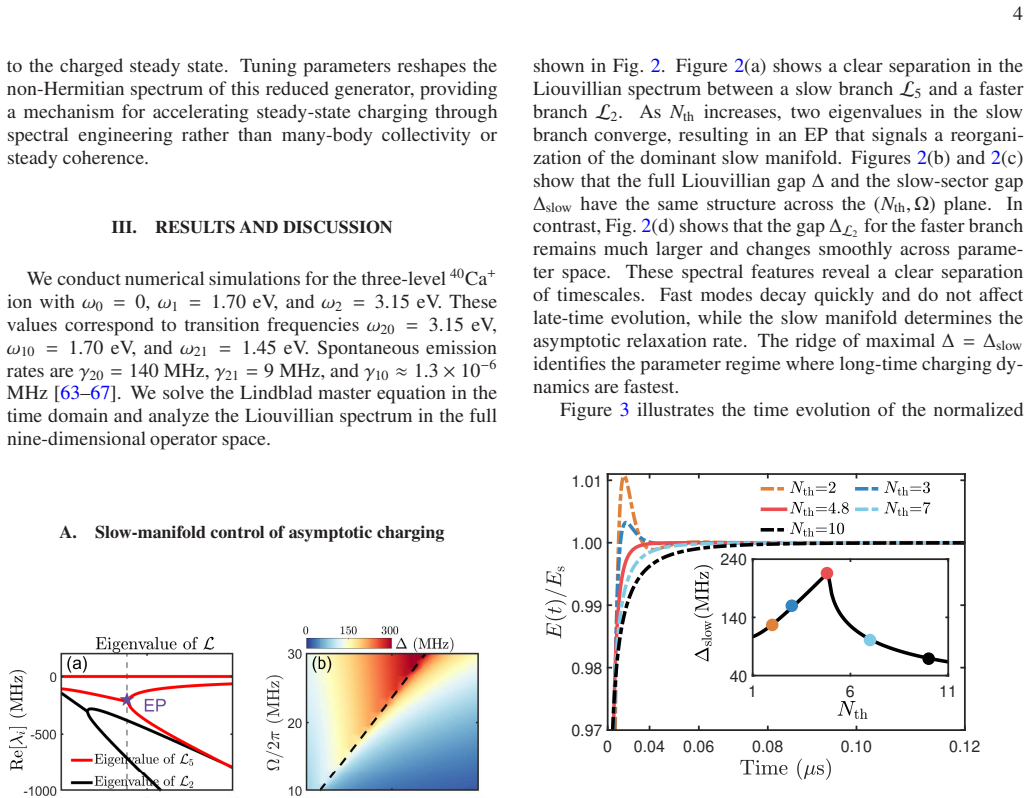
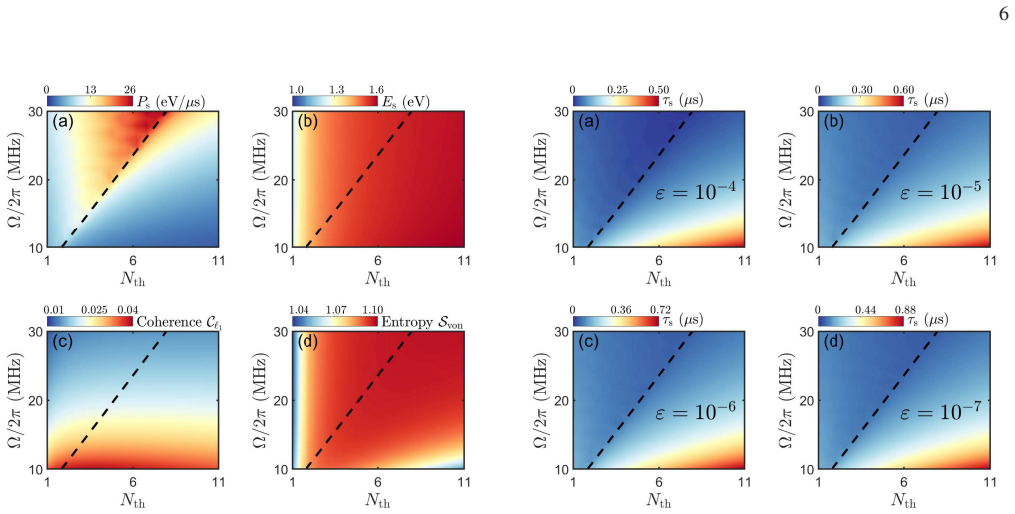
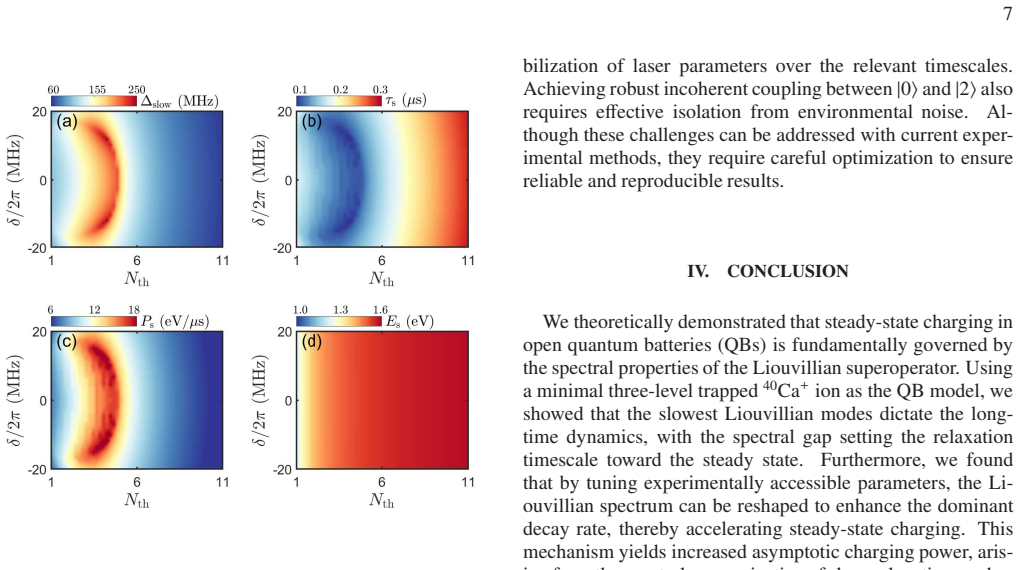
Figure 2(a) shows a clear separation in the Liouvillian spectrum between a slow branch L5 and a faster branch L2. As Nth increases, two eigenvalues in the slow branch converge, resulting in an EP that signals a reorgani- zation of the dominant slow manifold. Figures 2(b) and 2(c) show that the full Liouvillian gap ∆and the slow-sector gap ∆slow have the s...
-
[2]
Alicki and M
R. Alicki and M. Fannes, Entanglement boost for ex- tractable work from ensembles of quantum batteries, Phys. Rev. E 87, 042123 (2013)
2013
-
[3]
F. C. Binder, S. Vinjanampathy, K. Modi, and J. Goold, Quantacell: powerful charging of quantum batteries, New J. Phys. 17, 075015 (2015)
2015
-
[4]
Campaioli, F
F. Campaioli, F. A. Pollock, F. C. Binder, L. C´ eleri, J. G oold, S. Vinjanampathy, and K. Modi, Enhancing the charging power of quantum batteries, Phys. Rev. Lett. 118, 150601 (2017)
2017
-
[5]
Ferraro, M
D. Ferraro, M. Campisi, G. M. Andolina, V . Pellegrini, an d M. Polini, High-power collective charging of a solid-state quan- tum battery, Phys. Rev. Lett. 120, 117702 (2018)
2018
-
[6]
Campaioli, S
F. Campaioli, S. Gherardini, J. Q. Quach, M. Polini, and G. M. Andolina, Colloquium: Quantum batteries, Rev. Mod. Phys. 96, 031001 (2024)
2024
-
[7]
J. Q. Quach, K. E. McGhee, L. Ganzer, D. M. Rouse, B. W. Lovett, E. M. Gauger, J. Keeling, G. Cerullo, D. G. Lidzey, an d T. Virgili, Superabsorption in an organic microcavity: Toward a quantum battery, Sci. Adv. 8, eabk3160 (2022)
2022
-
[8]
C.-K. Hu, J. Qiu, P . J. P . Souza, J. Y uan, Y . Zhou, L. Zhang, J. Chu, X. Pan, L. Hu, J. Li, Y . Xu, Y . Zhong, S. Liu, F. Yan, D. Tan, R. Bachelard, C. J. Villas-Boas, A. C. Santos, and D. Y u, Optimal charging of a superconducting quantum battery, Quantum Sci. Technol. 7, 045018 (2022)
2022
-
[9]
C.-K. Hu, C. Liu, J. Zhao, L. Zhong, Y . Zhou, M. Liu, H. Y uan, Y . Lin, Y . Xu, G. Hu, G. Xie, Z. Liu, R. Zhou, Y . Ri, W. Zhang, R. Deng, A. Saguia, X. Linpeng, M. S. Sarandy, S. Liu, A. C. Santos, D. Tan, and D. Y u, Quan- tum charging advantage in superconducting solid-state bat ter- ies, Phys. Rev. Lett. 136, 060401 (2026)
2026
-
[10]
Hymas, J
K. Hymas, J. B. Muir, D. Tibben, J. van Embden, T. Hirai, C. J. Dunn, D. E. G´ omez, J. A. Hutchison, T. A. Smith, and J. Q. Quach, Superextensive electrical power from a quantum bat- tery, Light Sci. Appl. 15, 168 (2026)
2026
-
[11]
Zhang, P
J. Zhang, P . Wang, W. Chen, Z. Cai, M. Qiao, R. Li, Y . Huang , H. Tian, C. Luan, H. Tu, K. Cui, L. Yan, J. Zhang, J. Zhang, M. Y ung, and K. Kim, Single-ion information engine for charg- ing quantum battery, Phys. Rev. Lett. 135, 140403 (2025)
2025
-
[12]
F. T. Tabesh, F. H. Kamin, and S. Salimi, Environment- mediated charging process of quantum batteries, Phys. Rev. A 102, 052223 (2020)
2020
-
[13]
F. H. Kamin, S. Salimi, and M. B. Arjmandi, Steady- state charging of quantum batteries via dissipative ancill as, Phys. Rev. A 109, 022226 (2024)
2024
-
[14]
J. Q. Quach and W. J. Munro, Using dark states to charge and stabilize open quantum batteries, Phys. Rev. Appl. 14, 024092 (2020)
2020
-
[15]
Tacchino, T
F. Tacchino, T. F. F. Santos, D. Gerace, M. Campisi, and M . F. Santos, Charging a quantum battery via nonequilibrium heat current, Phys. Rev. E 102, 062133 (2020)
2020
-
[16]
J. Du, Y . Guo, and B. Li, Nonequilibrium quan- tum battery based on quantum measurements, Phys. Rev. Res. 7, 013151 (2025)
2025
-
[17]
Z.-G. Lu, G. Tian, X.-Y . L¨ u, and C. Shang, Topological q uan- tum batteries, Phys. Rev. Lett. 134, 180401 (2025)
2025
-
[18]
K.-X. Yan, Y . Liu, Y . Xiao, J.-H. Lin, J. Song, Y .-H. Chen, F. Nori, and Y . Xia, Giant-atom quantum batter- ies: Lossless energy transfer via interference engineerin g, Phys. Rev. Lett. 136, 180401 (2026)
2026
-
[19]
F.-Q. Dou, H. Zhou, and J.-A. Sun, Cavity heisenberg-sp in- chain quantum battery, Phys. Rev. A 106, 032212 (2022)
2022
-
[20]
Centrone, L
F. Centrone, L. Mancino, and M. Paternostro, Charging b atter- ies with quantum squeezing, Phys. Rev. A 108, 052213 (2023)
2023
-
[21]
M. B. Arjmandi, A. Shokri, E. Faizi, and H. Mohammadi, Pe r- formance of quantum batteries with correlated and uncorrel ated chargers, Phys. Rev. A 106, 062609 (2022)
2022
-
[22]
K. V . Hovhannisyan, M. Perarnau-Llobet, M. Huber, and A. Ac´ ın, Entanglement generation is not necessary for opti mal work extraction, Phys. Rev. Lett. 111, 240401 (2013)
2013
-
[23]
H.-L. Shi, S. Ding, Q.-K. Wan, X.-H. Wang, and W.-L. Yang , Entanglement, coherence, and extractable work in quantum bat- teries, Phys. Rev. Lett. 129, 130602 (2022)
2022
-
[24]
H. Li, H. Ma, Y . Hao, and W. Y u, Enhancing ergotropy of a quantum battery with coherent chargers: The catalystlike r ole of indefinite causal order, Phys. Rev. A 112, 042229 (2025)
2025
-
[25]
Liu, H.-L
J.-X. Liu, H.-L. Shi, Y .-H. Shi, X.-H. Wang, and W.-L. Ya ng, Entanglement and work extraction in the central-spin quant um battery, Phys. Rev. B 104, 245418 (2021)
2021
-
[26]
Zhou, Y .-W
A.-L. Zhou, Y .-W. Xiao, N. Xu, L.-L. Gao, L.-J. Li, H. Zhou, Z.-M. Li, and C.-C. Shu, Topological enhance- ment of a PT -symmetric su-schrieffer-heeger quantum battery, Phys. Rev. A 113, 042213 (2026)
2026
-
[27]
Ghosh and A
S. Ghosh and A. Sen(De), Dimensional enhance- ments in a quantum battery with imperfections, Phys. Rev. A 105, 022628 (2022)
2022
-
[28]
Guo, F.-M
W.-X. Guo, F.-M. Yang, and F.-Q. Dou, Analyti- cally solvable many-body rosen-zener quantum battery, Phys. Rev. A 109, 032201 (2024)
2024
-
[29]
Canzio, V
A. Canzio, V . Cavina, M. Polini, and V . Giovannetti, Sin gle- atom dissipation and dephasing in dicke and tavis-cummings quantum batteries, Phys. Rev. A 111, 022222 (2025)
2025
-
[30]
Yan and J
J.-s. Yan and J. Jing, Charging by quantum measurement, Phys. Rev. Appl. 19, 064069 (2023)
2023
-
[31]
Dou, Y .-Q
F.-Q. Dou, Y .-Q. Lu, Y .-J. Wang, and J.-A. Sun, Extendeddicke quantum battery with interatomic interactions and driving field, Phys. Rev. B 105, 115405 (2022)
2022
-
[32]
Yang, F.-M
D.-L. Yang, F.-M. Yang, and F.-Q. Dou, Three-level dicke quan- tum battery, Phys. Rev. B 109, 235432 (2024)
2024
-
[33]
Zhang, T.-R
Y .-Y . Zhang, T.-R. Yang, L. Fu, and X. Wang, Powerful harmonic charging in a quantum battery, Phys. Rev. E 99, 052106 (2019)
2019
-
[34]
Li and N
J. Li and N. Wu, Collective charging of an organic quantu m battery, Phys. Rev. E 111, 044118 (2025)
2025
-
[35]
P . A. Erdman, G. M. Andolina, V . Giovannetti, and F. No´ e, Re- inforcement learning optimization of the charging of a dick e quantum battery, Phys. Rev. Lett. 133, 243602 (2024)
2024
-
[36]
L. Gao, C. Cheng, W.-B. He, R. Mondaini, X.-W. Guan, and H .- Q. Lin, Scaling of energy and power in a large quantum battery- charger model, Phys. Rev. Res. 4, 043150 (2022)
2022
-
[37]
Barra, Dissipative charging of a quantum battery, Phys
F. Barra, Dissipative charging of a quantum battery, Phys. Rev. Lett. 122, 210601 (2019)
2019
-
[38]
Song, H.-B
W.-L. Song, H.-B. Liu, B. Zhou, W.-L. Yang, and J.-H. An, Remote charging and degradation suppression for the quantu m battery, Phys. Rev. Lett. 132, 090401 (2024)
2024
-
[39]
Yao and X
Y . Yao and X. Q. Shao, Stable charging of a rydberg quantu m battery in an open system, Phys. Rev. E 104, 044116 (2021)
2021
-
[40]
Gherardini, F
S. Gherardini, F. Campaioli, F. Caruso, and F. C. Binder , Sta- bilizing open quantum batteries by sequential measurement s, Phys. Rev. Res. 2, 013095 (2020)
2020
-
[41]
Shastri, C
R. Shastri, C. Jiang, G.-H. Xu, B. Prasanna V enkatesh, a nd G. Watanabe, Dephasing enabled fast charging of quantum bat - teries, npj Quantum Inf. 11, 9 (2025) . 11
2025
-
[42]
Chang, T.-R
W. Chang, T.-R. Yang, H. Dong, L. Fu, X. Wang, and Y .-Y . Zhang, Optimal building block of multipar- tite quantum battery in the driven-dissipative charging, New J. Phys. 23, 103026 (2021)
2021
-
[43]
Spohn, An algebraic condition for the approach to equ ilib- rium of an open n-level system, Lett
H. Spohn, An algebraic condition for the approach to equ ilib- rium of an open n-level system, Lett. Math. Phys. 2, 33 (1977)
1977
-
[44]
Macieszczak, M
K. Macieszczak, M. u. u. u. u. Gut ¸˘ a, I. Lesanovsky, and J. P . Garrahan, Towards a theory of metastability in open quantum dynamics, Phys. Rev. Lett. 116, 240404 (2016)
2016
-
[45]
V . V . Albert and L. Jiang, Symmetries and conserved quantities in lindblad master equations, Phys. Rev. A 89, 022118 (2014)
2014
-
[46]
Minganti, A
F. Minganti, A. Miranowicz, R. W. Chhajlany, and F. Nori , Quantum exceptional points of non-hermitian hamiltoni- ans and liouvillians: The e ffects of quantum jumps, Phys. Rev. A 100, 062131 (2019)
2019
-
[47]
Minganti, A
F. Minganti, A. Miranowicz, R. W. Chhajlany, I. I. Arkhipov, and F. Nori, Hybrid-liouvillian formalism con- necting exceptional points of non-hermitian hamiltonians and liouvillians via postselection of quantum trajectorie s, Phys. Rev. A 101, 062112 (2020)
2020
-
[48]
Khandelwal, N
S. Khandelwal, N. Brunner, and G. Haack, Signatures of l i- ouvillian exceptional points in a quantum thermal machine, PRX Quantum 2, 040346 (2021)
2021
-
[49]
Kochsiek, F
S. Kochsiek, F. Carollo, and I. Lesanovsky, Acceler- ating the approach of dissipative quantum spin sys- tems towards stationarity through global spin rotations, Phys. Rev. A 106, 012207 (2022)
2022
-
[50]
Levy and R
A. Levy and R. Koslo ff, Quantum absorption refrigerator, Phys. Rev. Lett. 108, 070604 (2012)
2012
-
[51]
Klatzow, J
J. Klatzow, J. N. Becker, P . M. Ledingham, C. Weinzetl, K. T. Kaczmarek, D. J. Saunders, J. Nunn, I. A. Walms- ley, R. Uzdin, and E. Poem, Experimental demonstration of quantum e ffects in the operation of microscopic heat engines, Phys. Rev. Lett. 122, 110601 (2019)
2019
-
[52]
W. Chen, M. Abbasi, B. Ha, S. Erdamar, Y . N. Joglekar, and K. W. Murch, Decoherence-induced ex- ceptional points in a dissipative superconducting qubit, Phys. Rev. Lett. 128, 110402 (2022)
2022
-
[53]
Bu, J.-Q
J.-T. Bu, J.-Q. Zhang, G.-Y . Ding, J.-C. Li, J.-W. Zhang , B. Wang, W.-Q. Ding, W.-F. Y uan, L. Chen, i. m. c. K. ¨Ozdemir, F. Zhou, H. Jing, and M. Feng, Enhancement of quan- tum heat engine by encircling a liouvillian exceptional poi nt, Phys. Rev. Lett. 130, 110402 (2023)
2023
-
[54]
D.-G. Lai, A. Miranowicz, and F. Nori, Nonreciprocal topological phonon transfer independent of both de- vice mass and exceptional-point encircling direction, Phys. Rev. Lett. 132, 243602 (2024)
2024
-
[55]
Bu, J.-Q
J.-T. Bu, J.-Q. Zhang, G.-Y . Ding, J.-C. Li, J.-W. Zhang , B. Wang, W.-Q. Ding, W.-F. Y uan, L. Chen, Q. Zhong, A. Kec ¸ebas ¸, S ¸ . K.¨Ozdemir, F. Zhou, H. Jing, and M. Feng, Chiral quantum heating and cooling with an optically controlled ion, Light Sci. Appl. 13, 143 (2024)
2024
-
[56]
Zhang, J.-Q
J.-W. Zhang, J.-Q. Zhang, G.-Y . Ding, J.-C. Li, J.-T. Bu, B. Wang, L.-L. Yan, S.-L. Su, L. Chen, F. Nori, S ¸ . K. ¨Ozdemir, F. Zhou, H. Jing, and M. Feng, Dynami- cal control of quantum heat engines using exceptional point s, Nat. Commun. 13, 6225 (2022)
2022
-
[57]
B. Zhu, P . Meystre, W. Zhang, and K. Zhang, Autonomous quantum heat engine enabled by molecular optomechanics and hysteresis switching, Phys. Rev. A 112, 043508 (2025)
2025
-
[58]
Zhou, X.-D
Y .-L. Zhou, X.-D. Y u, C.-W. Wu, X.-Q. Li, J. Zhang, W. Li,and P .-X. Chen, Accelerating relaxation through liouvillian e xcep- tional point, Phys. Rev. Res. 5, 043036 (2023)
2023
-
[59]
Minganti, A
F. Minganti, A. Biella, N. Bartolo, and C. Ciuti, Spec- tral theory of liouvillians for dissipative phase transiti ons, Phys. Rev. A 98, 042118 (2018)
2018
-
[60]
Ashida, Z
Y . Ashida, Z. Gong, and M. Ueda, Non-hermitian physics, Adv. Phys. 69, 249 (2020)
2020
-
[61]
Gorini, A
V . Gorini, A. Kossakowski, and E. C. G. Sudarshan, Com- pletely positive dynamical semigroups of n-level systems, J. Math. Phys. 17, 821 (1976)
1976
-
[62]
Lindblad, On the generators of quantum dynamical sem i- groups, Commun
G. Lindblad, On the generators of quantum dynamical sem i- groups, Commun. Math. Phys. 48, 119 (1976)
1976
-
[63]
W. D. Heiss, The physics of exceptional points, J. Phys. A: Math. Theor. 45, 444016 (2012)
2012
-
[64]
Kramida, Y
A. Kramida, Y . Ralchenko, J. Reader, and N. A. Team, NIST Atomic Spectra Database (ver. 5.12) , [Online]. Avail- able: https://physics.nist.gov/asd (2024)
2024
-
[65]
P . A. Barton, C. J. S. Donald, D. M. Lucas, D. A. Stevens, A. M. Steane, and D. N. Stacey, Measurement of the lifetime of the 3d2D5/ 2 state in 40ca+, Phys. Rev. A 62, 032503 (2000)
2000
-
[66]
Gerritsma, G
R. Gerritsma, G. Kirchmair, F. Z¨ ahringer, J. Benhelm, R. Blatt, and C. F. Roos, Precision measurement of the branching fractions of the 4p 2p3 /2 decay of ca ii, Eur. Phys. J. D 50, 13 (2008)
2008
-
[67]
M. Ramm, T. Pruttivarasin, M. Kokish, I. Talukdar, and H. H¨ affner, Precision measurement method for branch- ing fractions of excited P1/ 2 states applied to 40Ca+, Phys. Rev. Lett. 111, 023004 (2013)
2013
-
[68]
Hettrich, T
M. Hettrich, T. Ruster, H. Kaufmann, C. F. Roos, C. T. Schmiegelow, F. Schmidt-Kaler, and U. G. Poschinger, Mea- surement of dipole matrix elements with a single trapped ion , Phys. Rev. Lett. 115, 143003 (2015)
2015
-
[69]
Baumgratz, M
T. Baumgratz, M. Cramer, and M. B. Plenio, Quantifying c o- herence, Phys. Rev. Lett. 113, 140401 (2014)
2014
-
[70]
Leibfried, R
D. Leibfried, R. Blatt, C. Monroe, and D. Wineland, Quantum dynamics of single trapped ions, Rev. Mod. Phys. 75, 281 (2003)
2003
-
[71]
J. T. Barreiro, M. M¨ uller, P . Schindler, D. Nigg, T. Mon z, M. Chwalla, M. Hennrich, C. F. Roos, P . Zoller, and R. Blatt, An open-system quantum simulator with trapped ion s, Nature 470, 486 (2011)
2011
-
[72]
C. J. Myatt, B. E. King, Q. A. Turchette, C. A. Sackett, D. Kielpinski, W. M. Itano, C. Monroe, and D. J. Wineland, De- coherence of quantum superpositions through coupling to en gi- neered reservoirs, Nature 403, 269 (2000)
2000
-
[73]
Nagourney, J
W. Nagourney, J. Sandberg, and H. Dehmelt, Shelved op- tical electron amplifier: Observation of quantum jumps, Phys. Rev. Lett. 56, 2797 (1986)
1986
-
[74]
J. C. Bergquist, R. G. Hulet, W. M. Itano, and D. J. Wineland, Observation of quantum jumps in a single atom, Phys. Rev. Lett. 57, 1699 (1986)
1986
-
[75]
J. F. Poyatos, J. I. Cirac, and P . Zoller, Quantum reservoir engineering with laser cooled trapped ions, Phys. Rev. Lett. 77, 4728 (1996)
1996
discussion (0)
Sign in with ORCID, Apple, or X to comment. Anyone can read and Pith papers without signing in.