Recognition: unknown
PACSim: A Flexible Simulation Framework for Polymer-Attenuated Coulombic Self-Assembly
Pith reviewed 2026-05-14 18:50 UTC · model grok-4.3
The pith
PACSim is an open-source molecular dynamics framework for simulating polymer-attenuated Coulombic self-assembly of colloids.
A machine-rendered reading of the paper's core claim, the machinery that carries it, and where it could break.
Core claim
The authors present PACSim as a flexible open-source MD simulation framework built on OpenMM that enables studies of assembly by PACS across a range of experimentally relevant scenarios through implementation of interaction potentials capturing polymer-brush attenuation and Coulombic forces, with support for integration with enhanced-sampling and machine-learning tools.
What carries the argument
PACSim, the simulation framework that implements customizable interaction potentials for polymer-brush attenuation and Coulombic forces on top of OpenMM.
If this is right
- Simulations can predict whether oppositely charged colloids crystallize and which structures form for given concentrations, charges, sizes, and salt levels.
- Particle-level trajectories provide insight into assembly mechanisms that complement experimental data.
- The framework supports modeling across multiple experimentally relevant parameter ranges without requiring new code for each case.
- Integration with enhanced sampling and machine learning methods becomes straightforward for studying rare assembly events.
Where Pith is reading between the lines
- Direct side-by-side comparison of PACSim trajectories against confocal microscopy movies from the same parameters could confirm or refute the model's fidelity.
- The open-source code could be extended by users to test hypothetical particle sizes or brush lengths before synthesis.
- Screening wide ranges of salt concentration in simulation first could guide efficient experimental trials to locate new crystal phases.
- Coupling PACSim output to structure-prediction algorithms might accelerate identification of stable assemblies from simple building blocks.
Load-bearing premise
The interaction potentials implemented in PACSim accurately capture the polymer-brush attenuation and Coulombic forces present in real PACS experiments without post-hoc adjustments.
What would settle it
Running PACSim with parameters matching a published PACS experiment and obtaining crystal structures or assembly kinetics that differ from the experimental observations.
Figures




read the original abstract
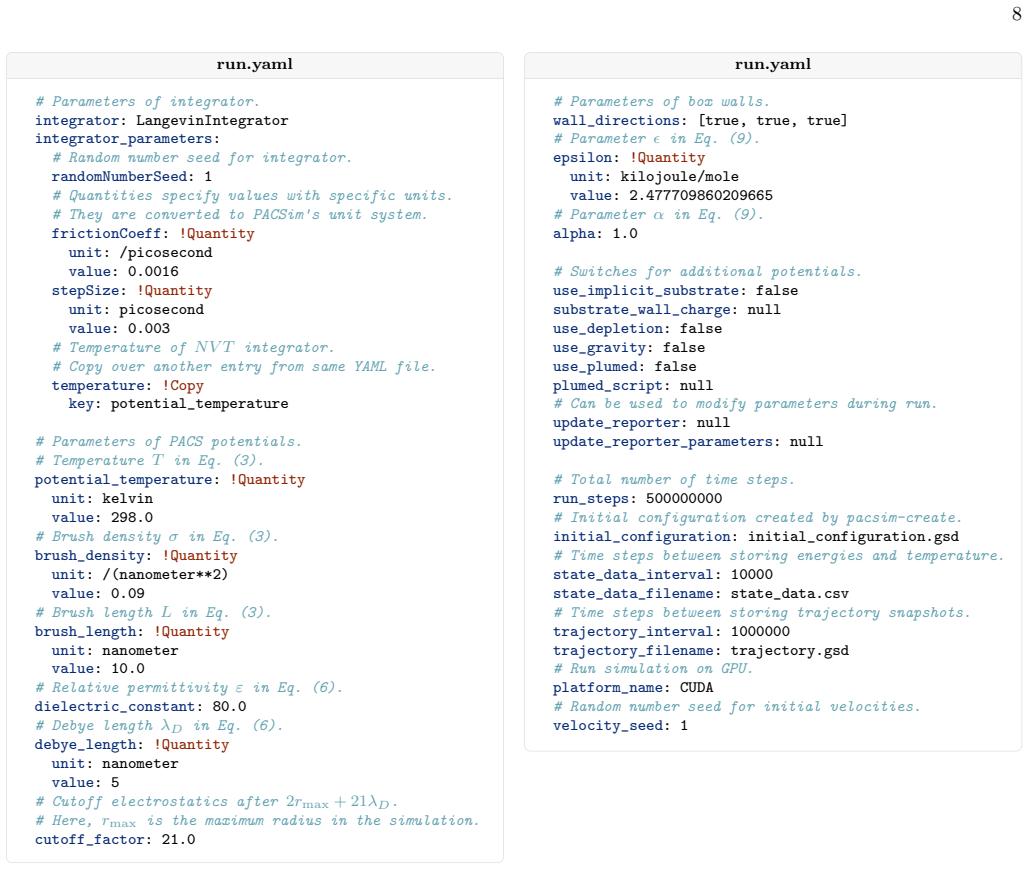
Polymer-Attenuated Coulombic Self-Assembly (PACS) is a flexible experimental approach for generating crystals from simple colloidal building blocks. The central components are charged spherical particles coated with a polymer brush that prevents irreversible aggregation. Whether oppositely charged colloids crystallize, and which structures they form, depends on several factors, including colloid concentration, charge, and size, as well as the salt concentration of the solution. Molecular dynamics (MD) simulations are a powerful tool for predicting the outcomes of PACS assembly experiments and also provide particle-level insight into the assembly processes. Here, we present an open-source simulation framework, PACSim, that enables MD simulation studies of assembly by PACS across a range of experimentally relevant scenarios. PACSim is built on top of OpenMM, a flexible MD simulation framework that readily supports the implementation of different interaction potentials, as well as integration with other tools such as enhanced-sampling and machine-learning frameworks. We describe the motivation for PACSim, outline its features, report methodological advancements inspired by this framework, and provide examples of its use.
Editorial analysis
A structured set of objections, weighed in public.
Referee Report
Summary. The manuscript presents PACSim, an open-source molecular dynamics simulation framework built on OpenMM for investigating Polymer-Attenuated Coulombic Self-Assembly (PACS) of charged colloidal particles coated with polymer brushes. It outlines the motivation for the tool, describes its features including flexible implementation of polymer-brush repulsion and screened Coulomb potentials, reports methodological advancements, and provides examples of simulations across varying colloid concentrations, charges, sizes, and salt conditions.
Significance. If validated, PACSim would offer a reusable, extensible platform for MD studies of PACS that integrates with enhanced sampling and machine-learning tools, potentially aiding prediction of assembly outcomes and particle-level insights in colloidal crystallization. The open-source nature and OpenMM foundation are strengths for reproducibility and extensibility in soft-matter simulations.
major comments (2)
- [Abstract] Abstract: The central claim that PACSim 'enables MD simulation studies of assembly by PACS across a range of experimentally relevant scenarios' is load-bearing for the paper's contribution but is not supported by any direct validation; no comparisons of simulated lattice constants, phase behavior, or critical salt concentrations to published PACS experiments are reported.
- [Examples of its use] Examples section: The provided simulation examples demonstrate code usage and trajectory generation but supply no quantitative benchmarks (e.g., radial distribution functions, assembly yields, or error bars) against experimental data, leaving the fidelity of the implemented polymer-brush attenuation and Coulomb potentials untested.
minor comments (2)
- [Framework features] The description of custom force implementations in OpenMM could include explicit code snippets or pseudocode for the polymer-brush repulsion term to improve reproducibility for users.
- [Methodological advancements] No discussion of computational performance (e.g., scaling with particle number or system size) is provided, which would help assess practicality for experimentally relevant system sizes.
Simulated Author's Rebuttal
We thank the referee for their constructive review of our manuscript on PACSim. We address the major comments point by point below, clarifying the scope of the work as a framework presentation while outlining planned revisions.
read point-by-point responses
-
Referee: [Abstract] Abstract: The central claim that PACSim 'enables MD simulation studies of assembly by PACS across a range of experimentally relevant scenarios' is load-bearing for the paper's contribution but is not supported by any direct validation; no comparisons of simulated lattice constants, phase behavior, or critical salt concentrations to published PACS experiments are reported.
Authors: We agree that the manuscript does not provide direct experimental validation such as comparisons of lattice constants, phase behavior, or critical salt concentrations. The primary aim is to introduce the open-source PACSim framework built on OpenMM, including its flexible implementation of polymer-brush and screened-Coulomb potentials, along with examples demonstrating its use across relevant parameter ranges (colloid concentration, charge, size, and salt). The abstract claim refers to this enabling capability rather than completed validation studies. To address the concern, we will revise the abstract to explicitly note that PACSim supplies the simulation infrastructure for such investigations, with the reported examples serving as demonstrations of functionality; comprehensive experimental benchmarking is planned as follow-on work. revision: partial
-
Referee: [Examples of its use] Examples section: The provided simulation examples demonstrate code usage and trajectory generation but supply no quantitative benchmarks (e.g., radial distribution functions, assembly yields, or error bars) against experimental data, leaving the fidelity of the implemented polymer-brush attenuation and Coulomb potentials untested.
Authors: The examples section is designed to illustrate practical code usage and the generation of trajectories under varied conditions. We acknowledge the absence of quantitative benchmarks against experiments. In the revised manuscript we will add radial distribution functions computed from the example trajectories, report assembly metrics where applicable, and include error estimates from replicate runs. We will also discuss how the implemented potentials reproduce expected theoretical behavior for polymer-brush repulsion and Debye-screened Coulomb interactions, thereby providing an internal consistency check even if full experimental matching remains beyond the current scope. revision: yes
Circularity Check
No circularity: PACSim is a tool-release paper with independent implementation description
full rationale
The manuscript presents an open-source MD framework (PACSim) built on OpenMM for simulating polymer-attenuated Coulombic self-assembly. Its central claim is the availability of the code and its features for exploring experimentally relevant scenarios. No derivation chain, fitted parameters renamed as predictions, or load-bearing self-citations appear in the abstract or described structure. The interaction potentials are implemented directly from standard forms (polymer brush repulsion plus screened Coulomb), with no reduction of outputs to inputs by construction. The reader's assessment of score 2 is consistent with minor self-citation norms but does not indicate circularity here.
Axiom & Free-Parameter Ledger
axioms (1)
- domain assumption OpenMM supports flexible implementation of interaction potentials needed for PACS
Reference graph
Works this paper leans on
-
[1]
Gasser, E
U. Gasser, E. R. Weeks, A. Schofield, P. N. Pusey, and D. A. Weitz, Real-space imaging of nucleation and growth in colloidal crystallization, Science 292, 258 (2001)
2001
-
[2]
Hueckel, G
T. Hueckel, G. M. Hocky, and S. Sacanna, Total synthesis of colloidal matter, Nat. Rev. Mater. 6, 1053 (2021)
2021
-
[3]
S. Zang, A. W. Hauser, S. Paul, G. M. Hocky, and S. Sacanna, Enabling three-dimensional real-space analy- sis of ionic colloidal crystallization, Nat. Mater. 23, 1131 (2024)
2024
-
[4]
Ducrot, M
´E. Ducrot, M. He, G.-R. Yi, and D. J. Pine, Colloidal al- loys with preassembled clusters and spheres, Nat. Mater. 16, 652 (2017)
2017
-
[5]
Y. Wang, I. C. Jenkins, J. T. McGinley, T. Sinno, and J. C. Crocker, Colloidal crystals with diamond symmetry at optical lengthscales, Nat. Commun. 8, 14173 (2017)
2017
-
[6]
Zhang, A. S. Keys, T. Chen, and S. C. Glotzer, Self- assembly of patchy particles into diamond structures through molecular mimicry, Langmuir 21, 11547 (2005)
2005
-
[7]
P. F. Damasceno, M. Engel, and S. C. Glotzer, Predic- tive self-assembly of polyhedra into complex structures, Science 337, 453 (2012)
2012
-
[8]
Dhakal, K
S. Dhakal, K. L. Kohlstedt, G. C. Schatz, C. A. Mirkin, and M. Olvera de la Cruz, Growth dynamics for DNA- guided nanoparticle crystallization, ACS Nano 7, 10948 (2013)
2013
-
[9]
H. Fang, M. F. Hagan, and W. B. Rogers, Two-step crystallization and solid–solid transitions in binary col- loidal mixtures, Proc. Natl. Acad. Sci. U.S.A. 117, 27927 (2020)
2020
-
[10]
Hueckel, G
T. Hueckel, G. M. Hocky, J. Palacci, and S. Sacanna, Ionic solids from common colloids, Nature 580, 487 (2020)
2020
-
[11]
Dijkstra and E
M. Dijkstra and E. Luijten, From predictive modelling to machine learning and reverse engineering of colloidal self-assembly, Nat. Mater. 20, 762 (2021)
2021
-
[12]
S. Zang, S. Paul, C. W. Leung, M. S. Chen, T. Hueckel, G. M. Hocky, and S. Sacanna, Direct observation and control of non-classical crystallization pathways in binary colloidal systems, Nat. Commun. 16, 3645 (2025)
2025
-
[13]
R. J. Hunter, Foundations of Colloid Science , 2nd ed. (Oxford University Press, 2001)
2001
-
[14]
J. N. Israelachvili, Intermolecular and Surface Forces, 3rd ed. (Academic Press, 2011)
2011
-
[15]
C. A. Mirkin, R. L. Letsinger, R. C. Mucic, and J. J. Storhoff, A DNA-based method for rationally assembling nanoparticles into macroscopic materials, Nature 382, 607 (1996)
1996
-
[16]
A. P. Alivisatos, K. P. Johnsson, X. Peng, T. E. Wilson, C. J. Loweth, M. P. Bruchez, and P. G. Schultz, Orga- nization of ’nanocrystal molecules’ using DNA, Nature 382, 609 (1996)
1996
-
[17]
W. B. Rogers, W. M. Shih, and V. N. Manoharan, Using DNA to program the self-assembly of colloidal nanoparti- cles and microparticles, Nat. Rev. Mater.1, 16008 (2016)
2016
-
[18]
M. E. Leunissen, C. G. Christova, A.-P. Hynninen, C. P. Royall, A. I. Campbell, A. Imhof, M. Dijkstra, R. van Roij, and A. van Blaaderen, Ionic colloidal crystals of oppositely charged particles, Nature 437, 235 (2005)
2005
-
[19]
van Kesteren, N
S. van Kesteren, N. Smina, S. Zang, C. W. Leung, G. M. Hocky, and S. Sacanna, Light-controlled colloidal crys- tallization, Chem 12, 102917 (2026)
2026
-
[20]
J. A. Anderson, J. Glaser, and S. C. Glotzer, HOOMD- blue: A Python package for high-performance molecu- lar dynamics and hard particle Monte Carlo simulations, Comput. Mater. Sci. 173, 109363 (2020)
2020
-
[21]
A. P. Thompson, H. M. Aktulga, R. Berger, D. S. Bolin- tineanu, W. M. Brown, P. S. Crozier, P. J. in ’t Veld, A. Kohlmeyer, S. G. Moore, T. D. Nguyen, R. Shan, M. J. Stevens, J. Tranchida, C. Trott, and S. J. Plimpton, LAMMPS - a flexible simulation tool for particle-based materials modeling at the atomic, meso, and continuum scales, Comput. Phys. Commun....
2022
-
[22]
Eastman, R
P. Eastman, R. Galvelis, R. P. Pel´ aez, C. R. A. Abreu, S. E. Farr, E. Gallicchio, A. Gorenko, M. M. Henry, F. Hu, J. Huang, A. Kr¨ amer, J. Michel, J. A. Mitchell, V. S. Pande, J. P. Rodrigues, J. Rodriguez-Guerra, A. C. Simmonett, S. Singh, J. Swails, P. Turner, Y. Wang, I. Zhang, J. D. Chodera, G. De Fabritiis, and T. E. Mark- land, OpenMM 8: Molecula...
2024
-
[23]
J. P. Gales, M. J. Kim, G. M. Hocky, and D. J. Pine, Crystallization of non-convex colloids: the roles of parti- cle shape and entropy, Soft Matter 21, 7021 (2025)
2025
-
[24]
Mitra, C
G. Mitra, C. Chang, A. McMullen, D. Puchall, J. Brujic, and G. M. Hocky, A coarse-grained simulation model for colloidal self-assembly via explicit mobile binders, Soft Matter 19, 4223 (2023)
2023
-
[25]
T. Shu, G. Mitra, J. Alberts, M. P. Viana, E. D. Levy, G. M. Hocky, and L. J. Holt, Mesoscale molecular assem- bly is favored by the active, crowded cytoplasm, PRX Life 2, 033001 (2024)
2024
-
[26]
T. R. Holoman, B. Prajwal, G. M. Hocky, and T. M. Truskett, Simulating dynamic bonding in soft materials, Curr. Opin. Colloid Interface Sci. 83, 102019 (2026)
2026
-
[27]
Bonomi, G
M. Bonomi, G. Bussi, C. Camilloni, G. A. Tribello, P. Ba- nas, A. Barducci, M. Bernetti, P. G. Bolhuis, S. Bot- taro, D. Branduardi, R. Capelli, P. Carloni, M. Ceriotti, A. Cesari, H. Chen, W. Chen, F. Colizzi, S. De, M. D. L. Pierre, D. Donadio, V. Drobot, B. Ensing, A. L. Fer- guson, M. Filizola, J. S. Fraser, H. Fu, P. Gasparotto, F. L. Gervasio, F. Gi...
2019
-
[28]
G. A. Tribello, M. Bonomi, G. Bussi, C. Camilloni, B. I. Armstrong, A. Arsiccio, S. Aureli, F. Ballabio, M. Bernetti, L. Bonati, S. G. Brookes, Z. F. Brotza- kis, R. Capelli, M. Ceriotti, K.-T. Chan, P. Cossio, S. Dasetty, D. Donadio, B. Ensing, A. L. Ferguson, G. Fraux, J. D. Gale, F. L. Gervasio, T. Giorgino, N. S. Herringer, G. M. Hocky, S. E. Hoff, M....
2025
-
[29]
Paszke, S
A. Paszke, S. Gross, F. Massa, A. Lerer, J. Bradbury, G. Chanan, T. Killeen, Z. Lin, N. Gimelshein, L. Antiga, A. Desmaison, A. K¨ opf, E. Yang, Z. DeVito, M. Raison, A. Tejani, S. Chilamkurthy, B. Steiner, L. Fang, J. Bai, and S. Chintala, PyTorch: an imperative style, high- performance deep learning library, NeurIPS 33, 8026 (2019)
2019
-
[30]
P. F. Zubieta Rico, L. Schneider, G. R. P´ erez-Lemus, R. Alessandri, S. Dasetty, T. D. Nguyen, C. A. Men´ endez, Y. Wu, Y. Jin, Y. Xu, S. Varner, J. A. Parker, A. L. Fer- guson, J. K. Whitmer, and J. J. de Pablo, PySAGES: flexible, advanced sampling methods accelerated with GPUs, npj Comput. Mater. 10, 35 (2024)
2024
-
[31]
Alexander, Adsorption of chain molecules with a po- lar head a scaling description, J
S. Alexander, Adsorption of chain molecules with a po- lar head a scaling description, J. Phys. France 38, 983 (1977)
1977
-
[32]
de Gennes, Polymers at an interface; a simplified view, Adv
P. de Gennes, Polymers at an interface; a simplified view, Adv. Colloid Interface Sci. 27, 189 (1987)
1987
-
[33]
Derjaguin and L
B. Derjaguin and L. Landau, Theory of the stability of strongly charged lyophobic sols and of the adhesion of strongly charged particles in solutions of electrolytes, Prog. Surf. Sci. 43, 30 (1993), reprint of the 1941 Acta Physicochim. U.R.S.S. article
1993
-
[34]
E. J. W. Verwey and J. T. G. Overbeek, Theory of the Stability of Lyophobic Colloids (Elsevier, 1948)
1948
-
[35]
Asakura and F
S. Asakura and F. Oosawa, Interaction between particles suspended in solutions of macromolecules, J. Polym. Sci. 33, 183 (1958)
1958
-
[36]
Vrij, Polymers at interfaces and the interactions in colloidal dispersions, Pure Appl
A. Vrij, Polymers at interfaces and the interactions in colloidal dispersions, Pure Appl. Chem. 48, 471 (1976)
1976
-
[37]
Dijkstra, J
M. Dijkstra, J. M. Brader, and R. Evans, Phase be- haviour and structure of model colloid-polymer mixtures, J. Phys.: Condens. Matter 11, 10079 (1999)
1999
-
[38]
Dijkstra, Computer simulations of charge and steric stabilised colloidal suspensions, Curr
M. Dijkstra, Computer simulations of charge and steric stabilised colloidal suspensions, Curr. Opin. Colloid In- terface Sci. 6, 372 (2001)
2001
-
[39]
Sacanna, W
S. Sacanna, W. T. M. Irvine, P. M. Chaikin, and D. J. Pine, Lock and key colloids, Nature 464, 575 (2010)
2010
-
[40]
C. N. Likos, K. A. Vaynberg, H. L¨ owen, and N. J. Wag- ner, Colloidal stabilization by adsorbed gelatin, Lang- muir 16, 4100 (2000)
2000
-
[41]
S. J. O’Shea, M. E. Welland, and T. Rayment, An atomic force microscope study of grafted polymers on mica, Langmuir 9, 1826 (1993)
1993
-
[42]
R. Hogg, T. W. Healy, and D. W. Fuerstenau, Mutual coagulation of colloidal dispersions, Trans. Faraday Soc. 62, 1638 (1966)
1966
-
[43]
H. N. W. Lekkerkerker and R. Tuinier, Colloids and the Depletion Interaction (Springer, 2011)
2011
-
[44]
A. V. Petukhov, R. Tuinier, and G. J. Vroege, Entropic patchiness: Effects of colloid shape and depletion, Curr. Opin. Colloid Interface Sci. 30, 54 (2017)
2017
-
[45]
Stukowski, Visualization and analysis of atomistic simulation data with OVITO—the Open Visualization Tool, Model
A. Stukowski, Visualization and analysis of atomistic simulation data with OVITO—the Open Visualization Tool, Model. Simul. Mater. Sci. Eng. 18, 015012 (2009)
2009
-
[46]
Humphrey, A
W. Humphrey, A. Dalke, and K. Schulten, VMD: Visual molecular dynamics, J. Mol. Graph. 14, 33 (1996)
1996
-
[47]
van Kesteren, S
S. van Kesteren, S. Zang, G. M. Hocky, and S. Sacanna, Structure selection in ionic colloidal crystals via indepen- dent charge tuning, In review (2026)
2026
-
[48]
Hjorth Larsen, J
A. Hjorth Larsen, J. Jørgen Mortensen, J. Blomqvist, I. E. Castelli, R. Christensen, M. Du lak, J. Friis, M. N. Groves, B. Hammer, C. Hargus, E. D. Hermes, P. C. Jennings, P. Bjerre Jensen, J. Kermode, J. R. Kitchin, E. Leonhard Kolsbjerg, J. Kubal, K. Kaasb- jerg, S. Lysgaard, J. Bergmann Maronsson, T. Max- son, T. Olsen, L. Pastewka, A. Peterson, C. Ros...
2017
-
[49]
A. Jain, S. P. Ong, G. Hautier, W. Chen, W. D. Richards, S. Dacek, S. Cholia, D. Gunter, D. Skinner, G. Ceder, and K. A. Persson, Commentary: The Materials Project: A materials genome approach to accelerating materials innovation, APL Mater. 1, 011002 (2013)
2013
-
[50]
Zhang, X
Z. Zhang, X. Liu, K. Yan, M. E. Tuckerman, and J. Liu, Unified efficient thermostat scheme for the canonical ensemble with holonomic or isokinetic constraints via molecular dynamics, J. Phys. Chem. A 123, 6056 (2019)
2019
-
[51]
Eastman and V
P. Eastman and V. S. Pande, Constant constraint ma- trix approximation: A robust, parallelizable constraint method for molecular simulations, J. Chem. Theory Comput. 6, 434 (2010)
2010
-
[52]
Eastman and V
P. Eastman and V. Pande, Accelerating development and execution speed with just-in-time GPU code generation, in GPU Computing Gems Jade Edition , edited by W. W. Hwu (Morgan Kaufmann, Boston, 2012) pp. 399–407
2012
-
[53]
B. Peng, F. Smallenburg, A. Imhof, M. Dijkstra, and A. van Blaaderen, Colloidal clusters by using emulsions and dumbbell-shaped particles: Experiments and simu- lations, Angew. Chem. Int. Ed. 52, 6709 (2013)
2013
-
[54]
M. He, J. P. Gales, ´E. Ducrot, Z. Gong, G.-R. Yi, S. Sacanna, and D. J. Pine, Colloidal diamond, Nature 585, 524 (2020)
2020
-
[55]
Bussi and A
G. Bussi and A. Laio, Using metadynamics to explore complex free-energy landscapes, Nat. Rev. Phys. 2, 200 (2020)
2020
discussion (0)
Sign in with ORCID, Apple, or X to comment. Anyone can read and Pith papers without signing in.