Recognition: 1 theorem link
· Lean TheoremSeparating Shortcut Transition from Cross-Family OOD Failure in a Minimal Model
Pith reviewed 2026-05-14 20:31 UTC · model grok-4.3
The pith
A minimal model with one invariant and one shortcut coordinate separates training transition from cross-family OOD failure.
A machine-rendered reading of the paper's core claim, the machinery that carries it, and where it could break.
Core claim
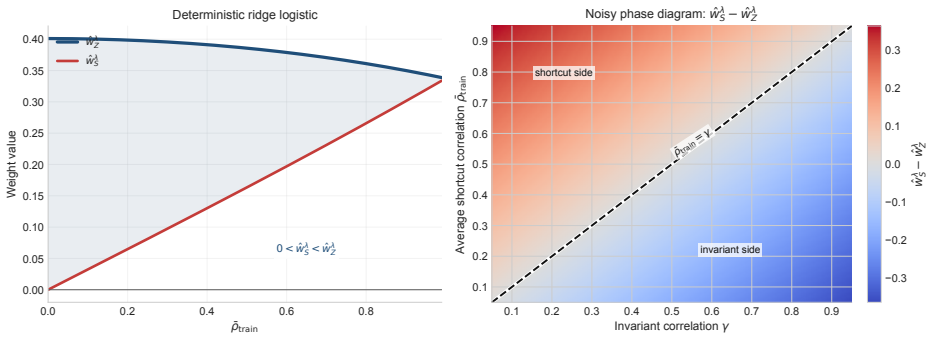
In this minimal model, shortcut attraction, the transition to a shortcut decision rule, and cross-family OOD failure are distinct: the identical training transition to shortcut use produces positive excess risk on weaker-correlation families and above-chance error on sign-flipped families, while ridge regularization keeps the classifier invariant-dominated in the deterministic regime.
What carries the argument
Minimal binary model with one invariant coordinate and one family-dependent shortcut coordinate, analyzed under ridge-logistic empirical risk minimization.
If this is right
- Ridge regularization keeps the learned classifier invariant-dominated even when average shortcut correlation is positive.
- The switch to the shortcut rule occurs precisely when the training shortcut signal exceeds the invariant signal.
- The same training transition produces excess risk on weaker-correlation families and above-chance error on sign-flipped families.
- Synthetic checks reproduce the analytic regimes and confirm that training-side transition and held-out failure are separable.
Where Pith is reading between the lines
- Diagnostic methods for OOD failure could therefore isolate family-specific correlation mismatches rather than attempting global shortcut removal.
- The separation suggests that interventions should target the relative signal strengths at test time for each family instead of altering the training objective alone.
- Extending the model to multiple shortcuts or continuous labels would test whether the same decoupling persists beyond the binary case.
Load-bearing premise
The data-generating process consists of exactly one invariant coordinate and one family-dependent shortcut coordinate whose relative strengths govern the transition under ridge-logistic ERM.
What would settle it
Generate data from the model with noisy invariant coordinate so the training transition occurs, then measure whether excess risk remains zero on a held-out family whose shortcut correlation exactly matches the training family.
Figures


read the original abstract
Shortcut features are often invoked to explain out-of-distribution (OOD) failure, but training correlation, learned shortcut use, and test-time failure need not coincide. We study a minimal binary model with one invariant coordinate and one family-dependent shortcut coordinate. In the deterministic regime, positive average shortcut correlation pulls logistic ERM toward positive shortcut weight, but ridge regularization keeps the classifier invariant-dominated and prevents deterministic OOD failure. When the invariant coordinate is noisy, ridge-logistic ERM switches to the shortcut rule once the training shortcut signal exceeds the invariant signal. Whether that transition causes failure depends on the held-out family: weaker shortcut correlation yields positive excess risk, and sign-flipped families yield above-chance error. Synthetic checks match these analytic regimes and show that the same training-side transition can have different held-out consequences. The model separates shortcut attraction, shortcut-rule transition, and cross-family OOD failure.
Editorial analysis
A structured set of objections, weighed in public.
Referee Report
Summary. The manuscript constructs a minimal binary classification model with exactly one invariant coordinate and one family-dependent shortcut coordinate. Under ridge-logistic ERM it analytically derives three regimes: (i) positive shortcut correlation pulls weights toward the shortcut yet ridge keeps the classifier invariant-dominated with no deterministic OOD failure; (ii) when the invariant coordinate is noisy the model transitions to the shortcut rule once the training shortcut signal exceeds the invariant signal; (iii) the same transition produces qualitatively different held-out consequences depending on the test-family shortcut correlation strength or sign flip. Synthetic experiments are reported to match the analytic thresholds and excess-risk predictions.
Significance. If the derivations hold, the model supplies a transparent theoretical instrument that cleanly disentangles training-time shortcut attraction, the ERM decision-rule transition, and cross-family OOD failure. This separation addresses a common conflation in the shortcut-learning literature and offers a reproducible, low-dimensional testbed for studying when correlation-induced failures do or do not materialize at test time.
major comments (1)
- [§3] The central analytic claim that the transition threshold is governed solely by the relative strength of the noisy invariant signal versus the shortcut signal (under fixed ridge) is load-bearing for the separation result; the manuscript should explicitly state the closed-form threshold (including its dependence on the ridge parameter λ) rather than summarizing it, so that readers can verify the scaling without re-deriving the logistic loss.
minor comments (2)
- [§4] Synthetic checks in §4 would be strengthened by reporting standard errors or confidence intervals across random seeds rather than single-run curves, to confirm that the observed transition points align with the analytic predictions within sampling variability.
- [§2] Notation for the family index and the shortcut correlation parameter should be introduced once in the model definition and used consistently; occasional reuse of the same symbol for different quantities in the OOD section creates minor ambiguity.
Simulated Author's Rebuttal
We thank the referee for the positive assessment and the constructive suggestion regarding clarity of the analytic threshold. We address the comment below.
read point-by-point responses
-
Referee: [§3] The central analytic claim that the transition threshold is governed solely by the relative strength of the noisy invariant signal versus the shortcut signal (under fixed ridge) is load-bearing for the separation result; the manuscript should explicitly state the closed-form threshold (including its dependence on the ridge parameter λ) rather than summarizing it, so that readers can verify the scaling without re-deriving the logistic loss.
Authors: We agree that an explicit statement of the closed-form threshold will improve readability. In the revised manuscript we will add the precise expression for the transition point (the value at which the training shortcut signal exceeds the effective noisy invariant signal under ridge regularization) directly in §3, including its explicit dependence on λ. revision: yes
Circularity Check
Derivation self-contained in newly constructed minimal model
full rationale
The paper defines a minimal binary model consisting of one invariant coordinate and one family-dependent shortcut coordinate, then derives all separation results (shortcut attraction under ridge, ERM transition when invariant noise is exceeded, and cross-family OOD consequences) directly from the ridge-logistic ERM objective and the model's data-generating assumptions. Analytic regimes are stated to be matched by synthetic data generated from the identical model. No load-bearing step reduces to a fitted parameter renamed as a prediction, a self-citation chain, an imported uniqueness theorem, or a renamed known empirical pattern. The central claims remain independent of external fitted quantities or prior author results.
Axiom & Free-Parameter Ledger
free parameters (2)
- shortcut correlation strength
- invariant noise level
axioms (2)
- domain assumption Data consists of exactly one invariant coordinate and one family-dependent shortcut coordinate
- domain assumption Ridge-logistic ERM is the training procedure
invented entities (1)
-
minimal binary model with invariant and family-dependent shortcut coordinates
no independent evidence
Lean theorems connected to this paper
-
IndisputableMonolith/Foundation/RealityFromDistinction.leanreality_from_one_distinction unclear?
unclearRelation between the paper passage and the cited Recognition theorem.
We study a minimal binary model with one invariant coordinate and one family-dependent shortcut coordinate... ridge-logistic ERM switches to the shortcut rule once the training shortcut signal exceeds the invariant signal.
What do these tags mean?
- matches
- The paper's claim is directly supported by a theorem in the formal canon.
- supports
- The theorem supports part of the paper's argument, but the paper may add assumptions or extra steps.
- extends
- The paper goes beyond the formal theorem; the theorem is a base layer rather than the whole result.
- uses
- The paper appears to rely on the theorem as machinery.
- contradicts
- The paper's claim conflicts with a theorem or certificate in the canon.
- unclear
- Pith found a possible connection, but the passage is too broad, indirect, or ambiguous to say the theorem truly supports the claim.
Reference graph
Works this paper leans on
-
[1]
Invariant Risk Minimization , author =. arXiv preprint arXiv:1907.02893 , year =
work page internal anchor Pith review Pith/arXiv arXiv 1907
-
[2]
Nature Machine Intelligence , volume =
Shortcut Learning in Deep Neural Networks , author =. Nature Machine Intelligence , volume =
-
[3]
International Conference on Learning Representations , year =
In Search of Lost Domain Generalization , author =. International Conference on Learning Representations , year =
-
[4]
arXiv preprint arXiv:2010.05761 , year =
The Risks of Invariant Risk Minimization , author =. arXiv preprint arXiv:2010.05761 , year =
-
[5]
Journal of the Royal Statistical Society: Series B , volume =
Causal Inference by Using Invariant Prediction: Identification and Confidence Intervals , author =. Journal of the Royal Statistical Society: Series B , volume =
-
[6]
Journal of Machine Learning Research , volume =
Invariant Models for Causal Transfer Learning , author =. Journal of Machine Learning Research , volume =
-
[7]
Proceedings of the National Academy of Sciences , volume =
Toward Causal Representation Learning , author =. Proceedings of the National Academy of Sciences , volume =
-
[8]
Out-of-Distribution Generalization via Risk Extrapolation (
Krueger, David and Caballero, Ethan and Jacobsen, J. Out-of-Distribution Generalization via Risk Extrapolation (. International Conference on Machine Learning , pages =
-
[9]
International Conference on Artificial Intelligence and Statistics , pages =
Does Invariant Risk Minimization Capture Invariance? , author =. International Conference on Artificial Intelligence and Statistics , pages =
-
[10]
International Conference on Learning Representations , year =
Distributionally Robust Neural Networks for Group Shifts: On the Importance of Regularization for Worst-Case Generalization , author =. International Conference on Learning Representations , year =
-
[11]
Koh, Pang Wei and Sagawa, Shiori and Marklund, Henrik and Xie, Sang Michael and Zhang, Marvin and Balsubramani, Akshay and Hu, Weihua and Yasunaga, Michihiro and Phillips, Richard and Beery, Sara and Leskovec, Jure and Liang, Percy , booktitle =
-
[12]
Machine Learning , volume =
A Theory of Learning from Different Domains , author =. Machine Learning , volume =
-
[13]
Journal of Machine Learning Research , volume =
Domain-Adversarial Training of Neural Networks , author =. Journal of Machine Learning Research , volume =
-
[14]
Sun, Baochen and Saenko, Kate , booktitle =. Deep
-
[15]
Advances in Neural Information Processing Systems , volume =
Learning from Failure: Training Debiased Classifier from Biased Classifier , author =. Advances in Neural Information Processing Systems , volume =
discussion (0)
Sign in with ORCID, Apple, or X to comment. Anyone can read and Pith papers without signing in.