Recognition: no theorem link
Numerical security analysis for practical quantum key distribution
Pith reviewed 2026-05-14 19:19 UTC · model grok-4.3
The pith
A numerical finite-key security framework proves security for realistic QKD setups against general coherent attacks using only partial device characterization.
A machine-rendered reading of the paper's core claim, the machinery that carries it, and where it could break.
Core claim
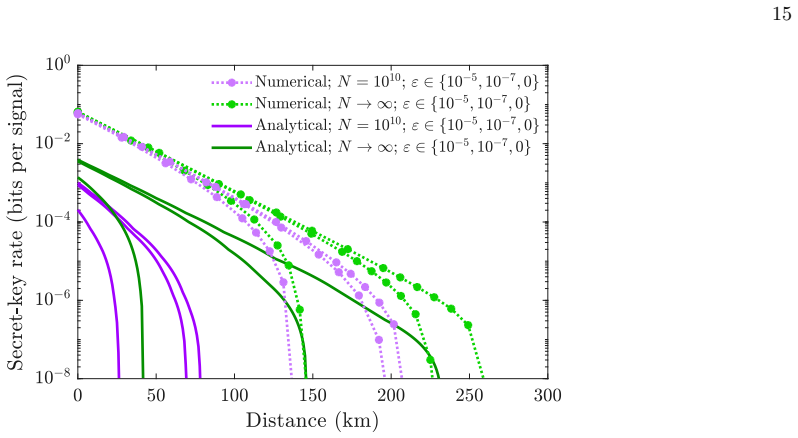
We introduce a versatile numerical finite-key security framework valid against general coherent attacks and applicable to a broad class of practical QKD setups. It accommodates most relevant imperfections at both transmitter and receiver, including non-independent-and-identically-distributed signals arising in high-speed QKD systems due to the limited bandwidth of optical modulators, while requiring only partial characterization of the apparatuses. We demonstrate the power of our framework by proving the security of a realistic decoy-state QKD implementation with laser sources.
What carries the argument
The numerical optimization procedure that computes finite-key rates by bounding the effect of observed statistics on the worst-case eavesdropper information under partial device models.
If this is right
- Security can be certified for decoy-state protocols using real laser sources without assuming perfect devices.
- High-speed systems with time-varying signals from modulator bandwidth limits become provably secure.
- The same method applies to many different QKD hardware configurations without requiring full device tomography.
- Finite-key rates can be computed numerically rather than through analytic bounds that ignore practical imperfections.
Where Pith is reading between the lines
- The framework could be adapted to analyze security in other quantum communication tasks such as quantum repeaters or entanglement distribution.
- It provides a route to standardized certification procedures that test only a subset of device parameters.
- Manufacturers could use the method during design to quantify how much characterization effort is needed for a target security level.
Load-bearing premise
Partial characterization of the transmitter and receiver suffices to bound how all uncharacterized imperfections can affect the security proof.
What would settle it
An experimental or simulated QKD run where the observed statistics match the partial characterization but the actual key leakage exceeds the numerical bound computed by the framework.
Figures


read the original abstract
Quantum key distribution (QKD) promises information-theoretic security based on quantum mechanics and idealized device models. Practical implementations, however, deviate from these models due to unavoidable device imperfections, and existing security proofs fall short of capturing the complexity of real-world systems. Here we introduce a versatile numerical finite-key security framework valid against general coherent attacks and applicable to a broad class of practical QKD setups. It accommodates most relevant imperfections at both transmitter and receiver, including non-independent-and-identically-distributed (non-IID) signals arising in high-speed QKD systems due to the limited bandwidth of optical modulators, while requiring only partial characterization of the apparatuses. We demonstrate the power of our framework by proving the security of a realistic decoy-state QKD implementation with laser sources, providing a practical route towards rigorous security certification of real-world QKD setups.
Editorial analysis
A structured set of objections, weighed in public.
Referee Report
Summary. The manuscript introduces a numerical finite-key security framework for practical QKD that is valid against general coherent attacks. It handles transmitter and receiver imperfections, including non-IID signals from limited modulator bandwidth, using only partial device characterization, and demonstrates the approach on a realistic decoy-state implementation.
Significance. If the numerical optimization correctly bounds information leakage from all coherent attacks consistent with the supplied partial characterization, the framework would offer a practical route to rigorous security proofs for real-world QKD systems that current analytical methods cannot address. The ability to incorporate non-IID effects without full device models is a notable strength.
major comments (2)
- [Abstract and framework description] The central security claim rests on the assertion that partial characterization of the transmitter and receiver is sufficient to bound the effect of all uncharacterized imperfections, including those correlated with non-IID pulse statistics. The manuscript does not provide an explicit argument or constraint formulation showing that the numerical optimization (presumably an SDP or convex program) encloses all possible adversarial correlations between unmodeled side channels and the finite-bandwidth-induced dependencies. This assumption is load-bearing for the general-coherent-attack guarantee.
- [Numerical method section] No explicit derivation steps, error analysis, or verification data (e.g., convergence checks or comparison against known analytical bounds) are supplied for the numerical optimization procedure. Without these, it is impossible to confirm that the reported security bounds are tight or that the finite-key corrections are correctly implemented.
minor comments (2)
- [Method] Clarify the precise form of the optimization constraints used to encode the partial characterization data and the non-IID statistics.
- [Demonstration] Add a table or figure comparing the numerical bounds against existing analytical decoy-state results for the same experimental parameters.
Simulated Author's Rebuttal
We thank the referee for their thorough review and constructive comments. We address each major comment point by point below and have revised the manuscript to incorporate additional details where needed.
read point-by-point responses
-
Referee: [Abstract and framework description] The central security claim rests on the assertion that partial characterization of the transmitter and receiver is sufficient to bound the effect of all uncharacterized imperfections, including those correlated with non-IID pulse statistics. The manuscript does not provide an explicit argument or constraint formulation showing that the numerical optimization (presumably an SDP or convex program) encloses all possible adversarial correlations between unmodeled side channels and the finite-bandwidth-induced dependencies. This assumption is load-bearing for the general-coherent-attack guarantee.
Authors: We thank the referee for identifying this point. The current manuscript relies on the numerical optimization being formulated over all quantum states consistent with the supplied partial characterization (pulse intensity bounds, detection efficiencies, and modulator response functions), with non-IID statistics incorporated by allowing each pulse in the block to occupy a state within those bounds. To make the argument explicit, the revised manuscript will add a dedicated paragraph deriving the SDP constraints: the objective maximizes the Holevo information subject to linear constraints on the observed statistics for each pulse and a joint state over the finite block that permits arbitrary correlations. This construction encloses adversarial correlations between uncharacterized side channels and bandwidth-induced dependencies by construction, as any such correlation must still satisfy the partial characterization bounds. We will include the explicit constraint matrices. revision: yes
-
Referee: [Numerical method section] No explicit derivation steps, error analysis, or verification data (e.g., convergence checks or comparison against known analytical bounds) are supplied for the numerical optimization procedure. Without these, it is impossible to confirm that the reported security bounds are tight or that the finite-key corrections are correctly implemented.
Authors: We agree that the numerical procedure requires more supporting detail. In the revised manuscript we will expand the Numerical method section with: (i) step-by-step derivation of the SDP from the finite-key security definition, (ii) error analysis bounding the solver precision and its propagation into the key-rate estimate, and (iii) verification data consisting of convergence plots, comparisons against known analytical bounds in the asymptotic and ideal-device limits, and explicit checks that the finite-key corrections match standard formulas. These additions will allow independent confirmation of tightness and correctness. revision: yes
Circularity Check
Numerical optimization derives bounds from partial characterization without circular reduction
full rationale
The paper introduces a numerical finite-key security framework that uses optimization (likely SDP-style) over quantum states/channels constrained by partial transmitter/receiver characterization to bound information leakage under general coherent attacks, including non-IID effects from modulator bandwidth. No derivation step reduces by construction to a fitted parameter renamed as prediction, a self-definitional loop, or a load-bearing self-citation chain; the security claim rests on the external validity of the convex-set constraints and the optimization procedure itself, which are independent of the final key-rate output. The framework is self-contained against the supplied partial data and does not invoke uniqueness theorems or ansatzes from prior self-work as the sole justification.
Axiom & Free-Parameter Ledger
axioms (2)
- domain assumption Quantum mechanics governs the evolution and measurement of the optical states
- ad hoc to paper The partial device characterization provides sufficient bounds on uncharacterized imperfections
Reference graph
Works this paper leans on
-
[1]
MDI-QKD type protocols General setting A generic description of a measurement-device-independent (MDI) type QKD protocol is given in Box 3. We assume that Eq. (1) holds for both Alice’s and Bob’s transmitted states for a certainε≥ε iu ∀iu, and so we can apply Lemma 4 (see Appendix C) and consider that the emitted quantum states are pure. In particular, le...
-
[2]
In each round a u∈ {1, . . . , N}, (a) Alice chooses a pair of bit/basis (a) and intensity (µ) settings, which for conciseness we group in a single indexi∈ {0,1, n A −1}, with probabilityp A i ≡p A a,µ. Then she prepares an-photon state with density matrixσ n,iu u−L C —which in general may depend not only on the current setting choicesi≡i u but also on th...
-
[3]
Alice and Bob publicly exchange classical information and decide if the round is assigned askeyortestround. The key rounds—i.e., those in whichβ=Z,a, b∈ {0,1}, andµ= 0—are used to generate the users’ sifted keys. In the test rounds—i.e., the remaining rounds—we assume that the users reveal all the parametersa, µ, β, andb. Alice and Bob record the number o...
-
[4]
a In this box we omit the round indexufrom the quantities whenever it is clear from the context
Alice and Bob perform error correction, error verification, and privacy amplification. a In this box we omit the round indexufrom the quantities whenever it is clear from the context
-
[5]
Decoy-state QKD protocols General setting In a decoy-state QKD scheme (see Box 4), Alice generates phase-randomized weak-coherent pulses (PRWCPs)—for concreteness we consider continuous phase randomization here, but we remark that the security analysis also applies to discrete-phase-randomization setups—such that the phase-averaged pulses can be described...
-
[6]
Alice prepares the entangled state|Ψ ε⟩AN 1 RN 1 CN 1 —defined in Eq. (A25) for certainε—and sends all systemsC N 1 through the quantum channel to Bob, who receives the systemsB N 1
-
[7]
(A33) with eigenvaluesω∈ Sncut n=0 {ωn}ωn ∪ {λ∗ i,∞}i
Then, in each roundu, Alice and Bob perform the POVM {(1−α)|1⟩ ⟨1| R ⊗ ˆV a,b AB }a,b∈{0,1} ∪ {(1−α)|n⟩ ⟨n| R ⊗ ˆSa,µ,β,b AB }(n,µ,a,β,b)/∈K∪ {α|ω⟩ ⟨ω|RA ⊗1 B}ω, on the systemsRAB, whereαis the probability that a round is tagged as LWM, K:={(n, a, µ, β, b) :n= 1, µ= 0, β=Z, a, b∈ {0,1}}, and the states|ω⟩ RA are eigenvectors of the operator ˆWRA defined i...
-
[8]
Alice and Bob computeM key,1 = P u χu key,1 Mph = P u χu ph,M key = P u χu key,M Q,l = P u χu Q,l and MW = P u χu W. a In particular, the states{|ω⟩} ω in general differ between the two VEPs, as may the coefficientsc l a,µ,β,b,inter alia. b The coefficientsc l a,0,Z,b are assumed to be identical for alla, b∈ {0,1}. After solving the dual SDP given by Eq. ...
-
[9]
,Xn be independent, zero-mean random variables satisfying |Xi| ≤calmost surely
Auxiliary results on concentration bounds The finite-key analysis requires the use of certain results on concentration bounds for sums of RVs that we include below for completeness: Lemma 1(Bernstein’s inequality [54, 55]).LetX 1, . . . ,Xn be independent, zero-mean random variables satisfying |Xi| ≤calmost surely. Defines= 1 n Pn u=1 Xu andv= 1 n Pn u=1 ...
-
[10]
Upper bound on the number of phase errors of the VEP Now we show how to derive a probabilistic upper bound on the number of phase errors of the VEP, namelyM ph, by using Kato’s inequality. We start from Eq. (15), which comprises three summations related with different types of RVs: those associated with the phase-errors (χ u ph); those associated with the...
-
[11]
Imperfect detectors Next, we extend the upper bound on the number of phase errors of the VEP,M U ph, to the case in which there is a detection-efficiency mismatch at Bob’s receiver. In particular, we consider that the detection efficiencies and dark counts of Bob’s single-photon detectors are not known precisely, but are only characterized within some kno...
-
[12]
Upper bound on the phase-error rate of the VP We now derive an upper bound on the number of phase errorsN ph of the VP—a protocol in which no LWM rounds are defined—starting from the bound onM ph in the VEP given by Eq. (B27). To do so, we rely on two observations. First, the upper bound in Eq. (B27) depends solely on the RVsM Q,l and Mkey, i.e., it is in...
-
[13]
H.-K. Lo, M. Curty, and K. Tamaki, Nature Photonics8, 595 (2014)
work page 2014
-
[14]
S. Pirandola, U. L. Andersen, L. Banchi, M. Berta, D. Bunandar, R. Colbeck, D. Englund, T. Gehring, C. Lupo, C. Ot- taviani,et al., Advances in Optics and Photonics12, 1012 (2020)
work page 2020
-
[15]
F. Xu, X. Ma, Q. Zhang, H.-K. Lo, and J.-W. Pan, Reviews of Modern Physics92, 025002 (2020)
work page 2020
-
[16]
US National Security Agency, Quantum key distribution (QKD) and quantum cryptography (QC),https://www.nsa. gov/Cybersecurity/Quantum-Key-Distribution-QKD-and-Quantum-Cryptography-QC/(2020), accessed: 2026-04-21
work page 2020
-
[17]
UK National Cyber Security Centre, Quantum security technologies,https://www.ncsc.gov.uk/whitepaper/ quantum-security-technologies(2020), accessed: 2026-04-21
work page 2020
-
[18]
ANSSI, BSI, NLNCSA, and Swedish NCSA, Position paper on quantum key distribution,https://www.bsi.bund.de/ SharedDocs/Downloads/EN/BSI/Crypto/Quantum_Positionspapier.pdf(2024), accessed: 2026-04-21
work page 2024
- [19]
- [20]
-
[21]
M. Pereira, G. Kato, A. Mizutani, M. Curty, and K. Tamaki, Science Advances6, eaaz4487 (2020)
work page 2020
- [22]
-
[23]
D. Tupkary, S. Nahar, P. Sinha, and N. L¨ utkenhaus, Quantum9, 1937 (2025)
work page 1937
-
[24]
G. Curr´ as-Lorenzo, M. Pereira, S. Nahar, and D. Tupkary, preprint arXiv:2507.03549 (2025)
- [25]
-
[26]
M. Pereira, G. Curr´ as-Lorenzo, A. Mizutani, D. Rusca, M. Curty, and K. Tamaki, Quantum Science and Technology10, 015001 (2024)
work page 2024
-
[27]
V. Zapatero, ´A. Navarrete, K. Tamaki, and M. Curty, Quantum5, 602 (2021)
work page 2021
- [28]
-
[29]
G. Curr´ as-Lorenzo, S. Nahar, N. L¨ utkenhaus, K. Tamaki, and M. Curty, Quantum Science and Technology9, 015025 (2023)
work page 2023
-
[30]
Security of decoy-state quantum key distribution with correlated bit-and-basis encoders
G. Curr´ as-Lorenzo, M. Pereira, A. Marcomini, K. Tamaki, and M. Curty, preprint arXiv:2605.11767 (2026)
work page internal anchor Pith review Pith/arXiv arXiv 2026
-
[31]
G. Curr´ as-Lorenzo, M. Pereira, K. Tamaki, and M. Curty, preprint arXiv:2601.08417 (2026)
-
[32]
G. Curr´ as-Lorenzo, M. Pereira, G. Kato, M. Curty, and K. Tamaki, Optica Quantum3, 525 (2025)
work page 2025
-
[33]
G. Curr´ as-Lorenzo,´A. Navarrete, J. N´ u˜ nez-Bon, M. Pereira, and M. Curty, Quantum Science and Technology10, 035031 (2025)
work page 2025
-
[34]
M. Pereira, G. Curr´ as-Lorenzo, and M. Ara´ ujo, preprint arXiv:2510.13085 (2025)
-
[35]
´A. Navarrete, M. Pereira, M. Curty, and K. Tamaki, Physical Review Applied15, 034072 (2021)
work page 2021
-
[36]
Hwang, Physical Review Letters91, 057901 (2003)
W.-Y. Hwang, Physical Review Letters91, 057901 (2003)
work page 2003
-
[37]
H.-K. Lo, X. Ma, and K. Chen, Physical Review Letters94, 230504 (2005)
work page 2005
-
[38]
Wang, Physical Review Letters94, 230503 (2005)
X.-B. Wang, Physical Review Letters94, 230503 (2005)
work page 2005
-
[39]
P. J. Coles, E. M. Metodiev, and N. L¨ utkenhaus, Nature Communications7, 11712 (2016)
work page 2016
- [40]
-
[41]
Y. Wang, I. W. Primaatmaja, E. Lavie, A. Varvitsiotis, and C. C. W. Lim, npj Quantum Information5, 17 (2019)
work page 2019
- [42]
-
[43]
D. Bunandar, L. C. Govia, H. Krovi, and D. Englund, npj Quantum Information6, 104 (2020)
work page 2020
- [44]
- [45]
-
[46]
H. Zhou, T. Sasaki, and M. Koashi, Physical Review Research4, 033126 (2022)
work page 2022
- [47]
-
[48]
A. G. Lorente, P. V. Parellada, M. Castillo-Celeita, and M. Ara´ ujo, Quantum9, 1657 (2025)
work page 2025
-
[49]
Finite-size quantum key distribution rates from R\'enyi entropies using conic optimization
M. Navarro, A. G. Lorente, P. V. Parellada, C. Pascual-Garc´ ıa, and M. Ara´ ujo, preprint arXiv:2511.10584 (2025)
work page internal anchor Pith review Pith/arXiv arXiv 2025
-
[50]
D. Tupkary, S. Nahar, A. Arqand, E. Y.-Z. Tan, and N. L¨ utkenhaus, preprint arXiv:2601.18035 (2026)
- [51]
- [52]
-
[53]
F. Gr¨ unenfelder, A. Boaron, D. Rusca, A. Martin, and H. Zbinden, Appl. Phys. Lett.117, 144003 (2020)
work page 2020
-
[54]
A. Agulleiro, F. Gr¨ unenfelder, M. Pereira, G. Curr´ as-Lorenzo, H. Zbinden, M. Curty, and D. Rusca, preprint arXiv:2506.18684 (2025)
-
[55]
G. L. Roberts, M. Pittaluga, M. Minder, M. Lucamarini, J. F. Dynes, Z. L. Yuan, and A. J. Shields, Opt. Lett.43, 5110 (2018). 38
work page 2018
-
[56]
K.-i. Yoshino, M. Fujiwara, K. Nakata, T. Sumiya, T. Sasaki, M. Takeoka, M. Sasaki, A. Tajima, M. Koashi, and A. Tomita, npj Quantum Information4, 8 (2018)
work page 2018
-
[57]
D. Trefilov, X. Sixto, V. Zapatero, A. Huang, M. Curty, and V. Makarov, Optica Quantum3, 417 (2025)
work page 2025
-
[58]
Azuma, Tohoku Mathematical Journal19, 357 (1967)
K. Azuma, Tohoku Mathematical Journal19, 357 (1967)
work page 1967
-
[59]
Kato, preprint arXiv:2002.04357 (2020)
G. Kato, preprint arXiv:2002.04357 (2020)
-
[60]
F. Xu, K. Wei, S. Sajeed, S. Kaiser, S. Sun, Z. Tang, L. Qian, V. Makarov, and H.-K. Lo, Physical Review A92, 032305 (2015)
work page 2015
- [61]
-
[62]
M. Pittaluga, M. Minder, M. Lucamarini, M. Sanzaro, R. I. Woodward, M.-J. Li, Z. Yuan, and A. J. Shields, Nature Photonics15, 530 (2021)
work page 2021
-
[63]
The MathWorks Inc., Global Optimization Toolbox, version 25.1 (R2025a) (2025)
work page 2025
- [64]
-
[65]
Koashi, New Journal of Physics11, 045018 (2009)
M. Koashi, New Journal of Physics11, 045018 (2009)
work page 2009
- [66]
-
[67]
S. Boucheron, G. Lugosi, and P. Massart,Concentration Inequalities: A Nonasymptotic Theory of Independence(Oxford University Press, 2013)
work page 2013
-
[68]
R. J. Serfling, The Annals of Statistics2, 39 (1974)
work page 1974
-
[69]
G. Curr´ as-Lorenzo,´A. Navarrete, M. Pereira, and K. Tamaki, Physical Review A104, 012406 (2021)
work page 2021
-
[70]
´A. Navarrete and M. Curty, Quantum Science and Technology7, 035021 (2022)
work page 2022
-
[71]
V. Mannalath, V. Zapatero, and M. Curty, Physical Review Letters135, 020803 (2025)
work page 2025
-
[72]
Uhlmann, Reports on Mathematical Physics9, 273 (1976)
A. Uhlmann, Reports on Mathematical Physics9, 273 (1976)
work page 1976
- [73]
discussion (0)
Sign in with ORCID, Apple, or X to comment. Anyone can read and Pith papers without signing in.