Recognition: no theorem link
Quantum dynamics of two XX interacting PT-symmetric non-Hermitian qubits: enhancement of quantum annealing
Pith reviewed 2026-05-14 19:15 UTC · model grok-4.3
The pith
Adding small PT-symmetric non-Hermitian terms to two interacting qubits greatly enhances the probability of reaching the ground state in quantum annealing.
A machine-rendered reading of the paper's core claim, the machinery that carries it, and where it could break.
Core claim
In a minimal model of two interacting XX-coupled PT-symmetric non-Hermitian qubits, adding even tiny PT-symmetric non-Hermitian terms in the qubits Hamiltonian allows to greatly enhance the probability of reaching the ground state after annealing.
What carries the argument
PT-symmetric non-Hermitian terms added to the XX-coupled qubit Hamiltonian that alter the time evolution to favor ground-state convergence during annealing.
If this is right
- Annealing success probability rises substantially with small non-Hermitian additions.
- The enhancement appears in both PT-symmetric and PT-broken regimes.
- Time-dependent Hamiltonians used in annealing benefit directly from these terms.
- The approach supplies a basis for building networks of interacting non-Hermitian qubits.
- Coherent dynamics persist in the minimal interacting case.
Where Pith is reading between the lines
- Implementations in superconducting circuits or trapped ions could test the enhancement by balancing engineered gain and loss.
- The same mechanism might improve annealing in larger qubit arrays for more complex problems.
- Similar non-Hermitian modifications could be examined in other quantum simulation tasks such as state preparation.
Load-bearing premise
The qubits undergo fully coherent unitary evolution with no decoherence or environmental noise.
What would settle it
An experiment on two physically coupled PT-symmetric qubits that measures the final ground-state probability after a controlled annealing schedule and checks whether it shows the predicted large increase.
Figures






read the original abstract
Quantum information platforms enable analog quantum simulations, such as quantum annealing, offering a promising route to solving complex combinatorial optimization problems. Here, we propose a quantum information architecture based on networks of interacting parity-time (PT)-symmetric non-Hermitian qubits. While the dynamics of individual PT-symmetric qubits have been experimentally demonstrated across multiple platforms including NV centers, superconducting circuits, and trapped-ion systems yet coherent dynamics in interacting systems remain largely unexplored. To address this issue we theoretically investigate stationary and time-dependent Hamiltonians relevant to quantum annealing using a minimal model of two interacting XX-coupled PT-symmetric non-Hermitian qubits. We analyze both symmetry-preserving and symmetry-broken regimes and demonstrate that adding even tiny PT-symmetric non-Hermitian terms in the qubits Hamiltonian allows to greatly enhance the probability of reaching the ground state after annealing.
Editorial analysis
A structured set of objections, weighed in public.
Referee Report
Summary. The manuscript examines the dynamics of two XX-coupled PT-symmetric non-Hermitian qubits for quantum annealing. It claims that even tiny PT-symmetric non-Hermitian terms added to the Hamiltonian significantly increase the final ground-state probability compared to the Hermitian case, based on direct numerical integration of the time-dependent Schrödinger equation in both unbroken and broken PT phases.
Significance. If the reported enhancement survives consistent treatment of the non-unitary norm, the result would be significant for analog quantum optimization: it suggests a practical route to boosting annealing success probabilities using experimentally accessible non-Hermitian couplings in platforms such as superconducting circuits or trapped ions. The minimal two-qubit model is analytically tractable and provides a concrete starting point for larger networks.
major comments (1)
- [Numerical results on annealing dynamics] The central claim (enhancement of ground-state probability) is obtained from numerical solution of i d|ψ>/dt = H(t)|ψ> with non-Hermitian H(t). Because the Euclidean norm is not preserved, the overlap with the instantaneous ground state is ill-defined without an explicit prescription. The manuscript must state whether |ψ(t)> is renormalized at each time step before computing the probability or whether the PT-symmetric inner product ⟨ψ|C|ϕ⟩ is used; without this, the quantitative enhancement cannot be verified and may be an artifact of the chosen convention. This issue is load-bearing for the headline result.
minor comments (2)
- [Abstract] The abstract states that the enhancement occurs 'after annealing' but does not specify the annealing schedule, total time T, or the precise definition of the final probability; adding these details would improve reproducibility.
- [Figure captions] Figure captions should explicitly note whether the plotted probability uses the standard or PT inner product.
Simulated Author's Rebuttal
We thank the referee for the positive assessment of our work and for the constructive comment on the numerical procedure. We address the concern below and will revise the manuscript accordingly.
read point-by-point responses
-
Referee: [Numerical results on annealing dynamics] The central claim (enhancement of ground-state probability) is obtained from numerical solution of i d|ψ>/dt = H(t)|ψ> with non-Hermitian H(t). Because the Euclidean norm is not preserved, the overlap with the instantaneous ground state is ill-defined without an explicit prescription. The manuscript must state whether |ψ(t)> is renormalized at each time step before computing the probability or whether the PT-symmetric inner product ⟨ψ|C|ϕ⟩ is used; without this, the quantitative enhancement cannot be verified and may be an artifact of the chosen convention. This issue is load-bearing for the headline result.
Authors: We agree that an explicit statement of the normalization convention is essential for reproducibility. In our simulations the state vector |ψ(t)> is renormalized to unit Euclidean norm after each integration step before the overlap |⟨g(t)|ψ(t)⟩|^2 is evaluated, where |g(t)> is the instantaneous ground state of H(t). This is the standard convention used in the reported data. We will add a dedicated paragraph in the revised manuscript (new subsection on numerical methods) that states the renormalization step explicitly, gives the relevant formula, and briefly justifies the choice. For completeness we have also recomputed the annealing trajectories with the PT-symmetric inner product ⟨ψ|C|ϕ⟩; the qualitative enhancement survives, although the absolute probabilities shift by a few percent. These additional curves will be included as a supplementary figure. revision: yes
Circularity Check
No significant circularity; central claim obtained from direct numerical solution of the time-dependent Schrödinger equation on a small Hilbert space.
full rationale
The paper's demonstration of enhanced ground-state reachability after annealing rests on explicit integration of the Schrödinger equation for the two-qubit XX model, both with and without the added PT-symmetric non-Hermitian terms. This constitutes an independent forward computation rather than any redefinition, parameter fit to the target observable, or reduction to a prior self-citation. No load-bearing uniqueness theorem, ansatz imported via citation, or renaming of known results is invoked to force the outcome. The small system size (4-dimensional space) allows straightforward numerical verification without statistical forcing or self-referential construction. The reader's assessment of low circularity is consistent with this self-contained numerical approach.
Axiom & Free-Parameter Ledger
free parameters (1)
- non-Hermitian strength gamma
axioms (2)
- standard math Time evolution is governed by the Schrödinger equation i ħ d|ψ>/dt = H(t) |ψ> with time-dependent H(t).
- domain assumption PT symmetry of the non-Hermitian qubit terms is preserved or broken in controlled regimes.
Reference graph
Works this paper leans on
-
[1]
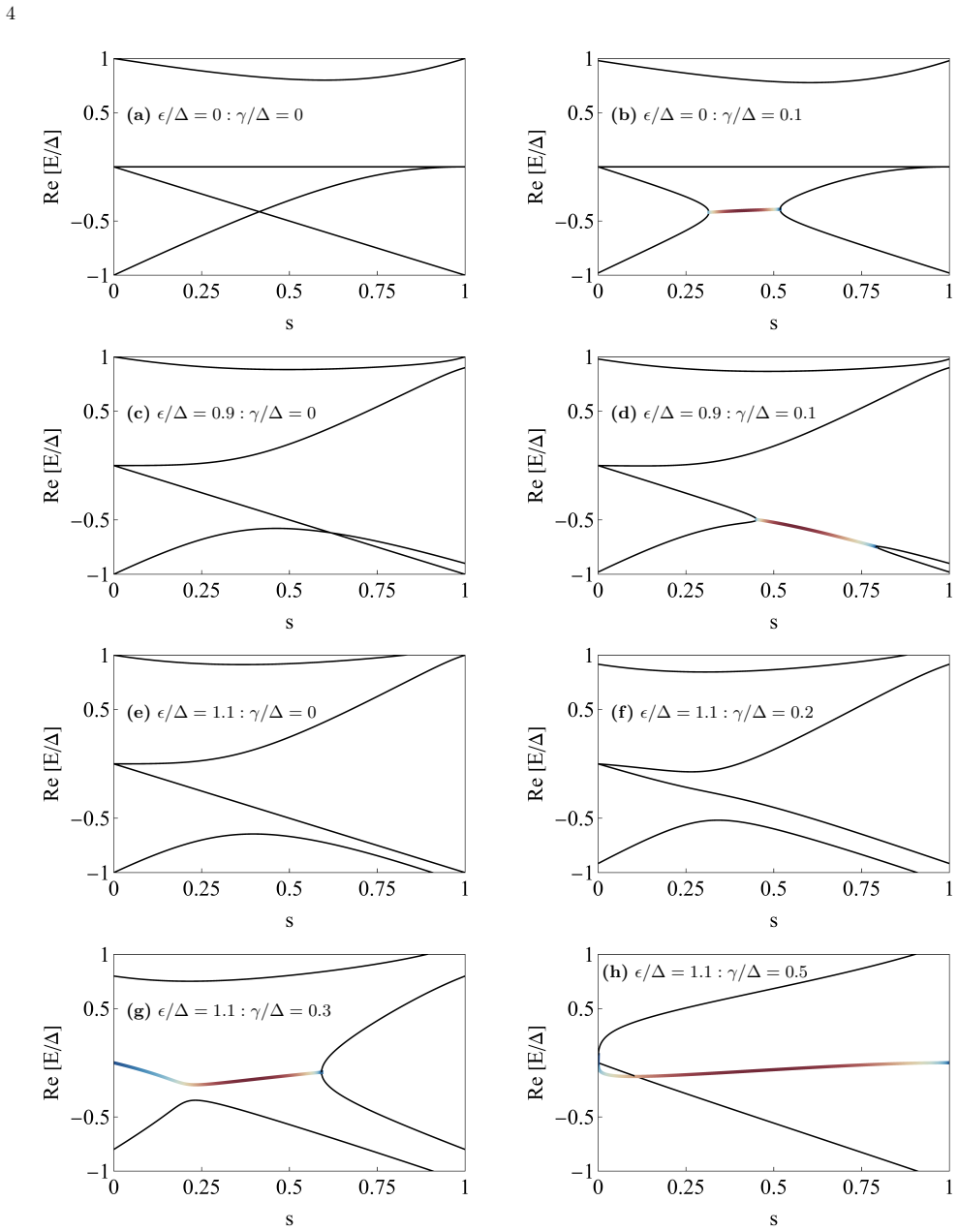
(5) and can be represented as 4×4 matrix: ˆH= sϵ(1−s) ∆ 2 (1−s) ∆ 2 0 (1−s) ∆ 2 −2iγ sg(1−s) ∆ 2 (1−s) ∆ 2 sg2iγ(1−s) ∆ 2 0 (1−s) ∆ 2 (1−s) ∆ 2 −sϵ .(6) III. TWO INTERACTINGPT–SYMMETRIC QUBITS: INSTANTANEOUS ENERGY SPECTRUM The four eigenvalues of thePT––symmetric non- Hermitian Hamiltonian (6) depending on parameters, i.e., theinstantaneousen...
-
[2]
D. Mehta and C. Grosan, A collection of challenging opti- mization problems in science, engineering and economics, in2015 IEEE Congress on Evolutionary Computation (CEC)(IEEE, 2015) pp. 2697–2704
work page 2015
-
[3]
S. Kirkpatrick, C. D. Gelatt, and M. P. Vecchi, Optimiza- tion by simulated annealing, Science220, 671 (1983)
work page 1983
-
[4]
R. Sioshansi, A. J. Conejo,et al., Optimization in en- gineering, Cham: Springer International Publishing120 (2017)
work page 2017
-
[5]
G. B. Dantzig and J. H. Ramser, The truck dispatching problem, Management Science6, 80 (1959)
work page 1959
-
[6]
S. M. Islam,Mathematical economics of multi-level op- timisation: Theory and application(Springer Science & Business Media, 2012)
work page 2012
-
[7]
H. Li, L. Liu, N. Xia, and M. Yu, High-dimensional expected utility portfolios under the spiked covariance model, Finance Research Letters93, 109637 (2026)
work page 2026
-
[8]
Lucas, Ising formulations of many np problems, Fron- tiers in physics2, 74887 (2014)
A. Lucas, Ising formulations of many np problems, Fron- tiers in physics2, 74887 (2014)
work page 2014
-
[9]
F. A. Quinton, P. A. S. Myhr, M. Barani, and H. Zhang, Quantum annealing applications, challenges and limita- tions for optimisation problems compared to classical solvers, Scientific Reports15, 12733 (2025)
work page 2025
-
[10]
A. Barzegar, C. Pattison, W. Wang, and H. G. Katz- graber, Optimization of population annealing monte carlo for large-scale spin-glass simulations, Physical Re- view E98, 053308 (2018)
work page 2018
-
[11]
B. Heim, T. F. Rønnow, S. V. Isakov, and M. Troyer, Quantum versus classical annealing of ising spin glasses, Science348, 215 (2015)
work page 2015
-
[12]
H. Dahrouj, R. Alghamdi, H. Alwazani, S. Bahanshal, A. A. Ahmad, A. Faisal, R. Shalabi, R. Alhadrami, A. Subasi, M. T. Al-Nory,et al., An overview of ma- chine learning-based techniques for solving optimization problems in communications and signal processing, Ieee Access9, 74908 (2021)
work page 2021
-
[13]
D. Alcalde Puente and I. M. Eremin, Convolutional re- stricted boltzmann machine aided monte carlo: An ap- plication to ising and kitaev models, Physical Review B 102, 195148 (2020)
work page 2020
- [14]
-
[15]
E. Farhi and S. Gutmann, Analog analogue of a digi- tal quantum computation, Physical Review A57, 2403 (1998)
work page 1998
-
[16]
Quantum Computation by Adiabatic Evolution
E. Farhi, J. Goldstone, S. Gutmann, and M. Sipser, Quantum computation by adiabatic evolution, arXiv preprint quant-ph/0001106 (2000)
work page internal anchor Pith review Pith/arXiv arXiv 2000
-
[17]
M. Q. Mohammed, H. Meeß, and M. Otte, Review of the application of quantum annealing-related technologies in transportation optimization, Quantum Information Pro- cessing24, 296 (2025)
work page 2025
-
[18]
M. Born and V. Fock, Beweis des adiabatensatzes, Zeitschrift f¨ ur Physik51, 165 (1928)
work page 1928
-
[19]
M. W. Johnson, M. H. Amin, S. Gildert, T. Lanting, F. Hamze, N. Dickson, R. Harris, A. J. Berkley, J. Jo- hansson, P. Bunyk,et al., Quantum annealing with man- ufactured spins, Nature473, 194 (2011)
work page 2011
- [20]
-
[21]
A. D. King, J. Carrasquilla, J. Raymond, I. Ozfidan, E. Andriyash, A. Berkley, M. Reis, T. Lanting, R. Harris, F. Altomare,et al., Observation of topological phenom- ena in a programmable lattice of 1,800 qubits, Nature 560, 456 (2018)
work page 2018
-
[22]
W. Bo˙ zejko, R. Klempous, J. Pempera, J. Rozenblit, C. Smutnicki, M. Uchro´ nski, and M. Wodecki, Optimal solving of a scheduling problem using quantum anneal- ing metaheuristics on the d-wave quantum solver, IEEE Transactions on Systems, Man, and Cybernetics: Sys- tems55, 196 (2024)
work page 2024
-
[23]
F. Neukart, G. Compostella, C. Seidel, D. von Dollen, S. Yarkoni, and B. Parney, Traffic flow optimization using a quantum annealer, Frontiers in ICT4, 29 (2017)
work page 2017
- [24]
-
[25]
S. Yarkoni, E. Raponi, T. B¨ ack, and S. Schmitt, Quan- tum annealing for industry applications: Introduction and review, Reports on Progress in Physics85, 104001 (2022)
work page 2022
-
[26]
R. K. Nath, H. Thapliyal, and T. S. Humble, A review of machine learning classification using quantum annealing for real-world applications, SN Computer science2, 365 (2021)
work page 2021
- [27]
-
[28]
A. M. Childs, E. Farhi, and J. Preskill, Robustness of adiabatic quantum computation, Physical Review A65, 012322 (2001)
work page 2001
-
[29]
M. H. Amin, P. J. Love, and C. Truncik, Thermally as- sisted adiabatic quantum computation, Physical review letters100, 060503 (2008)
work page 2008
-
[30]
D. S. Wild, S. Gopalakrishnan, M. Knap, N. Y. Yao, and M. D. Lukin, Adiabatic quantum search in open systems, Physical review letters117, 150501 (2016)
work page 2016
-
[31]
A. J. Leggett, S. Chakravarty, A. T. Dorsey, M. P. Fisher, A. Garg, and W. Zwerger, Dynamics of the dissipa- tive two-state system, Reviews of Modern Physics59, 1 (1987)
work page 1987
- [32]
-
[33]
A. Rezakhani, A. Pimachev, and D. Lidar, Accuracy ver- sus run time in an adiabatic quantum search, Physical Review A—Atomic, Molecular, and Optical Physics82, 052305 (2010)
work page 2010
-
[34]
P. R. Hegde, G. Passarelli, A. Scocco, and P. Lucignano, Genetic optimization of quantum annealing, Physical Re- view A105, 012612 (2022)
work page 2022
- [35]
-
[36]
G. A. Starkov, M. V. Fistul, and I. M. Eremin, Quan- 13 tum phase transitions in non-hermitian pt-symmetric transverse-field ising spin chains, Annals of Physics456, 169268 (2023)
work page 2023
- [37]
-
[38]
C. M. Bender and S. Boettcher, Real spectra in non- hermitian hamiltonians having p t symmetry, Physical review letters80, 5243 (1998)
work page 1998
-
[39]
C. M. Bender, S. Boettcher, and P. N. Meisinger, Pt- symmetric quantum mechanics, Journal of Mathematical Physics40, 2201 (1999)
work page 1999
-
[41]
A. I. Nesterov, J. C. B. Zepeda, and G. P. Berman, Non- hermitian quantum annealing in the ferromagnetic ising model, Physical Review A—Atomic, Molecular, and Op- tical Physics87, 042332 (2013)
work page 2013
-
[42]
A. I. Nesterov, G. P. Berman, J. C. B. Zepeda, and A. R. Bishop, Non-hermitian quantum annealing in the antifer- romagnetic ising chain, Quantum information processing 13, 371 (2014)
work page 2014
-
[43]
A. Guo, G. J. Salamo, D. Duchesne, R. Morandotti, M. Volatier-Ravat, V. Aimez, G. A. Siviloglou, and D. N. Christodoulides, Observation of pt-symmetry breaking in complex optical potentials, Physical review letters103, 093902 (2009)
work page 2009
-
[44]
Y. Wu, W. Liu, J. Geng, X. Song, X. Ye, C.-K. Duan, X. Rong, and J. Du, Observation of parity-time symme- try breaking in a single-spin system, Science364, 878 (2019)
work page 2019
-
[45]
M. Naghiloo, M. Abbasi, Y. N. Joglekar, and K. Murch, Quantum state tomography across the exceptional point in a single dissipative qubit, Nature Physics15, 1232 (2019)
work page 2019
- [46]
-
[47]
A. S. Kazmina, I. V. Zalivako, A. S. Borisenko, N. A. Nemkov, A. S. Nikolaeva, I. A. Simakov, A. V. Kuznetsova, E. Y. Egorova, K. P. Galstyan, N. V. Se- menin, A. E. Korolkov, I. N. Moskalenko, N. N. Abramov, I. S. Besedin, D. A. Kalacheva, V. B. Lubsanov, A. N. Bolgar, E. O. Kiktenko, K. Y. Khabarova, A. Galda, I. A. Semerikov, N. N. Kolachevsky, N. Male...
work page 2024
-
[48]
L. Ding, K. Shi, Q. Zhang, D. Shen, X. Zhang, and W. Zhang, Experimental determination of pt-symmetric exceptional points in a single trapped ion, Physical Re- view Letters126, 083604 (2021)
work page 2021
-
[49]
A. D. King, J. Raymond, T. Lanting, R. Harris, A. Zucca, F. Altomare, A. J. Berkley, K. Boothby, S. Ejtemaee, C. Enderud,et al., Quantum critical dynamics in a 5,000- qubit programmable spin glass, Nature617, 61 (2023)
work page 2023
-
[50]
G. A. Starkov, M. V. Fistul, and I. M. Eremin, Quan- tum phase transitions in non-hermitian pt-symmetric transverse-field ising spin chains, Annals of Physics456, 169268 (2023)
work page 2023
-
[51]
G. A. Starkov, M. V. Fistul, and I. M. Eremin, Schrieffer- wolff transformation for non-hermitian systems: Appli- cation for pt-symmetric circuit qed, Physical Review B 108, 235417 (2023)
work page 2023
-
[52]
C. M. Bender, Making sense of non-hermitian hamiltoni- ans, Reports on Progress in Physics70, 947 (2007)
work page 2007
-
[53]
L. D. Landau, Zur theorie der energie¨ ubertragung bei st¨ oßen ii, Physikalische Zeitschrift der Sowjetunion2, 46 (1932)
work page 1932
-
[54]
Zener, Non-adiabatic crossing of energy levels, Pro- ceedings of the Royal Society of London
C. Zener, Non-adiabatic crossing of energy levels, Pro- ceedings of the Royal Society of London. Series A137, 696 (1932)
work page 1932
-
[55]
E. C. G. St¨ uckelberg, Theorie der unelastischen st¨ oße zwischen atomen, Helvetica Physica Acta5, 369 (1932)
work page 1932
-
[56]
X. Shen, F. Wang, Z. Li, and Z. Wu, Landau- zener-st¨ uckelberg interferometry inPT-symmetric non- hermitian models, Phys. Rev. A100, 062514 (2019)
work page 2019
-
[57]
F. Kivel¨ a, S. Dogra, and G. S. Paraoanu, Quantum simu- lation of the pseudo-hermitian landau-zener-st¨ uckelberg- majorana effect, Physical Review Research6, 023246 (2024)
work page 2024
- [58]
-
[59]
S. Erdamar, M. Abbasi, W. Chen, N. H¨ ornedal, A. Chenu, and K. W. Murch, Exploring the riemann- surface topology of a non-hermitian superconducting qubit using shortcuts to adiabaticity, PRX Quantum7, 010337 (2026)
work page 2026
-
[60]
Kayanuma, Nonadiabatic transitions in level crossing with energy fluctuation
Y. Kayanuma, Nonadiabatic transitions in level crossing with energy fluctuation. I. analytical investigations, J. Phys. Soc. Jpn.53, 108 (1984)
work page 1984
-
[61]
Y. Kayanuma and H. Nakayama, Nonadiabatic transition at a level crossing with dissipation, Phys. Rev. B57, 13099 (1998)
work page 1998
-
[62]
M. Grifoni and P. H¨ anggi, Driven quantum tunneling, Physics Reports304, 229 (1998)
work page 1998
discussion (0)
Sign in with ORCID, Apple, or X to comment. Anyone can read and Pith papers without signing in.