Recognition: 2 theorem links
· Lean TheoremPitfall of Precision in Noisy Signaling
Pith reviewed 2026-05-14 01:57 UTC · model grok-4.3
The pith
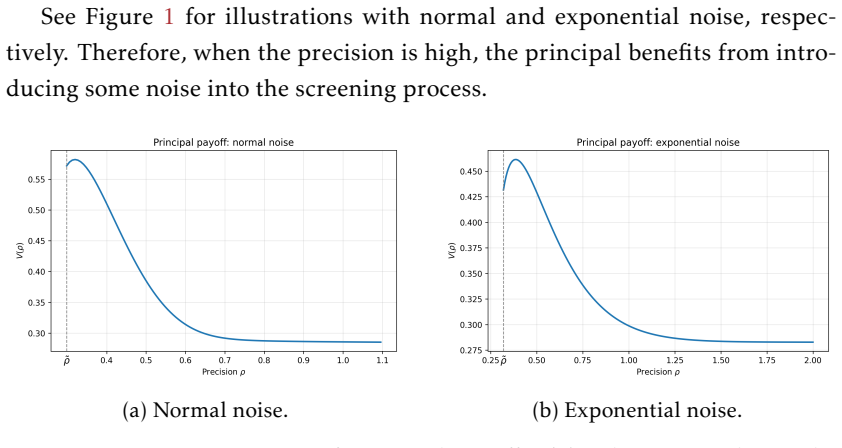
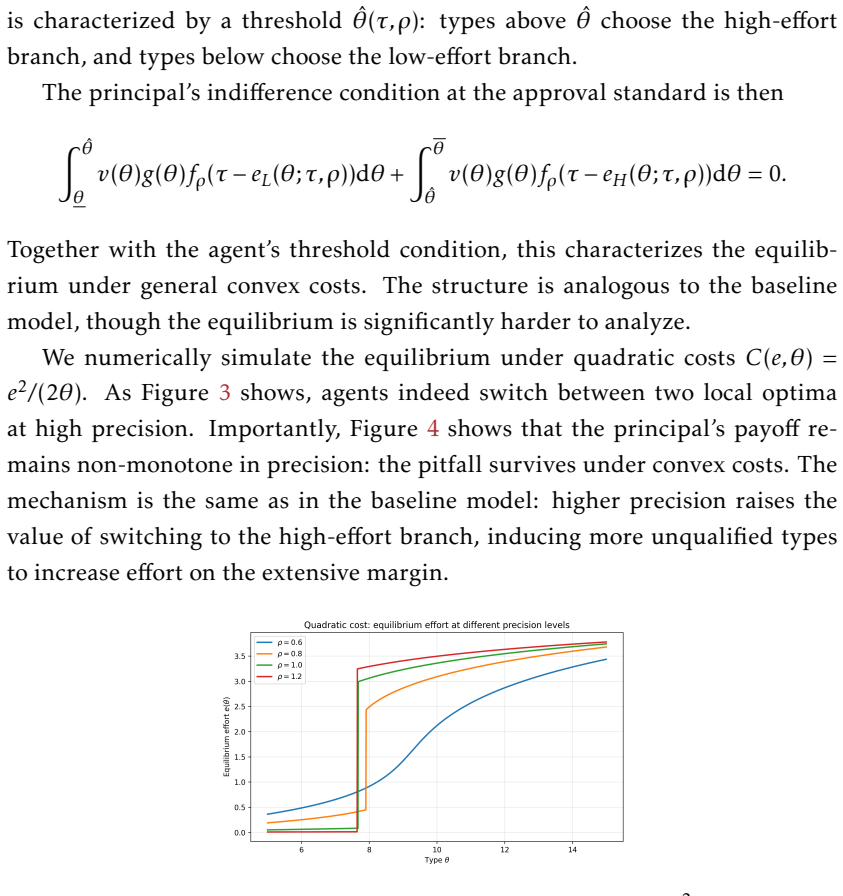
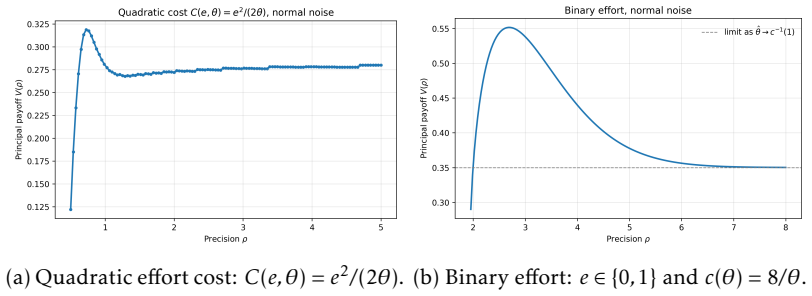
When signal precision is already high, further improvements reduce screening accuracy and lower the principal's welfare.
A machine-rendered reading of the paper's core claim, the machinery that carries it, and where it could break.
Core claim
The paper establishes that greater precision in the screening technology incentivizes strategic signaling from additional low-quality agents, and when precision is already high this behavioral response outweighs the direct reduction in noise, leading to lower screening accuracy and principal welfare. The mechanism also implies that groups facing noisier technologies may receive lower approval rates but can be favored ex ante in terms of welfare.
What carries the argument
The pitfall of precision, in which reduced noise from higher precision induces low-quality agents to increase mimicry effort enough to dominate the informational benefit.
If this is right
- Screening accuracy declines with further precision gains once precision exceeds a threshold.
- The principal's welfare is non-monotonic in precision and falls in the high-precision region.
- Groups observed through noisier technologies receive lower approval rates yet can enjoy higher ex ante welfare.
- Commitment by the principal to a fixed approval threshold can eliminate the pitfall.
Where Pith is reading between the lines
- Screening technologies therefore have an interior optimum rather than a corner solution at maximum precision.
- The result extends naturally to any setting in which agents can adjust effort in response to observable improvements in measurement quality.
- Regulators improving data quality for public screening systems should anticipate and measure the behavioral response of low-quality applicants.
Load-bearing premise
Low-quality agents can raise their signaling effort at sufficiently low marginal cost when precision improves, so that the rise in mimicry outweighs the direct reduction in noise.
What would settle it
An experiment that exogenously raises precision in an already high-precision regime and measures whether the share of low-quality agents who choose to signal rises enough to reduce the principal's approval payoff.
Figures
read the original abstract
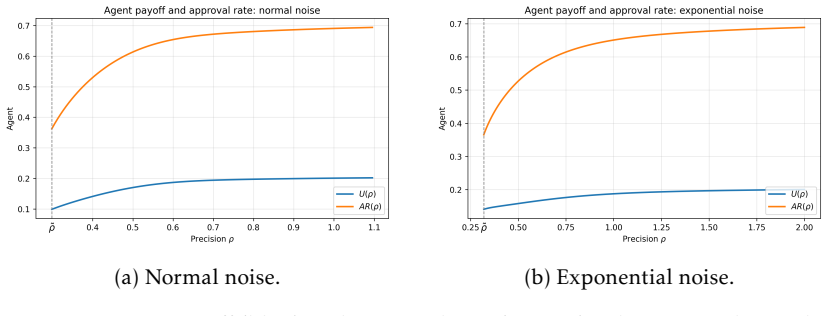
A principal decides whether to approve an agent based on a noisy signal (e.g., test scores) generated by the agent. High-quality agents can produce high signals on average at lower cost, but the realizations are subject to noise that depends on the screening technology's precision. We uncover a paradoxical "pitfall of precision": when precision is already high, further improvements reduce screening accuracy and lower the principal's welfare. This occurs because greater precision incentivizes strategic signaling from more low-quality agents, outweighing the direct benefit from improved precision. The pitfall of precision also has implications for statistical discrimination: groups with noisier technologies face lower approval rates yet may be favored ex ante -- a reversal of discrimination. We also examine how commitment power helps mitigate the pitfall.
Editorial analysis
A structured set of objections, weighed in public.
Referee Report
Summary. The paper analyzes a principal-agent screening model in which a principal approves or rejects agents based on a noisy signal whose variance decreases with the precision of the screening technology. High types produce higher signals at lower cost than low types, but both types can exert effort to influence the signal. The central claim is that once precision is already high, further increases in precision reduce the principal's welfare because they induce more low types to exert higher signaling effort, raising the approval threshold and causing the indirect mimicry effect to dominate the direct reduction in noise. The paper also derives implications for statistical discrimination across groups with different noise levels and shows that commitment by the principal can mitigate the pitfall.
Significance. If the result is robust, the paper identifies a novel mechanism-design channel through which improvements in information technology can be welfare-reducing once precision crosses a threshold. This contributes to the signaling and contract-theory literature by endogenizing the composition of the signal distribution via strategic responses. The discrimination reversal and commitment analysis provide additional testable implications for empirical work on testing and hiring.
major comments (3)
- [§3.2, Proposition 1] §3.2, Proposition 1 and the subsequent equilibrium characterization: the dominance of the indirect effect (increased low-type mimicry) over the direct precision gain is asserted to hold for sufficiently high precision, but the proof sketch relies on the low-type best-response effort rising linearly with precision; this is not shown to survive strictly convex costs or bounded noise supports (e.g., uniform rather than Gaussian), which could keep the low-type effort interior and reverse the welfare ranking.
- [§4.1, Eq. (12)] §4.1, welfare expression (Eq. 12): the principal's ex-ante payoff is written as an integral over the equilibrium approval probabilities, yet no comparative-statics derivative with respect to precision is provided that isolates the threshold at which the pitfall begins; without this, it is unclear whether the reported welfare loss is generic or specific to the chosen functional forms.
- [§5] §5, statistical-discrimination extension: the claim that noisier groups can be favored ex ante rests on the same equilibrium effort response; if the cost function is changed so that low-type effort does not increase with precision, the reversal disappears, making the discrimination result sensitive to the same untested assumption.
minor comments (2)
- [Abstract] The abstract states the paradox clearly but omits any mention of the maintained assumptions on cost convexity and noise distribution; adding one sentence would help readers assess scope.
- [§2] Notation for the precision parameter and the effort cost function is introduced without a consolidated table of symbols; a short notation appendix would improve readability.
Simulated Author's Rebuttal
We thank the referee for their constructive comments, which highlight important robustness considerations in our equilibrium analysis and welfare results. We address each major point below and outline the revisions we will make.
read point-by-point responses
-
Referee: [§3.2, Proposition 1] the dominance of the indirect effect (increased low-type mimicry) over the direct precision gain is asserted to hold for sufficiently high precision, but the proof sketch relies on the low-type best-response effort rising linearly with precision; this is not shown to survive strictly convex costs or bounded noise supports (e.g., uniform rather than Gaussian), which could keep the low-type effort interior and reverse the welfare ranking.
Authors: We acknowledge that the current proof relies on quadratic costs and Gaussian noise, under which low-type effort increases linearly with precision. For strictly convex costs the marginal incentive to mimic remains increasing in precision provided the approval probability gain is sufficiently responsive, which holds in a neighborhood of our parameterization. For bounded supports such as uniform noise, effort may become interior at high precision, but the indirect effect still dominates once the threshold is crossed because the direct noise reduction is bounded while mimicry continues to raise the cutoff. We will add a remark clarifying these conditions and note the maintained assumptions on cost convexity and noise support. revision: partial
-
Referee: [§4.1, Eq. (12)] the principal's ex-ante payoff is written as an integral over the equilibrium approval probabilities, yet no comparative-statics derivative with respect to precision is provided that isolates the threshold at which the pitfall begins; without this, it is unclear whether the reported welfare loss is generic or specific to the chosen functional forms.
Authors: We agree that an explicit derivative would strengthen the presentation. In the revision we will compute dW/dρ explicitly from the equilibrium approval probabilities and show that the sign turns negative once ρ exceeds a threshold determined by the cost parameters and the distribution of types. This derivation will confirm that the welfare reversal is driven by the relative strength of the indirect mimicry channel rather than the specific functional forms chosen for illustration. revision: yes
-
Referee: [§5] the claim that noisier groups can be favored ex ante rests on the same equilibrium effort response; if the cost function is changed so that low-type effort does not increase with precision, the reversal disappears, making the discrimination result sensitive to the same untested assumption.
Authors: The discrimination reversal is indeed a direct implication of the same effort response that generates the pitfall. When low-type effort is increasing in precision, noisier groups induce less mimicry and can be favored ex ante despite lower approval rates. We will add a short paragraph noting that the result requires a positive effort response to precision, which is satisfied under the maintained cost assumptions; if costs were independent of precision the reversal would vanish, but so would the core pitfall mechanism itself. revision: partial
Circularity Check
No significant circularity; pitfall derived from equilibrium responses without reduction to inputs
full rationale
The derivation models a noisy signaling game in which the principal's approval decision and agents' effort choices are solved simultaneously for a given precision parameter. The welfare comparison across precision levels follows from substituting equilibrium effort and approval thresholds into the principal's payoff function; the indirect effect (increased low-type mimicry) is obtained from the low types' best-response condition rather than being imposed by definition or by fitting to the target outcome. No equations equate the reported welfare loss to a fitted parameter, no self-citation supplies a uniqueness theorem that forces the result, and the abstract contains no renaming of known patterns. The model remains self-contained against its stated assumptions on cost and noise distributions.
Axiom & Free-Parameter Ledger
axioms (1)
- domain assumption Agents choose signaling effort to maximize expected approval probability net of cost, with costs lower for high-quality types.
Lean theorems connected to this paper
-
IndisputableMonolith/Cost/FunctionalEquation.leanwashburn_uniqueness_aczel unclears=e+ϵ/ρ ... C(e,θ)=e/θ ... marginal benefit fρ(τ−e) single-peaked ... threshold ˆθ solving 1−Fρ(τ−0)=1−Fρ(τ−ê)−ê/θ
-
IndisputableMonolith/Foundation/RealityFromDistinction.leanreality_from_one_distinction unclearV(ρ) non-monotone ... pitfall when ρ large because strategic effect on extensive margin dominates
Reference graph
Works this paper leans on
-
[1]
The Quarterly Journal of Economics , volume=
Job Market Signaling , author=. The Quarterly Journal of Economics , volume=
-
[2]
Problems of monetary management: the UK experience in papers in monetary economics , author=. Monetary Economics , volume=
-
[3]
Journal of Public Economics , volume=
The response of firms to eligibility thresholds: Evidence from the Japanese value-added tax , author=. Journal of Public Economics , volume=. 2009 , publisher=
work page 2009
-
[4]
American Economic Journal: Economic Policy , volume=
Under the radar: The effects of monitoring firms on tax compliance , author=. American Economic Journal: Economic Policy , volume=. 2018 , publisher=
work page 2018
-
[5]
Public Finance Review , volume=
Medicaid's nursing home coverage and asset transfers , author=. Public Finance Review , volume=. 2007 , publisher=
work page 2007
-
[6]
Journal of the European Economic Association , volume=
Improving information from manipulable data , author=. Journal of the European Economic Association , volume=. 2022 , publisher=
work page 2022
-
[7]
arXiv preprint arXiv:2004.03865 , year=
Manipulation-proof machine learning , author=. arXiv preprint arXiv:2004.03865 , year=
-
[8]
Games and Economic Behavior , volume=
Noisy signaling: theory and experiment , author=. Games and Economic Behavior , volume=. 2011 , publisher=
work page 2011
-
[9]
Journal of Economic Behavior & Organization , volume=
Signaling in deterministic and stochastic settings , author=. Journal of Economic Behavior & Organization , volume=. 2012 , publisher=
work page 2012
-
[10]
American Economic Journal: Microeconomics , volume=
Dynamic noisy signaling , author=. American Economic Journal: Microeconomics , volume=
-
[11]
Games and Economic Behavior , volume=
Repeated signaling games , author=. Games and Economic Behavior , volume=. 2009 , publisher=
work page 2009
- [12]
-
[13]
The Review of Economics and Statistics , pages=
Employer search: The interviewing and hiring of new employees , author=. The Review of Economics and Statistics , pages=. 1985 , publisher=
work page 1985
-
[14]
Econometrica: Journal of the Econometric Society , pages=
Equilibrium limit pricing: The effects of private information and stochastic demand , author=. Econometrica: Journal of the Econometric Society , pages=. 1983 , publisher=
work page 1983
-
[15]
Journal of Economic Theory , volume=
Noise-proof equilibria in two-action signaling games , author=. Journal of Economic Theory , volume=. 1997 , publisher=
work page 1997
- [16]
- [17]
-
[18]
american economic review , volume=
Social value of public information , author=. american economic review , volume=
-
[19]
Journal of Economic Theory , volume=
Welfare-improving ambiguity in insurance markets with asymmetric information , author=. Journal of Economic Theory , volume=. 2014 , publisher=
work page 2014
-
[20]
American Economic Review , volume=
Learning from manipulable signals , author=. American Economic Review , volume=. 2022 , publisher=
work page 2022
-
[21]
The Quarterly Journal of Economics , volume=
Grantmaking, grading on a curve, and the paradox of relative evaluation in nonmarkets , author=. The Quarterly Journal of Economics , volume=. 2024 , publisher=
work page 2024
-
[22]
American Economic Journal: Microeconomics , volume=
Screening Dominance: A Comparison of Noisy Signals , author=. American Economic Journal: Microeconomics , volume=. 2022 , publisher=
work page 2022
-
[23]
Information acquisition in auctions , author=. Econometrica , volume=. 2000 , publisher=
work page 2000
-
[24]
The Annals of Statistics , pages=
Comparing Location Experiments , author=. The Annals of Statistics , pages=. 1988 , publisher=
work page 1988
-
[25]
The Bell journal of economics , pages=
Moral hazard and observability , author=. The Bell journal of economics , pages=. 1979 , publisher=
work page 1979
-
[26]
The annals of mathematical statistics , pages=
Equivalent comparisons of experiments , author=. The annals of mathematical statistics , pages=. 1953 , publisher=
work page 1953
-
[27]
Proceedings of the second Berkeley symposium on mathematical statistics and probability , volume=
Comparison of experiments , author=. Proceedings of the second Berkeley symposium on mathematical statistics and probability , volume=. 1951 , organization=
work page 1951
- [28]
-
[29]
Games and Economic Behavior , volume=
Noisy persuasion , author=. Games and Economic Behavior , volume=. 2021 , publisher=
work page 2021
-
[30]
Journal of Political Economy , volume=
Muddled information , author=. Journal of Political Economy , volume=. 2019 , publisher=
work page 2019
-
[31]
Games and Economic Behavior , volume=
Dynamic quality signaling with hidden actions , author=. Games and Economic Behavior , volume=. 2019 , publisher=
work page 2019
-
[32]
The Quarterly Journal of Economics , volume=
Signaling games and stable equilibria , author=. The Quarterly Journal of Economics , volume=. 1987 , publisher=
work page 1987
-
[33]
Econometrica: Journal of the Econometric Society , pages=
Equilibrium selection in signaling games , author=. Econometrica: Journal of the Econometric Society , pages=. 1987 , publisher=
work page 1987
-
[34]
Journal of Economic Theory , volume=
The limits of meritocracy , author=. Journal of Economic Theory , volume=. 2022 , publisher=
work page 2022
-
[35]
Toward a Theory of the Rent-Seeking Society , pages=
Efficient rent seeking , author=. Toward a Theory of the Rent-Seeking Society , pages=. 1980 , publisher=
work page 1980
-
[36]
Journal of political Economy , volume=
Rank-order tournaments as optimum labor contracts , author=. Journal of political Economy , volume=. 1981 , publisher=
work page 1981
-
[37]
Journal of Economic Theory , volume=
How noise affects effort in tournaments , author=. Journal of Economic Theory , volume=. 2020 , publisher=
work page 2020
-
[38]
Comparative statics, informativeness, and the interval dominance order , author=. Econometrica , volume=. 2009 , publisher=
work page 2009
-
[39]
The american economic review , volume=
The statistical theory of racism and sexism , author=. The american economic review , volume=. 1972 , publisher=
work page 1972
-
[40]
Recent Contributions to Theories of Discrimination , author=
-
[41]
American Economic Journal: Microeconomics , volume=
Too Good to Be True? Retention Rules for Noisy Agents , author=. American Economic Journal: Microeconomics , volume=. 2023 , publisher=
work page 2023
-
[42]
Statistical theories of discrimination in labor markets , author=. Ilr Review , volume=. 1977 , publisher=
work page 1977
-
[43]
The Economic Journal , volume=
A characterisation of ‘Phelpsian’statistical discrimination , author=. The Economic Journal , volume=. 2021 , publisher=
work page 2021
-
[44]
arXiv preprint arXiv:2205.07128 , year=
Statistical discrimination and statistical informativeness , author=. arXiv preprint arXiv:2205.07128 , year=
-
[45]
Theoretical Economics , volume=
Informative tests in signaling environments , author=. Theoretical Economics , volume=. 2022 , publisher=
work page 2022
-
[46]
American Economic Journal: Microeconomics , volume=
Scoring strategic agents , author=. American Economic Journal: Microeconomics , volume=. 2025 , publisher=
work page 2025
-
[47]
American Economic Review , volume=
Attention discrimination: Theory and field experiments with monitoring information acquisition , author=. American Economic Review , volume=. 2016 , publisher=
work page 2016
-
[48]
Test design under falsification , author=. Econometrica , volume=. 2022 , publisher=
work page 2022
-
[49]
Games and Economic Behavior , volume=
Test design under voluntary participation , author=. Games and Economic Behavior , volume=. 2017 , publisher=
work page 2017
-
[50]
American Economic Journal: Microeconomics , volume=
Coarse grades: Informing the public by withholding information , author=. American Economic Journal: Microeconomics , volume=. 2018 , publisher=
work page 2018
-
[51]
Review of Economic Studies , pages=
Pareto improvements in the contest for college admissions , author=. Review of Economic Studies , pages=. 2025 , publisher=
work page 2025
-
[52]
American Economic Review , volume=
Test-optional admissions , author=. American Economic Review , volume=. 2025 , publisher=
work page 2025
-
[53]
The American Economic Review , pages=
Will affirmative-action policies eliminate negative stereotypes? , author=. The American Economic Review , pages=. 1993 , publisher=
work page 1993
-
[54]
Discrimination in Labor Markets , editor=
Arrow, Kenneth , title=. Discrimination in Labor Markets , editor=. 1973 , pages=
work page 1973
-
[55]
Journal of Public Economics , volume=
Belief flipping in a dynamic model of statistical discrimination , author=. Journal of Public Economics , volume=. 2007 , publisher=
work page 2007
-
[56]
American economic review , volume=
The dynamics of discrimination: Theory and evidence , author=. American economic review , volume=. 2019 , publisher=
work page 2019
-
[57]
The Quarterly Journal of Economics , volume=
Systemic discrimination: Theory and measurement , author=. The Quarterly Journal of Economics , volume=. 2025 , publisher=
work page 2025
discussion (0)
Sign in with ORCID, Apple, or X to comment. Anyone can read and Pith papers without signing in.