Recognition: unknown
Quantized Transport in Floquet Topological Insulators
Pith reviewed 2026-05-14 02:20 UTC · model grok-4.3
The pith
Floquet topological systems show quantized longitudinal and Hall conductances set by the winding invariant once all sideband contributions are summed.
A machine-rendered reading of the paper's core claim, the machinery that carries it, and where it could break.
Core claim
Using the Floquet nonequilibrium Green's-function formalism on a strip geometry, we demonstrate from exact numerics that the longitudinal conductance quantizes to |W_ε| e²/h and the Hall conductance to W_ε e²/h, where W_ε is the Floquet winding invariant tied to the quasienergy gap at ε = 0 or ε = Ω/2. Quantization is achieved only after summing over all Floquet sidebands. In the weak-coupling limit an analytic argument shows that the sideband contributions, including the signs of the edge-mode velocities, add to produce the exact quantized value predicted by the winding number.
What carries the argument
The Floquet winding invariant W_ε for a chosen quasienergy gap, which fixes the total conductance after the sideband sum is performed.
If this is right
- Longitudinal conductance reaches exactly |W_ε| times e²/h.
- Hall conductance reaches exactly W_ε times e²/h.
- The sum rule holds for both gaps at ε = 0 and ε = Ω/2.
- Convergence occurs rapidly over a wide range of parameters, making the quantization observable.
- An analytic proof of the Hall sum rule exists in the weak-reservoir-coupling limit.
Where Pith is reading between the lines
- The sideband-sum requirement distinguishes Floquet transport from its static counterpart and may apply to other non-equilibrium topological settings.
- The result points to a practical route for extracting winding numbers from mesoscopic conductance measurements in driven devices.
- Similar sum rules could be tested in multi-terminal or higher-dimensional Floquet geometries.
Load-bearing premise
The quantization requires adding the conductance contributions from every Floquet sideband.
What would settle it
A numerical evaluation of the strip conductance that leaves out some sidebands and yields a value different from |W_ε| e²/h or W_ε e²/h would falsify the sum-rule claim.
Figures





read the original abstract
We study quantum transport in a periodically driven (Floquet) topological system coupled to static fermionic reservoirs. Using the Floquet nonequilibrium Green's-function (NEGF) formalism we show, from exact numerics for a strip geometry, that the two-terminal (longitudinal) conductance is quantized as $|W_{\varepsilon}|\,e^2/h$, while the Hall (transverse) conductance is quantized as $W_{\varepsilon}\,e^2/h$, where $W_{\varepsilon}$ is the Floquet winding invariant associated with the quasienergy gap at $\varepsilon = 0$ or $\varepsilon = \Omega/2$. Quantization is achieved only after summing over the contribution of all Floquet sidebands. We provide an analytic understanding of this Floquet conductance sum rule, by considering the Hall conductance in the weak coupling limit. In that limit, we show that the Floquet Hall conductance gets contributions from the Floquet sidebands, which includes the signs of the velocities of the edge modes. Their sum yields exact quantization, as predicted by the Floquet sum rule. We find that in a wide range of parameter regime, the convergence is fast, making observation of the sum rule and Floquet winding numbers accessible to experiments.
Editorial analysis
A structured set of objections, weighed in public.
Referee Report
Summary. The paper studies quantum transport in a periodically driven Floquet topological insulator coupled to static reservoirs. Using the Floquet NEGF formalism, exact numerics on a strip geometry demonstrate that the longitudinal two-terminal conductance is quantized as |W_ε| e²/h and the transverse Hall conductance as W_ε e²/h, with W_ε the Floquet winding invariant of the quasienergy gap at ε = 0 or ε = Ω/2. Quantization requires summing all Floquet sideband contributions; an analytic derivation of the Hall sum rule is given in the weak-coupling limit, showing that edge-mode velocity signs yield exact quantization, with numerics indicating rapid convergence in a broad parameter range.
Significance. If the central claims hold, the work supplies direct numerical evidence that Floquet winding numbers control measurable conductances once all sidebands are included, together with a clean analytic confirmation of the sum rule in the weak-coupling regime. The combination of exact strip-geometry numerics and parameter-free analytic insight strengthens the link between Floquet topology and transport observables and indicates experimental accessibility given the reported fast convergence.
minor comments (2)
- [Abstract] The abstract states that quantization holds 'only after summing over the contribution of all Floquet sidebands'; a brief sentence in the introduction or §2 clarifying why single-sideband conductances deviate from quantization would improve readability for readers unfamiliar with Floquet transport.
- [Weak-coupling analytic derivation] In the weak-coupling analytic section, the statement that 'their sum yields exact quantization' would benefit from an explicit reference to the velocity-sign contribution (e.g., Eq. (X) or the paragraph immediately following the derivation) to make the cancellation transparent.
Simulated Author's Rebuttal
We thank the referee for their positive report, which accurately summarizes our results on quantized transport in Floquet topological insulators, and for recommending acceptance of the manuscript.
Circularity Check
No significant circularity detected
full rationale
The central result follows from direct numerical evaluation of the Floquet NEGF conductance formulas on a finite strip, summed over all sidebands, and is compared to the independently defined winding number W_ε extracted from the bulk quasienergy spectrum. The analytic weak-coupling Hall derivation uses only the standard Landauer-Büttiker structure plus the velocity signs of the edge modes; neither step defines W_ε in terms of the conductance nor fits parameters to the target quantization. No self-citation is load-bearing for the quantization claim, and the winding invariant is introduced via its standard topological definition rather than by ansatz or renaming.
Axiom & Free-Parameter Ledger
axioms (1)
- domain assumption Floquet NEGF formalism correctly captures transport in periodically driven systems coupled to static reservoirs
Reference graph
Works this paper leans on
-
[1]
We first consider the strip geometry and using the Floquet nonequilibrium Green’s function (NEGF) formalism [48], we demonstrate quantization of the two terminal conductance using the Floquet sum rules. We show that, in certain parameter regimes, the sum rule is even satisfied on including a small number of Floquet sidebands
-
[2]
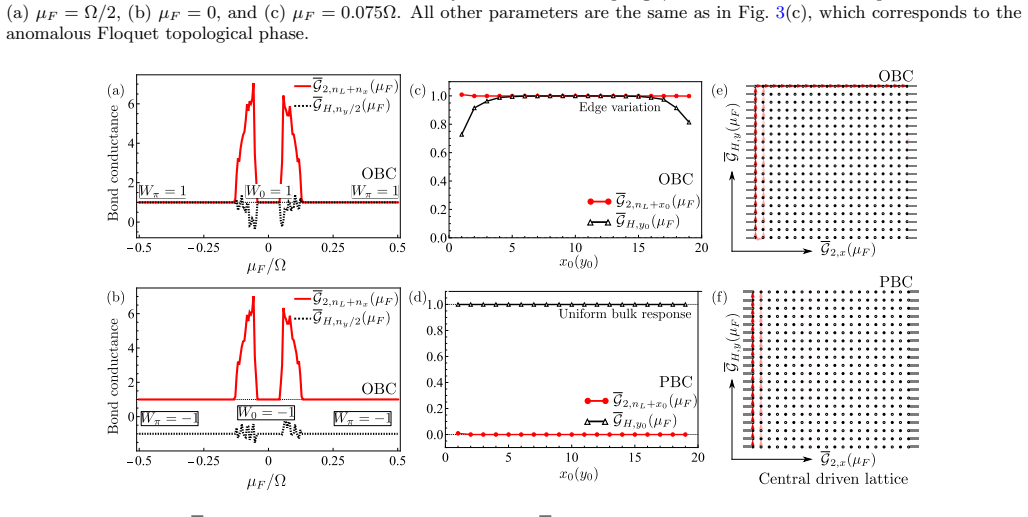
We show, again for the strip geometry, that the spatially resolved bond currents (summed over the Floquet sidebands) can be used to compute, in ad- dition to the two-terminal conductance, also the Hall conductance which encodes both the magni- tude and the sign of the Floquet winding invari- ants
-
[3]
This result is valid both for the strip and cylindrical geometries
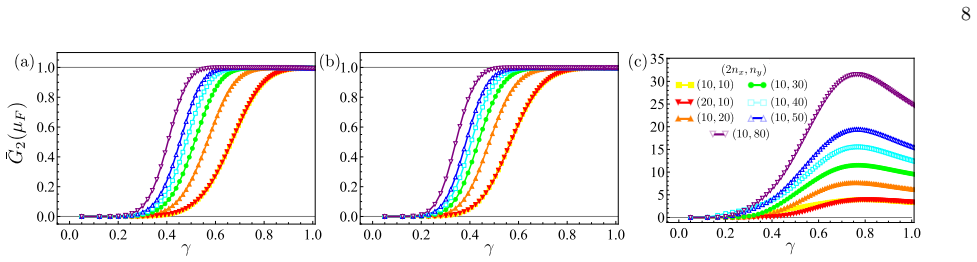
We analyze the dependence of both the two ter- minal and Hall conductance quantization on sys- tem size and system–reservoir coupling strength, and show that quantization emerges in the weak- coupling limit when the transverse system size is sufficiently large. This result is valid both for the strip and cylindrical geometries
-
[4]
In the cylindrical geometry and in the weak cou- pling limit, we provide a microscopic interpretation of the Floquet sum rule and an analytic proof of the Hall conductance quantization. We show that sum- ming over Floquet sidebands in the weak-coupling steady state reconstructs the full spectral weight of chiral Floquet edge modes distributed over Floquet...
-
[5]
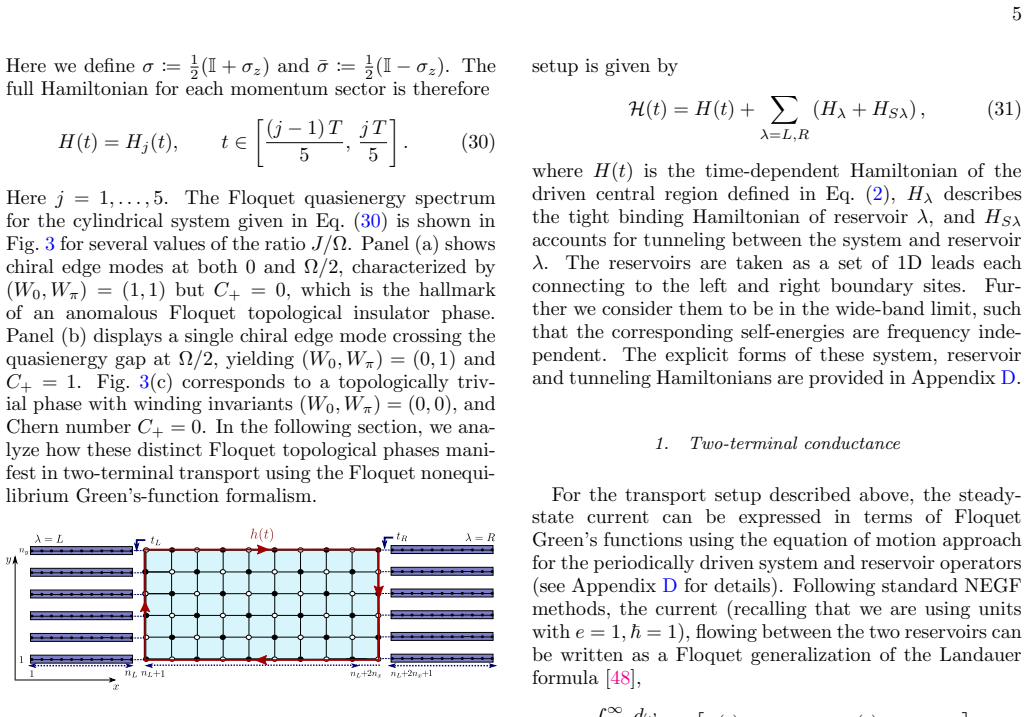
Two-terminal conductance For the transport setup described above, the steady- state current can be expressed in terms of Floquet Green’s functions using the equation of motion approach for the periodically driven system and reservoir operators (see Appendix D for details). Following standard NEGF methods, the current (recalling that we are using units wit...
-
[6]
Longitudinal and transverse bond currents In the strip geometry (recall Fig. 4), in addition to the two-terminal conductance, we now compute the lo- cal bond currents along the longitudinal (x) and trans- verse (y) directions of the lattice. This will help to bet- ter characterize the spatial structure of transport. For a time-periodic Hamiltonian satisfy...
-
[7]
In this case only the two chiral modes, localized in the left and right ends, contribute to theαsum
First consider the case whenµ F is in a topologi- cal gap. In this case only the two chiral modes, localized in the left and right ends, contribute to theαsum. For the left mode,|ϕ (n) α (xL)|2 is signif- icant while|ϕ (n) α (xR)|2 is small and vice-versa for the right edge mode. Hencew (n) α is negligible for 12 the right edge mode. For the left mode the...
-
[8]
We note that in addition to the quantization of the summed conductance our weak-coupling approach also allows us to compute the contribution of each side-band to the total conductance and this is given by Eq. (65)
-
[9]
Next we consider the case whereµ F lies in the bulk bands. In this case the weights,|ϕ α(Xλ)|2, at both left and right ends are small but comparable and so we getw (n) α <1. Secondly there are a large number ofαmodes which will contribute to the sum and hence we do not get any quantization. This completes our proof of the Floquet sum rule and quantization...
work page 2022
- [10]
-
[11]
N. Goldman and J. Dalibard, Periodically driven quan- tum systems: Effective hamiltonians and engineered gauge fields, Phys. Rev. X4, 031027 (2014)
work page 2014
-
[12]
Eckardt, Atomic quantum gases in periodically driven optical lattices, Rev
A. Eckardt, Atomic quantum gases in periodically driven optical lattices, Rev. Mod. Phys.89, 011004 (2017)
work page 2017
- [13]
- [14]
-
[15]
J. Cayssol, B. D´ ora, F. Simon, and R. Moessner, Flo- quet topological insulators, physica status solidi (RRL) – Rapid Research Letters7, 101 (2013)
work page 2013
-
[16]
M. Rodriguez-Vega, A. Kumar, and B. Seradjeh, Higher- order floquet topological phases with corner and bulk bound states, Phys. Rev. B100, 085138 (2019)
work page 2019
-
[17]
T. Morimoto, H. C. Po, and A. Vishwanath, Floquet topological phases protected by time glide symmetry, Phys. Rev. B95, 195155 (2017)
work page 2017
-
[18]
S. Chaudhary, A. Haim, Y. Peng, and G. Refael, Phonon- induced floquet topological phases protected by space- time symmetries, Phys. Rev. Res.2, 043431 (2020)
work page 2020
-
[19]
M. Jangjan, L. E. F. Foa Torres, and M. V. Hosseini, Floquet topological phase transitions in a periodically quenched dimer, Phys. Rev. B106, 224306 (2022)
work page 2022
- [20]
-
[21]
I.-D. Potirniche, A. C. Potter, M. Schleier-Smith, A. Vishwanath, and N. Y. Yao, Floquet symmetry- protected topological phases in cold-atom systems, Phys. Rev. Lett.119, 123601 (2017)
work page 2017
- [22]
- [23]
- [24]
- [25]
- [26]
-
[27]
L. Du, P. D. Schnase, A. D. Barr, A. R. Barr, and G. A. Fiete, Floquet topological transitions in extended kane- mele models with disorder, Phys. Rev. B98, 054203 (2018)
work page 2018
-
[28]
A. Raj, S. Chaudhary, M. Rodriguez-Vega, M. G. Vergniory, R. Ilan, and G. A. Fiete, Light-induced pseudomagnetic fields in three-dimensional topological semimetals, Phys. Rev. B113, 155117 (2026)
work page 2026
-
[29]
M. S. Rudner, N. H. Lindner, E. Berg, and M. Levin, Anomalous edge states and the bulk-edge correspondence for periodically driven two-dimensional systems, Phys. Rev. X3, 031005 (2013)
work page 2013
-
[30]
F. N. ¨Unal, A. Eckardt, and R.-J. Slager, Hopf character- ization of two-dimensional floquet topological insulators, Physical Review Research1, 022003 (2019)
work page 2019
-
[31]
F. Nathan and M. S. Rudner, Topological singularities and the general classification of floquet–bloch systems, New J. Phys.17, 125014 (2015)
work page 2015
- [32]
- [33]
-
[34]
M. S. Rudner and N. H. Lindner, Band structure engi- neering and non-equilibrium dynamics in floquet topo- logical insulators, Nat. Rev. Phys.2, 229 (2020)
work page 2020
- [35]
-
[36]
S. Mukherjee, A. Spracklen, M. Valiente, E. Andersson, P. ¨Ohberg, N. Goldman, and R. R. Thomson, Experimen- tal observation of anomalous topological edge modes in a slowly driven photonic lattice, Nature Communications 8, 13918 (2017)
work page 2017
- [37]
-
[38]
F. N. ¨Unal, A. Eckardt, and R.-J. Slager, Hopf character- ization of two-dimensional floquet topological insulators, Phys. Rev. Res.1, 022003 (2019)
work page 2019
-
[39]
K. von Klitzing, G. Dorda, and M. Pepper, New method for high-accuracy determination of the fine-structure con- stant based on quantized hall resistance, Phys. Rev. Lett. 45, 494 (1980)
work page 1980
-
[40]
D. J. Thouless, M. Kohmoto, M. P. Nightingale, and M. den Nijs, Quantized hall conductance in a two- dimensional periodic potential, Phys. Rev. Lett.49, 405 (1982)
work page 1982
-
[41]
B¨ uttiker, Absence of backscattering in the quantum hall effect in multiprobe conductors, Phys
M. B¨ uttiker, Absence of backscattering in the quantum hall effect in multiprobe conductors, Phys. Rev. B38, 9375 (1988)
work page 1988
-
[42]
M. Z. Hasan and C. L. Kane, Colloquium: Topological insulators, Rev. Mod. Phys.82, 3045 (2010)
work page 2010
-
[43]
B. A. Bernevig and S.-C. Zhang, Quantum spin hall ef- fect, Phys. Rev. Lett.96, 106802 (2006)
work page 2006
-
[44]
M. K¨ onig, S. Wiedmann, C. Br¨ une, and et al., Quantum spin hall insulator state in hgte quantum wells, Science 318, 766 (2007)
work page 2007
-
[45]
T. Ozawa and B. Mera, Relations between topology and the quantum metric for chern insulators, Phys. Rev. B 104, 045103 (2021)
work page 2021
-
[46]
B. Mera, K. Sacha, and Y. Omar, Topologically protected quantization of work, Phys. Rev. Lett.123, 020601 (2019). 20
work page 2019
- [47]
-
[48]
J. Majeed Bhat, R. Shankar, and A. Dhar, Quantized two terminal conductance, edge states and current patterns in an open geometry 2-dimensional chern insulator, Journal of Physics: Condensed Matter37, 275601 (2025)
work page 2025
-
[49]
A. Kundu and B. Seradjeh, Transport signatures of flo- quet majorana fermions in driven topological supercon- ductors, Phys. Rev. Lett.111, 136402 (2013)
work page 2013
-
[50]
L. E. F. Foa Torres, P. M. Perez-Piskunow, C. A. Bal- seiro, and G. Usaj, Multiterminal conductance of a flo- quet topological insulator, Phys. Rev. Lett.113, 266801 (2014)
work page 2014
-
[51]
I. Esin, M. S. Rudner, G. Refael, and N. H. Lindner, Quantized transport and steady states of floquet topo- logical insulators, Phys. Rev. B97, 245401 (2018)
work page 2018
-
[52]
H. Dehghani, T. Oka, and A. Mitra, Out-of-equilibrium electrons and the hall conductance of a floquet topologi- cal insulator, Phys. Rev. B91, 155422 (2015)
work page 2015
-
[53]
A. Farrell and T. Pereg-Barnea, Edge-state transport in floquet topological insulators, Phys. Rev. B93, 045121 (2016)
work page 2016
-
[54]
H. H. Yap, L. Zhou, J.-S. Wang, and J. Gong, Com- putational study of the two-terminal transport of floquet quantum hall insulators, Phys. Rev. B96, 165443 (2017)
work page 2017
- [55]
- [56]
- [57]
-
[58]
T. Iadecola, T. Neupert, and C. Chamon, Occupation of topological floquet bands in open systems, Phys. Rev. B 91, 235133 (2015)
work page 2015
-
[59]
O. Matsyshyn, J. C. W. Song, I. Sodemann Villadiego, and L.-k. Shi, Fermi-dirac staircase occupation of flo- quet bands and current rectification, Phys. Rev. B107, 195135 (2023)
work page 2023
-
[60]
L. Peralta Gavensky, G. Usaj, and N. Goldman, Stˇ reda formula for floquet systems: Topological invariants and quantized anomalies from ces` aro summation, Phys. Rev. X15, 031067 (2025)
work page 2025
-
[61]
R. Seshadri and D. Sen, Floquet topological phases and bulk–boundary correspondence in periodically driven systems, Phys. Rev. B106, 245401 (2022)
work page 2022
- [62]
- [63]
-
[64]
L.-k. Shi, O. Matsyshyn, J. C. W. Song, and I. Sode- mann Villadiego, Floquet fermi liquid, Phys. Rev. Lett. 132, 146402 (2024)
work page 2024
-
[65]
M. Rodriguez-Vega, M. Lentz, and B. Seradjeh, Flo- quet perturbation theory: formalism and application to low-frequency limit, New Journal of Physics20, 093022 (2018)
work page 2018
-
[66]
Sambe, Steady states and quasienergies of a quantum- mechanical system in an oscillating field, Phys
H. Sambe, Steady states and quasienergies of a quantum- mechanical system in an oscillating field, Phys. Rev. A 7, 2203 (1973)
work page 1973
-
[67]
L. Privitera, A. Russomanno, R. Citro, and G. E. San- toro, Nonadiabatic breaking of topological pumping, Phys. Rev. Lett.120, 106601 (2018)
work page 2018
-
[68]
W.-K. Shih and Q. Niu, Nonadiabatic particle transport in a one-dimensional electron system, Phys. Rev. B50, 11902 (1994)
work page 1994
- [69]
discussion (0)
Sign in with ORCID, Apple, or X to comment. Anyone can read and Pith papers without signing in.