Recognition: no theorem link
Feedback-based quantum optimization and its classical counterpart: quantum advantage and the power of classical algorithms
Pith reviewed 2026-05-14 19:03 UTC · model grok-4.3
The pith
Quantum optimization produces higher-quality solutions than classical counterparts but converges more slowly
A machine-rendered reading of the paper's core claim, the machinery that carries it, and where it could break.
Core claim
Using the quantum-classical correspondence of spin systems, the feedback-based algorithm for quantum optimization (FALQON) and its variants are compared directly to newly developed classical counterparts. Benchmark tests on small-scale instances show quantum algorithms can be advantageous in solution quality, while classical algorithms tend to converge faster. One classical algorithm also exhibits significant scalability when applied to large-scale higher-order unconstrained binary optimization problems.
What carries the argument
The quantum-classical correspondence of spin systems, which maps quantum feedback optimization to equivalent classical algorithms for direct performance comparison and enables extension to higher-order classical theory.
Load-bearing premise
The quantum-classical correspondence of spin systems preserves the relative performance ranking between the quantum and classical feedback algorithms on the tested instances.
What would settle it
A new benchmark set where a classical algorithm consistently matches or exceeds the quantum algorithm in final solution quality would undermine the claimed quantum advantage.
Figures




read the original abstract
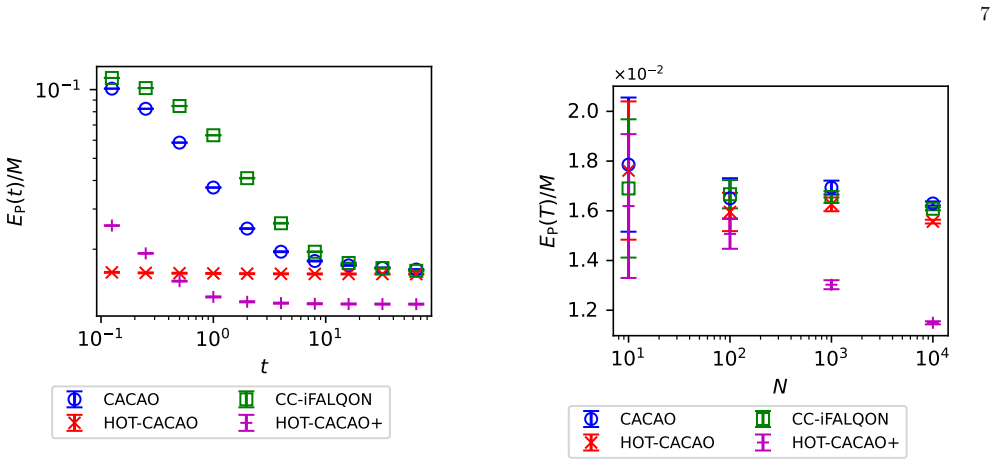
Feedback-based quantum optimization is a quantum approach to combinatorial optimization. In this paper, we introduce the classical counterpart of feedback-based quantum optimization by using the quantum-classical correspondence of spin systems to discuss the possibility of quantum advantage. It also enables us to develop higher-order theory of a previously proposed classical approach to feedback-based quantum optimization. First, we compare the feedback-based algorithm for quantum optimization (FALQON) and its variant with their classical counterparts. Then, we perform benchmark tests of various quantum and classical algorithms with small-scale instances, and of classical algorithms with large-scale instances. Main findings are that (i) quantum algorithms can be advantageous to classical algorithms in terms of the quality of solutions, while classical algorithms tend to show faster convergence than quantum ones, and (ii) one of the classical algorithms discussed in this paper shows significant scalability for higher-order unconstrained binary optimization problems. These findings highlight the importance of quantumness and the usefulness of classical approaches.
Editorial analysis
A structured set of objections, weighed in public.
Referee Report
Summary. The paper introduces classical counterparts to feedback-based quantum optimization algorithms such as FALQON and its variants by invoking the quantum-classical correspondence of spin systems. This enables both a direct performance comparison and the development of higher-order theory for classical feedback methods. On small-scale instances the authors report that the quantum algorithms achieve superior solution quality while the classical counterparts converge faster; on large-scale instances one classical algorithm demonstrates strong scalability for higher-order unconstrained binary optimization problems.
Significance. If the reported quality advantage of the quantum algorithms survives at larger scales, the work would usefully clarify the contribution of quantum coherence versus classical feedback dynamics in combinatorial optimization and would strengthen the case for using spin-system correspondences to derive scalable classical algorithms. The explicit large-scale classical benchmarks already constitute a concrete contribution to the classical side of the literature.
major comments (2)
- [Benchmark tests] Benchmark section: quantum advantage in solution quality is demonstrated exclusively on small-scale instances, while all large-scale tests are performed only with the classical algorithms. No scaling extrapolation, intermediate-size verification, or discussion of how the observed ranking behaves when the classical scalable method becomes applicable is provided, leaving the central quantum-advantage claim unsupported beyond the tested regime.
- [Quantum-classical correspondence] Quantum-classical correspondence section: the paper derives the classical algorithms from the quantum ones via the established spin-system mapping and uses the same mapping to motivate higher-order extensions, yet supplies no numerical check that the relative performance ordering between quantum and classical feedback is preserved at sizes where the correspondence could be used to simulate the quantum dynamics classically.
minor comments (2)
- Figure captions and legends should explicitly state the instance sizes and the number of independent runs used to generate each curve so that readers can assess statistical reliability without consulting the main text.
- The definition of the higher-order classical update rule (derived from the correspondence) would benefit from an explicit equation number and a short derivation sketch in the main text rather than relegation to an appendix.
Simulated Author's Rebuttal
We thank the referee for the constructive comments, which identify key limitations in the scope of our benchmarks and the validation of the quantum-classical mapping. We will revise the manuscript to add discussion and intermediate-size checks, while acknowledging the inherent constraints on large-scale quantum simulations.
read point-by-point responses
-
Referee: Benchmark section: quantum advantage in solution quality is demonstrated exclusively on small-scale instances, while all large-scale tests are performed only with the classical algorithms. No scaling extrapolation, intermediate-size verification, or discussion of how the observed ranking behaves when the classical scalable method becomes applicable is provided, leaving the central quantum-advantage claim unsupported beyond the tested regime.
Authors: We agree that quantum simulations are restricted to small instances due to exponential resource requirements, which is why large-scale tests use only the classical algorithms. The quality advantage is reported specifically for the tested small-scale regime. We will add a dedicated discussion subsection on scaling implications, incorporating qualitative extrapolation from the observed trends and the spin-system correspondence, along with caveats that direct quantum verification at large scales is currently infeasible. This will clarify that the classical scalability result stands as an independent contribution. revision: partial
-
Referee: Quantum-classical correspondence section: the paper derives the classical algorithms from the quantum ones via the established spin-system mapping and uses the same mapping to motivate higher-order extensions, yet supplies no numerical check that the relative performance ordering between quantum and classical feedback is preserved at sizes where the correspondence could be used to simulate the quantum dynamics classically.
Authors: We will add numerical comparisons at intermediate sizes (e.g., 10-20 spins) where classical simulation of the quantum feedback dynamics remains tractable. These checks will confirm whether the performance ordering observed at small scales is preserved in the regime accessible to both approaches, thereby supporting the validity of the mapping for deriving and extending the classical algorithms. revision: yes
- Direct quantum benchmarks on large-scale instances to test whether the solution-quality advantage persists where classical methods demonstrate scalability.
Circularity Check
No significant circularity; derivation grounded in external correspondence and explicit benchmarks
full rationale
The paper derives classical counterparts from the quantum-classical correspondence of spin systems, an established physical mapping independent of the present work. Performance claims rest on explicit numerical benchmarks for small instances (both quantum and classical) and large instances (classical only), with no fitted parameters renamed as predictions and no load-bearing self-citation chains. The central findings on solution quality and convergence are directly supported by the reported test results rather than reducing to definitions or prior self-references by construction. No steps meet the criteria for circularity.
Axiom & Free-Parameter Ledger
axioms (1)
- domain assumption Quantum-classical correspondence of spin systems preserves relative algorithmic performance
Reference graph
Works this paper leans on
-
[1]
The single parameterβ X(t) is given by βX(t) = i⟨Ψ(t)| " ˆHP, NX i=1 ˆXi # |Ψ(t)⟩,(6) which guarantees the reduction of the cost function (4)
FALQON In the original proposal of FALQON [48, 49], the fol- lowing Hamiltonian ˆH(t) = ˆHP +β X(t) NX i=1 ˆXi,(5) was considered. The single parameterβ X(t) is given by βX(t) = i⟨Ψ(t)| " ˆHP, NX i=1 ˆXi # |Ψ(t)⟩,(6) which guarantees the reduction of the cost function (4)
-
[2]
[49], we can introduce multiple parameters
iFALQON As summarized above and mentioned in Refs. [49], we can introduce multiple parameters. For example, we can consider the following Hamiltonian ˆH(t) = ˆHP + NX i=1 βX i (t) ˆXi,(7) with the parameters βX i (t) =i⟨Ψ(t)|[ ˆHP, ˆXi]|Ψ(t)⟩. (8) This algorithm is inspired by inhomogeneous driving for quantum annealing [75, 76], and thus we call it inhom...
-
[3]
CC-FALQON We introduce the classical counterpart of FALQON (CC-FALQON). In CC-FALQON, we consider the fol- lowing Hamiltonian Ht =H P +β X(t) NX i=1 mX i , (12) 4 with the parameter βX(t) =−2 NX i=1 mY i ∂HP ∂mZ i .(13) This is the exact classical counterpart of FALQON
-
[4]
CC-iFALQON We also introduce the classical counterpart of iFALQON (CC-iFALQON). In CC-iFALQON, we con- sider the following Hamiltonian Ht =H P + NX i=1 βX i (t)mX i , (14) with the parameters βX i (t) =−2m Y i ∂HP ∂mZ i .(15) This is the exact classical counterpart of iFALQON
-
[5]
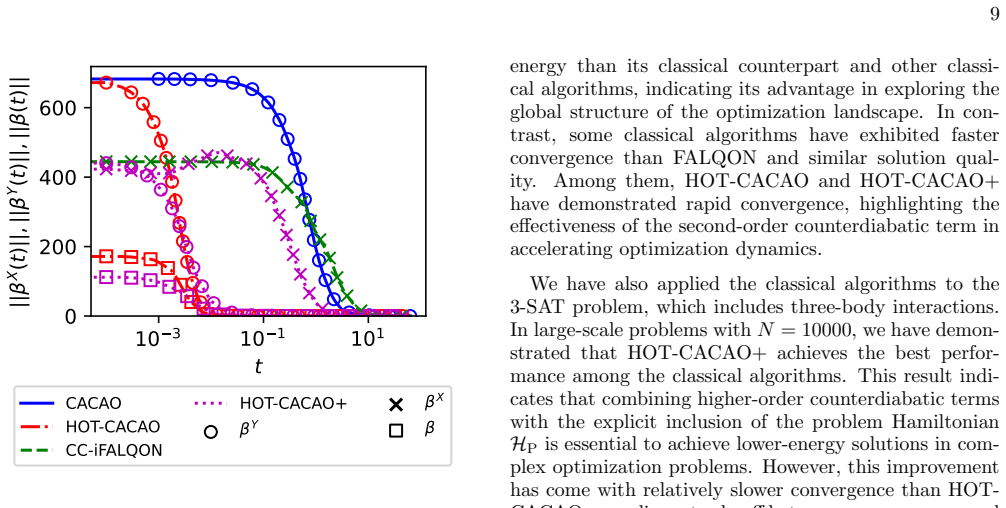
CACAO In CACAO [63], which was derived from the theory of FALQON, we consider the following Hamiltonian Ht = NX i=1 βY i (t)mY i , (16) with the parameters βY i (t) = 2mX i ∂HP ∂mZ i .(17) In the previous study [63], faster convergence than that of FALQON was confirmed, whereas the quality of solutions was worse than that of FALQON
-
[6]
III A enables to develop the higher-order theory of CACAO (HOT- CACAO)
HOT-CACAO The general idea introduced in Sec. III A enables to develop the higher-order theory of CACAO (HOT- CACAO). For example, HOT-CACAO with the second- order counterdiabatic term uses the following Hamilto- nian Ht = NX i=1 βY i (t)mY i + NX i,j=1 (i̸=j) βij(t)(mY i mZ j +m Z i mY j ),(18) with the parameters βY i (t) = 2mX i ∂HP ∂mZ i , βij(t) = 2m...
-
[7]
HOT-CACAO+ Finally, we introduce HOT-CACAO+, which includes all the terms discussed in this paper. The Hamiltonian is given by Ht =HP + X W={X,Y} NX i=1 βW i (t)mW i + NX i,j=1 (i̸=j) βij(t)(mY i mZ j +m Z i mY j ), (20) with the parameters βX i (t) =−2m Y i ∂HP ∂mZ i , βY i (t) = 2mX i ∂HP ∂mZ i , βij(t) = 2mX i mZ j ∂HP ∂mZ i . (21) This algorithm has t...
-
[8]
Pillac, M
V. Pillac, M. Gendreau, C. Gu´ eret, and A. L. Medaglia, A review of dynamic vehicle routing problems, Eur. J. Oper. Res.225, 1 (2013)
2013
-
[9]
B. L. Golden, S. Raghavan, and E. A. Wasil,The vehi- cle routing problem: latest advances and new challenges, Vol. 43 (Springer Science & Business Media, 2008)
2008
-
[10]
Neukart, G
F. Neukart, G. Compostella, C. Seidel, D. Von Dollen, S. Yarkoni, and B. Parney, Traffic flow optimization using a quantum annealer, Front. ICT4, 29 (2017)
2017
-
[11]
J. M. Sanchez, F. Ducastelle, and D. Gratias, Generalized cluster description of multicomponent systems, Phys. A: Stat. Mech. Appl.128, 334 (1984)
1984
-
[12]
Perdomo-Ortiz, N
A. Perdomo-Ortiz, N. Dickson, M. Drew-Brook, G. Rose, and A. Aspuru-Guzik, Finding low-energy conformations of lattice protein models by quantum annealing, Sci. Rep. 2, 571 (2012)
2012
-
[13]
Fu and P
Y. Fu and P. W. Anderson, Application of statistical me- chanics to NP-complete problems in combinatorial opti- misation, J. Phys. A: Math. Gen.19, 1605 (1986)
1986
-
[14]
Yarkoni, E
S. Yarkoni, E. Raponi, T. B¨ ack, and S. Schmitt, Quan- tum annealing for industry applications: Introduction and review, Rep. Prog. Phys.85, 104001 (2022)
2022
-
[15]
Garey and D
M. Garey and D. Johnson, Computers and intractability. freeman San Francisco (1979)
1979
-
[16]
Lucas, Ising formulations of many NP problems, Front
A. Lucas, Ising formulations of many NP problems, Front. Phys.2, 74887 (2014)
2014
-
[17]
M. W. Johnson, M. H. Amin, S. Gildert, T. Lanting, F. Hamze, N. Dickson, R. Harris, A. J. Berkley, J. Jo- hansson, P. Bunyk,et al., Quantum annealing with man- ufactured spins, Nature473, 194 (2011)
2011
-
[18]
Yamaoka, C
M. Yamaoka, C. Yoshimura, M. Hayashi, T. Okuyama, H. Aoki, and H. Mizuno, A 20k-spin Ising chip to solve combinatorial optimization problems with CMOS an- nealing, IEEE J. Solid-State Circuits51, 303 (2015)
2015
-
[19]
Inagaki, Y
T. Inagaki, Y. Haribara, K. Igarashi, T. Sonobe, S. Ta- mate, T. Honjo, A. Marandi, P. L. McMahon, T. Umeki, K. Enbutsu,et al., A coherent Ising machine for 2000- node optimization problems, Science354, 603 (2016)
2000
-
[20]
Fixstars Corporation, Fixstars Amplify,https:// amplify.fixstars.com/en/
-
[21]
H. Goto, K. Tatsumura, and A. R. Dixon, Combinatorial optimization by simulating adiabatic bifurcations in non- linear Hamiltonian systems, Sci. Adv.5, eaav2372 (2019)
2019
-
[22]
Kitai, J
K. Kitai, J. Guo, S. Ju, S. Tanaka, K. Tsuda, J. Shiomi, and R. Tamura, Designing metamaterials with quantum annealing and factorization machines, Phys. Rev. Res.2, 013319 (2020)
2020
-
[23]
Izawa, K
S. Izawa, K. Kitai, S. Tanaka, R. Tamura, and K. Tsuda, Continuous black-box optimization with an Ising ma- chine and random subspace coding, Phys. Rev. Res.4, 023062 (2022)
2022
-
[24]
Inoue, Y
T. Inoue, Y. Seki, S. Tanaka, N. Togawa, K. Ishizaki, and S. Noda, Towards optimization of photonic-crystal surface-emitting lasers via quantum annealing, Opt. Ex- press30, 43503 (2022)
2022
-
[25]
Matsumori, M
T. Matsumori, M. Taki, and T. Kadowaki, Application of QUBO solver using black-box optimization to struc- tural design for resonance avoidance, Sci. Rep.12, 12143 (2022)
2022
-
[26]
K. Nawa, T. Suzuki, K. Masuda, S. Tanaka, and Y. Miura, Quantum Annealing Optimization Method for the Design of Barrier Materials in Magnetic Tunnel Junc- tions, Phys. Rev. Appl.20, 024044 (2023)
2023
-
[27]
Couzini´ e, Y
Y. Couzini´ e, Y. Seki, Y. Nishiya, H. Nishi, T. Kosugi, S. Tanaka, and Y.-i. Matsushita, Machine learning sup- ported annealing for prediction of grand canonical crystal structures, J. Phys. Soc. Jpn.94, 044802 (2025)
2025
-
[28]
Tamura, Y
R. Tamura, Y. Seki, Y. Minamoto, K. Kitai, Y. Mat- suda, S. Tanaka, and K. Tsuda, Black-box optimization using factorization and Ising machines, Applied Physics Reviews13, 021307 (2026). 12 10 2 100 102 t 0.00 0.05 0.10 0.15 0.20EP(t)/M (a) 10 2 100 102 t 0.00 0.05 0.10 0.15 0.20EP(t)/M (b) 10 2 100 102 t 0.00 0.05 0.10 0.15 0.20EP(t)/M (c) 10 2 100 102 t...
2026
-
[29]
Nakano, Y
M. Nakano, Y. Seki, S. Kikuchi, and S. Tanaka, SWIFT-FMQA: Enhancing Factorization Machine With Quadratic-Optimization Annealing via Sliding Window, IEEE Access14, 10977 (2026)
2026
-
[30]
Karimi and G
H. Karimi and G. Rosenberg, Boosting quantum annealer performance via sample persistence, Quantum Inf. Pro- cess.16, 166 (2017)
2017
-
[31]
Karimi, G
H. Karimi, G. Rosenberg, and H. G. Katzgraber, Effec- tive optimization using sample persistence: A case study on quantum annealers and various Monte Carlo optimiza- tion methods, Phys. Rev. E96, 043312 (2017)
2017
-
[32]
H. Irie, H. Liang, T. Doi, S. Gongyo, and T. Hatsuda, Hybrid quantum annealing via molecular dynamics, Sci. Rep.11, 8426 (2021)
2021
-
[33]
Atobe, M
Y. Atobe, M. Tawada, and N. Togawa, Hybrid Anneal- ing Method Based on subQUBO Model Extraction With Multiple Solution Instances, IEEE Trans. Comput.71, 2606 (2022)
2022
-
[34]
Kikuchi, N
S. Kikuchi, N. Togawa, and S. Tanaka, Hybrid Optimiza- tion Method Using Simulated-Annealing-Based Ising Ma- chine and Quantum Annealer, J. Phys. Soc. Jpn.92, 124002 (2023). 13
2023
-
[35]
Hattori, H
T. Hattori, H. Irie, T. Kadowaki, and S. Tanaka, Advan- tages of fixing spins in quantum annealing, J. Phys. Soc. Jpn.94, 013001 (2025)
2025
-
[36]
Hattori, H
T. Hattori, H. Irie, T. Kadowaki, and S. Tanaka, Im- pact of Fixing Spins in a Quantum Annealer with Energy Rescaling, J. Phys. Soc. Jpn.94, 074001 (2025)
2025
- [37]
-
[38]
Hen and F
I. Hen and F. M. Spedalieri, Quantum annealing for con- strained optimization, Phys. Rev. Appl.5, 034007 (2016)
2016
-
[39]
Hen and M
I. Hen and M. S. Sarandy, Driver Hamiltonians for con- strained optimization in quantum annealing, Phys. Rev. A93, 062312 (2016)
2016
-
[40]
Kudo, Constrained quantum annealing of graph col- oring, Phys
K. Kudo, Constrained quantum annealing of graph col- oring, Phys. Rev. A98, 022301 (2018)
2018
-
[41]
Kudo, Localization in the constrained quantum an- nealing of graph coloring, J
K. Kudo, Localization in the constrained quantum an- nealing of graph coloring, J. Phys. Soc. Jpn.89, 064001 (2020)
2020
-
[42]
Hirama and M
S. Hirama and M. Ohzeki, Efficient algorithm for binary quadratic problem by column generation and quantum annealing, J. Phys. Soc. Jpn.92, 113002 (2023)
2023
-
[43]
Kanai, M
H. Kanai, M. Yamashita, K. Tanahashi, and S. Tanaka, Annealing-Assisted Column Generation for Inequality- Constrained Combinatorial Optimization Problems, IEEE Access12, 157669 (2024)
2024
-
[44]
Micheletti, P
C. Micheletti, P. Hauke, and P. Faccioli, Polymer physics by quantum computing, Phys. Rev. Lett.127, 080501 (2021)
2021
- [45]
-
[46]
Outeiral, G
C. Outeiral, G. M. Morris, J. Shi, M. Strahm, S. C. Ben- jamin, and C. M. Deane, Investigating the potential for a limited quantum speedup on protein lattice problems, New J. Phys.23, 103030 (2021)
2021
-
[47]
Slongo, P
F. Slongo, P. Hauke, P. Faccioli, and C. Micheletti, Quantum-inspired encoding enhances stochastic sam- pling of soft matter systems, Sci. Adv.9, eadi0204 (2023)
2023
-
[48]
Jun and H
K. Jun and H. Lee, HUBO formulations for solving the eigenvalue problem, Results Control Optim.11, 100222 (2023)
2023
-
[49]
Biamonte, Nonperturbative k-body to two-body com- muting conversion Hamiltonians and embedding prob- lem instances into Ising spins, Phys
J. Biamonte, Nonperturbative k-body to two-body com- muting conversion Hamiltonians and embedding prob- lem instances into Ising spins, Phys. Rev. A77, 052331 (2008)
2008
-
[50]
Ishikawa, Transformation of general binary MRF min- imization to the first-order case, IEEE Trans
H. Ishikawa, Transformation of general binary MRF min- imization to the first-order case, IEEE Trans. Pattern Anal. Mach. Intell.33, 1234 (2010)
2010
-
[51]
Kolmogorov and R
V. Kolmogorov and R. Zabin, What energy functions can be minimized via graph cuts?, IEEE Trans. Pattern Anal. Mach. Intell.26, 147 (2004)
2004
-
[52]
Delong, A
A. Delong, A. Osokin, H. N. Isack, and Y. Boykov, Fast approximate energy minimization with label costs, Int. J. Comput. Vis96, 1 (2012)
2012
-
[53]
Freedman and P
D. Freedman and P. Drineas, Energy minimization via graph cuts: Settling what is possible, in2005 IEEE Com- puter Society Conference on Computer Vision and Pat- tern Recognition (CVPR’05), Vol. 2 (IEEE, 2005) pp. 939–946
2005
-
[54]
Ikeuchi, Y
K. Ikeuchi, Y. Matsuda, and S. Tanaka, Evaluating the performance of direct higher-order formulations in com- binatorial optimization under simulated annealing, IEEE Access , 1 (2026)
2026
-
[55]
A. B. Magann, K. M. Rudinger, M. D. Grace, and M. Sarovar, Feedback-based quantum optimization, Phys. Rev. Lett.129, 250502 (2022)
2022
-
[56]
A. B. Magann, K. M. Rudinger, M. D. Grace, and M. Sarovar, Lyapunov-control-inspired strategies for quantum combinatorial optimization, Phys. Rev. A106, 062414 (2022)
2022
-
[57]
Cong and F
S. Cong and F. Meng, A survey of quantum Lyapunov control methods, Sci. World J.2013, 967529 (2013)
2013
-
[58]
Cerezo, A
M. Cerezo, A. Arrasmith, R. Babbush, S. C. Benjamin, S. Endo, K. Fujii, J. R. McClean, K. Mitarai, X. Yuan, L. Cincio,et al., Variational quantum algorithms, Nature Reviews Physics3, 625 (2021)
2021
-
[59]
L. T. Brady and S. Hadfield, Feedback-based optimally controlled quantum states, Phys. Rev. A111, 062406 (2025)
2025
-
[60]
Rattighieri, G
L. Rattighieri, G. Pexe, B. Bernardo, and F. Fan- chini, Accelerating feedback-based quantum algorithms through time rescaling, Phys. Rev. A112, 042607 (2025)
2025
-
[61]
D. Arai, K. N. Okada, Y. Nakano, K. Mitarai, and K. Fu- jii, Scalable circuit depth reduction in feedback-based quantum optimization with a quadratic approximation, Phys. Rev. Res.7, 013035 (2025)
2025
-
[62]
R. K. Malla, H. Sukeno, H. Yu, T.-C. Wei, A. Weich- selbaum, and R. M. Konik, Feedback-based quantum al- gorithm inspired by counterdiabatic driving, Phys. Rev. Res.6, 043068 (2024)
2024
-
[63]
P. Chandarana, K. Paul, K. R. Swain, X. Chen, and A. del Campo, Lyapunov controlled counterdiabatic quantum optimization, arXiv:2409.12525 (2024)
- [64]
-
[65]
Abdul Rahman, ¨O
S. Abdul Rahman, ¨O. Karabacak, and R. Wisniewski, Feedback-based quantum algorithm for constrained opti- mization problems, inInternational Conference on Paral- lel Processing and Applied Mathematics(Springer, 2024) pp. 277–289
2024
-
[66]
Abdul Rahman, H
S. Abdul Rahman, H. G. Clausen, ¨O. Karabacak, and R. Wisniewski, Adaptive sampling noise mitiga- tion technique for feedback-based quantum algorithms, inInternational Conference on Computational Science (Springer, 2024) pp. 321–329
2024
-
[67]
J. B. Larsen, M. D. Grace, A. D. Baczewski, and A. B. Magann, Feedback-based quantum algorithms for ground state preparation, Phys. Rev. Res.6, 033336 (2024)
2024
- [68]
- [69]
-
[70]
Hatomura, Classical algorithm inspired by the feedback-based algorithm for quantum optimization and local counterdiabatic driving, Phys
T. Hatomura, Classical algorithm inspired by the feedback-based algorithm for quantum optimization and local counterdiabatic driving, Phys. Rev. E112, 055303 (2025)
2025
-
[71]
Sels and A
D. Sels and A. Polkovnikov, Minimizing irreversible losses in quantum systems by local counterdiabatic driving, Proc. Natl. Acad. Sci. U.S.A.114, E3909 (2017). 14
2017
-
[72]
P. W. Claeys, M. Pandey, D. Sels, and A. Polkovnikov, Floquet-Engineering Counterdiabatic Protocols in Quan- tum Many-Body Systems, Phys. Rev. Lett.123, 090602 (2019)
2019
-
[73]
Hatomura and K
T. Hatomura and K. Takahashi, Controlling and explor- ing quantum systems by algebraic expression of adiabatic gauge potential, Phys. Rev. A103, 012220 (2021)
2021
-
[74]
Q. Xie, K. Seki, and S. Yunoki, Variational counter- diabatic driving of the hubbard model for ground-state preparation, Phys. Rev. B106, 155153 (2022)
2022
-
[75]
Takahashi and A
K. Takahashi and A. del Campo, Shortcuts to Adiabatic- ity in Krylov Space, Phys. Rev. X14, 011032 (2024)
2024
-
[76]
Bhattacharjee, A Lanczos approach to the adiabatic gauge potential, arXiv:2302.07228 (2023)
B. Bhattacharjee, A Lanczos approach to the adiabatic gauge potential, arXiv:2302.07228 (2023)
-
[77]
N. Ohga and T. Hatomura, Improving variational coun- terdiabatic driving with weighted actions and computer algebra, arXiv:2505.18367 (2025)
-
[78]
Hatomura, Shortcuts to adiabaticity: theoretical framework, relations between different methods, and ver- satile approximations, J
T. Hatomura, Shortcuts to adiabaticity: theoretical framework, relations between different methods, and ver- satile approximations, J. Phys. B: At. Mol. Opt. Phys. 57, 102001 (2024)
2024
-
[79]
J. Yao, L. Lin, and M. Bukov, Reinforcement Learn- ing for Many-Body Ground-State Preparation Inspired by Counterdiabatic Driving, Phys. Rev. X11, 031070 (2021)
2021
-
[80]
Wurtz and P
J. Wurtz and P. J. Love, Counterdiabaticity and the quantum approximate optimization algorithm, Quantum 6, 635 (2022)
2022
discussion (0)
Sign in with ORCID, Apple, or X to comment. Anyone can read and Pith papers without signing in.