Recognition: unknown
Impact of Terrestrial Blockage on the Coverage of Integrated Satellite-Terrestrial Networks
Pith reviewed 2026-05-14 18:39 UTC · model grok-4.3
The pith
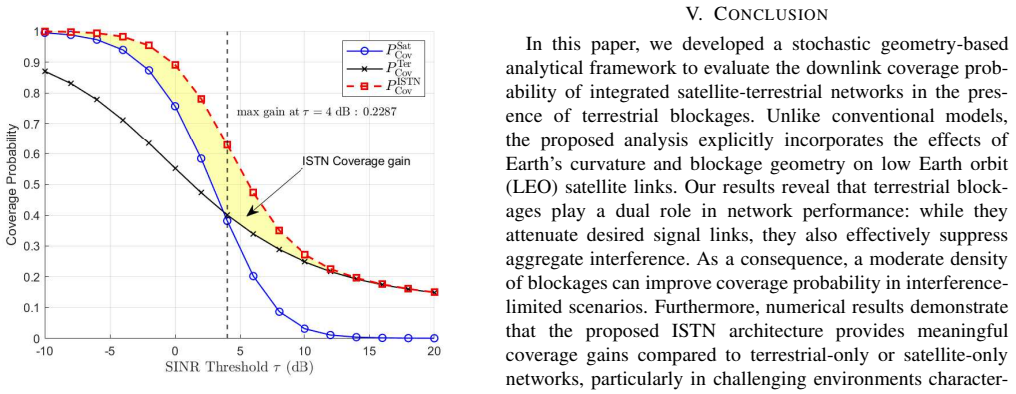
Blockages in urban areas raise coverage probability in integrated satellite-terrestrial networks by suppressing interference more than they weaken desired signals.
A machine-rendered reading of the paper's core claim, the machinery that carries it, and where it could break.
Core claim
Satellite-terrestrial integration enhances coverage probability across diverse environments ranging from open areas to dense urban deployments by turning terrestrial blockages into spatial shields that reduce aggregate interference while the combined links offset the resulting signal attenuation.
What carries the argument
Stochastic geometry framework with Boolean blockage model that tracks line-of-sight probability for both satellite and terrestrial links and derives the resulting coverage probability expressions.
Load-bearing premise
The Boolean blockage model and stochastic geometry assumptions accurately capture real urban propagation and interference statistics for both satellite and terrestrial links.
What would settle it
Field measurements of downlink coverage probability in a dense urban ISTN deployment compared against the analytical predictions for the same building density and link parameters.
Figures


read the original abstract
The integration of non-terrestrial networks (NTNs) with terrestrial networks (TNs) is an important step toward ubiquitous connectivity in sixth-generation (6G). Despite growing interest, the geometric impact of urban blockages on an integrated satellite-terrestrial network (ISTN) has not been rigorously quantified. In this paper, we develop a stochastic geometry-based analytical framework that incorporates a Boolean blockage model to characterize the downlink coverage probability of the ISTN and to provide insights for blockage-aware system design. Our analysis reveals that blockages affect satellite links in two competing ways: while they attenuate desired signals, they can also act as spatial shields that suppress aggregate interference. Leveraging this observation, we analytically show that satellite-terrestrial integration can enhance coverage probability across diverse environments ranging from open areas to dense urban deployments, offering a resilient and mathematically tractable approach to maintaining connectivity under heterogeneous blockage conditions.
Editorial analysis
A structured set of objections, weighed in public.
Referee Report
Summary. The paper claims to develop a stochastic geometry-based analytical framework that uses a Boolean blockage model to characterize the downlink coverage probability of integrated satellite-terrestrial networks (ISTNs). The analysis identifies competing effects of blockages on satellite links—attenuating desired signals while shielding against interference—and concludes that satellite-terrestrial integration enhances coverage probability in environments ranging from open areas to dense urban deployments, providing a resilient approach under heterogeneous blockage conditions.
Significance. If the analytical results hold, the paper provides valuable insights for blockage-aware design in 6G ISTNs by quantifying how blockages can yield net coverage gains through interference suppression in dense settings. The stochastic geometry approach offers mathematical tractability, enabling general expressions for coverage probability that can inform system-level decisions beyond specific simulation scenarios. This is particularly relevant for ensuring ubiquitous connectivity in next-generation networks.
major comments (2)
- [Section III (System Model and Blockage Modeling)] The Boolean blockage model applies independent processes to satellite visibility (elevation-dependent thinning) and terrestrial LOS/NLOS conditions. This independence assumption underpins the coverage probability derivations and the net-benefit claim for dense urban environments; shared urban structures induce spatial correlation that could reduce the interference-shielding advantage and change the analytical expressions.
- [Section IV (Coverage Probability Analysis)] The analytical demonstration that ISTN integration improves coverage (Section IV) rests on the competing effects of blockage. Without a joint point process for the blockage field, the expressions may overestimate gains when satellite shadowing aligns with terrestrial blockage, which is load-bearing for the conclusion across open-to-dense environments.
minor comments (3)
- Add a table listing all simulation parameters (e.g., densities, blockage sizes, path-loss exponents) with their numerical values to support reproducibility of the coverage curves.
- Clarify the exact form of the coverage probability expression (e.g., whether it is in closed form or requires numerical integration) in the abstract and introduction for readers unfamiliar with stochastic geometry.
- Ensure consistent notation for the Boolean model parameters (rectangle/disk radii, densities) across equations and figures.
Simulated Author's Rebuttal
We thank the referee for the constructive feedback on our manuscript. We have carefully reviewed the concerns regarding the independence assumption in the Boolean blockage model and its implications for the coverage analysis. Below we provide point-by-point responses, and we will incorporate clarifications and additional discussion of limitations in the revised version.
read point-by-point responses
-
Referee: [Section III (System Model and Blockage Modeling)] The Boolean blockage model applies independent processes to satellite visibility (elevation-dependent thinning) and terrestrial LOS/NLOS conditions. This independence assumption underpins the coverage probability derivations and the net-benefit claim for dense urban environments; shared urban structures induce spatial correlation that could reduce the interference-shielding advantage and change the analytical expressions.
Authors: We thank the referee for highlighting this modeling choice. The Boolean blockage model with independent thinning is adopted as a standard, tractable approximation in stochastic geometry literature to enable closed-form coverage expressions. While we recognize that real urban environments exhibit spatial correlations from shared structures, the independence assumption allows us to isolate and quantify the competing effects of signal attenuation and interference shielding. In the revised manuscript we will add an explicit discussion in Section III on this assumption, its justification via prior works, and a note that correlated models could be explored in future extensions. Our Monte Carlo validations confirm that the derived trends remain representative across the considered environments. revision: partial
-
Referee: [Section IV (Coverage Probability Analysis)] The analytical demonstration that ISTN integration improves coverage (Section IV) rests on the competing effects of blockage. Without a joint point process for the blockage field, the expressions may overestimate gains when satellite shadowing aligns with terrestrial blockage, which is load-bearing for the conclusion across open-to-dense environments.
Authors: We agree that a joint point process would capture alignment effects more precisely and could moderate the estimated gains in highly correlated scenarios. Under the current independent model, however, the analysis rigorously demonstrates the net coverage benefit through the derived probability expressions, which are further supported by extensive simulations matching the analytical curves. In the revision we will include a remark in Section IV acknowledging this limitation and add sensitivity results from simulations with partial correlation to show that the integration advantage persists, albeit with reduced magnitude in extreme cases. This strengthens rather than undermines the overall conclusion. revision: partial
Circularity Check
No circularity in the analytical derivation
full rationale
The abstract describes a stochastic geometry framework incorporating a standard Boolean blockage model to derive downlink coverage probability for ISTN. No equations are provided in the visible text, and there is no evidence of self-definitional steps, fitted inputs renamed as predictions, or load-bearing self-citations that reduce the central claim to its own inputs by construction. The analysis treats blockages as having competing effects (attenuation vs. shielding) under independent thinning assumptions, which are model choices rather than tautological reductions. The result is presented as derived from the framework rather than presupposed by it.
Axiom & Free-Parameter Ledger
axioms (2)
- domain assumption Boolean blockage model accurately represents urban obstacles as random shapes that block line-of-sight
- domain assumption Stochastic geometry assumptions hold for the spatial distribution of satellites, terrestrial base stations, users, and blockages
Reference graph
Works this paper leans on
-
[1]
Integrated Satellite-Terrestrial Networks Toward 6G: Architectures, Applications, and Challenges,
X. Zhu and C. Jiang, “Integrated Satellite-Terrestrial Networks Toward 6G: Architectures, Applications, and Challenges,” IEEE Internet Things J., vol. 9, no. 1, pp. 437-461, Jan. 2022
2022
-
[2]
Broadban d LEO Satellite Communications: Architectures and Key Technolo gies,
Y . Su, Y . Liu, Y . Zhou, J. Y uan, H. Cao and J. Shi, “Broadban d LEO Satellite Communications: Architectures and Key Technolo gies,” IEEE Wireless Commun., vol. 26, no. 2, pp. 55-61, Apr. 2019
2019
-
[3]
A Tractable Approach to Cove rage Analysis in Downlink Satellite Networks,
J. Park, J. Choi, and N. Lee, “A Tractable Approach to Cove rage Analysis in Downlink Satellite Networks,” IEEE Trans. Wireless Commun., vol. 22, no. 2, pp. 793-807, Feb. 2023
2023
-
[4]
Analysis of Blockage Effe cts on Urban Cellular Networks,
T. Bai, R. V aze and R. W. Heath, “Analysis of Blockage Effe cts on Urban Cellular Networks,” IEEE Trans. Wireless Commun. , vol. 13, no. 9, pp. 5070-5083, Sep. 2014
2014
-
[5]
Tractable Modelling and Perf ormance Analysis of UA V Networks With 3D Blockage Effects,
W. Tang, H. Zhang and Y . He, “Tractable Modelling and Perf ormance Analysis of UA V Networks With 3D Blockage Effects,” IEEE Wireless Commun. Lett. , vol. 9, no. 12, pp. 2064-2067, Dec. 2020
2064
-
[6]
Modeling and Analysis of mmWave UA V Sw arm Networks: A Stochastic Geometry Approach,
X. Shi and N. Deng, “Modeling and Analysis of mmWave UA V Sw arm Networks: A Stochastic Geometry Approach,” IEEE Trans. Wireless Commun., vol. 21, no. 11, pp. 9447-9459, Nov. 2022
2022
-
[7]
Performan ce Analysis of Satellite Communication System Under the Shadowed-Rici an Fading: A Stochastic Geometry Approach,
D. -H. Jung, J. -G. Ryu, W. -J. Byun and J. Choi, “Performan ce Analysis of Satellite Communication System Under the Shadowed-Rici an Fading: A Stochastic Geometry Approach,” IEEE Trans. Commun. , vol. 70, no. 4, pp. 2707-2721, Apr. 2022
2022
-
[8]
Stochastic geometry a nd wireless networks: V olume I theory,
F. Baccelli and B. Błaszczyszyn, “Stochastic geometry a nd wireless networks: V olume I theory,” F ound. Trends Netw., vol. 3, nos. 3–4, pp. 249–449, 2009
2009
-
[9]
Stochastic Geo metry-Based Uplink Performance Analysis of IoT Over LEO Satellite Commu nica- tion,
A. Talgat, M. A. Kishk and M. -S. Alouini, “Stochastic Geo metry-Based Uplink Performance Analysis of IoT Over LEO Satellite Commu nica- tion,” IEEE Trans. Aerosp. Electron. Syst. , vol. 60, no. 4, pp. 4198-4213, Aug. 2024
2024
-
[10]
Study on channel model for frequencies from 0.5 to 100 GHz
3GPP TR 38.901, “Study on channel model for frequencies from 0.5 to 100 GHz”, Sep. 2025
2025
-
[11]
https:// fcc.report/ IBFS/SA T-MOD-20230207-00021
Space Exploration Holdings, LLC, SpaceX Gen2 Direct-t o-Cellular Sys- tem FCC filing SA T-MOD-20230207-00021, [Online]. https:// fcc.report/ IBFS/SA T-MOD-20230207-00021
discussion (0)
Sign in with ORCID, Apple, or X to comment. Anyone can read and Pith papers without signing in.